
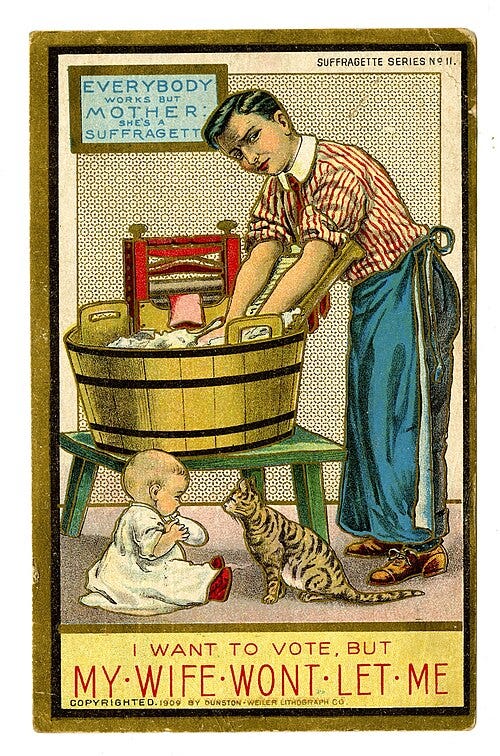
1909 – Anti‑Suffrage Postcard: “I want to vote, but my wife won’t let me.”
Artifacts from the Patriarchy #1

Since I’m turning my women’s history course lectures into podcasts, I figured I’d also use some of the images from my lectures as well. They don’t work as well in an audio only podcast, so instead you get to take a look here!
As long as you’re a paid subscriber anyway.
So let’s start out with a doozy of an anti-suffrage postcard from 1909:
Source: National Museum of American History
.jpg#:~:text=Description)
Ah yes, the early 20th century’s most fragile species: the man terrified that if women gained rights, they might start using them. This 1909 postcard shows a husband elbow-deep in domestic chaos — baby howling, laundry spilling over, dinner unmade — while his wife struts off to vote.
Imagine thinking democracy itself would collapse if you had to do your own washing for once. The subtext practically screams, “If women stop serving us, society will crumble!” The humor here relies on a deep insecurity — that women might become as independent, opinionated, and powerful as men had always been allowed to be. What if wives stopped acting like unpaid housekeepers and started acting like citizens? What if men suddenly had to share the public sphere and the dishwashing? The horror.
What makes this piece of patriarchal propaganda so deliciously ironic is that it projects men’s own behavior onto women. The cartoon assumes that once women get political power, they’ll treat men exactly the way men treated them — dismissively, condescendingly, and with total disregard for their domestic drudgery. In other words, it reveals that even in 1909, men knew how unfair the system was; they just didn’t want the tables turned. The postcard was supposed to scare people into preserving “traditional order.” Instead, over a century later, it perfectly captures the pathetic logic of patriarchal panic: when you’ve built your comfort on someone else’s labor, equality starts to look like oppression.
Now fast-forward a century, and somehow, the same panic is alive and well — just with better production values. In 2025, we’ve seen evangelical pastors and far-right figures call for the repeal of the 19th Amendment, the very law that gave women the right to vote in 1920. One Christian nationalist pastor publicly argued that only “heads of households” (read: men) should cast ballots — and that gem of a sermon was proudly reposted by Defense Secretary Pete Hegseth before he halfheartedly walked it back (Reuters). Meanwhile, others in the conservative movement have flirted with the same idea — “male-only voting” jokes and all — as a way to “restore traditional values” (People Magazine).
It’s tempting to dismiss these calls as fringe nonsense, but the 1909 postcard reminds us that mockery often masks intention. Back then, anti-suffrage propaganda was also treated as a joke — and it worked to delay women’s enfranchisement for decades. Today, the same rhetoric hides behind memes, sermons, and “just kidding” tweets. The message hasn’t changed: when women have political power, the patriarchal order trembles. Because deep down, it knows that if equality ever really meant reciprocity, men might not like the taste of their own medicine.