
1952: Chase & Sanborn Coffee - Primary Source Tea
Artifacts from the Patriarchy - Chase & Sanborn asked one question: what if stale coffee deserved corporal punishment?

There are vintage ads that make you laugh because the past was ridiculous.
And then there are vintage ads that make you stare into the middle distance and wonder if the entire advertising industry needed a supervised field trip to therapy.
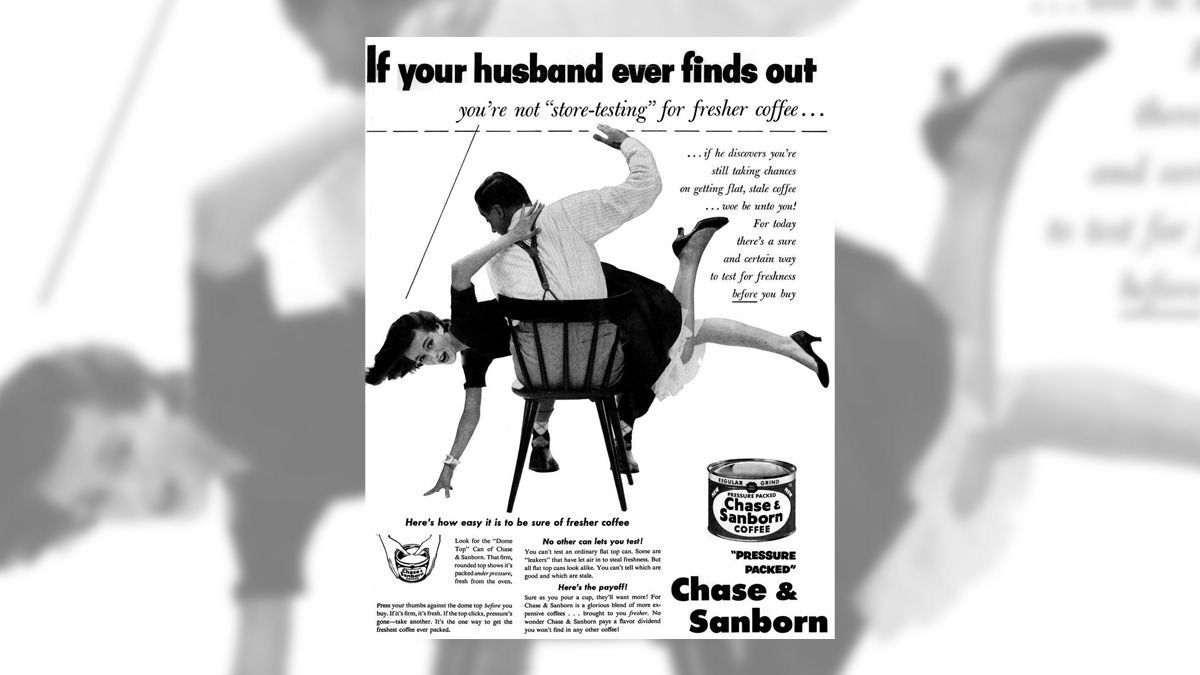
Today’s artifact from the Housewife-Industrial Complex is this 1952 Chase & Sanborn coffee ad, which asks the timeless question: what if stale coffee justified a little light domestic violence?
The headline reads:
“If your husband ever finds out you’re not ‘store-testing’ for fresher coffee…”
The image shows a husband spanking his wife because, apparently, she failed to properly investigate the freshness of canned coffee before purchase. In the ad copy, if he discovers she has been “taking chances on getting flat, stale coffee,” then “woe be unto you.”
And before anyone starts typing, “Surely, Professor Meredith, this must be satire. You should have fact-checked this. There is no way this was real,” please know that I regret to inform you I did, in fact, fact-check it.
Snopes fact-checked it too.
Unfortunately for everyone who still wants to believe the mid-century advertising industry had a functioning shame gland, the ad is real. Snopes confirms that the Chase & Sanborn advertisement appeared in a 1952 issue of Life magazine, and Lafayette College’s digital exhibit also identifies the same ad copy. So no, this is not a modern parody. This is not a feminist meme designed to make the 1950s look bad. The 1950s did that all on its on while chain-smoking and calling a secretary ‘darlin’.
What makes the ad so useful as a primary source is not simply that it is sexist. Vintage ads being sexist is not exactly breaking news. That’s more of a general weather report for the 1950s.
“Today we’ll have a low of 65 and an advertisement that encourages domestic violence. We’ll be back with sports after these messages from our sponsor!”
The important part is how casually it turns women’s domestic labor into a marital survival test.
This is not really about coffee. It is about responsibility. Specifically, the postwar expectation that wives were responsible for the comfort of the home, the happiness of the husband, the smooth functioning of domestic life, and apparently the freshness profile of every beverage served within a five-mile radius of Father’s Chair.
After World War II, American consumer culture increasingly treated the home as a symbol of national stability and prosperity. The New-York Historical Society notes that most home products were marketed to women, and wives made roughly 75 percent of family purchases.
Translation: women were the household purchasing department, but not necessarily the household authority.
That’s the trap this ad depends on.
The wife buys the coffee. The husband judges the coffee. The wife is blamed if the coffee fails. The brand then presents itself as the solution.
Chase & Sanborn is not just selling coffee. It is selling a way for women to avoid male displeasure.
What a charming little coupon for marital terror.
This is how the Housewife-Industrial Complex works: take an ordinary household task, inflate it into a referendum on womanhood, then sell women the product that supposedly keeps them from failing.
Buy this coffee and be a better wife.
Buy this toothpaste and maybe your man won’t cheat on you with his secretary.
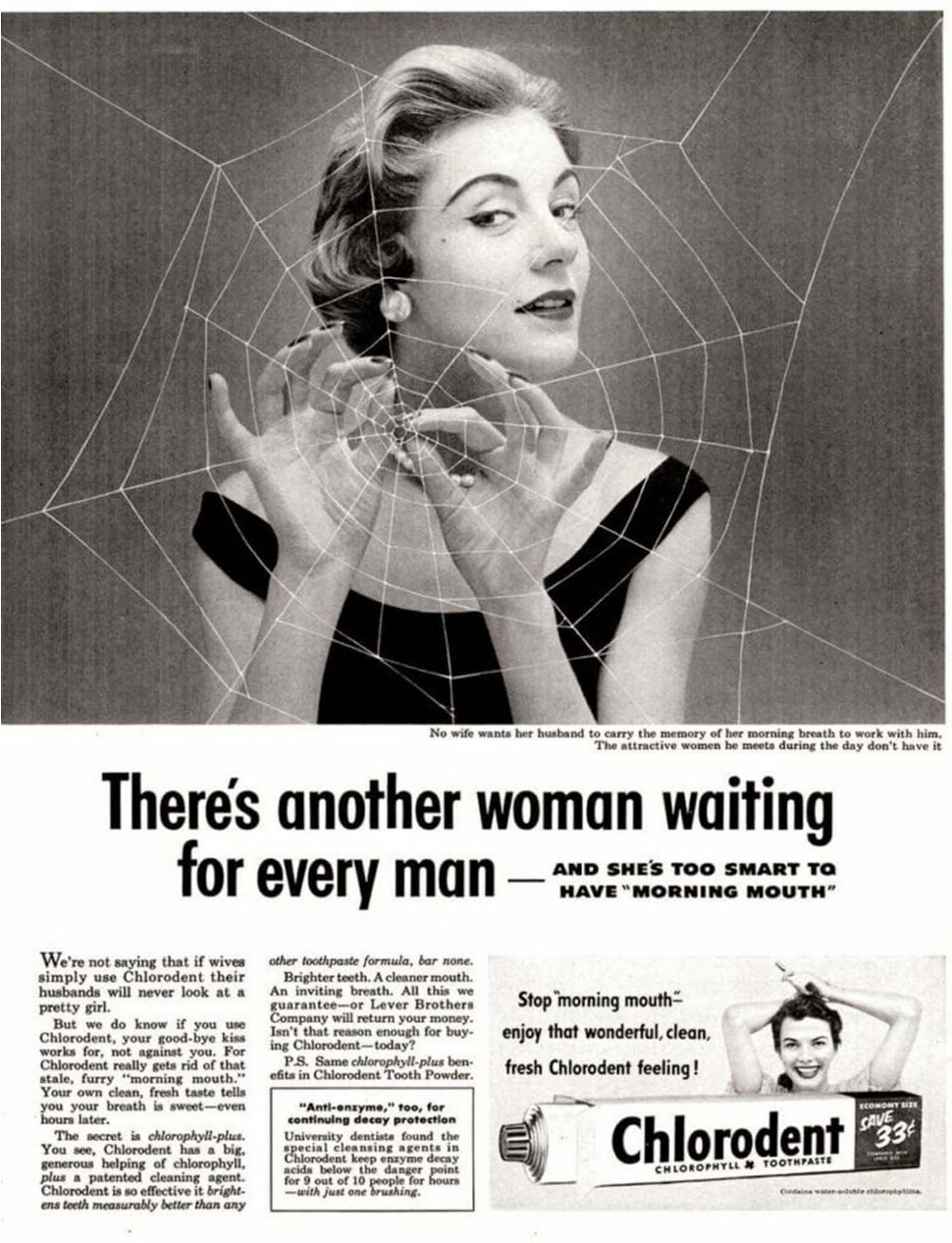
Buy this appliance and be more efficient.
Buy this floor wax and maybe your husband won’t look at you with the quiet disappointment of a man denied adequate shine.
The joke only works because the culture underneath it made the husband’s authority legible. He is the final judge of the home, even though she is the one expected to maintain it. She is competent enough to manage the shopping, cooking, cleaning, budgeting, hosting, child-rearing, emotional labor, and caffeine logistics. But not powerful enough to escape being treated like a naughty child when the product disappoints.
That is the central scam of mid-century domesticity: women were told the home was their kingdom, then reminded they were not the king.
The Smithsonian has written about Ruth Schwartz Cowan’s argument in More Work for Mother?, noting that so-called labor-saving devices could actually increase the time women spent on housework by raising standards. That same logic applies here. Consumer culture did not simply make women’s lives easier. It kept expanding the job description.
Now she is not just a wife. She is a coffee freshness auditor.
Congratulations, Barbara. The revolution is percolating.
And this is why these ads matter. They are not just “old-timey sexism.” They are little paper fossils of power. They show us what companies thought consumers would find funny, acceptable, persuasive, or normal.
This ad tells us that in 1952, a major coffee company believed it could sell canned coffee by joking that a wife might be physically punished for buying the wrong kind.
So no, the past was not just silly.
The past was instructional.
It taught women that love meant service, safety meant compliance, and a bad cup of coffee could apparently bring down the full disciplinary apparatus of the breakfast table.
All to sell canned coffee.
What if stale men deserved more corporal punishment? Just make sure you don't pick a man who likes it.