
1970s: “Innocence Is Sexier Than You Think” - Primary Source Tea
Artifacts from the Patriarchy - From Ivory Soap to Love’s Baby Soft, the beauty industry kept asking women to be softer, younger, and less like adults.

Some vintage ads whisper their sexism.
This one kicks the door open wearing baby powder and a thousand-yard stare.
Today’s artifact from the Department of Absolutely Not is this mid-1970s Love’s Baby Soft ad, because while I do spend a lot of time dragging the 1950s by its pearls, no decade is safe when it decides to put its gender politics in writing.
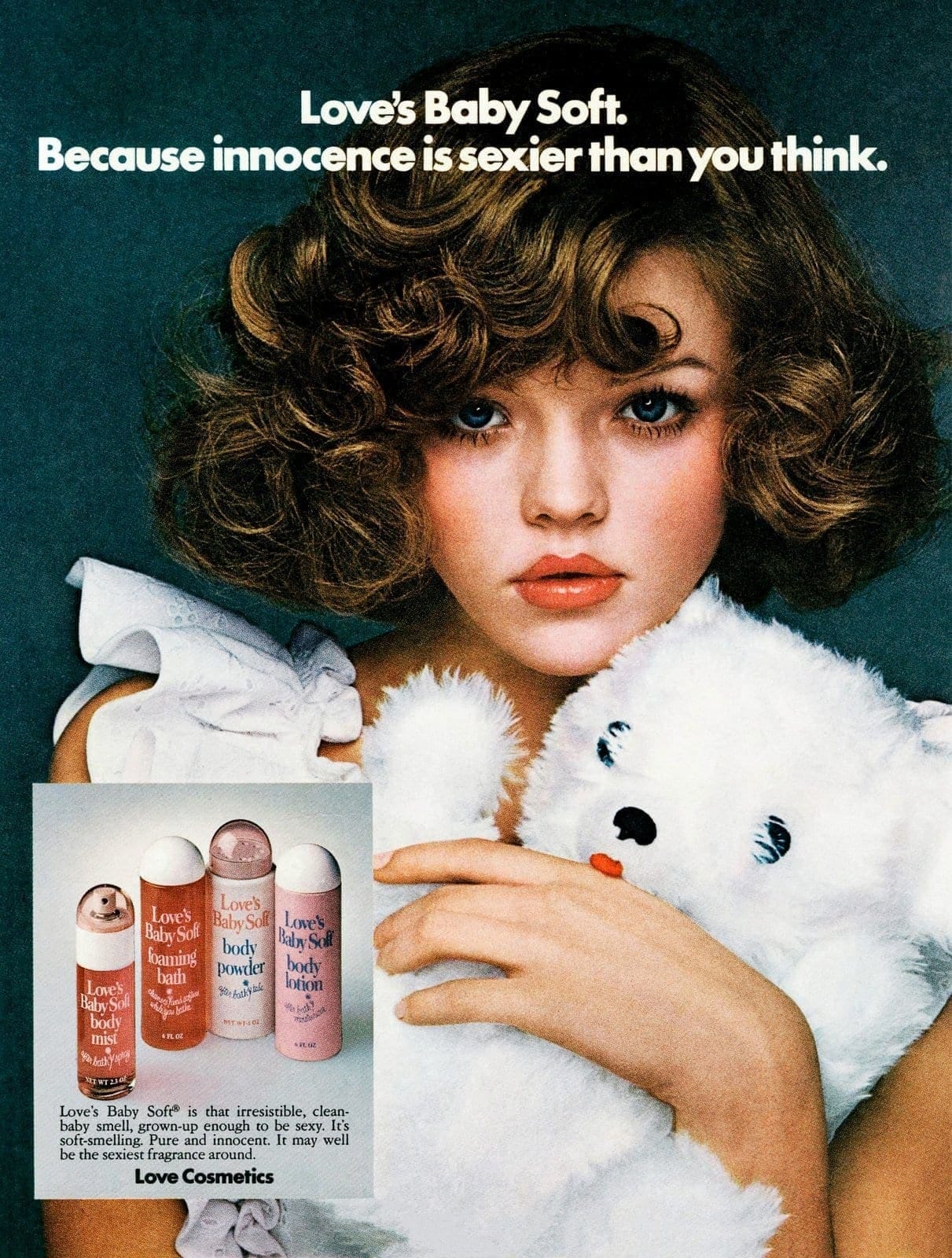
The 1970s had feminism, disco, and some truly heroic hair, but it also had this perfume campaign, which announces:
“Love’s Baby Soft. Because innocence is sexier than you think.”
No, thank you. I do not, in fact, want to think that.
Don’t watch this ad unless you have a barf bag handy.
The ad shows a very young-looking model with wide eyes, soft curls, a white teddy bear, and the facial expression of someone who has just been asked to embody three different patriarchal fantasies before algebra class. The product copy promises “that irresistible, clean-baby smell,” which is “grown-up enough to be sexy.” It then describes the scent as “soft-smelling,” “pure,” and “innocent,” before concluding that it “may well be the sexiest fragrance around.”
So the pitch is not subtle.
It is not even pretending to be subtle.
This is not “women should smell nice.” This is “what if adult desirability could be bottled by making women smell like infants?”
A normal sentence? No. A perfume campaign? Apparently yes.
Love’s Baby Soft came out in the 1970s, and the campaign’s whole nightmare ballet was built around collapsing girlhood, innocence, softness, and sexual desirability into one pink aerosol cloud. The brand was not merely selling perfume. It was selling infantilized femininity as erotic appeal.
But Love’s Baby Soft did not invent the “baby equals beauty” problem. It just made the quiet part horny.
Decades earlier, Ivory Soap was already using babies as a beauty credential for adult women. In a wartime Ivory ad, a young woman writes to her sister:
“Your baby has given me a beauty tip, and I’ve got myself a Marine!”
The plot, because apparently soap ads needed the narrative architecture of a small propaganda musical, is this: a woman babysits, notices the baby’s soft skin, asks the doctor about it, switches to Ivory, improves her complexion, and lands a Marine lieutenant.
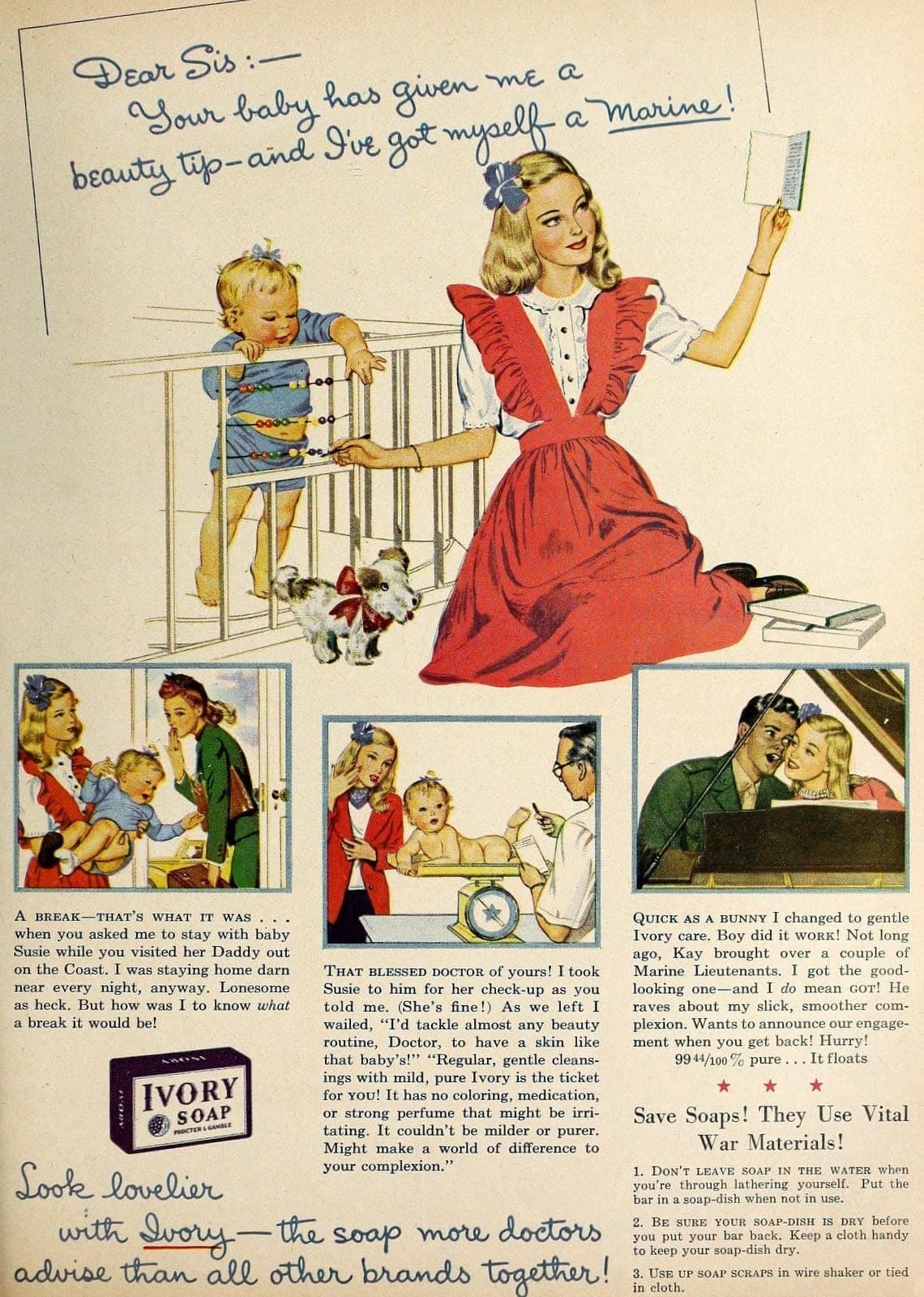
So, to recap: the baby’s skin becomes the model for adult female attractiveness, the doctor provides scientific authority, the soap supplies purity, and the reward is male approval wrapped in military masculinity.
Subtle? No.
Efficient? Horrifyingly.
The Ivory ad is not sexualizing babies in quite the same blunt, nightmare-confetti way as Love’s Baby Soft. But it does establish the same underlying association: baby softness, purity, gentleness, and innocence are treated as things adult women should imitate to become more desirable.
By the 1970s, Love’s Baby Soft simply took that older beauty logic, poured perfume on it, handed it a teddy bear, and announced that “innocence is sexier than you think.”
Which is exactly the problem.
The through-line is not just “women should be pretty.” It is that women should be soft, pure, harmless, young-coded, medically approved, and romantically rewarded for approximating infancy without making anyone say the word infancy too loudly.
This is where the ad becomes historically useful, because it captures a larger pattern in beauty advertising: women were expected to be sexually attractive, but not sexually knowing; desirable, but not experienced; available, but not threatening; grown-up, but not too grown-up.
In other words, sexy, but harmless.
This is the same cultural machinery that keeps dragging women toward impossible contradictions. Be innocent, but seductive. Be childlike, but available. Be pure, but pleasing. Be desirable, but never too aware of your own desire, because then everyone starts clutching pearls and calling you a slut.
Love’s Baby Soft did not invent that contradiction. It just put it in a bottle and gave it a baby-pink label.
Jean Kilbourne’s work on advertising has long argued that advertising does not merely sell products. It sells ideas about what women are supposed to be. Ads teach us what kind of femininity is rewarded, what kind is punished, and what kind can be converted into money. In this case, the rewarded femininity is soft, passive, young, clean, wide-eyed, and available for projection.
Basically: less woman, more decorative child-bride-adjacent hostage.1
And the ad’s childlike imagery matters. The teddy bear matters. The “baby” language matters. The claim that innocence is “sexy” matters. This is not accidental branding. It is a whole aesthetic of eroticized helplessness.
The American Psychological Association’s report on the sexualization of girls defines sexualization partly as treating someone’s value as coming primarily from sexual appeal or imposing sexuality inappropriately. That framework helps explain why this ad feels so rancid decades later. It is not just awkward. It is doing the thing. It ties value to sexual appeal while dressing that appeal in babyish innocence.
And then, because capitalism never sees a boundary it does not want to monetize, it sells that contradiction as a fragrance.
This is the Housewife-Industrial Complex’s younger, glitterier cousin: the Girlhood-Industrial Complex. It teaches girls to practice being looked at before they are even fully allowed to be people. It tells women that desirability means shrinking themselves back toward softness, silence, cuteness, and innocence. It treats maturity as suspicious and girlhood as commercially useful.
The ad is creepy because it says the quiet part in a jingle voice.
It does not ask women to be confident.
It does not ask women to be sensual on their own terms.
It does not even ask women to smell like flowers, spice, smoke, or anything remotely adult.2
It asks them to smell like “clean baby” and asks us to not ask too many weird questions about it.3
There is a whole archive of misogyny in that logic.
Because when culture eroticizes innocence, it is not celebrating innocence. It is celebrating power imbalance. Innocence becomes sexy precisely because it can be controlled, shaped, instructed, and consumed without having to confront a woman as an adult subject with agency, appetite, opinions, and inconvenient thoughts about politics.
The fantasy is not really innocence.
The fantasy is control.
So yes, this ad is horrifying. But it is also useful. It shows us how openly advertisers linked femininity, youth, purity, softness, and sexual desirability, and how easily that language moved through mainstream culture without setting off every alarm in the building.
Love’s Baby Soft promised that innocence was sexier than we thought.
History suggests the better question is: why did advertisers think that was a selling point?
And why were they right?
Yes, I’m aware that’s a hell of sentence. I workshopped it.
A man once told me that my favorite perfume (Autumn Vibes, Maison Margiela) smelled like rotting leaves in a bonfire and I have worn it almost every day since, because if it makes men make that disgusted face I will BATHE in it. That last thing I want is to smell appealing to men.
Unfortunately my whole thing is “ask the weird question.”
"eroticized helplessness"
Those two words together are haunting me. It reminds me of the purpose of sexual violence. Power over. Just look at all the horrors connected to that fantasy. Epstein, Maxwell, Trump abusing little girls for a hit off the power bong. I grew up in the 70s, graduated high school in '76. Those ads were aimed at me. I don't remember being offended by them at all. I remember there was a product called Love's Baby Soft. I don't know if I had any, but I doubt it. I'm sure I took in the message, though. I'm sure it got in.
Brilliant, as always. I remember those ads well. Those of us who came of age in the 70’s were given so many mixed messages. Be like a soft, little baby while smoking your Virginia Slims. “You’ve come a long way, baby!” Ugh.