

Trigger Warning: the videos linked in this article contain graphic depictions of violence and death in video games. Please do not watch if that is going to disturb you. Honestly they are not necessary to watch to understand my point, but I felt illustration was important.
A few days ago I stumbled across a discussion on Reddit about the rumored removal of Lara Croft’s elaborate death animations from an upcoming Tomb Raider game.
The original poster was upset.
“If that’s the case,” they wrote, “then that’s really disappointing and sucks.”
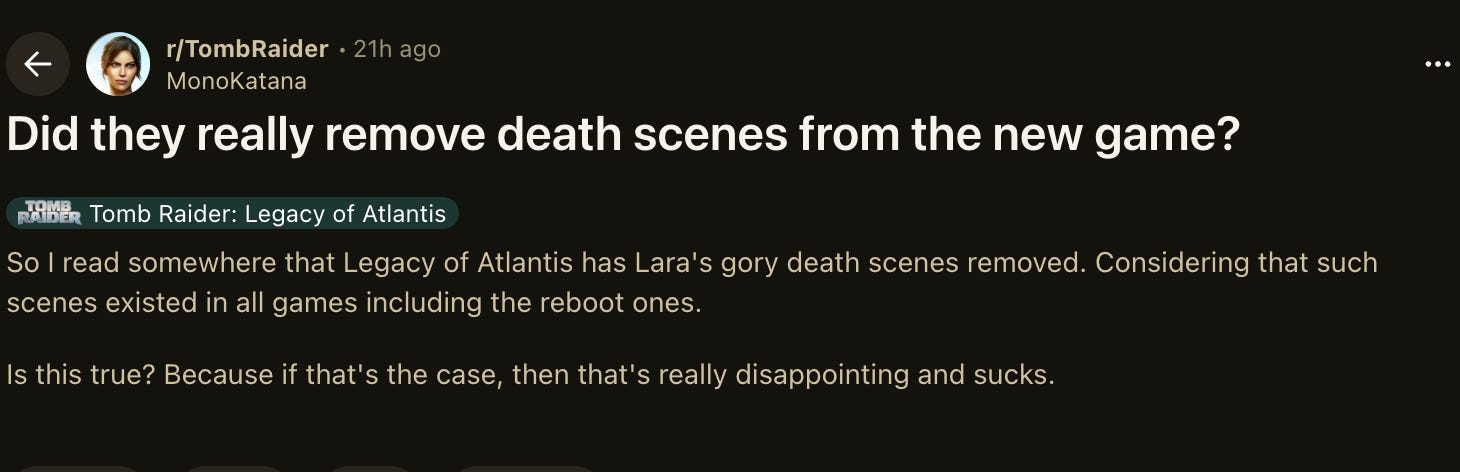
While some responses said essentially what I’m saying in this post, but with fewer citations, most responses were largely in agreement.
“The signs so far point to them being absent, which does indeed suck.”
“Oh my, why the heck would they even do this?”
“Lara had violent impalements and deaths in the original games. Removing them is an odd choice.”
One commenter argued that the darker, more mature tone of the reboot trilogy depended on these scenes. Another compared Lara’s deaths to those of male characters like Leon Kennedy from Resident Evil and suggested that people only become uncomfortable when the victim happens to be female.
And that is the point where this conversation usually goes completely off the rails.
Because the argument immediately gets transformed into something nobody actually said.
Nobody is asking for Lara Croft to become immortal or demanding that female protagonists be protected from violence.
Nobody is insisting that adventure games should stop having death animations.
The actual question is much simpler.
Why are so many people upset specifically about losing the elaborate depictions of Lara Croft suffering?
Because that’s what is actually being discussed.
Not danger or challenging gameplay or death itself.
Suffering.
More specifically, the spectacle of suffering.
One commenter offered what may have been the most revealing observation in the entire discussion. Defending the scenes, they wrote that people who enjoy them might simply have a “personal preference” and that some people enjoy “those sounds.”
The comment was intended as a defense.
Instead, it accidentally identified exactly why so many critics have found these sequences uncomfortable for years.
This video is…a lot, so trigger warning before you go in. I didn’t really want to include visuals, but I think it’s necessary.
Because once we start talking about enjoying the sounds of a woman gasping, choking, crying out in pain, or dying in increasingly elaborate ways, we are no longer having a conversation about game mechanics.
We are having a conversation about spectatorship. About why certain forms of suffering become entertaining. And especially about why violence against women is so often framed differently than violence against men.
This is where discussions about Tomb Raider tend to become frustrating. Critics point out that Lara Croft’s death scenes often linger on her body, emphasize her pain through detailed voice acting, and transform failure states into miniature spectacles of suffering. Defenders respond that men die in games too.
Of course they do.
Nathan Drake dies.
Kratos dies.
Arthur Morgan dies.
Joel dies.
Leon Kennedy dies.
Nobody disputes that.
The question is not whether male characters experience violence.
The question is whether violence against women is frequently animated, framed, and performed…differently.
Because there is a meaningful difference between a character dying and a game seeming unusually interested in making sure we watch them do it, linger on the impalement and their struggle, while they make sounds that are…not exactly a death rattle.
And once you start looking for that distinction, it becomes surprisingly difficult to ignore.
Violence Is Not Neutral
One of the reasons these conversations become so circular is that people often treat violence as though it is a simple yes-or-no proposition. Either a game contains violence or it does not. Either a character dies or they do not. Once that box has been checked, many assume the conversation is over.
But violence is not a neutral act. It is a visual language.
A character can be shot in a way that is tragic. They can be shot in a way that is horrifying. They can be shot in a way that is funny, exciting, empowering, or disturbing. The event itself may be identical, but the meaning changes depending on how it is framed. Camera angles, animation, sound design, pacing, and performance all influence how audiences understand what they are seeing.
This is not a radical feminist observation. It is one of the most basic principles of visual storytelling.
Film theorist Laura Mulvey famously argued that visual media often position women as objects to be looked at rather than subjects who act. While Mulvey was writing about cinema in the 1970s, her work remains foundational because it directs our attention toward a deceptively simple question: who is being looked at, and how?
That question becomes particularly interesting when violence enters the picture.
Because suffering can also become a spectacle.
A camera can document pain, or it can linger on pain. It can present suffering as an unfortunate consequence of a story, or it can invite audiences to consume that suffering as part of the entertainment itself. The distinction is subtle, but once you notice it, it becomes difficult to ignore.
This is why the common response that “men die too” misses the point so completely.
Of course they do.
The issue is not the existence of violence. The issue is how violence is presented.
Lara Croft and the Spectacle of Suffering
The Tomb Raider reboot trilogy provides perhaps the clearest example of this distinction.
Lara Croft is hardly the first action hero to endure extraordinary amounts of punishment. In the 2013 reboot, she is shot, stabbed, beaten, strangled, mauled by animals, nearly drowns multiple times, falls from impossible heights, and survives injuries that would probably kill several ordinary people. None of this is unusual for an action-adventure protagonist. Indiana Jones built an entire career out of being repeatedly punched in the face.
What drew criticism was not that Lara experienced violence. It was the remarkable amount of attention devoted to depicting her suffering.
Many of the game’s death animations are elaborate set pieces in their own right. Lara is impaled through the neck. She is crushed by machinery. She falls onto spikes. She is caught in traps that leave her twitching, gasping, choking, and writhing before the screen fades to black. The camera frequently moves in close. The audio emphasizes every cry, every ragged breath, every moment of visible pain.
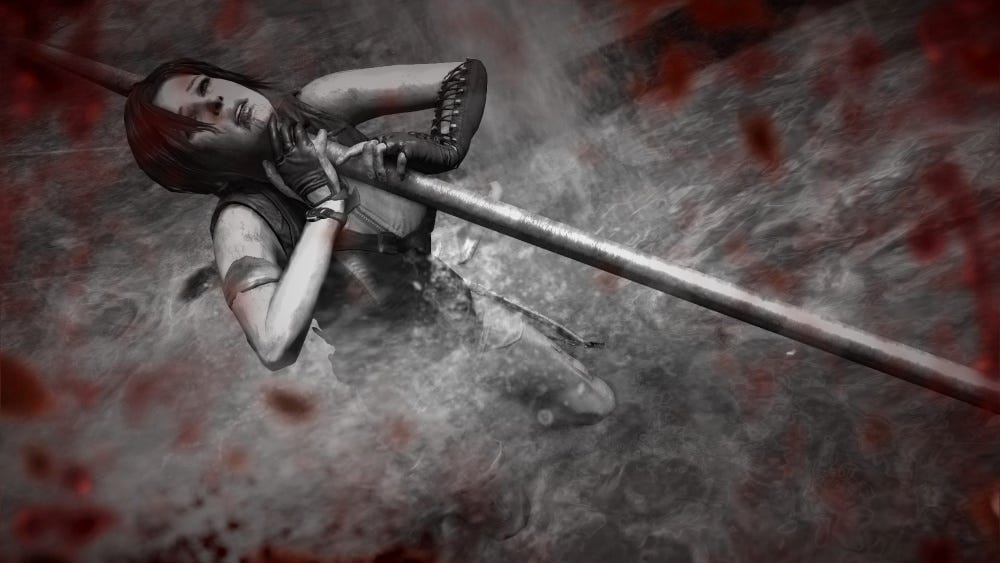
The deaths are not merely functional.
They are performed.
This distinction matters because the game repeatedly transforms failure states into miniature spectacles of female suffering. The player is not simply informed that Lara has died. The player is encouraged to watch it happen.
In isolation, a single death animation might not mean very much. Taken together, however, they reveal a pattern. The game seems unusually interested in Lara’s vulnerability, unusually interested in her pain, and unusually interested in ensuring that the audience experiences both in intimate detail.
The result is an odd contradiction at the heart of the reboot series. Tomb Raider wants Lara to be a capable survivor, but it also repeatedly returns to her suffering as a source of visual fascination.
Compare the Men
The easiest way to identify a pattern is often to compare it to a control group.
Consider some of gaming’s most famous male protagonists.
Nathan Drake dies constantly in Uncharted. Kratos dies. Joel dies. Arthur Morgan dies. Leon Kennedy dies. In terms of raw body count, male characters are subjected to extraordinary levels of violence.
Yet the presentation is often very different.
This distinction is not something critics invented years later. It was visible enough that even Crystal Dynamics seemed aware of it during the marketing campaign for the 2013 reboot.
One of the most controversial moments in the game’s pre-release coverage involved discussion of a scene in which Lara is captured by a scavenger on the island. During the struggle, the man grabs her, restrains her, and runs his hand up the inside of her thigh before she escapes and kills him. The scene sparked immediate criticism because many viewers interpreted it as invoking the threat of sexual assault as part of Lara’s character development.
The studio spent months trying to clarify what audiences had seen. Some representatives insisted the scene was not intended to depict an attempted rape, while others described it as illustrating Lara’s vulnerability and growth into a survivor. Regardless of the official explanation, the controversy itself revealed something interesting: the reboot was repeatedly returning to specifically gendered forms of vulnerability. Lara was not simply endangered. She was endangered as a woman.
What makes this particularly relevant is a comment from Crystal Dynamics’ global brand director, Karl Stewart, who was asked whether the same scene would have worked if the protagonist had been a male character like Nathan Drake from Uncharted. His answer was essentially no. Stewart acknowledged that if it had been Nathan Drake in that situation, the man would not have been rubbing his thigh.
Think about what that admission means for a moment. If the scene would not work with Nathan Drake, then the scene was not simply about danger. It was not simply about survival. It was not simply about establishing stakes. The scene relied on the audience understanding Lara’s body differently than they would understand a male protagonist’s body. The threat was gendered. The vulnerability was gendered. The intended audience reaction was gendered.1
And that is precisely what critics have been arguing all along. Nobody needed to invent a double standard. The developers themselves acknowledged that certain scenes were built around the fact that Lara was a woman in ways that would not apply to a male action hero.
Once you recognize that, it becomes much harder to pretend that all depictions of violence are interchangeable. The question is not whether Lara suffers. The question is why her suffering is so often framed through forms of vulnerability, bodily exposure, and spectacle that would never be applied to a character like Nathan Drake in the first place.
When Nathan Drake falls to his death, the sequence is generally brief and functional. The game communicates failure and resets. The emphasis remains on the gameplay challenge rather than on Nathan’s suffering.
Kratos experiences horrific violence throughout God of War, but the focus tends to remain on action, impact, and consequence. The audience is encouraged to identify with him as an active participant in the violence rather than as an object of observation.
Even Leon Kennedy, frequently invoked in discussions like the Reddit thread that inspired this article, illustrates the distinction rather than disproving it. Defenders often point out that Leon can be dismembered, decapitated, or cut apart by monsters and traps. This is true.
But Leon’s deaths are generally horrifying.
Lara’s deaths are often intimate.
That difference matters.
Horror and suffering are not the same thing. A gruesome death is not automatically a voyeuristic one. A chainsaw cutting a character in half is shocking, but it does not necessarily invite the audience to linger on that character’s pain. The emphasis is on the violence itself.
Many of Lara’s controversial death animations place the emphasis somewhere else. The audience is encouraged to focus on her reaction to the violence. Her breathing. Her sounds. Her body.
The suffering becomes the event.
The Assassin’s Creed Test
Ironically, one of the strongest pieces of evidence for this argument comes from a series that rarely enters the conversation at all.
Beginning with Assassin’s Creed Odyssey, players could choose whether to experience the game as Kassandra or Alexios. Assassin’s Creed Valhalla similarly allowed players to play as a male or female version of Eivor.
Because these games were designed around interchangeable protagonists, their approach to violence became revealing.
Kassandra can die.
Female Eivor can die.
They can be stabbed, shot, burned, crushed, and thrown from enormous heights.
Yet their deaths are generally presented in the same manner as those of their male counterparts because the game systems are built to accommodate both.
The violence is not removed.
It is simply no longer gendered.
No elaborate emphasis is placed on female suffering specifically because the same animation must also work for a male protagonist. The player character is treated primarily as an adventurer rather than as a female body.
This is why arguments about “censorship” often feel misplaced. Nobody is asking games to remove danger, failure, injury, or death. The Assassin’s Creed games demonstrate that violent gameplay can coexist perfectly well with female protagonists without transforming their suffering into a spectacle.
The violence remains.
The voyeurism diminishes.
And remarkably few people seem to notice the absence.
When Suffering Becomes Content
One of the most revealing aspects of the Tomb Raider debate is that it exposes a broader cultural pattern that extends far beyond video games.
Scholar Susan Sontag argued in Regarding the Pain of Others that images of suffering are never neutral. The act of watching pain creates a relationship between observer and observed. The viewer becomes a spectator to another person’s vulnerability, and the way that suffering is presented shapes how it is understood.
That observation becomes especially relevant when we consider how often female pain has been transformed into entertainment.
Horror films have long relied on lingering shots of women being stalked, terrorized, and victimized. Crime dramas routinely center stories around violated female bodies. Television, film, advertising, and popular culture have repeatedly found ways to transform women’s suffering into something simultaneously horrifying, titillating, and captivating.
Video games inherited these traditions rather than inventing them.
What makes games unique is that they add participation to the equation.
The player does not simply witness the death animation. They trigger it. They repeat it. They can watch it again and again. Entire YouTube compilations exist for this purpose. Videos dedicated exclusively to Lara Croft’s deaths have accumulated millions of views over the years. Not Tomb Raider gameplay. Not puzzle solutions. Not story analysis.
Deaths.
Just deaths.
And that is where the conversation becomes difficult for defenders of these scenes.
Because if these animations are merely functional indicators of failure, why are people so attached to them?
Why does their removal inspire disappointment?
Why are players lamenting their absence before they have even played the game?
The answer cannot be gameplay. Removing a death animation does not remove a puzzle. It does not remove exploration. It does not remove combat. It does not remove platforming.
The only thing being removed is the spectacle itself.
Which raises an uncomfortable question.
What exactly is being lost?
Philosopher Martha Nussbaum argues that objectification occurs when a person is treated less as a subject with agency and more as something to be consumed, used, or observed. While discussions of objectification often focus on sexuality, the concept applies equally well to suffering.
A person can be objectified through pain.
Their vulnerability can become the attraction.
Their suffering can become the product.
That does not mean everyone who enjoys Tomb Raider is secretly harboring violent fantasies. Nor does it mean every depiction of female suffering is inherently exploitative.
But it does mean we should be willing to ask why some forms of violence are presented the way they are, and why some audiences become so attached to those presentations.
Because at a certain point the conversation stops being about action-adventure game design and starts becoming something more concerning.
The Problem Was Never the Deaths
The frustrating thing about these debates is how quickly critics are accused of wanting to sanitize games or protect women from danger. That has never been the argument. Lara Croft can die. She should be able to die. She is an adventurer exploring ancient tombs, fighting mercenaries, surviving disasters, and throwing herself into situations that would make an insurance company quietly fake its own death. Danger is part of the premise. Failure is part of the game. Death is part of the experience.
The question is why some people seem so invested in a very particular kind of death.
Because frankly, as much as I enjoyed the Tomb Raider reboot trilogy, those sequences disgusted me every time they appeared.2 Not because they were violent. Not because they were graphic, but because they felt weirdly fascinated with Lara’s suffering. The lingering camera. The choking. The gasping. The impalements. The prolonged audio of pain. The sense that the game wanted me to spend a few extra seconds watching a conventionally attractive woman suffer before allowing me to reload my save.
That is not the same thing as a character simply dying.
And if the absence of those scenes genuinely ruins the game for you, I think it is fair to ask why. The tombs are still there. The puzzles are still there. The exploration is still there. The combat is still there. Lara Croft is still there. So why is this the thing you’re mourning?
Because if removing a few seconds of elaborately animated throttling, impalement, choking, and moaning somehow destroys the entire experience for you, then the archaeology and ancient myths was never the feature you were most invested in.
And I’m sorry, but at a certain point we can stop pretending this is about “maturity” or “horror” or “respecting the franchise.” If your enjoyment of Tomb Raider depends on briefly watching Lara Croft suffer in ways that are animated, framed, and voice-acted like discount torture porn, that is not fandom.
That is being a fucking creep.
You are not defending artistic integrity.
You are telling on yourself.
Recommended Reading
Laura Mulvey, “Visual Pleasure and Narrative Cinema”
Susan Sontag, Regarding the Pain of Others
Martha Nussbaum, “Objectification”
Carol J. Clover, Men, Women, and Chain Saws
Kenzie Gordon, “‘Fight Back or Die’: Rape, Revenge, and the Supernatural in Tomb Raider”
Hannah McInnes, A Feminist Textual Analysis of the 2013 Tomb Raider Video Game
To be clear, I am not arguing that stories should never explore the specific dangers women face in violent, isolated, patriarchal, or historically grounded settings. They should. In fact, when handled well, those stories can be powerful precisely because they refuse to flatten danger into some generic universal experience. Women do face gendered forms of threat, and pretending otherwise would be dishonest. But there is a difference between acknowledging that women face specific dangers and eroticizing those dangers for the viewer. There is a difference between “this setting exposes women to particular forms of violence” and “let us frame attempted rape like a sexy prestige-drama trope.” This is the same reason I stopped watching Outlander after one season. At a certain point, the repeated attempted rapes stopped feeling like narrative evidence that women experienced specific dangers in that period and started feeling like the show wanted rape to function as titillation with historical wallpaper.
The 2013 game is the worst for this. I find myself unable to replay it because anytime I fail a sequence I have to see those scenes. You can’t even turn them off. In The Witcher 3 I can turn off the violent finishing moves in fights, but I can’t turn off Lara being impaled and moaning while she dies? Deeply weird how the violence we view against men in one game can be reduced, but a game with a female protagonist has unskippable cutscenes of her brutal death over and over.
Early in my career, I was a 3D animator. Because I am female (in a male-dominated, at that time, industry), I was getting a lot of job offers. The money would have been more than I’d ever made. But, I couldn’t create animations that depicted violence. At the time, my son was two. I just didn’t want to be part of building a world and imparting forms of violence and violence as a thing to enjoy, regardless of gender, into the world in which he would be growing up.
If I’d thought far ahead enough to include female violence in the ways you’ve described from these games, definitely would have been a deal-breaker.
Thank you for this analysis. Even though I would surely have been comfortably retired by now, had I chosen that path, after reading this, I can now certainly put that life pivot-choice to rest.
I personally curate a collection of revenge fantasy business ideas that I will never act on. So here's one for the universe, free for the taking:
A video game with a strong, vibrant female hero. Men find her deeply attractive and she is comfortable with her attractiveness. In the game, the player is faced with a series of choices. Will they be her faithful comrade and help her rid the world of misogynist creeps? Or will they join with the misogynist creeps?
It will be SO appealing to first time gamers of a certain male demographic to join the creeps. They seem to be winning! They get to dominate and insult women!
But then our hero takes action. She doesn't just kill the creeps - that would be too easy. (Though I suppose that could be a game setting you turn on, call it the Survivor Revenge Therapy Mode.)
Oh no, killing is too easy. She humiliates them. She tells them how pathetic they are. All the female NPCs (who are rendered in a variety of ages and body types) gather around to witness. (Also, his mother and sisters are there, if he has chosen the unique Family Mode.)
In the end, our heroine gives the player who joined the creeps one last option: join her on the righteous side of fairness and equality for all (where he has the option of getting a really cool game-girlfriend), or choose between several graphic punishments, all of which lead to permanent erectile disfunction.
Ok, maybe I got a little carried away there. But revenge fantasy business ideas might be a topic for the Babblery sometime soon.