
In His Defense, He Did Warn Us
On “Grievance Feminism,” False Choices, and Men Who Mistake Evasion for Nuance

A quick note before I begin: yes, I blocked the man whose post I’m responding to. This is not because I fear debate. It is because I have no desire to spend my finite mortal life arguing with someone whose grasp of feminist thought has the intellectual depth of a puddle in the Sainsbury’s parking lot and roughly the same reflective qualities. This response is not for him. Men like this are rarely trying to understand anything. They are trying to repackage discomfort as insight and call their own inability to follow an argument “nuance.” He is merely today’s specimen.
Normally I would not begin with a writer’s Substack bio, but in this case it feels relevant. His description reads: “Don’t listen me. I have no idea what I’m talking about.”
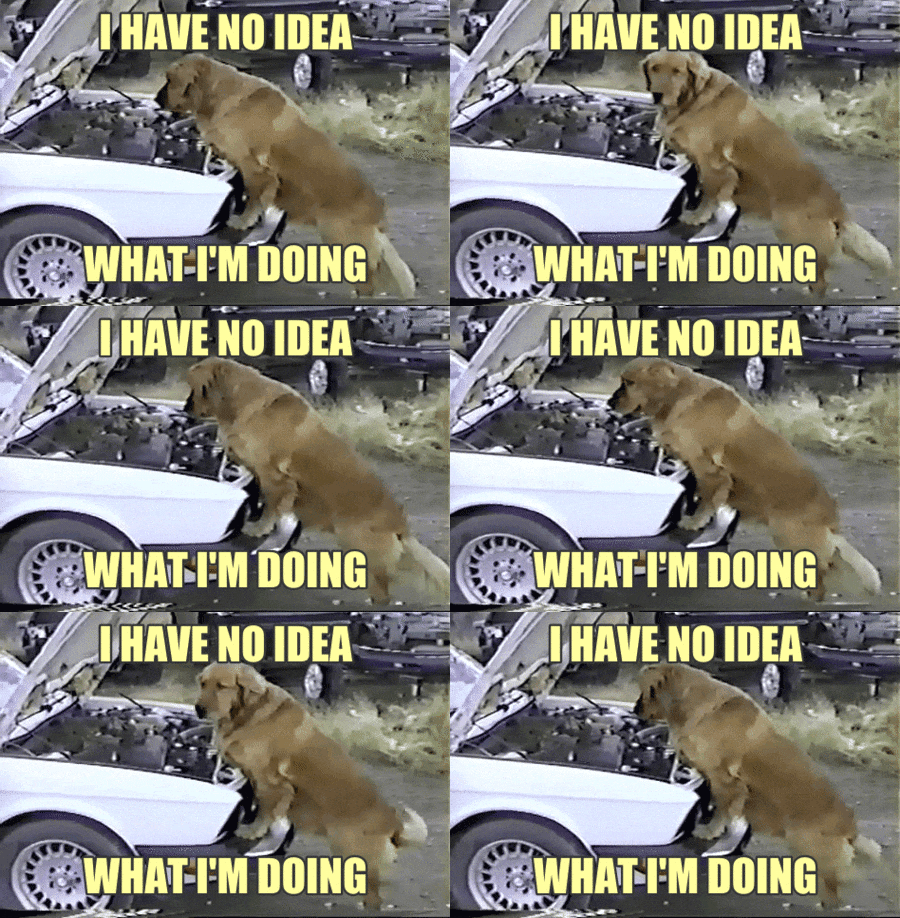

Reader, I should have listened.
Because the post in question, titled “Grievance Feminism and the Yelp Review Model of Society,” is not a serious engagement with feminist analysis. It is a familiar anti-feminist trick dressed up in the language of moderation, realism, and mature concern. It takes structural critique, renames it grievance, invents a fake opposition between accountability and action, and then congratulates itself for being the only adult in the room.
This genre is not new. Every few months, some man rediscovers feminism, gets annoyed that women are naming patterns instead of soothing his feelings about them, and produces a long essay explaining that the real problem is not sexism, violence, entitlement, or the social distribution of harm. No, the real problem, apparently, is women being too “grievance-oriented” when we talk about those things.
And because the piece is built almost entirely out of rhetorical sleight of hand, it is worth slowing down and answering a few of its core moves directly.
1. Feminism is not a Yelp review of society
He writes:
“The tone of the discourse begins to resemble something very familiar.
A Yelp review.
‘Nice place. Food was fine. Crowd needs work. 3 stars.’”
And:
“The world isn’t safe enough. The outcomes aren’t fair enough. The experience doesn’t match expectations. And from that framing comes the same conclusion every time:
Someone, somewhere, has failed to deliver for me. And I am owed better.”
This is the first sleight of hand, and it is doing a lot of work for him. Feminist critique is not a customer service complaint. Women are not standing outside society like annoyed diners sending back a cold entrée. Feminism is not saying, “my experience was suboptimal and I would like a refund.” It is asking how institutions, culture, norms, law, labor, family structures, and everyday behavior distribute harm, authority, credibility, and risk unevenly.
That is not consumer logic. That is structural analysis.
He is taking a political framework and reducing it to the image of an unreasonable woman leaving a one-star review because that caricature is easier to mock than the actual argument. It is an old trick. If women name a system, turn it into a feeling. If women describe a pattern, call it whining. If women critique power, recast them as difficult customers.
Cute metaphor. Empty argument.
Women are not upset because “the experience doesn’t match expectations.” Women are angry because violence, coercion, entitlement, and inequality are not random accidents. They are patterned. They are normalized. They are political. That is not Yelp. That is history.
2. “Who failed?” and “What is my role?” are not opposing questions
He writes:
“Because once the framework becomes:
‘Who failed me?’
‘Who owes me?’
‘Who is to blame?’
There’s very little room left for:
‘What is my role?’
‘What actually works?’
‘How do we reduce this, realistically?’
And without those questions, nothing improves.”
This is where he tries to sound like the adult in the room, and instead ends up announcing that he does not know how analysis works.
If you want to do anything meaningful, you have to ask all of those questions.
Who failed?
Who is responsible?
Who benefits?
Who bears the cost?
What structures produced the outcome?
What is my role?
What actually works?
How do we reduce harm realistically?
Those are not opposing frameworks. They are sequential ones.
Diagnosis is not the enemy of action. It is the precondition for it.
You cannot reduce harm “realistically” without naming what kind of harm you are dealing with, how it is reproduced, who is empowered by it, who is endangered by it, and who is expected to quietly absorb it. Pretending that naming responsibility is somehow less mature than “moving on to solutions” is not nuance. It is evasiveness dressed up as wisdom.
And this is a recurring problem in anti-feminist writing. Structural critique gets recast as passivity, while vague calls for “personal responsibility” get recast as pragmatism. But serious political work has always required both. Ask what happened. Ask who made it possible. Ask who benefits. Ask what can change. Ask what your role is. Ask what collective action looks like.
“Who failed?” and “What is my role?” are not enemies. They are consecutive questions.
3. No, rage is not proof of irrationality
He writes:
“And any attempt to introduce nuance, context, or data is often treated not as engagement, but as dismissal. Or worse, as complicity.
The response?
Rage.
Don’t believe me? Try it yourself.”
This part really gives the game away.
Because why exactly would people not rage?
Why would women not rage at a society harming them, their families, their friends, and strangers half the world away? Why would queer people not rage? Why would marginalized people not rage? Why would anyone watching violence, domination, and cruelty get neatly folded into the furniture of everyday life respond with a calm little nod and a spreadsheet smile?
Rage is not proof that analysis has failed. Often it is proof that someone still has a functioning moral nervous system.
If your reaction to violence, exploitation, and systemic harm is not rage, I am less impressed by your nuance than I am concerned by your deadened moral imagination. Too often “nuance” in pieces like this just means feigned helplessness in a blazer: a way of pretending nothing can really be done, no one can really be named, and no one should get too upset about any of it.
What he is doing here is one of the oldest tricks in the book: treating emotional detachment as the only legitimate form of thought. “Nuance, context, or data” are presented as neutral goods, and rage is framed as the embarrassing response of people too irrational to handle complexity.
But context can clarify, yes.
Data can illuminate, yes.
Nuance can sharpen analysis, yes.
They can also be used to blur responsibility, anesthetize urgency, flatten lived reality into abstraction, and dress feigned helplessness up in tidy intellectual clothes. The issue is not whether we should use context or data. Of course we should. The issue is how they are being used.
Are they helping us understand harm more clearly?
Or are they being deployed to smooth over brutality with abstraction and delay accountability until everyone is too tired to keep asking?
Flat affect is not the same thing as depth. A calm tone does not make an argument more ethical. It only makes it more socially comfortable.
Too often, what gets sold as “nuance” is just moral cowardice with a neutral accent.
4. Feminists are not asking for utopia. We are asking who produces the world we live in.
He writes:
“If the implicit standard is a world without violence, without risk, without harm of any kind, then we are no longer talking about improvement. We are talking about utopia.”
And:
“Utopia has a problem though. It has no producer.”
This is a straw man so old it should qualify for a pension.
No serious feminist argument depends on the belief that all violence, risk, and harm can be eliminated forever in a perfectly frictionless world. The claim is not that human beings can build a paradise where nothing bad ever happens. The claim is that many forms of harm are socially produced, politically structured, culturally normalized, and unevenly distributed.
Which means they can be reduced.
They can be interrupted.
They can be made harder to commit.
They can be treated as public problems instead of private fate.
They can be made less acceptable, less rewarded, and less invisible.
“You can’t eliminate all harm” is not a rebuttal to “this harm is patterned and preventable.” It is just a lazy way of lowering the bar until no one can ask anything of society at all.
And then there is his line, “Utopia has a problem though. It has no producer.”
The fuck it doesn’t.
We are the producers.
Society is not weather. It is not an accidentally occurring puddle. It is made and remade all the time by institutions, laws, schools, churches, media, families, workplaces, norms, habits, and culture. Some people have much more power over that process than others, obviously. That is the point. Human beings produce social arrangements. That is why critique matters. That is why politics matters. That is why feminism matters.
We are not consumers standing outside society filing product complaints. We are its producers, maintainers, critics, and repair crew. If unjust arrangements can be made, they can be unmade. Or at the very least made less cruel, less violent, less unequal, and less structured around the comfort of those already best served by them.
5. “Shared responsibility” is not the same thing as equal responsibility
He writes:
“Responsibility is distributed. It is distributed across institutions, and across the cultural norms that result.
It is shared by individuals, families and communities and across the environments that shape our behavior over time.
All of us. Whether you like it or not.”
And:
“To point at an outcome and assign responsibility to only one part of the system isn’t analysis.
It’s outsourcing.”
This is where he wants the social prestige of sounding complex without actually saying anything useful.
Of course systems are reproduced broadly. Feminists know that. Feminist scholarship has spent decades analyzing how gender norms are reinforced through families, education, religion, media, labor, law, and culture. He is not adding complexity here. He is using complexity to muddy accountability.
Because shared participation is not the same thing as equal power.
Shared participation is not the same thing as equal risk.
Shared participation is not the same thing as equal responsibility for outcomes.
A woman navigating male entitlement in public is not situated the same way as the man producing that entitlement. A service worker being verbally cornered by a customer is not “equally responsible” for the structure of that interaction simply because both are alive inside society. A world can be collectively reproduced without its burdens falling evenly.
That is one of feminism’s most basic observations: we may all live inside a system, but we do not all occupy the same position within it.
So no, naming patterns of male violence, male entitlement, or patriarchal structure is not “outsourcing.” It is analysis. The actual outsourcing move is pretending that because everyone participates somehow, no one can be named clearly enough to be held accountable.
That is not nuance. It is a fog machine.
6. Calling women’s anger “grievance” is just tone policing in a nicer outfit
He writes:
“Grievance. Layered on grievance. Framed as unwavering moral clarity. Followed by anger.”
And:
“The claims escalate quickly. The language sharpens. The stakes become absolute.”
This is, frankly, just tone policing in a blazer.
Women point to harm. Women speak sharply about harm. Women refuse to wrap every sentence in little bows of emotional reassurance, and suddenly the focus shifts. Not to the harm itself, but to our tone. Our intensity. Our anger. Our “moral clarity.” Our failure to sound sufficiently detached while discussing our own precarity.
Men’s anger is so often read as seriousness.
Women’s anger is still read as excess.
Men’s outrage becomes evidence that something important has happened.
Women’s outrage becomes evidence that we are overreacting to it.
That is not neutrality. That is hierarchy with better vocabulary.
And it is especially rich in this case, because the whole post is itself a grievance performance. A man reads feminist analysis, dislikes the emotional and political implications, and writes a long essay about how women noticing patterns too angrily is the real problem. He has not transcended grievance. He has simply redirected it at feminism.
7. The article accidentally proves the feminist point
He writes:
“The problem is when those instincts are paired with a model of the world that treats society like a defective product, rather than a shared system.”
And:
“A society built on grievance asks:
‘Who failed me?’
A society that works asks:
‘What is my role in making this better?’”
But the irony here is almost too perfect.
A woman says: male entitlement in public creates risk, delay, and silent self-management for the people around it, especially women.
His answer is not to engage the structure of that claim. His answer is to complain that feminism is too grievance-oriented, too angry, too blame-focused, too insufficiently impressed by data and “nuance.”
That is not a rebuttal. That is a demonstration.
Women say, “Here is how male grievance becomes social force.”
A man replies, “Have you considered that women naming this pattern are the real grievance merchants?”
You could not ask for a cleaner case study if you tried.
What feminists actually ask
Since he is so invested in pretending feminism begins and ends with “Who failed me?”, let’s be clear about what feminist analysis actually asks.
It asks:
What structures make certain harms more likely?
Whose fear is normalized?
Whose behavior is excused?
Who gets to externalize their discomfort?
Who is expected to manage it?
Who is believed?
Who is punished for speaking?
What forms of labor, law, narrative, and custom reproduce this?
What interventions actually work?
How do we reduce harm materially, culturally, and politically?
What do we owe one another?
And yes, what is my role in making this better?
That is not passivity.
That is not consumer logic.
That is not utopian fantasy.
That is political work.
The difference is that feminism refuses to answer the question “How do we build something better?” by pretending it is impolite to ask who built the current mess.
Final thought
In the end, the piece offers a familiar trick. Recast feminist structural critique as personal grievance. Recast accountability as childish blame. Recast systemic change as utopian fantasy. Recast women’s anger as proof that the real problem is our tone.
It is not especially rigorous. It is not especially original. And it is nowhere near as nuanced as it thinks it is.
But in fairness to the author, he did warn us.
“Don’t listen me. I have no idea what I’m talking about.”
For once, I do not disagree.
God I’m sick to death of men. If I never heard from one again it would be too soon.
He is adding nothing to the conversation- nothing. He has no new ideas, no new anything. He’s spewing the same bullshit that’s been spewed for generations but he thinks he’s somehow doing it differently. I’m just over it. I’m over listening, reading and hearing voices like his and all the other male voices- they are the void. The nothing, the no value add, the joke, the laughable add on
I do not care what they have to say anymore
I’ve heard what they have to say
That’s all I’ve heard my whole fucking life
And they don’t care to listen or empathize or change their perspective- so fuck them. No more discourse, no more discussion
No more bringing them to the table
They are not welcome at the table
They don’t belong at the table
They have their Society
We will create a new one with out them