
Fairytales, Feminism, and the Case Against Cynicism: What Enchanted Teaches Us About Romance and Joy
Notes from the trenches of a Gender Studies MA

Bet you thought you’d seen the last of these articles.
But no, the series was just on hiatus during the winter break at my university. This week I’m back to classes and back to writing about my academic reading for you all.
This semester I’m taking a couple of courses, one of which is Gender and Film. Now I’ve taking film courses before, usually they involve some of the driest, most boring, “critically acclaimed” films in history.
Not this class.
This class wants to look at films that people might actually watch for…you know…enjoyment. Because why analyze the gender issues in a film watched by 100 people and the Oscar Awards voting list? It’s much more useful to look at the ways gender is portrayed in films people watch, rewatch, and internalize.
This week:
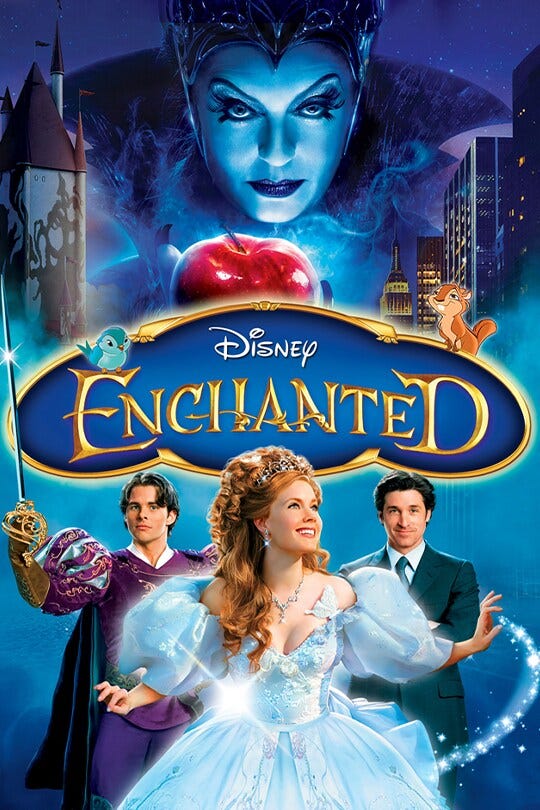
And surprising to no one who reads this newsletter, I had a lot of thoughts.
One of the things that becomes very obvious when you rewatch Enchanted with even a little bit of feminist media theory rattling around in your brain is that it’s very much a product of its moment.
The early-to-mid 2000s were a specific era in pop feminism. This was the age of Legally Blonde, Mean Girls, and glossy magazine feminism that tried to push back against the idea that being feminist meant being dour, humorless, aggressively anti-romance, and allergic to the color pink.
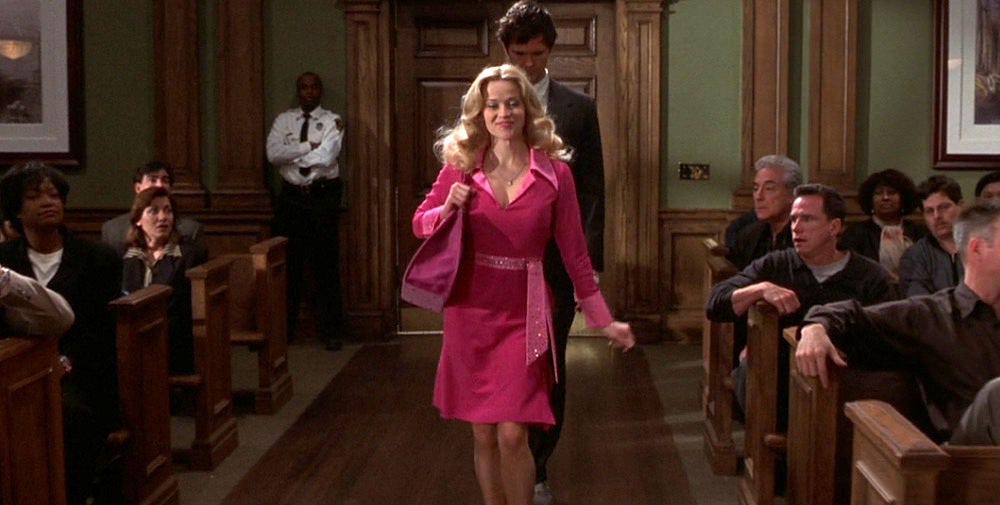
This was what’s often called lipstick feminism: the argument that femininity, pleasure, pop music, fashion, and optimism didn’t have to be disavowed in order for women to be intelligent, principled, or politically legible.
Enchanted leans hard into that logic.
Giselle is aggressively feminine. She loves romance. She sings about her feelings to strangers. She cries easily. She wears absurdly impractical dresses. She is not interested in being cool, ironic, or restrained.
And the film does not punish her for that.
That’s important, because a lot of media still does.
Postfeminism, irony, and the fear of sincerity
Of course, Enchanted is also deeply ironic. It knows it’s playing with Disney tropes. It winks at the audience constantly. Prince Edward is ridiculous. The instant-marriage logic is treated as absurd. The fairytale world is exaggerated to the point of parody.
This is where postfeminism enters the chat.
Postfeminist media loves irony because irony functions as a safety net. If you mock something first, you can still enjoy it without fully committing. You get to have your princess fantasy and your feminist self-awareness too.
The problem, as feminist media scholars have pointed out, is that irony can also neutralize critique. If everything is a joke, nothing is accountable. Feminism gets “taken into account” just enough to be dismissed as already solved, already outdated, already unnecessary.
Enchanted absolutely does this. It mocks traditional romance while still delivering it. It acknowledges feminist objections to fairytale narratives, then gently ushers those objections out the door so the movie can get back to singing about true love.
But here’s where I part ways with the most dismissive readings of the film.
Cynicism is not maturity, and Enchanted knows it
Robert, the male lead, isn’t just “realistic.” He’s more emotionally bruised than Taylor Swift’s Tortured Poets Department. He’s a divorce lawyer who treats love like a liability. He lives in a gray, hyper-rational version of adulthood where feelings are inconvenient and romance is something to be managed, not experienced.
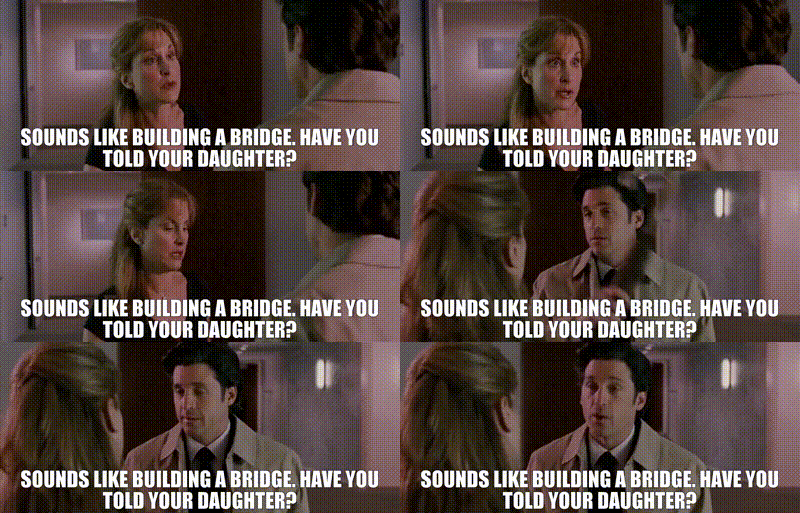
Giselle doesn’t just bring romance into his life. She brings sincerity. Joy. Play. Emotional vulnerability.
And the film treats that not as childishness, but as something that modern life has beaten out of people.
This is where a reparative reading becomes useful (hello, Sedgwick, I have resurrected you from last semester).
A reparative reading doesn’t ignore ideology. It just refuses the idea that the only intelligent relationship to culture is suspicion and contempt. It asks: what else is going on here? What is this text offering people as a resource?
And for Enchanted, one of the biggest resources it offers is a rebuttal to compulsory cynicism.
Giselle’s optimism isn’t just naïveté. It’s an insistence that joy, tenderness, and sincerity can be choices too, not just manipulation or weakness. In a culture that trains women to be “cool girls” about everything (including being mistreated), her emotional openness reads less like childishness and more like rebellion.
This is where Annette Kuhn becomes a useful anchor for me: she pushes against the idea that feminist meaning lives only in content or authorial intent. Meaning is produced through reading practices, through the relationship between viewer and text.
In other words: a film can circulate postfeminist contradictions and still be used as something reparative. Those aren’t mutually exclusive.
The “turn against cynicism”: Robert, Giselle, and Nancy
If Giselle is sincerity personified, Robert is the adult world’s emotional austerity policy. He’s what happens when you treat love like a risk assessment.
And the movie doesn’t just “fix” him by dropping a princess into his lap like an emotional support tiara. It frames cynicism itself as a kind of impoverishment. Giselle doesn’t just bring romance into his life; she brings play, music, and the possibility of joy back into his life and his daughter’s.
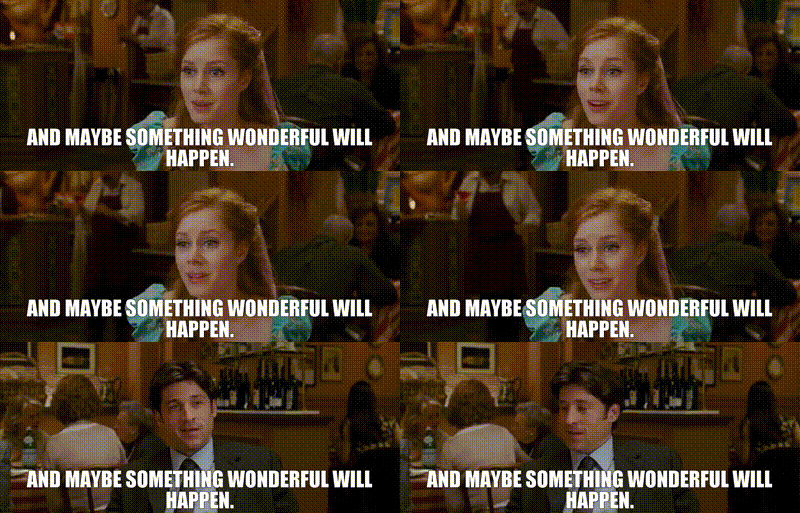
This is something Yvonne Tasker gets at in her chapter on Enchanted in Feminism at the Movies. Tasker points out how the film builds its argument visually: Giselle’s “too much” femininity is set against the grim monochrome of professional Manhattan, where adulthood is coded as rational, restrained, and joyless by default. That contrast isn’t neutral. It’s the film saying, look at what we call maturity. Look at what we’ve decided counts as realism.
And then there’s Nancy, who matters more to this story than people give her credit for.
Nancy is the “modern woman” figure: competent, tailored, knowing. She’s not naïve about men, romance, or the world.
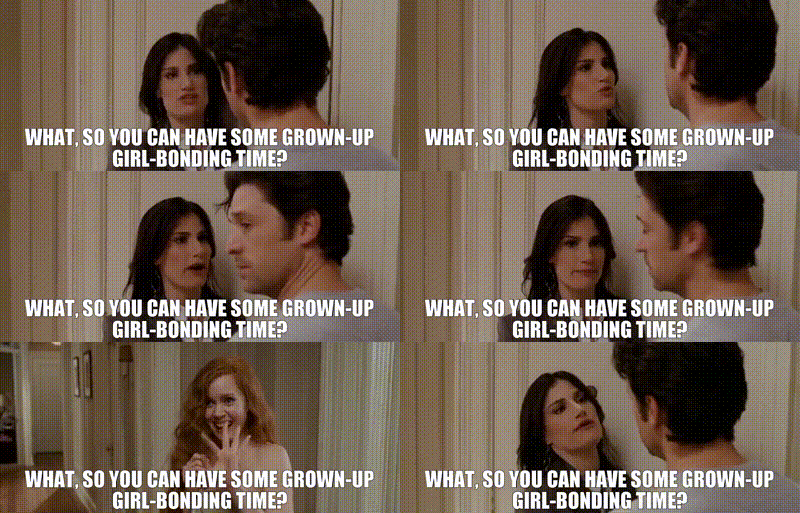
And in Tasker’s reading, she’s doing a very specific job in the film’s postfeminist architecture: she’s the professional woman who looks like she has the “right” contemporary life, but is framed as dissatisfied with it, and ultimately chooses fantasy domesticity instead.
That ending is wild when you actually sit with it.
Nancy doesn’t “lose” Robert so much as opt out of Manhattan realism.
She chooses a world where romance is not drenched in irony.
She chooses, essentially, sincerity without apology.
It’s a turn against cynicism, but it’s also a postfeminist fantasy solution: the costs of modern life are resolved by escape rather than change. And yes, both things can be true at once.
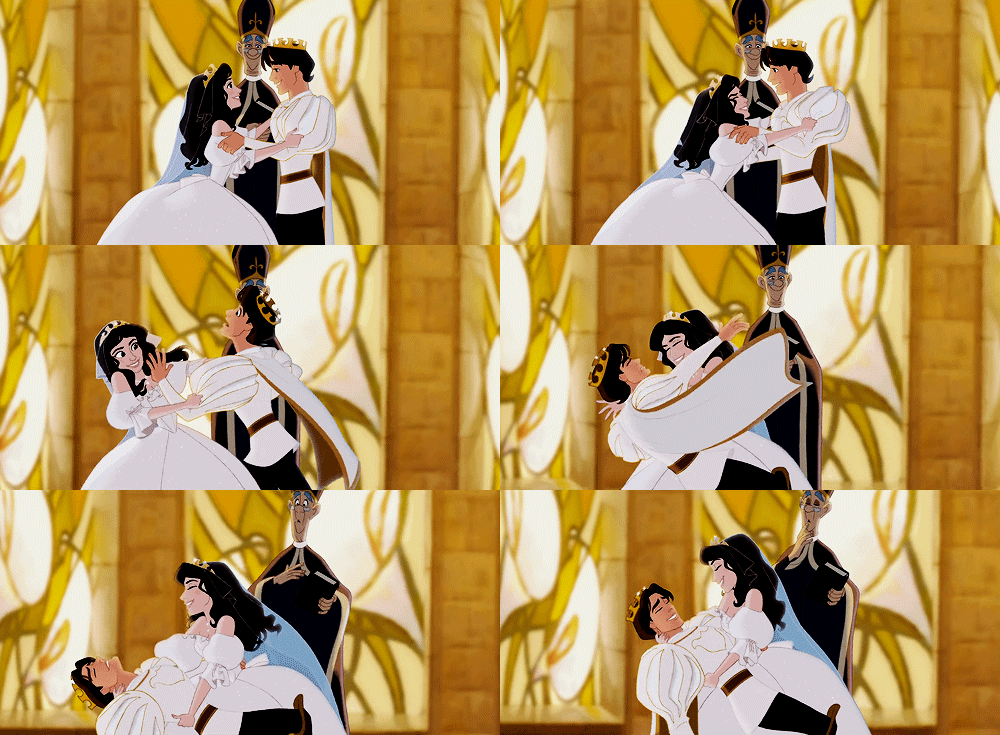
Anger is also an emotion. And it’s allowed to be freeing.
The thing I actually love about Enchanted is that it doesn’t fully commit to the idea that femininity must be sweet to be good.
Giselle experiences anger in New York, and the film treats it as growth, not corruption. She feels joy at expressing it because anger is clarifying. It’s boundary-setting. It’s the moment when “nice girl” conditioning loosens its grip and you realize, wait, I’m allowed to dislike things. I’m allowed to say no. I’m allowed to be mad.
That matters because one of the traps of lipstick feminism (and of postfeminist “empowerment” culture more broadly) is the pressure for women’s strength to remain aesthetically pleasing. Like yes, you can be powerful, but can you be powerful in a way that still photographs well for the algorithm?
Angela McRobbie’s classic article “Post-feminism and popular culture” is useful here because she argues that postfeminism works by “taking feminism into account” while undoing it, often through the language of choice and the demand that women remain palatable while being “empowered.” Enchanted flirts with that constraint, but it also lets Giselle’s emotional range expand beyond perkiness. She gets to be furious. She gets to be disappointed. She gets to be real.
The film’s quiet message isn’t “be happy all the time.” It’s:
happiness isn’t childish,
cynicism isn’t wisdom,
and anger doesn’t cancel out joy.
You can want softness without surrendering your spine.
That’s a lesson I’m still trying to relearn as I get older.
Disney talking to itself: Idina Menzel, Enchanted, and Frozen
One of my favorite cultural echoes from Enchanted is this:
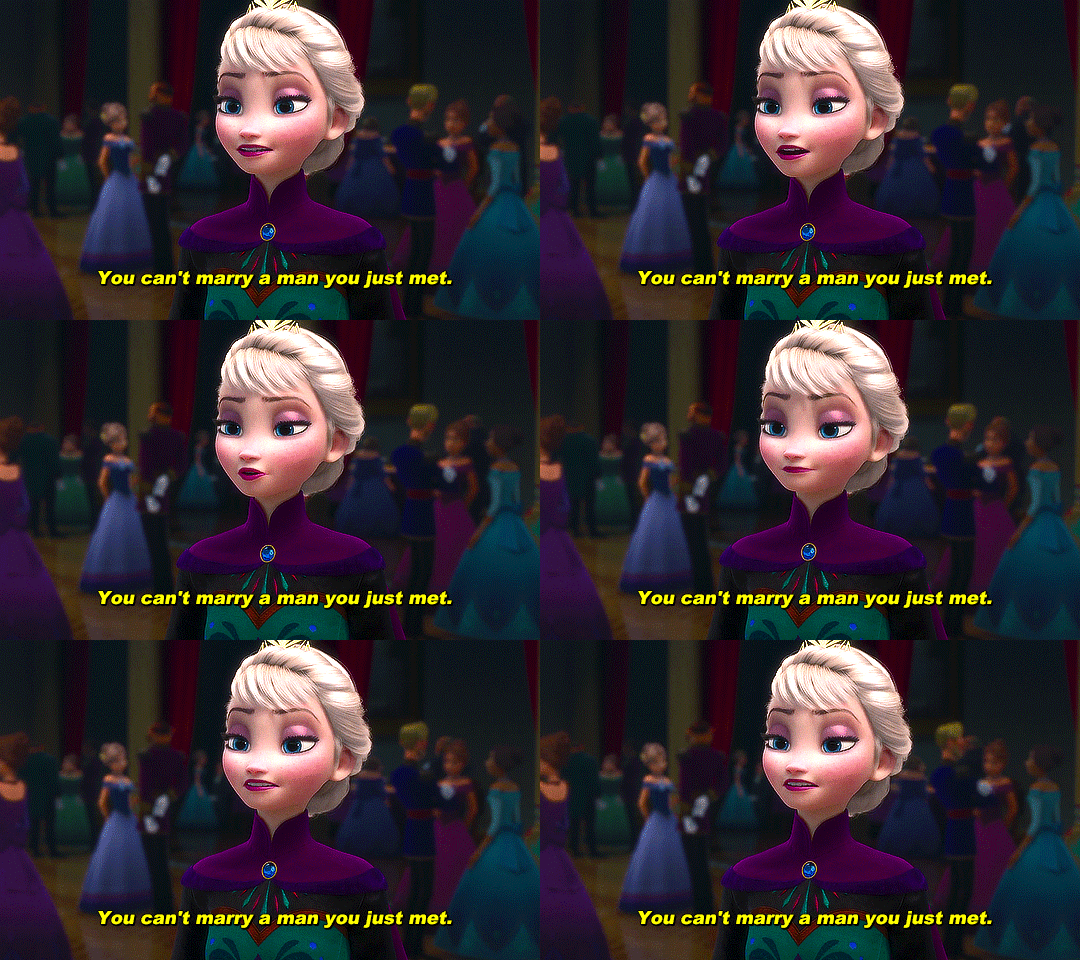
And in Enchanted, Idina Menzel’s Nancy… literally does exactly that.
That casting resonance turns into a weird little Disney meta-conversation across time. Enchanted uses knowingness to make the instant-marriage trope feel playful and chosen. Frozen states the critique directly, like Disney got tired of winking and decided to just say the thing out loud.
That doesn’t mean Enchanted becomes “bad feminism” retroactively. It means Disney is an institution that learns in public, rewrites itself, and argues with its own back catalogue in real time.
(And yes, I am absolutely the kind of person who thinks corporate intellectual property can function as a cultural diary. It’s…kind of my whole thing.)
So, is Enchanted feminist?
I don’t think that question is helpful in the way people want it to be, because it treats feminism like a sticker you either earn or you don’t. I know some people treat it that way, but I think it’s a hell of a lot more complicated.
What Annette Kuhn reminds us in “Passionate Detachment” (from Women’s Pictures: Feminism and Cinema, another course reading) is that feminism in relation to cinema isn’t just “in the text.” It’s produced through interpretation, use, and context. Meaning isn’t a fixed substance inside a film like jam in a donut. It’s something that happens between the film and the viewer, shaped by culture, history, and the frameworks we bring to it.
And what McRobbie reminds us is that postfeminism is extremely good at making patriarchy feel like a lifestyle choice.
And what Tasker shows, very specifically, is that Enchanted is exactly the kind of film where those contradictions aren’t a mistake, they’re the engine.
So my answer is:
Enchanted is a film where romance is both a fantasy of retreat and a fantasy of repair.
It reassures audiences that femininity and love don’t have to be embarrassing. It also packages that reassurance in a postfeminist style that sometimes smooths over the structural realities feminism is meant to keep visible.
But if you approach it reparatively, you can also see why it lands: it offers a counter to the cultural demand that women perform toughness as credibility. Dourness to be taken seriously. Bitchiness to avoid being taken advantage of.
And honestly? Sometimes the most radical thing a woman can do in a cynical world is to insist that she still deserves sweetness.
Not instead of anger. Not instead of clarity. But alongside it.
Notes from the Trenches: What I’m Reading (and Using Here)
For fellow students, pop-culture nerds, and anyone who enjoys watching Disney get gently interrogated.
Annette Kuhn, “Passionate Detachment”
From Women’s Pictures: Feminism and Cinema.
Yvonne Tasker, “Enchanted (2007): Postfeminism, Gender, Irony, and the New Romantic Comedy”
Angela McRobbie, “Post-Feminism and Popular Culture”
Eve Kosofsky Sedgwick, “Paranoid Reading and Reparative Reading”