
Lolita Complex in Space
The Problem of Feminism in Star Trek: Voyager

Adapted from a paper I presented at the Pop Culture Association Conference in 2025
Star Trek: Voyager occupies a strange place in television history.
Depending on who you ask, it is either one of the most feminist shows of the 1990s or a reminder that even progressive television can accidentally drive straight into a wall while congratulating itself for breaking barriers.
On paper, Voyager was revolutionary. It gave television its first female captain leading a Star Trek series. Captain Janeway wasn’t the ship’s counselor. She wasn’t the doctor’s assistant. She wasn’t somebody’s wife standing on the bridge asking if anyone wanted coffee. She was the captain.
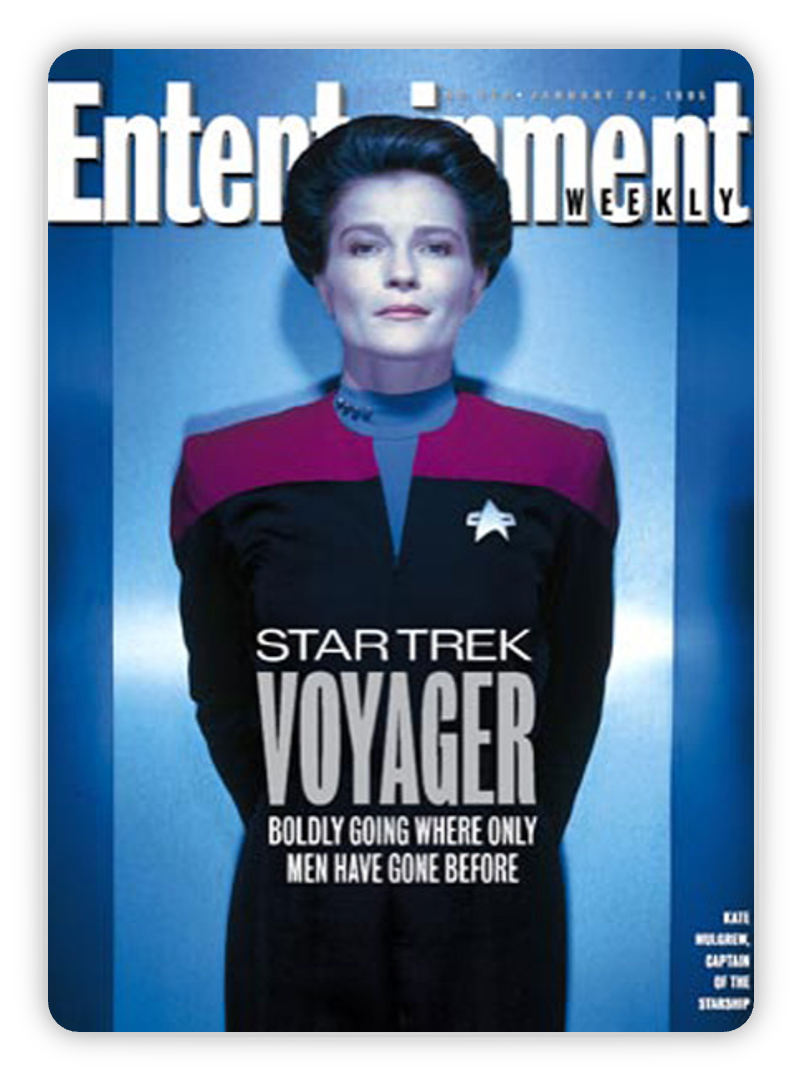
She gave the orders. She made life-and-death decisions. She got to be brilliant, stubborn, compassionate, ruthless, diplomatic, and occasionally terrifying.
For many women and girls watching in the 1990s, that mattered.
It still matters.
But if you’ve spent any time revisiting Voyager as an adult, you may eventually notice something odd happening in the background. While the show was busy proving a woman could sit in the captain’s chair, it was also doing some deeply weird things with its younger female characters.
And by “deeply weird,” I mean one of them was technically two years old and the other was marketed like she had escaped from a very expensive intergalactic Victoria’s Secret catalog.
The result is a show that feels like a perfect time capsule of 1990s feminism.
Women could have power.
Women could have authority.
Women could command a starship.
But apparently someone in the production office still believed viewers might panic if there wasn’t also a conventionally attractive woman in skin-tight clothing standing nearby to reassure them that nobody was getting too feminist.
This is the central contradiction of Voyager: it gave us feminist visibility while constantly trying to make that visibility less threatening. It put a woman in command, then surrounded her with narratives that turned youth, fragility, trauma, and sexual availability into selling points.
Voyager shows us what happens when feminism passes through the machinery of 1990s television: it gets polished, packaged, softened, sexualized, and sold back to us with a ratings bump.
In other words, Voyager did not reject feminism.
It commodified it.
There Was a Woman in the Captain’s Chair and Nobody Knew What to Do
One of the most revealing things about Voyager is that even Janeway wasn’t allowed to simply be a captain.
The production team spent an astonishing amount of time worrying about how to write a woman in command. Not whether she could command. Not whether she could lead. Not whether audiences would accept her authority. They worried about whether she was being written “as a woman.”
Producer and director Winrich Kolbe explained:
“I knew that we had to find a way of not writing her as a man, but writing her as a woman.”
Which is one of those statements that becomes more fascinating the longer you stare at it.
Because what exactly does that mean?
Janeway is commanding a starship. She is making strategic decisions, negotiating treaties, resolving crises, and occasionally threatening hostile aliens with the kind of calm intensity that suggests she has already planned three different ways to ruin their day.
At what point does leadership become masculine?
At what point does competence become male?
The concern itself reveals the underlying assumption: that authority is male by default, and therefore a woman exercising authority must somehow perform femininity at the same time to avoid making everyone uncomfortable.
Kate Mulgrew certainly noticed.
Reflecting on the early years of the series, she famously said:
“That bloody thing with my hair. Endlessly stupid hijinks with my hair! Not only my hair. My hair, my breasts, my feet, my waist. There was a woman in the captain’s chair and they didn’t know what to do.”
That quote should probably be engraved on a plaque somewhere in the Museum of Feminist Media Criticism.
Because Mulgrew identified the problem perfectly.
The production couldn’t stop looking at Janeway as a woman.
No matter how many diplomatic victories she secured or impossible decisions she made, conversations kept circling back to her appearance.
Her hair.
Her body.
Her femininity.
Male captains got to simply exist. Women captains apparently required an extensive ongoing review process.
In Laura Mulvey’s influential essay Visual Pleasure and Narrative Cinema, Mulvey argued that women in media are often positioned as objects to be looked at rather than subjects who act.
Even when women occupy positions of power, they remain visually coded as women first and characters second.
Janeway constantly bumps into this problem.
The show wants her authority.
The show likes what her authority says about the franchise.
The show just seems a little nervous about letting that authority stand entirely on its own.
And if Janeway represented female authority, the rest of the show’s women increasingly represented something else.
Because while the production was trying to figure out what to do with a female captain, it also created one of the strangest female characters in the history of Star Trek.
Her name was Kes.
She was two years old.
And somehow nobody thought that was a problem.
The Lolita Complex in Space
Before we talk about Kes, we need to talk about a cultural phenomenon that media scholar Gigi Durham calls The Lolita Effect.
The term “Lolita” gets thrown around so often in popular culture that most people have forgotten what it actually refers to.
Vladimir Nabokov’s Lolita was never intended to be a love story. It was a horror story told from the perspective of a predator. Yet over time, popular culture transformed “Lolita” into something very different: a shorthand for a particular type of girlhood. Young, innocent, vulnerable, naïve, and somehow also sexually desirable.
Durham argues that modern media is saturated with these images.

Advertising, film, television, music videos, fashion photography, and celebrity culture repeatedly blur the line between childhood and adult sexuality.

Girls are encouraged to appear older. Women are encouraged to appear younger. Youth itself becomes a form of currency.

As Durham writes:
Numerous clothing ads feature grown women dressed as little girls, sucking on lollipops, with tiny barrettes or bows in their hair, kneeling, crouching or lying flat in positions of utter helplessness and subordination. Childishness is sexy, these messages imply. Ergo, children—especially little girls—are sexy.
That is the core contradiction.
The idealized female figure is often expected to embody two things at once:
Sexual availability and emotional innocence.
Adult desirability and childlike vulnerability.
Power and helplessness.
The result is what Durham calls the “Pretty Baby” myth, where youth itself becomes eroticized.
This isn’t necessarily about literal children. In fact, it often isn’t. It is about the cultural preference for women who appear inexperienced, dependent, emotionally undeveloped, and non-threatening.
The fantasy is not simply beauty.
The fantasy is vulnerability.
The fantasy is a woman who has all the physical characteristics of an adult but retains the innocence, dependence, and pliability associated with childhood.
If that sounds familiar, congratulations. You’ve probably consumed American media at some point during the last century.
You can see it in the endless parade of teenage love interests played by actresses in their twenties. You can see it in beauty standards that prize youth above almost every other characteristic. You can see it in the recurring cultural obsession with women who are “barely legal,” “girl next door,” “innocent,” “pure,” or “untouched.”
And you can absolutely see it in 1990s television.
This is where Voyager becomes interesting.
Because the show didn’t simply create a young female character.
It created a character whose youth, innocence, fragility, and emotional inexperience were central to her identity.
Her name was Kes.
And she was two years old.
The Child-Bride of the Delta Quadrant
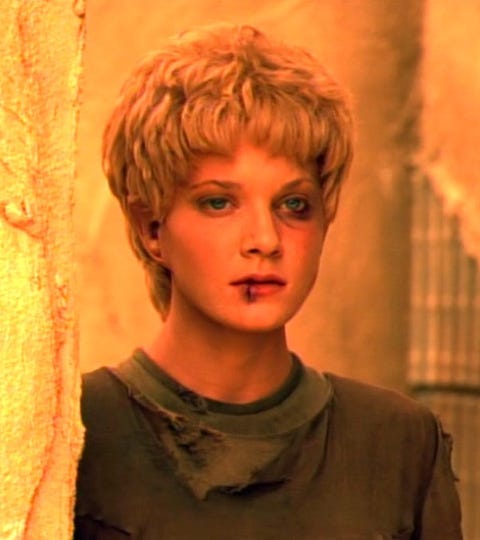
Kes is one of those characters who becomes more alarming the longer you think about her.
At first glance she seems harmless enough.
She’s kind, compassionate, curious, eager to learn. She’s basically a golden retriever in a jumpsuit.
She is also canonically less than two years old when she joins Voyager.
Not metaphorically.
Not spiritually.
Not “well alien years work differently.”
Two years old.
The show repeatedly reminds viewers of this fact. The Ocampa have lifespans of approximately nine years, making Kes extraordinarily young even by the standards of her own species.
And yet the series simultaneously presents her as an adult romantic partner.
This is where things start getting weird.
Or rather, this is where they start getting weird enough that somebody should have maybe raised a hand in the writers’ room.
The production’s own descriptions of Kes are remarkably revealing.
Rick Berman1 described the role as requiring “a sort of elfin female.”
Winrich Kolbe elaborated:
“You didn’t want a ball-buster, you didn’t want to have tank-like women saying, ‘Follow me!’ We wanted somebody who could be fragile, but with a steely will underneath.”
Notice the language.
Not intelligent.
Not capable.
Not authoritative.
Fragile.
The goal was fragility, delicacy, vulnerability.
Kes wasn’t accidentally written as childlike.
She was designed that way.
She was intentionally constructed as small, innocent, emotionally inexperienced, and physically delicate.
Then the writers surrounded her with older men who were attracted to her.
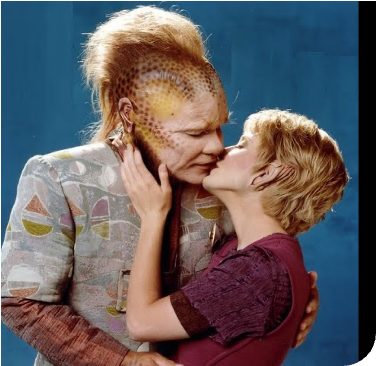
Neelix.
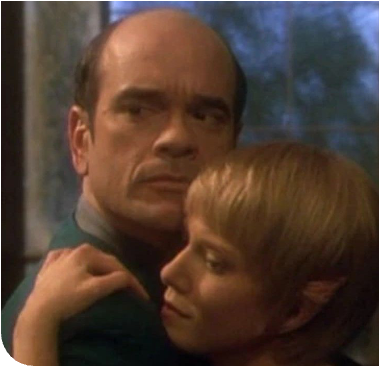
The Doctor.
Tom Paris in alternate timelines.
Perhaps one reason for our fascination with the sexy little girl is her tricky double role in contemporary society—she is simultaneously a symbol of female empowerment and the embodiment of a chauvinistic “beauty myth.”
She invokes the specter of pedophilia while kindling the prospect of potent female sexuality.
- Dr. M. Gigi Durham “The Lolita Effect”
At various points, Kes becomes the object of affection, fascination, mentorship, obsession, or romantic interest from men significantly older and more experienced than she is.
The power of Durham’s framework is that it explains why Kes feels unsettling even when the show insists everything is perfectly normal.
The issue isn’t simply that she’s young. It’s that her youth is central to her appeal. She is desirable because she is innocent. She is attractive because she is emotionally undeveloped.
She embodies Durham’s “Pretty Baby” myth, where girls are simultaneously framed as sexually desirable and emotionally childlike.
The contradiction isn’t accidental.
The contradiction is the point.
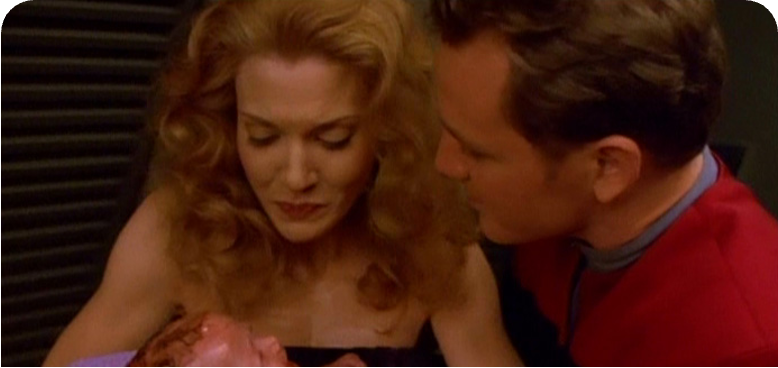
And nowhere does that contradiction become more uncomfortable than in the episode “Elogium.”
Because somehow Voyager looked at a character who repeatedly reminds everyone she is not yet two years old and thought:
“You know what this storyline needs? Puberty.”
Elogium and the Most Uncomfortable Puberty Metaphor in Star Trek History
If Kes’s existence raises uncomfortable questions, the episode “Elogium” takes those questions, puts them in a shuttlecraft, and accelerates directly into an asteroid field.
The premise is simple enough. An encounter with an alien lifeform triggers Kes’s Elogium, a biological process unique to the Ocampa. The Elogium is essentially a combination of puberty, fertility, and menopause rolled into a single event. It is the brief period during which Ocampa can reproduce.2
The problem is that Kes is not supposed to be experiencing it yet.
As Janeway attempts to help her understand what is happening, she explains that humans go through a similar process called puberty.
Kes responds:
“But I’m too young. Much too young. It usually happens between the ages of four and five. I’m not even two yet.”
And there it is.
The episode has now explicitly framed itself as a story about premature puberty, fertility, and reproductive decision-making involving a character who repeatedly reminds us that she is not yet two years old.
What follows is one of the strangest attempts at social commentary in the franchise.
At least in theory.
Because there is a genuinely interesting science fiction concept buried somewhere underneath the wreckage.
Imagine a story about a young woman suddenly confronted with the possibility of reproduction before she feels ready. Imagine a thoughtful exploration of bodily autonomy, reproductive choice, family expectations, or the pressure society places on women to become mothers.
There are fascinating questions here.
What does it mean to have control over your reproductive future?
What happens when biology imposes a timeline you did not choose?
How do you decide whether motherhood is right for you?
For a franchise that has often used science fiction as a vehicle for discussing contemporary political issues, this should have been fertile ground. No pun intended.
Instead, Voyager somehow manages to stumble directly past every interesting conversation available to it.
The episode never meaningfully engages with reproductive rights.
It never explores bodily autonomy in any sustained way.
It never develops a coherent metaphor for pregnancy, fertility, or social expectations surrounding motherhood.
Instead, it rushes through the entire dilemma so quickly that the audience barely has time to process the implications before the credits roll.
Which is perhaps fortunate, because the implications are deeply uncomfortable. But it was still a missed opportunity. One of many in Voyager’s run.
The central problem is that the episode accidentally creates what feels like a teen pregnancy narrative while simultaneously insisting that the character at the center of that narrative is developmentally younger than a teenager.
The language used throughout the episode repeatedly emphasizes Kes’s youth and inexperience. She is frightened. Confused. Unprepared. She openly states that she is too young for what is happening to her.
And yet the story still asks viewers to engage seriously with the possibility of her becoming a mother.
It’s difficult to overstate how bizarre this becomes once you stop accepting the show’s premises at face value.
Imagine if a contemporary television series introduced a character explicitly coded as a preteen and then centered an episode around whether she should have a child.
The audience would rightly be horrified.
But Voyager seems strangely unaware of the implications of its own worldbuilding.
Part of the problem is that the series wants Kes to occupy two contradictory roles at once.
She is supposed to be innocent and childlike. She is also supposed to be an adult romantic partner.
She is supposed to be inexperienced and vulnerable. She is also supposed to be old enough to navigate questions of sex, reproduction, and parenthood.
The show wants both versions of Kes simultaneously.
It wants the appeal of innocence and the narrative functions of adulthood.
And “Elogium” exposes just how unstable that balancing act really is.
Durham argues that media frequently creates female characters who exist in a liminal space between childhood and adulthood, combining the vulnerability associated with youth with the sexual desirability associated with adulthood.
That tension is not a side effect of Kes’s characterization.
It is the foundation of it.
“Elogium” simply makes the contradiction impossible to ignore.
The episode accidentally asks the audience to confront the logical consequences of a character who has been constructed as both child and woman at the same time.
The results are exactly as uncomfortable as that sounds. Except the show never acknowledges that discomfort or how disturbing the framing is.
And if Kes represented the 1990s obsession with innocence packaged as desirability, her eventual replacement represented something slightly different.
Because when Jennifer Lien left the series, Voyager stopped selling innocence.
It started selling sex.
Quite literally.
Because the next major female character arrived with a production mandate, a skin-tight catsuit, and one of the most revealing quotes in the history of the franchise.
As producer Brannon Braga3 later recalled:
“Then I called Rick... and it was his idea to make it a Borg babe.”
And with that, Voyager entered its next phase.
The Day Star Trek Invented the Phrase “Borg Babe”
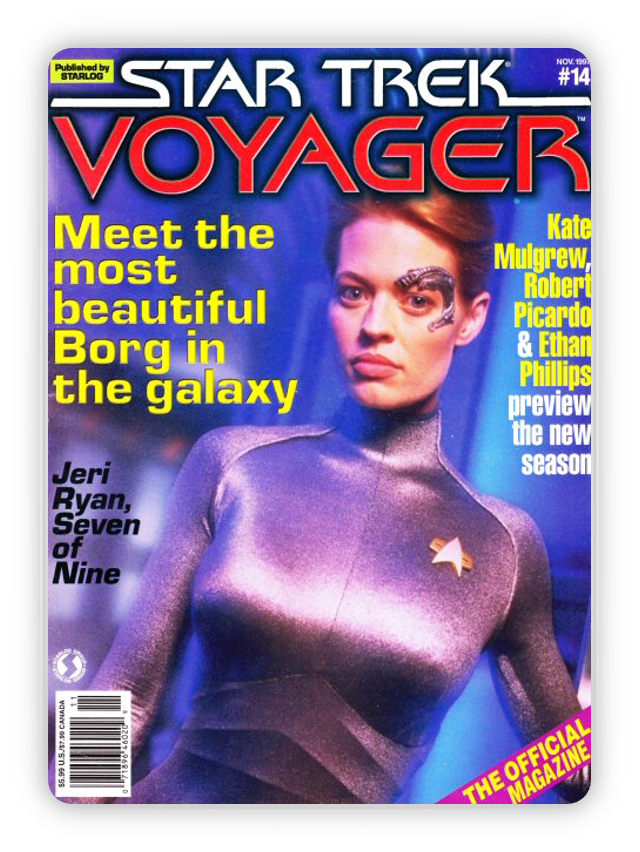
If Kes represented innocence sexualized, Seven of Nine represented something else entirely.
Trauma sexualized.
And unlike the Kes discussion, where fans can at least argue about authorial intent, the production team was remarkably honest about what they were doing.
Sometimes, media critics spend years dissecting symbolism, interviewing creators, and searching for hidden meanings.
Sometimes a producer just walks into the room and says the quiet part out loud.
This is one of those times.
Discussing the creation of Seven of Nine, Brannon Braga recalled:
“What if we had a Borg character on the show? I mean, there’s some conflict for you. Then I called Rick…and it was his idea to make it a Borg babe. We formulated the character, who had a proper name a the time – I think it was Perrin, short for Perineum.”

A Borg babe.
Not a former Borg struggling with identity.
Not a survivor of assimilation.
Not a woman attempting to reconstruct her humanity after decades of psychological trauma.
A Borg babe.
Honestly, I appreciate the honesty.
Fans have spent decades trying to explain Seven’s appearance through narrative logic. The catsuit was necessary. The costume reflected her alien nature. The design represented her struggle with identity. The outfit was symbolic.
The producers called her a Borg babe.
Case closed.
What’s fascinating is that the underlying concept for Seven is actually excellent.
She was assimilated by the Borg at age six.
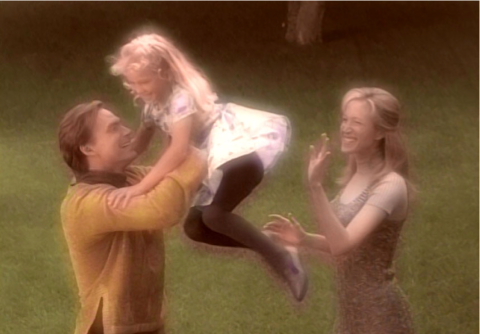
Everything that made her an individual was stripped away.
She spent decades as part of a collective consciousness before being separated from it and forced to rebuild a sense of self.

That’s an incredible premise.
It’s arguably one of the strongest character concepts in the franchise.
In another version of Voyager, Seven might have become a sustained exploration of trauma, recovery, identity formation, and what it means to reclaim one’s humanity after experiencing profound psychological violation.
Sometimes that version of the character even appears on screen.
Jeri Ryan’s performance is often excellent. Many of Seven’s episodes are among the strongest in the series. Her gradual evolution from detached Borg drone to fully realized individual remains one of Voyager’s greatest achievements.
The problem is that the production never seems entirely interested in the same character arc the writers are creating.
The writers are building a story about identity.
The marketing department and production team is building a pinup calendar.
And those two goals spend seven seasons crashing into each other.
Writer Bryan Fuller described Seven as:
“This woman who was raised in the wild by wolves and now has to be trained to be human again.”
That’s actually a remarkably accurate description.
Seven’s early stories revolve around basic socialization. She struggles with humor. She struggles with friendship. She struggles with intimacy. She struggles with understanding emotions.
Jeri Ryan herself often discussed Seven’s journey in terms that sound less like an adult character arc and more like developmental milestones. Seven experiences first laughter. First friendships. She goes through what Ryan jokingly described as an “unruly teenage phase.”
In many respects, Seven is emotionally younger than her physical appearance suggests.
Which is where things start becoming familiar.
Because if you’ve been paying attention, you’ve probably noticed a pattern.
Kes was characterized by emotional innocence.
Seven is characterized by emotional immaturity.
Kes was positioned as vulnerable.
Seven is positioned as vulnerable.
Kes’s appeal was tied to youth.
Seven’s appeal is tied to a kind of developmental incompleteness.
Different packaging.
Similar logic.
The women who populate Voyager are repeatedly defined through forms of emotional dependency and vulnerability.
The difference is that by 1997, the show had stopped wrapping those qualities in fairy-tale innocence.
Now it was wrapping them in spandex.
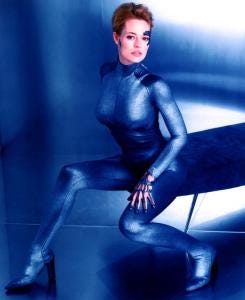
And nowhere is that contradiction more obvious than in the costume.
Because if Seven’s story is supposedly about reclaiming her humanity, someone should probably explain why the first step in that process involved engineering one of the most notorious outfits in science fiction history.
The answer, unfortunately, is exactly what you think it is.
The Corset Under the Borg
One of the things I find most refreshing about Brannon Braga is that he occasionally says things media critics might have spent twenty years trying to prove.
Discussing Seven of Nine’s arrival on Voyager, Braga recalled that some members of the Deep Space Nine production staff thought they were “sellouts” for “just putting tits and ass on the show.”
His response?
“Yeah, we’re putting tits and ass on the show.”
Honestly, thank you for your service to feminist media criticism.
That quote matters because it cuts through decades of fan over-explanation. Seven’s appearance was not an unfortunate side effect of storytelling. It was not an accidental consequence of character design. It was not simply “Borg aesthetics.”
It was deliberate.
The point was sex appeal.
The point was ratings.
The point was to make sure viewers noticed Seven’s body before they had to think too hard about her trauma.
This is where Laura Mulvey’s concept of “to-be-looked-at-ness” becomes almost painfully useful. In Visual Pleasure and Narrative Cinema, Mulvey argues that women in film are often positioned as spectacles: displayed, eroticized, and visually coded for the pleasure of the viewer.
“In their traditional exhibitionist role women are simultaneously looked at and displayed, with their appearance coded for strong visual and erotic impact so that they can be said to connote to-be-looked-at-ness.”
- Laura Mulvey “Visual Pleasure and Narrative Cinema”
Seven of Nine might as well have arrived with a footnote.
Her actual character premise is fascinating. Her story could have been one that focused on trauma, identity, recovery, and personhood.
And sometimes it is.
But very often, Voyager filters that story through sexual appeal.
Her awkwardness becomes sexy.
Her vulnerability becomes sexy.
Her emotional immaturity becomes sexy.
The show repeatedly asks us to watch a woman who is learning basic human social behavior while also framing her as an object of constant male desire.
Even when the writers insisted she was not being written as a “sex kitten,” the episodes often disagreed. In “Revulsion,” after Seven realizes Harry Kim is sexually attracted to her, she immediately offers to “copulate” with him as a way to learn more about being human.
The scene is played for comedy, but it reveals the larger pattern. Seven’s journey toward humanity is repeatedly routed through sexuality. Friendship, community, and identity are all there, but the show keeps wandering back toward sex like a dog returning to a suspicious smell.
Sarah Banet-Weiser would recognize this as popular feminism turned into commodity. Seven looks empowered. She is brilliant, strong, capable, and central to the series. But her empowerment is packaged in a form that boosts ratings rather than challenges patriarchy.
It sells.
It does not liberate.
That preoccupation with sex wasn’t limited to the writing.
It was literally stitched into the costume.
And this is where Seven of Nine becomes difficult to separate from the broader history of women in Star Trek.
By 1998, the franchise should have known better.
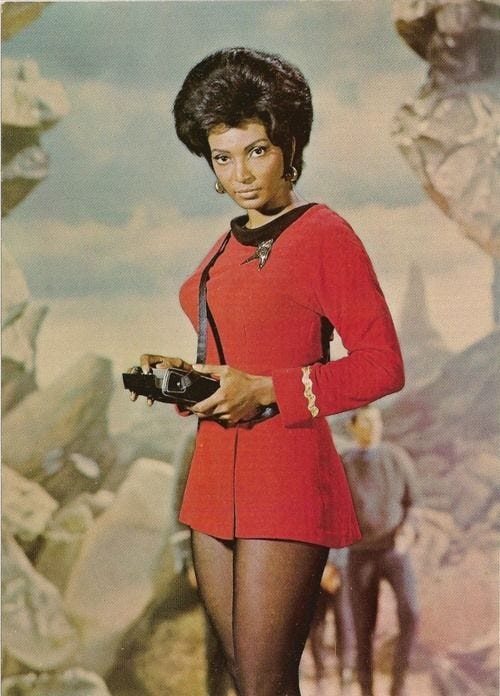
It had been nearly thirty years since the female bridge officers of the original Enterprise stopped wearing miniskirts as standard uniform issue.
The Next Generation had finally abandoned the infamous cleavage-baring “cosmic cheerleader” outfit that Marina Sirtis spent years wearing as Counselor Troi.
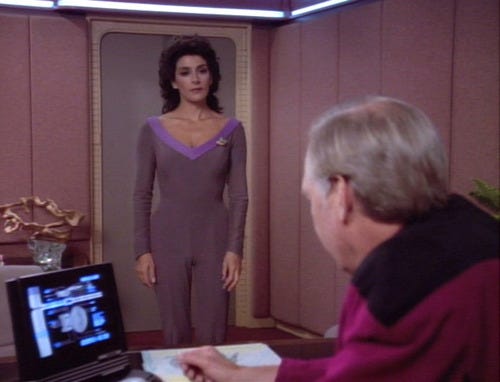
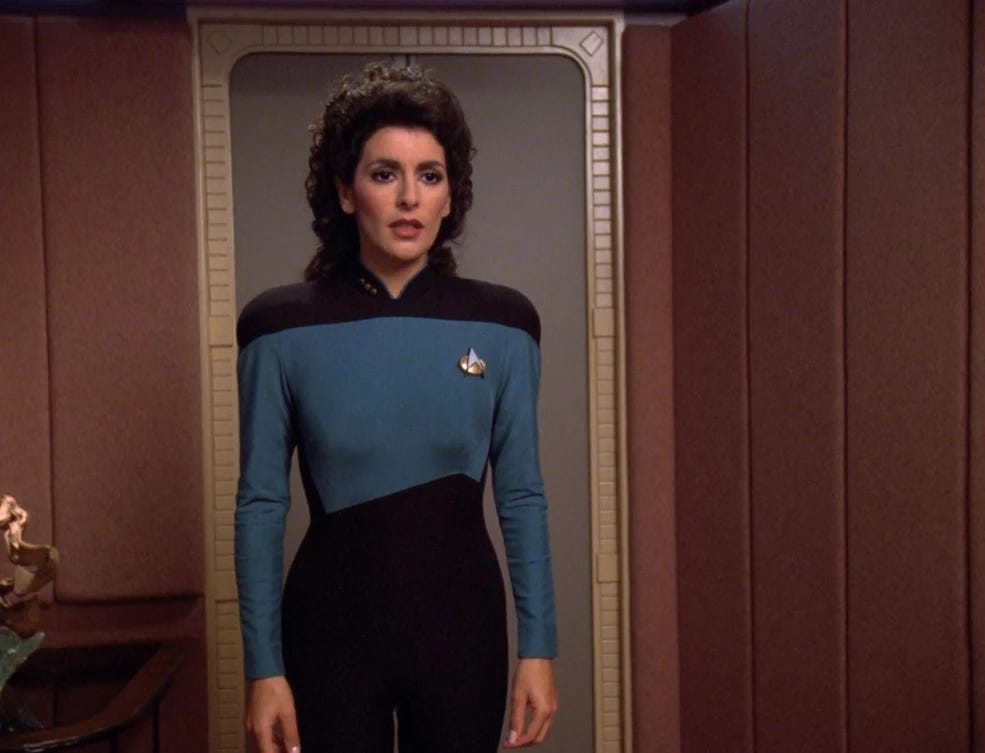
The franchise appeared to be moving, however slowly, toward treating women like Starfleet officers rather than decorative accessories.
Then Voyager decided it needed a ratings boost.
All it took was Rick Berman and Brannon Braga deciding the show needed a little more sex appeal, and suddenly the newest female cast member was squeezed into a skin-tight catsuit with a science-fiction explanation so flimsy it practically dissolved on contact with air.
The official justification was that the suit was “skin regenerative.”
The real purpose was considerably less subtle.
Years later, Jeri Ryan described the elaborate construction hidden underneath the costume:
“The producers had said that they wanted it to look like skin, to be skin-regenerative fabric. For the breast mound, they wanted two individual breasts and they wanted it to hug every curve, like skin.”
I’m sorry.
The what?
The breast mound.
That was apparently the actual production term.
According to Ryan, the costume designer had to engineer a complex corset beneath the suit because the producers wanted the fabric to cling to every contour of her body while still maintaining the visual separation of what Ryan politely referred to as “two individual breasts.”
At a certain point, we are no longer discussing costume design.
We are discussing aerospace engineering for cleavage.
The result was a costume so restrictive that Ryan couldn’t get in or out of it without assistance. She had a dedicated dresser. Bathroom breaks became production events.
As Ryan recalled:
“If I had to go to the bathroom it was a 20-minute production shutdown. It’s true, no joke. The whole crew had to know about it.”
Think about what that means.
A female actor’s ability to perform basic bodily functions became a logistical challenge because the production was so committed to maximizing visual appeal.
And this is where Sarah Banet-Weiser’s concept of popular feminism becomes particularly useful.
Seven looks empowered.
She is brilliant. Strong. Capable. Central to the narrative.
But her empowerment is packaged for consumption.
The visual presentation of the character constantly reassures viewers that no matter how intelligent, powerful, or important she becomes, she remains available to the gaze.
The character is not merely a former Borg drone reclaiming her humanity.
She is a former Borg drone reclaiming her humanity while wearing a corset designed around something called a breast mound.
If that sounds absurd, that’s because it is.
The absurdity is the point.
"Tinker Tenor Doctor Spy"
The episode is mostly a comedy about the Doctor’s ego running loose in the holodeck of his own mind, but one fantasy is especially revealing: he imagines himself as a celebrated painter, with Seven of Nine posed nude as his model.
The joke is supposed to be about the Doctor.
But the image still works the way the male gaze always works.
He stands. She reclines.
He creates. She is displayed.
He gets interiority. She becomes atmosphere.
The scene is brief, ridiculous, and played for laughs. It also distills the problem beautifully: even when Seven is one of the most interesting characters on the ship, the show can still reduce her to a fantasy object the moment someone else’s imagination takes over.
Hugh, Seven, and the Gender Politics of Borg Recovery
The strongest evidence that Seven’s treatment wasn’t inevitable comes from another Borg character entirely.
Several years before Seven of Nine arrived on Voyager, The Next Generation introduced Hugh.
Like Seven, Hugh is separated from the Collective and forced to develop an individual identity. Like Seven, he must learn friendship, autonomy, emotion, and personhood after existing as part of the Borg hive mind.
The basic premise is remarkably similar.
The treatment is not.
When the Enterprise crew encounters Hugh, they treat him like what he effectively is: a traumatized individual. He is confused. Vulnerable. Childlike in some respects. The story approaches his recovery with patience, empathy, and curiosity.
Nobody builds storylines around whether the audience finds him attractive.
His trauma is allowed to simply be trauma.
His humanity is allowed to simply be humanity.
Seven, by contrast, is introduced through a framework of visual appeal almost immediately. Her rehabilitation becomes entangled with sexuality. Her vulnerability becomes part of her marketability.
The difference between the two characters is not narrative.
It is gender.
What makes the comparison even more interesting is that Brannon Braga had a hand in both worlds. He wrote “I, Borg,” one of the franchise’s most thoughtful explorations of Borg individuality. He also co-wrote Star Trek: First Contact, which introduced the overtly sexualized Borg Queen, and later helped create Seven of Nine.
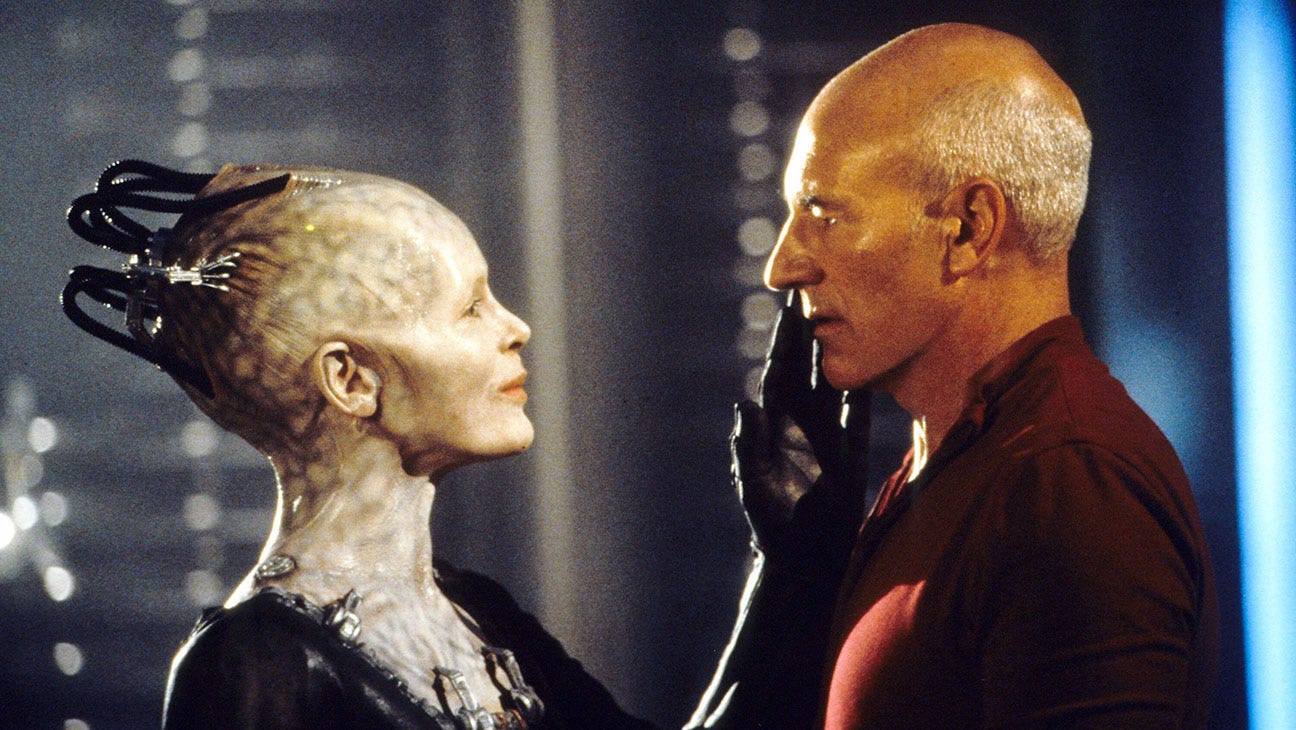
The shift is telling.
As the Borg became female, they also became sexualized.
Hugh is treated as a person first.
The Borg Queen is treated as temptation.
Seven is treated as spectacle.
Hugh’s experience is dignified.
Seven’s experience is commodified.
And that isn’t an accident.
It’s a reminder that media doesn’t simply tell us stories about gender. It teaches us whose suffering deserves empathy, whose recovery deserves respect, and whose trauma can be repackaged as entertainment.
Which brings us back to the central contradiction at the heart of Voyager.
The series wanted credit for being progressive.
The question is what kind of progress it was actually selling.
Feminism With a Ratings Bump
Kes and Seven ultimately reveal what I think is Voyager’s central contradiction.
The series wanted credit for progressive representation while still prioritizing viewer demographics, network expectations, and commercial appeal. Its female characters were visible but not protected. Complex but commodified. Empowered, but only within carefully controlled limits.
In Empowered: Popular Feminism and Popular Misogyny, Sarah Banet-Weiser argues that popular misogyny often emerges alongside popular feminism rather than in opposition to it. As women become more visible in public life and media, new forms of backlash emerge to contain, dilute, and repackage that visibility.
In other words, feminism becomes acceptable so long as it remains marketable.
That framework helps explain a great deal about Voyager.
The series gave us Janeway.4
But it also gave us Kes.
It gave us Seven.
It gave us a female captain, then surrounded her with increasingly hyperfeminized female characters whose bodies, vulnerability, and desirability could reassure audiences that feminism had not, in fact, gone “too far.”
This isn’t simply a Voyager problem.
It’s a 1990s problem.5
The decade loved “girl power.” It loved independent women. It loved female professionals, female action heroes, and female leaders.
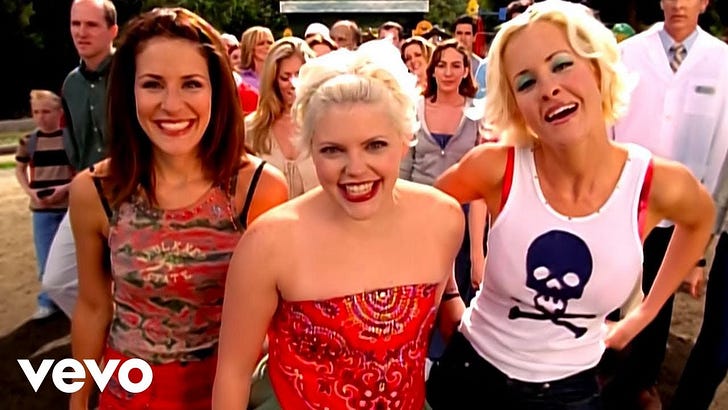
As long as they were attractive.
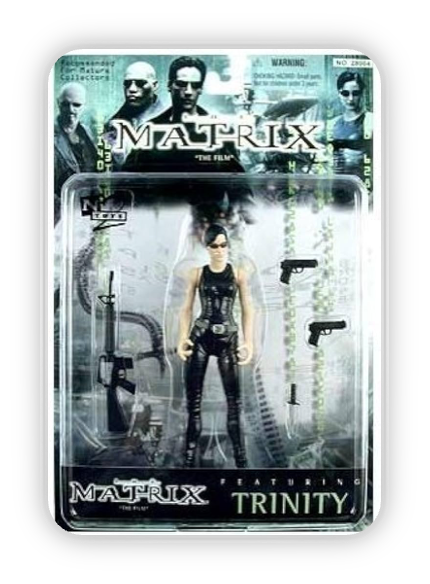
As long as they were non-threatening.

As long as they remained consumable.
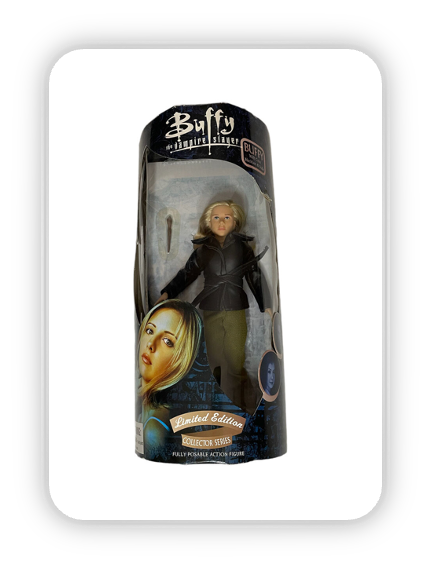
As long as they could still sell magazines, merchandise, and television ratings.

Seen through that lens, Voyager becomes less of an anomaly and more of a perfect cultural artifact.
The series genuinely expanded representation. Janeway mattered. Seven mattered. The show inspired countless women and girls to imagine themselves as scientists, leaders, explorers, and problem-solvers.
That progress was real.
But so were the limitations.
Ultimately, Voyager reflects the tensions at the heart of 1990s feminism: progressive on the surface, deeply compromised underneath.
This is how misogyny often operates under neoliberalism. It doesn’t necessarily silence women. It doesn’t always erase them from the screen.
Instead, it hyper-visualizes them.
It turns them into brands.
It makes them profitable.
It allows women to have power, provided that power remains attractive, marketable, and reassuring.
The irony is that we can see the limits of that model most clearly by looking at what happened decades later. When Star Trek: Picard finally allowed Seven of Nine to be openly queer and less obviously constructed around the male gaze, parts of the fandom reacted as though the franchise had suddenly become political.
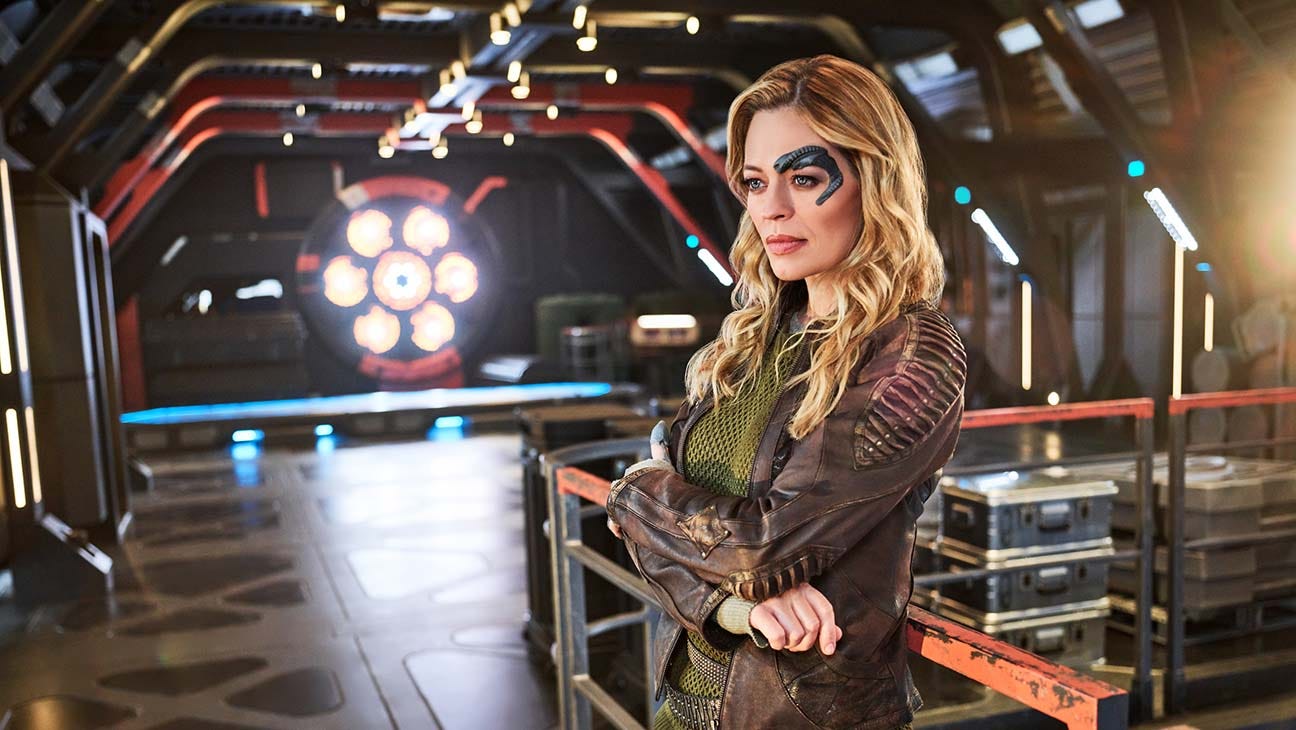
As if the real controversy wasn’t the corset.
As if the real controversy wasn’t the “Borg babe.”
As if the real controversy wasn’t spending years packaging a trauma survivor as fan service.
No, apparently the dangerous thing was letting her kiss a woman.
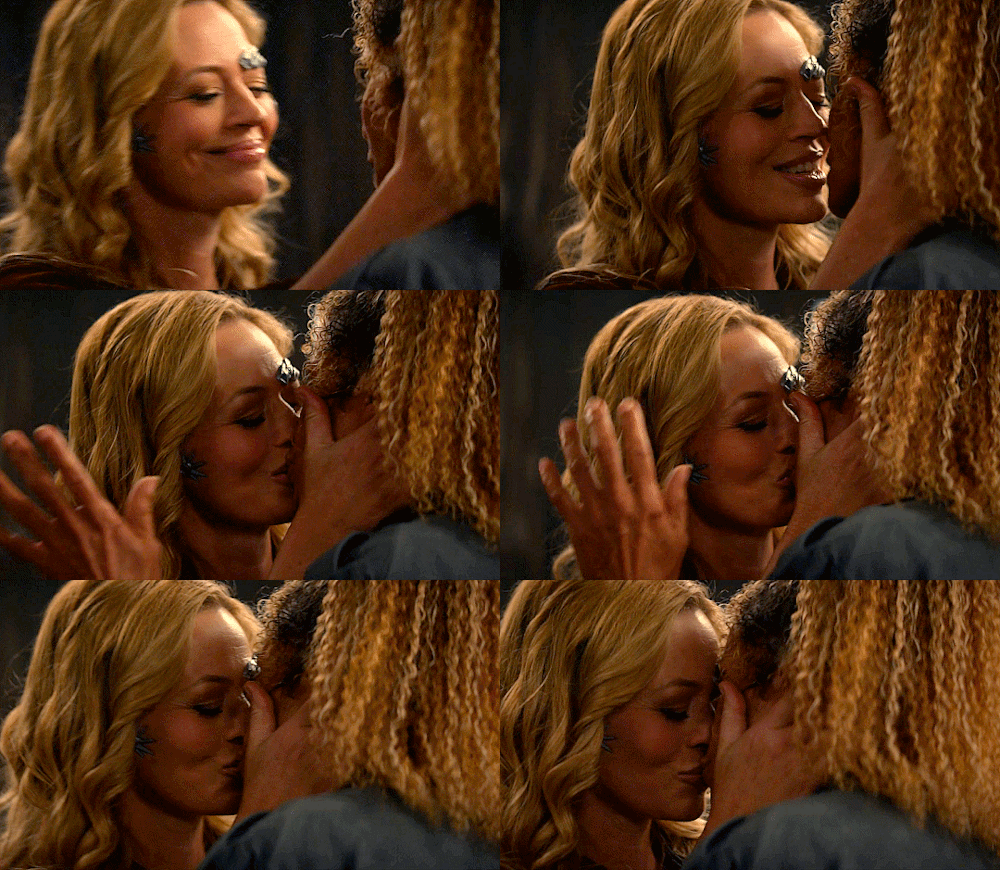
Which tells us everything we need to know.
Voyager is a landmark for representation.
But it comes with an asterisk.
The series didn’t reject feminism.
It commodified it.
It gave us visibility without protection, empowerment without power, feminism with a wink and a ratings bump.
Kes and Seven are not failed characters. In many ways, they are exactly what the production intended them to be.6
That is what makes them so fascinating.
And so frustrating.
Their stories remind us that representation alone is never enough. Visibility is not liberation. A woman can be at the center of the screen and still be trapped inside someone else’s fantasy.
The real question is not whether a show includes women.
The real question is what those women are allowed to be.
On Voyager, the answer was often: captain, genius, survivor, explorer, scientist, leader...
...but only after the camera had a good look first.
My arch-nemesis
We are going to ignore the clear fact that the writer’s room didn’t understand anything about replacement rates for population, since if all Ocampa can only give birth a single time, the species would have died out a long time ago.
My other arch-nemesis
And honestly there are feminist issues with Janeway as well, that just wasn’t something I got into in this particular paper.
And a 2000s problem, a 2010s problem, and a 2020s problem.
The number of times I texted my best friend “fuck Rick Berman and Brannon Braga” while I was writing the Voyager chapter of first MA thesis should be studied.
Great article!
I'm a big fan of Voyager (it's my favorite Star Trek iteration) and I certainly don't deny that any of the flaws you identified exist. You're dead on about all of them.
However, just for the sake of playing the devil's advocate, I want to present a few storylines that show how the writers of the show were earnestly trying to embrace progressive feminism despite some of the dumb bullshit being forced on them by production's demand for tits and ass and all that 90s nonsense.
First, there's the episode "Blood Fever," where B'Elanna is the victim of the Vulcan equivalent of sexual assault. This episode should be commended for not shying away from the fact of sexual harassment and sexual assault in the workplace. B'Elanna experiences a very believable trauma response from this event. And then when she contracts pon farr from her assailant and becomes UNSTOPPABLY HORNY as a result, the writers *could* have used that plot twist to make it into a 90s sexfest. There's even a point where the other male characters tell Tom Paris that the only way to SAVE B'ELANNA'S LIFE is for him to bang the shit out of her. (For readers unfamiliar with the show, Tom is kind of the requisite "hot dude who gets all the chicks" Star Trek character... and he's also secretly in love with B'Elanna.) Rather than seizing the opportunity to justify his long-desired dicking of B'Elanna Torres, Tom absolutely refuses to have sex with her because she's not in her right frame of mind and he's not convinced that she can truly consent. Even when she is very aggressively attempting to fuck him, he refuses because he insists that he will only bang a hot chick if he can be sure she's fully consenting, and that's not the case here.
Another example: There’s an episode in, I think, season 6 or 7 where Kes catches up with Voyager and returns as an aging woman to try to save her younger self by manipulating tachyons and traveling back in time to get her child-self off Voyager and back to her home planet. That episode does deal really well with the “Kes is two years old, lol” problem… I suspect that, as the show went on, more writers (and perhaps viewers) objected to the ick factor of Kes’s age. So her age and all the ethical problems it raises are addressed. It’s perhaps too little too late, but I appreciate that the writer’s room for Voyager felt the need to address it at all. That was quite a large step in the right direction for the late 90s, when so much social currency was placed on female youth.
Seven, despite being undeniably and quite obviously the sexpot eye candy intended to boost ratings, remained an incredibly complex character. The writers seemed to have seized control of her—if the higher-ups were going to force them to have a sexy female character, by god they were at least going to maintain control over her storylines to keep her complex and interesting beyond her surface appearance. Yes, most of the other male characters are attracted to her at one point or another. But virtually all that time, Seven doesn’t pay any attention to all those dumb boys unless her job requires her to interact with them. Her storylines remain focused on her self-discovery, education, and her ability to be a hero in her own right. Seven of Nine not only passes the Bechdel test despite her “skin-regenerating breast mounds,” but she kicks the Bechdel test in the nuts. She doesn’t give a fuuuuuuuuck about the dudes. She’s there to explore the galaxy and figure out how to be a human again, and apparently for her, being a human doesn’t involve romance or sex. (Until—spoiler alert—the weird thing with Chakotay right at the end of the show, which doesn’t even last, as if the writers realized it was a betrayal of Seven’s character and just couldn’t be borne.)
Anyway, those are my counter-arguments as a hardcore Voyager nerd, in defense of the writers, who I believe were earnestly trying their best to push back on the demands of 1990s TV’s gross misogyny. Cheers!
Oh my gosh, Voyager and its women. Entire books could be written about how fucked up it all is. I quit watching after the 'women saying they've been raped are either confused or lying' episode.