
Please Laugh Now
How television used fake audiences to teach Americans what was normal

There is currently a very detailed book proposal sitting on my agent’s desk called June Cleaver Must Die. At some point, with any luck and perhaps a small intervention from the publishing gods, a publisher will look at it, hand me an advance, and allow me to spend an unhealthy amount of time writing several hundred pages about gender, nostalgia, television, and the remarkable durability of postwar American myths. For now, though, the proposal is still just that: a proposal. A holding stage. A blueprint. A promise that a book might eventually exist if the right people decide that yes, actually, perhaps the world does need a feminist field guide to dismantling June Cleaver’s cultural afterlife.
The difficulty is that a proposal is supposed to come before the real writing begins, and I keep finding myself unable to wait. Every time I research one piece of the book, I fall down another rabbit hole that connects to the same larger argument. A normal person would make a note, save it for later, and move on. I am apparently not that person. I have too much to say, and while I would very much enjoy being paid an advance to sit around and write the actual book, some of these ideas are already scratching at the inside of my skull like tiny raccoons with footnotes.
This particular raccoon arrived in the form of the laugh track. More specifically, it arrived through the Laff Box, the machine developed by sound engineer Charles Douglass in the 1950s that allowed television producers to insert prerecorded audience laughter into programs whenever they wanted. A joke that received only a polite chuckle could suddenly sound like it had brought the house down. A mediocre punchline could be transformed into a moment of collective hysteria. A scene filmed without an audience could be supplied with one after the fact. In other words, television executives invented a machine that could peer-pressure you from inside your own living room, and somehow everyone decided this was normal.
That should strike us as stranger than it usually does. Most people think of laugh tracks as an irritating relic of old television, or maybe as a technical quirk from the days when sitcoms were still figuring out how to translate theater and radio comedy and shows filmed in front of a live studio audience into a domestic visual medium that filmed on a back studio lot. But the more I thought about the Laff Box, the more I became convinced that the laugh track was never only about comedy. It was about agreement. The truly fascinating thing is not simply that producers could fake laughter. It is that they understood fake laughter would work.
They understood something fundamental about human beings: we are social creatures who constantly look to one another for cues. We look for signals about how to behave, what to value, what to admire, what to reject, and what to find embarrassing. Psychologists might call this social proof, while cultural theorists might frame it as the production of common sense, but the basic mechanism is not hard to understand. People often determine what seems normal by observing what appears to be normal for everyone else. The laugh track creates precisely that illusion. It does not tell viewers what to think so much as it tells viewers what everyone else supposedly already thinks.
That distinction matters because people resist authority all the time. We argue with teachers, politicians, parents, clergy, experts, and strangers on the internet who have somehow mistaken a podcast microphone for a personality. But we are often much less resistant to what appears to be consensus. If everyone else is laughing, perhaps we should be laughing too. The genius of the laugh track was that it transformed television from a private viewing experience into a manufactured social event. Even when viewers sat alone in their homes, they were given the impression that they were watching alongside hundreds of other people. The audience became invisible but ever-present, a ghostly crowd living inside the television, already reacting before the viewer had fully decided how to feel.
This mattered especially in the 1950s, when television was rapidly becoming one of the most powerful cultural institutions in American life. In 1950, only about 9 percent of American households had a television. By 1960, that number had risen to roughly 90 percent. That is not a gradual cultural adjustment. That is a media avalanche. In a single decade, television went from novelty to household fixture, and the stories it told about American life became some of the most repeated images in the country.
The family sitcoms of this period did not merely entertain. Shows like Leave It to Beaver, The Adventures of Ozzie and Harriet, The Donna Reed Show, and Father Knows Best offered audiences a clean, orderly, deeply selective vision of American domestic life.
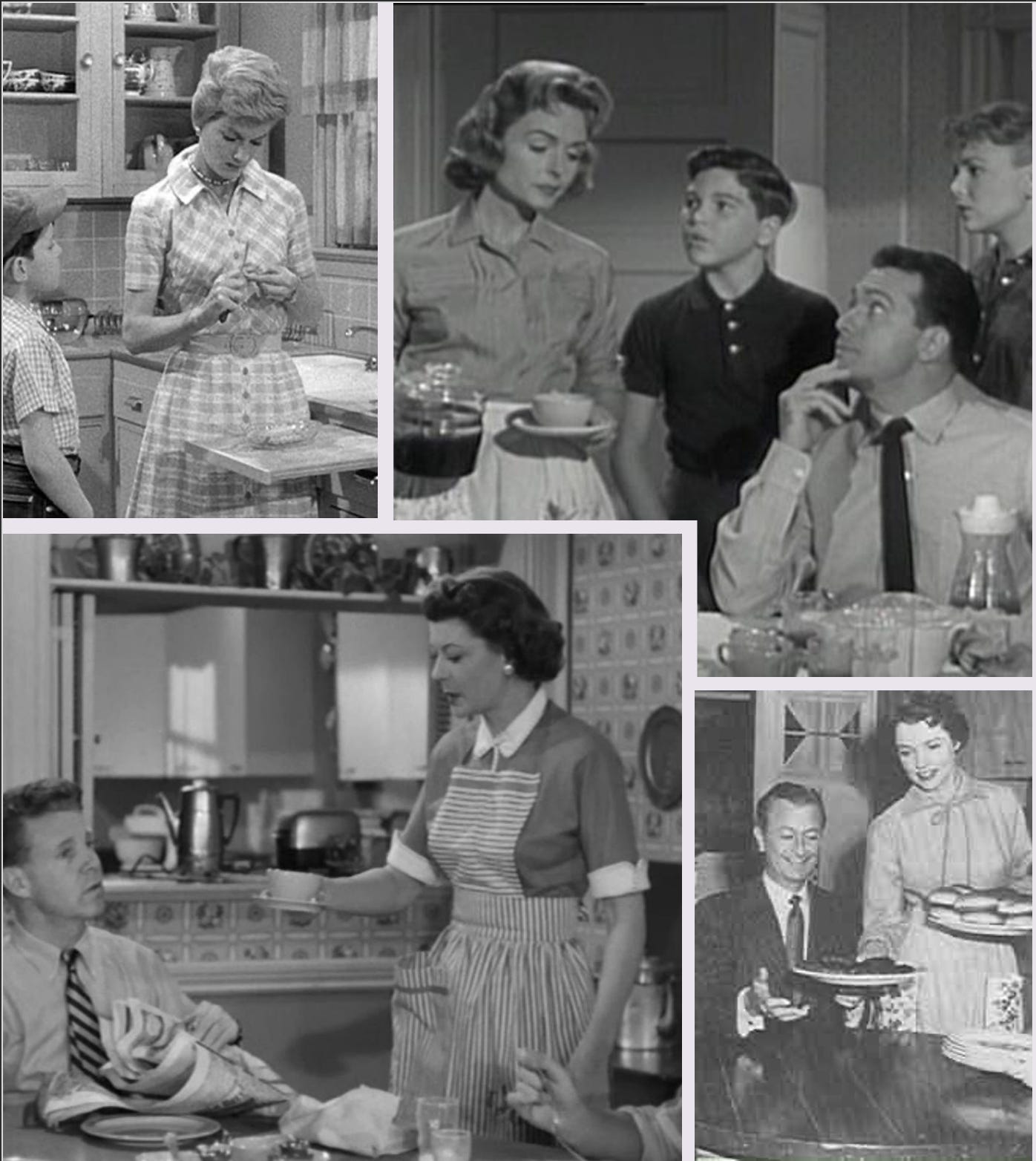
Their worlds were serene, middle-class, white, heterosexual, and usually insulated from the messier realities of the actual decade. The Cold War, racial segregation, labor conflict, queer repression, economic inequality, and women’s dissatisfaction did not disappear from America. They simply did not get invited into the Cleaver living room.
That is where the larger argument behind June Cleaver Must Die comes in. Postwar American media did not simply reflect American culture. It helped manufacture it. Television, advertising, magazines, films, domestic advice manuals, and political rhetoric all worked together to create a vision of gender, family, and national belonging that felt natural precisely because it was repeated so often. The idealized housewife was not merely discovered in the American home and then faithfully represented on screen. She was assembled, polished, marketed, sentimentalized, and sold back to the public as though she had been there all along, waiting patiently beside the casserole dish.
Some people were remarkably explicit about wanting exactly that. In the 1947 national bestseller Modern Woman: The Lost Sex1, Ferdinand Lundberg and Marynia F. Farnham argued that modern women were psychologically disordered by ambitions beyond wifehood and motherhood. They even advocated for “government and socially-minded organizations” to create “propaganda” making it clear that women pursuing anything other than motherhood and housewife status was “not generally desirable for women.” Which is one of those historical moments where the mask does not slip so much as fling itself into traffic. With the rise of postwar domestic sitcoms, Lundberg and Farnham essentially got what they wished for: a cultural machine that repeatedly presented domestic femininity as fulfillment and female ambition as confusion, selfishness, or comic disorder.
That is how common sense works. The most effective cultural messages rarely announce themselves as ideology. They appear as obvious truths. Everyone knows what a good wife looks like. Everyone knows what a normal family looks like. Everyone knows what kind of woman is admirable and what kind is ridiculous. These assumptions become powerful because they stop looking like assumptions. They become the background noise of everyday life. Or, in this case, the background laughter.
Once you start thinking about laugh tracks this way, the more interesting question is not whether they made jokes funnier. The more interesting question is what audiences were being invited to agree about. Sitcoms are never just collections of jokes. They are stories, and stories carry values. They tell us what kinds of people are reasonable, what kinds of conflicts matter, what kinds of behavior disrupt the social order, and what kinds of resolutions feel satisfying. The laugh track does not create those meanings by itself, but it helps guide viewers toward them. It marks the approved interpretation. It says, in effect, this is where we laugh.
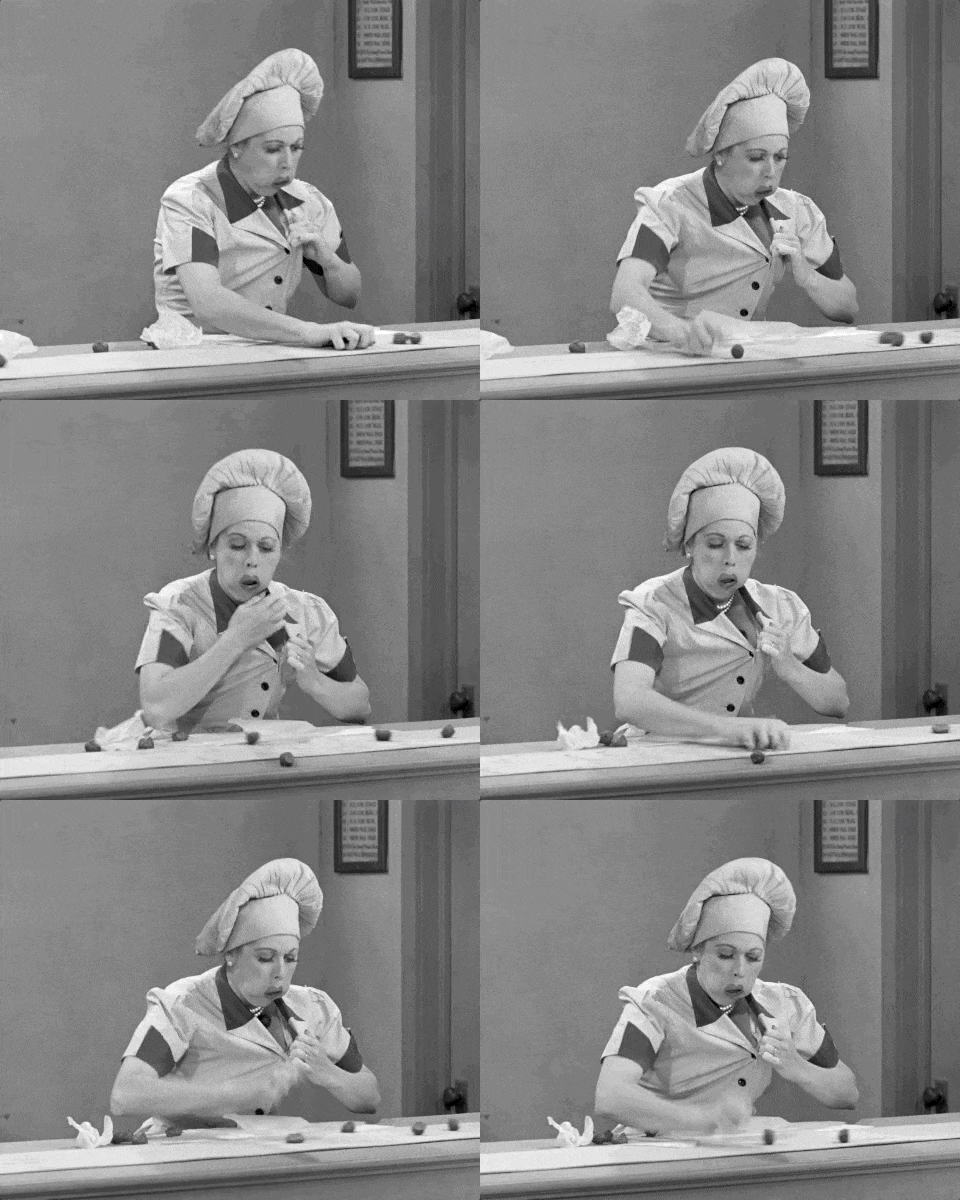
This brings us to Lucy Ricardo, who is useful precisely because she is so beloved. I love Lucy. Most people love Lucy. That is what makes her such a good example, because a feminist critique of television does not require us to pretend that beloved shows were secretly evil artifacts pulled from Satan’s prop closet. The point is not that I Love Lucy hated women or that viewers were wrong to enjoy it. The point is that the show repeatedly drew comedy from Lucy wanting something she was not supposed to want. She wanted to perform. She wanted recognition. She wanted adventure. She wanted access to opportunities that seemed routinely available to her husband. She wanted more than the role assigned to her, and the machinery of the sitcom turned that wanting into comic disruption.2
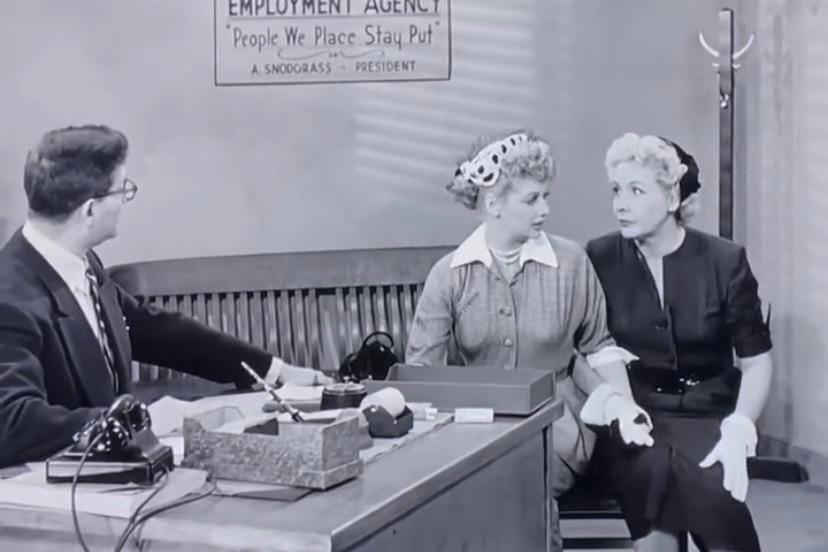
The pattern matters more than any single joke. Lucy schemes, reaches, dreams, disguises herself, inserts herself into public spaces, and tries to cross boundaries that domestic life has placed around her. Then everything falls apart. The audience laughs, Ricky scolds or reacts, the disruption is contained, and normality returns. Lucy is not framed as a villain. That would be too blunt and far less effective. She is framed as lovable, chaotic, excessive, and fundamentally disruptive. The laughter does not tell us she is bad. It tells us she has stepped outside the expected order of things, and that stepping outside can be enjoyed so long as the door closes again by the end of the episode.
Sometimes the lesson was subtler than that, and sometimes the script simply walked into the room, slapped the audience in the face with a gender role, and waited for applause.

In a second-season episode of Father Knows Best, Betty Anderson decides she wants to be an engineer and signs up for field experience. Her family mocks her choice throughout the episode, because apparently the idea of a young woman wanting to understand bridges or machinery was treated as less “promising career path” and more “urgent family emergency.” When Betty finally begins her training, the engineer in charge tells her that “the male has his job, the female has hers, don’t confuse them.” He even explains that although his mother votes, she does not go to the polls until after she has cooked her husband’s breakfast. Democracy, yes, but only after eggs.
This is not just an old sitcom being old. It is an unusually clear example of the cultural logic these programs often helped normalize. Betty’s ambition is not treated as an ordinary interest. It becomes the problem the episode has to manage. Her desire to enter a male-coded field is framed as confusion, disruption, and comedy before the domestic order can reassert itself.
The laugh track does not need to say, “Women should not be engineers.” The structure of the episode can do that work while laughter softens the edges. It becomes a joke, and jokes have a wonderful way of letting ideology walk around in public without showing identification.
You can see the same structure across a wide range of mid-century television. The ambitious woman, the dissatisfied wife, the woman who wants a career, the woman who wants sexual or social autonomy, the woman who refuses to remain gratefully contained within domestic life: again and again, these figures become sources of comic tension. They are not always condemned outright. They are often made funny, which can be a much more flexible and durable form of discipline. A society does not always need to outlaw a behavior if it can successfully make that behavior seem ridiculous.
Ridicule is one of the oldest tools of social control because it operates through embarrassment rather than force. People may defy a rule, challenge a law, or argue with authority, but nobody wants to become the joke. That is why comic humiliation matters. The sitcom did not need to punish nonconforming women with tragedy. It could punish them with laughter. It could turn ambition into overreach, dissatisfaction into nagging, intelligence into meddling, and independence into spectacle. Viewers did not have to leave an episode thinking, “I have been instructed in the proper boundaries of femininity.” They simply absorbed, week after week, the rhythm of what was treated as sensible and what was treated as absurd.
This is one reason television matters so much to the history of gender. When people imagine how societies maintain gender roles, they often picture politicians, religious leaders, legal systems, and formal institutions. Those absolutely matter. But culture matters too, and sometimes culture is more effective precisely because it feels less coercive. Advertisements sold products. Women’s magazines sold advice. Politicians sold nostalgia. Sitcoms sold normality. None of these needed to operate as part of some grand conspiracy. They only needed to share the same assumptions about family, gender, authority, and belonging. Over time, those assumptions reinforced one another until the argument disappeared and only the image remained.
That image has had a very long afterlife. The 1950s that appears in modern political rhetoric is rarely the actual decade. It is not the 1950s of segregation, McCarthyism, queer persecution, compulsory conformity, domestic dissatisfaction, tranquilizers, or women being told that ambition was a symptom of psychological disorder. It is the antiseptic television 1950s: the living room, the kitchen, the smiling wife, the wise father, the children learning lessons, the world restored before the credits roll. That is the version of the decade that nostalgia politics keeps trying to resurrect. Not history, exactly. More like a rerun with policy ambitions.
This distinction matters because nostalgia does not always mean people literally want to live in the past. People often want the feeling of the imagined past without the medical care, the laundry technology, the infant mortality, the legal inequality, or, in my personal nightmare, the historical underwear.
The problem is that modern right-wing nostalgia often turns that feeling into political demand. The fantasy becomes a governing project. The family sitcom becomes a policy mood board. When politicians, pundits, and influencers talk about returning to “traditional” family values, they are frequently invoking a version of the 1950s that owes more to June and Ward Cleaver than to the complicated lives of actual mid-century women. The soundstage becomes a historical source. The laugh track becomes evidence. The rerun becomes memory.
“The next conservatism includes ‘retroculture’: a conscious, deliberate recovery of the past.”
- Paul Weyrich and William Lind, The Next Conservatism
That is why the laugh track is worth taking seriously. It was never the architect of postwar American culture. It did not invent patriarchy, domesticity, or the housewife ideal. That would be giving a box of recorded chuckles far too much credit, and frankly, I refuse to let the Laff Box get that full of itself. But it was one small and revealing component of a larger system. It helped create the impression that certain reactions were shared, certain judgments were obvious, and certain social boundaries were already agreed upon. It was a tiny machine hidden inside the walls of the myth factory, reminding viewers every week that everyone else already knew what was funny.
The next time you watch an old sitcom, ignore the joke for a moment and listen to the audience instead. Ask who is being laughed at. Ask who gets to be sensible and who gets to be ridiculous. Ask whose desires create the conflict and whose desires represent the solution. Ask what kind of world is being constructed through those choices, and why it needed a fake crowd to help hold it together.
Because sometimes the most revealing character on television is not the husband, the wife, the boss, or the nosy neighbor. Sometimes it is the crowd that does not actually exist, laughing on cue, telling you that everyone else already agrees.
Whether they actually did is another matter entirely.
It always comes back to this fucking book. If I could travel back in time I would burn the manuscript.
A quick historical note: I Love Lucy was filmed before a live studio audience rather than using the fully artificial laugh tracks that became common in later sitcoms. That distinction is worth making, but it does not mean the laughter was entirely organic. Producers still used sound editing and enhancement to make sure the laughs were loud enough, clean enough, and placed effectively within the rhythm of the scene. Audience reactions could be edited, shaped, and occasionally “sweetened” in post-production, so even live laughter entered the finished episode through the machinery of television production.
One other very popular show, “The Honeymooners,” had a laugh track louder than most it seemed. Laughter as Ralph, oversized hard working put upon man, threatened his wife, fist raised, “to the moon Alice.” I hated the show. As a young child it made no sense. It was not funny.
Wonderful article Meredith. Thank you.
I want to read this book, so I hope someone with a brain realizes its potential 👏👏