
Some Viewers Are Bad at Watching TV. Others Are Worse at Watching Women Be Treated Humanely
The problem with this Pitt take is not just bad media criticism. It is what happens when trauma-informed care offends someone’s misogynist politics.

Sometimes you find a new archnemesis to add to your list on a quiet Friday night when you should have logged off the internet hours ago and gone to watch Noah Wyle be a nerdy librarian in a movie from 2004, but sadly, I have poor impulse control.
So instead, here we are dealing with an upsettingly bad take about The Pitt.

More specifically a bad take about the show’s sexual assault storyline in season 2. The complaint, roughly, is that the ER is usually chaotic and full of gallows humor, but then a sexual assault survivor arrives and suddenly everyone gets quiet, solemn, careful, and respectful. A private room appears. Professionals gather. Evidence is collected. The staff stop joking.
And apparently this is suspicious.
Which is a fascinating complaint, if by “fascinating” we mean “makes me want to walk directly into the sea.”
Because first of all, this is simply not how The Pitt works as a show.
This is not a zany medical comedy occasionally interrupted by overzealous feminist takes on female suffering.

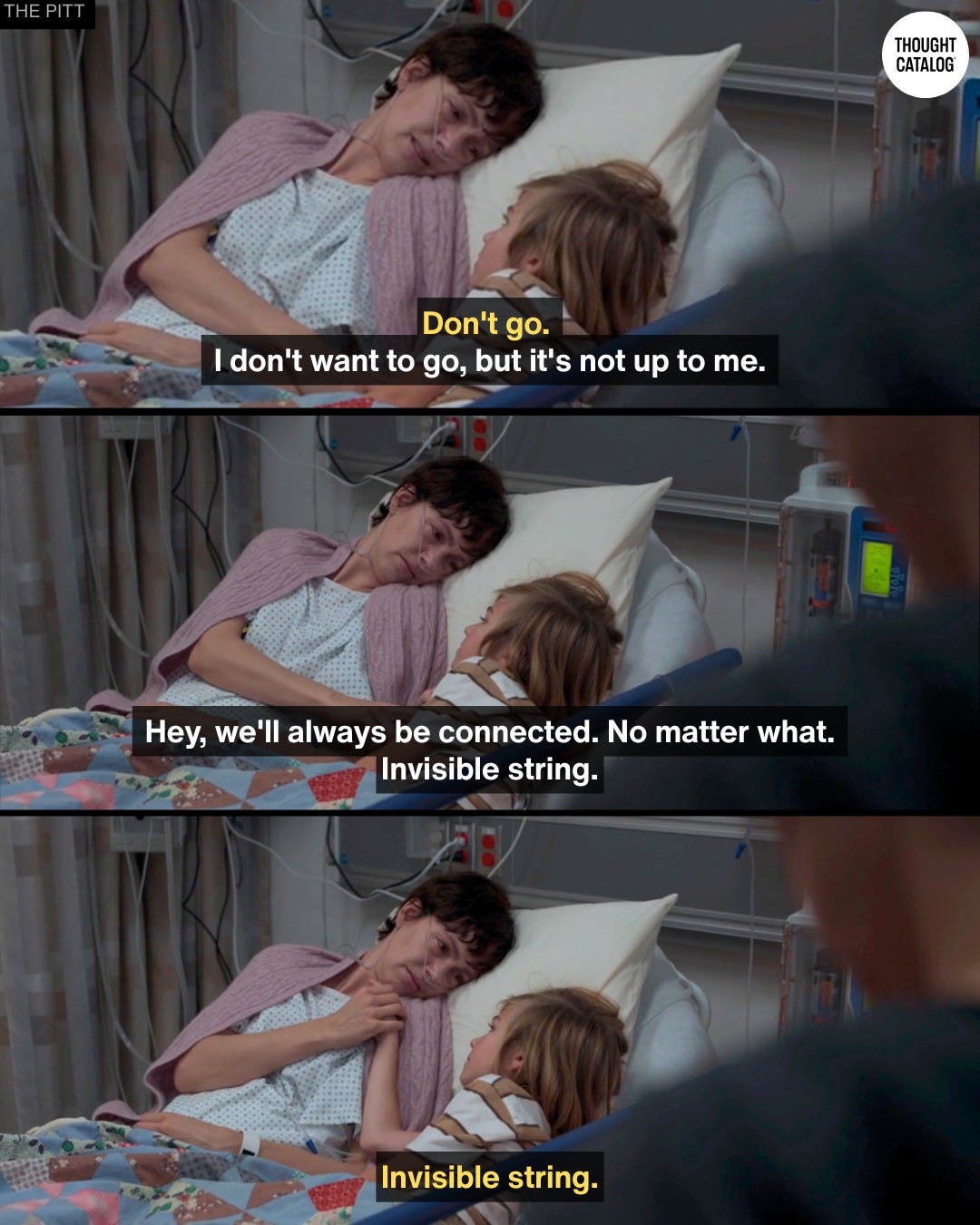
Across both seasons, The Pitt has repeatedly slowed down for devastating cases: a mother dying in agony from cancer while her husband and children prepare to lose her; a brain-dead young man after an overdose while his parents confront the death of their only child; an elderly father dying of pneumonia while his adult children stumble through grief.
This is not a happy, fun, jokey show. It is a show where jokes exist because the room is often unbearable without them.

So the idea that sexual assault is the only kind of suffering the show treats seriously is not just wrong. It requires watching the entire series with the interpretive skills of a damp napkin.
And apparently, this is becoming something of a trend.
As Chris Evangelista recently argued at SlashFilm, The Pitt has developed a fandom problem where some viewers appear to be bad at watching television. His point is that some viewers treat The Pitt like a mystery-box show, a puzzle to outsmart, or a narrative that owes them the version they personally assembled in their heads from social media dust bunnies.
But Bettina appears to be a different subspecies of bad-at-watching-TV.
She is not looking for hidden clues about who dies in the finale or whether the show is secretly foreshadowing some grand twist. She is watching The Pitt with a little anti-woman metal detector, sweeping it over the floor until it beeps near a sexual assault survivor receiving competent medical care.
And instead of asking, “What is the show doing here?” she seems to ask, “How can I turn this into evidence that women are being treated too delicately by society?”
Which is, frankly, an astonishing way to watch a show whose entire emotional architecture is built around the fact that medical emergencies are also human catastrophes. This is not subtle. The Pitt is not hiding its themes inside a puzzle box from Hellraiser. It is putting grief, pain, burnout, institutional collapse, and moral exhaustion directly under hospital lighting and saying: please observe the wreckage of the American healthcare system.
So yes, some people are bad at watching TV because they think every line is a clue.
Bettina is bad at watching TV because she saw trauma-informed care and thought, “Finally, a chance to complain that rape victims are getting too much attention.”
That is a gender grievance disguised as media criticism.
But even if we set aside the basic media literacy problem, the complaint gets worse when it sneers at the “private room, specialized lighting, and three dedicated professionals” involved in the exam.
Because this is where the mask slips a little.
What Bettina seems angry about is not really the lighting. It is not the room. It is not even the number of medical professionals.
What she seems angry about is the underlying premise that a woman whose body has been used against her will still has rights afterward.
The right to privacy.
The right to be believed enough to be treated with seriousness.
The right to have evidence collected carefully.
The right to say yes, no, wait, stop, I need a break.
The right to have the violation of her body treated as a medical emergency, not a social inconvenience.
The right to bodily autonomy, even after someone else has already decided her autonomy was optional.
That is the part that seems to offend her.
Not the realism. Not the tone. Not the alleged reverence.
The premise.
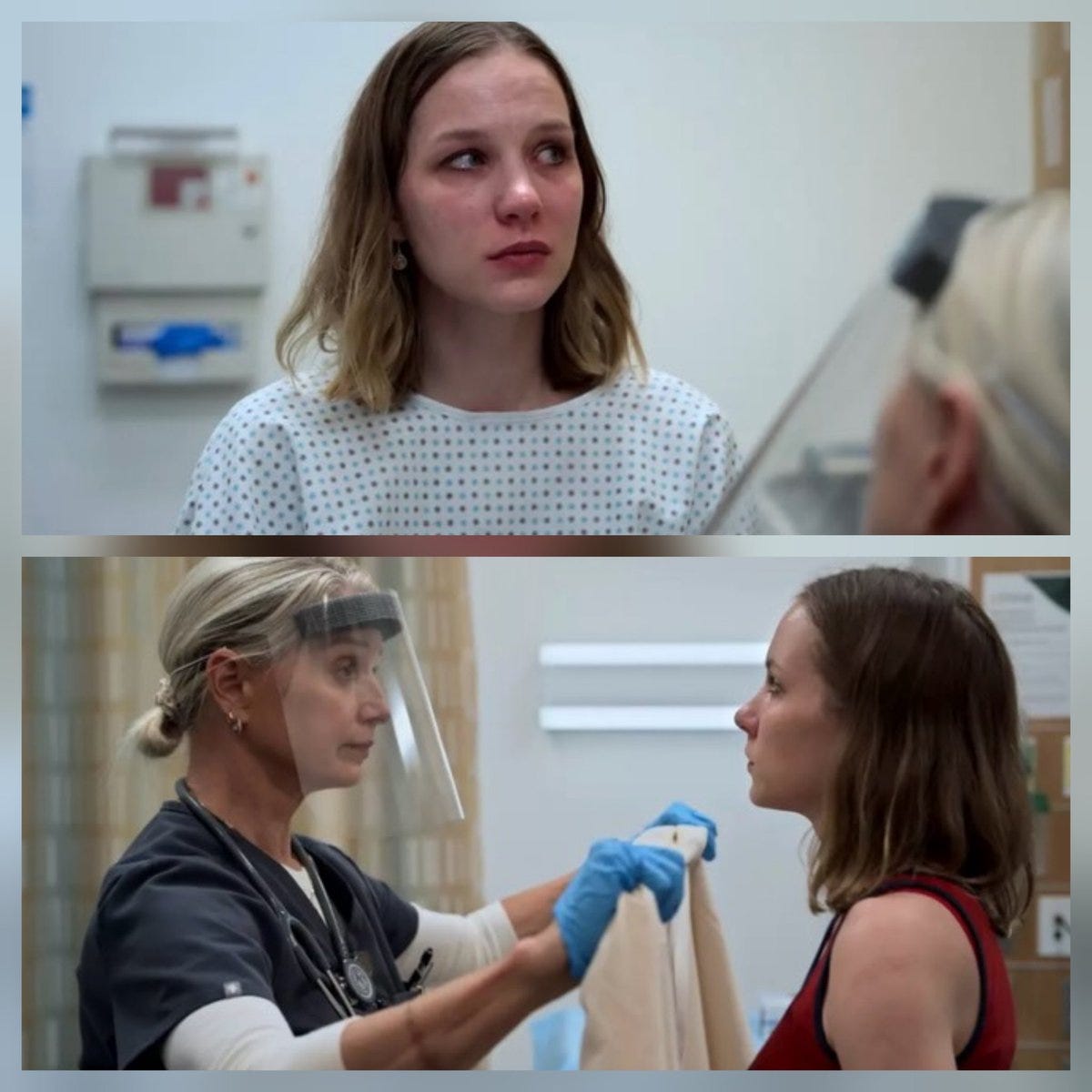
That a woman might say, “My body was used against my will,” and the correct response might be something other than suspicion, irritation, minimization, or a lecture about how emergency departments are busy.
That is what sexual assault forensic care is built around. The Department of Justice’s national protocol for sexual assault medical forensic exams says sexual assault patients deserve competent and compassionate medical forensic care, and it emphasizes informed consent, patient choice, and privacy throughout the process. The protocol also says patients may decline portions of the exam and that responders should seek a private, quiet setting for gathering information whenever possible.
So no, the private room is not narrative overindulgence.
It is part of restoring control to someone whose control was taken from her.
The Rape, Abuse & Incest National Network (RAINN) explains that a sexual assault forensic exam exists both to protect a survivor’s health and to preserve evidence. That evidence may include clothing, swabs, documentation, biological samples, containers, envelopes, and labels, all collected through a careful process that a survivor may choose even if she is not ready to report to police.
So when The Pitt gives Ilana privacy, time, explanations, medical attention, evidence collection, emergency contraception, STI prevention, and access to advocacy, it is not handing her a velvet fainting couch and a feminist gift basket.
It is showing the job. The job that SANE nurses and advocates do every day.
And the fact that this apparently reads as excessive to her tells us quite a lot about Bettina Arndt as a person.
Because if a sexual assault survivor receiving competent, consent-centered medical care looks like “too much,” then the actual objection is not realism.
The objection is bodily autonomy.
The objection is that a woman might get to say: something was done to me, it mattered, and I deserve to be treated like a human being while I decide what happens next.
Which brings us to the even uglier part of Arndt is so mad about this storyline: the apparent irritation that this was date rape, or acquaintance rape, or a rape committed by a male friend.
Because apparently, some people like Bettina Arndt are still clinging to the idea that rape only really counts when it happens in an alley, committed by a stranger, preferably with ominous lighting and no prior social context. Anything else becomes murky. Complicated. Debatable. Regrettable. A misunderstanding. A private matter. A “bad experience.”
Or, apparently, just something women should get over.
After all, what’s a little sexual assault between friends, right?
That sentence is vile. It is supposed to be vile. Typing it made me throw up a little in my mouth. It is also the logic under so many rape myths that it might as well have its own parking space at the patriarchy office.
The CDC (pre-Trump at least) states plainly that sexual violence is usually committed by someone the victim knows, including a friend, current or former intimate partner, coworker, neighbor, or family member.
RAINN’s perpetrator statistics make the same point: most rapes are committed by someone known to the victim, not by a stranger.
So this is not some special snowflake category of rape invented by feminists to ruin Bettina’s Sunday brunch.
It is normal. Not morally normal. Statistically normal.
Women are assaulted by men they know. Women are assaulted by men they trusted. Women are assaulted by men who had been welcomed into their social circles, homes, cars, bedrooms, friend groups, workplaces, families, and lives.
And then, far too often, those same women are asked to explain why they trusted him.
Why they were alone with him.
Why they drank with him.
Why they flirted.
Why they froze.
Why they did not scream.
Why they did not fight.
Why they did not immediately report.
Why they did not act like the version of a rape victim people have decided is believable.
Can you tell I am bitter as someone who was sexually assaulted by a “friend”?
Good.
Because I am.
And that bitterness is not a failure of objectivity. It is the residue of knowing exactly how this script works. A woman says someone she knew violated her, and suddenly everyone becomes an amateur philosopher of ambiguity. The conversation stops being about what was done to her and becomes about whether she has successfully performed victimhood to the satisfaction of spectators.
This is what makes The Pitt’s storyline important.
It does not make Ilana beg for the category of victim.
It does not force her to perform purity.
It does not turn her into a courtroom hypothetical.
It does not make the audience sit through a debate over whether being raped by a friend is really rape.
It treats the assault as rape because that is what it is.
The Los Angeles Times reported that the show’s writers and actors consulted experts from the UCLA Health Rape Treatment Center and Pittsburgh Action Against Rape to portray the exam accurately. The same article notes that a SANE consultant for the show wanted viewers to understand the extent of the exam, because many people misunderstand what the process entails.
That is not the show “changing the mood” for no reason.
That is the show depicting a different kind of emergency requiring a different kind of care.
And again, this should not be difficult. Sexual assault is not a broken wrist. It is not food poisoning. It is not a weird rash. It is a violation of bodily autonomy that may also require medical treatment, forensic documentation, STI prevention, pregnancy prevention, injury assessment, psychological support, and legal preservation of evidence.
Different emergency. Different care.
That is how medicine works. Hope that helps.
But Arndt’s framing repeatedly drags the focus away from Ilana’s body and toward the accused man’s future. The article’s most revealing phrase may be “Nail the bloke!” because it tells us where the sympathy has gone. The patient disappears. The rape disappears. The medical care disappears. Suddenly the story is not about a woman whose body was violated. It is about the poor man who might face consequences.
This is the emotional center of the piece.
His future.
His reputation.
His life.
His presumed vulnerability to the terrible machine of women being believed for approximately eight consecutive seconds.
And then comes the rhetorical move that tells you exactly what game we are playing: “regret sex.”
Not rape.
Not assault.
Not sex without consent.
Regret.
The oldest trick in the book: rename the violation until the victim sounds dramatic and the perpetrator sounds unlucky.
Bettina reaches for the language of alcohol, ambiguity, friendship, mistakes, and “misunderstandings between friends.”
But friendship is not consent.
Alcohol is not consent.
Social proximity is not consent.
And calling rape a misunderstanding between friends does not make the violence disappear. It just makes the woman carry it more quietly.
Which is, of course, the point.
What she seems angry about is not really the private room. It is the premise that a woman can say, “My body was used against my will,” and the appropriate response might be care rather than interrogation. She seems angry that date rape is treated as rape. Angry that a woman might not want a male friend to have sex with her. Angry that “he’s my friend” does not magically transform violation into unfortunate social awkwardness.
Being raped by someone you know does not make it less rape.
But it often makes it harder to name.
That is part of what The Pitt understands. Ilana’s hesitation is not weakness. It is not melodrama. It is not a failure to understand her own victimhood. It is a realistic depiction of what happens when someone has to decide, in the immediate aftermath of trauma, whether to enter a system that may expose her, doubt her, delay her, mishandle her evidence, or quietly discard her case into some institutional basement of indifference.
The carefulness is not reverence.
It is repair.
Not magical repair. Not cinematic repair. Just the smallest institutional attempt to say: your body is yours again, and this time no one touches it without asking.
That is why consent during the exam matters so much. A sexual assault forensic exam is not just evidence collection. It is evidence collection from the body of someone who has already had their boundaries violated. If the exam simply reproduces that loss of control, then the institution has failed before the paperwork is even finished.
The SANE protocol recognizes that. Consent is not a one-time signature at the beginning of the process. It is ongoing, flexible, and revocable. The patient can decline part of the exam. The patient can stop. The patient can ask questions. The patient can take breaks.
That is why the pacing, the private room, the lowered voices, and the explanations matter.
Not because rape survivors are delicate porcelain figurines.
Because they are people.
Because bodies are not public property.
Because a woman does not forfeit the right to bodily autonomy because the man who violated her was charming, familiar, socially adjacent, or invited to the same barbecue.
And because being friends with someone is not consent.
Let me say that again, because apparently we are still stuck in remedial humanity.
Being friends with someone is not consent.
And The Pitt knows that, too.
The storyline does not end with one compassionate exam and a triumphal swell of justice-flavored violins. It points toward the real-world problem of rape kits sitting untested, with the show invoking the broader institutional failure that often follows even when the exam itself is done properly.
That detail matters because it undercuts the fantasy that all a survivor needs is one good nurse, one private room, one brave moment, one completed kit.
And the most devastating part is that even when individual people do everything right, the institution can still fail.
That is what The Pitt is about. Not just in the sexual assault storyline, but across the show. It is about people trying to practice care inside systems that are too crowded, too exhausted, too underfunded, too bureaucratic, and too brittle to hold all the suffering pouring through the doors.
That is why the complaint that the mood changes is so revealing.
Of course the mood changes.
The mood changes when a mother is dying in front of her children.
The mood changes when parents are asked whether their brain-dead child’s organs can save someone else.
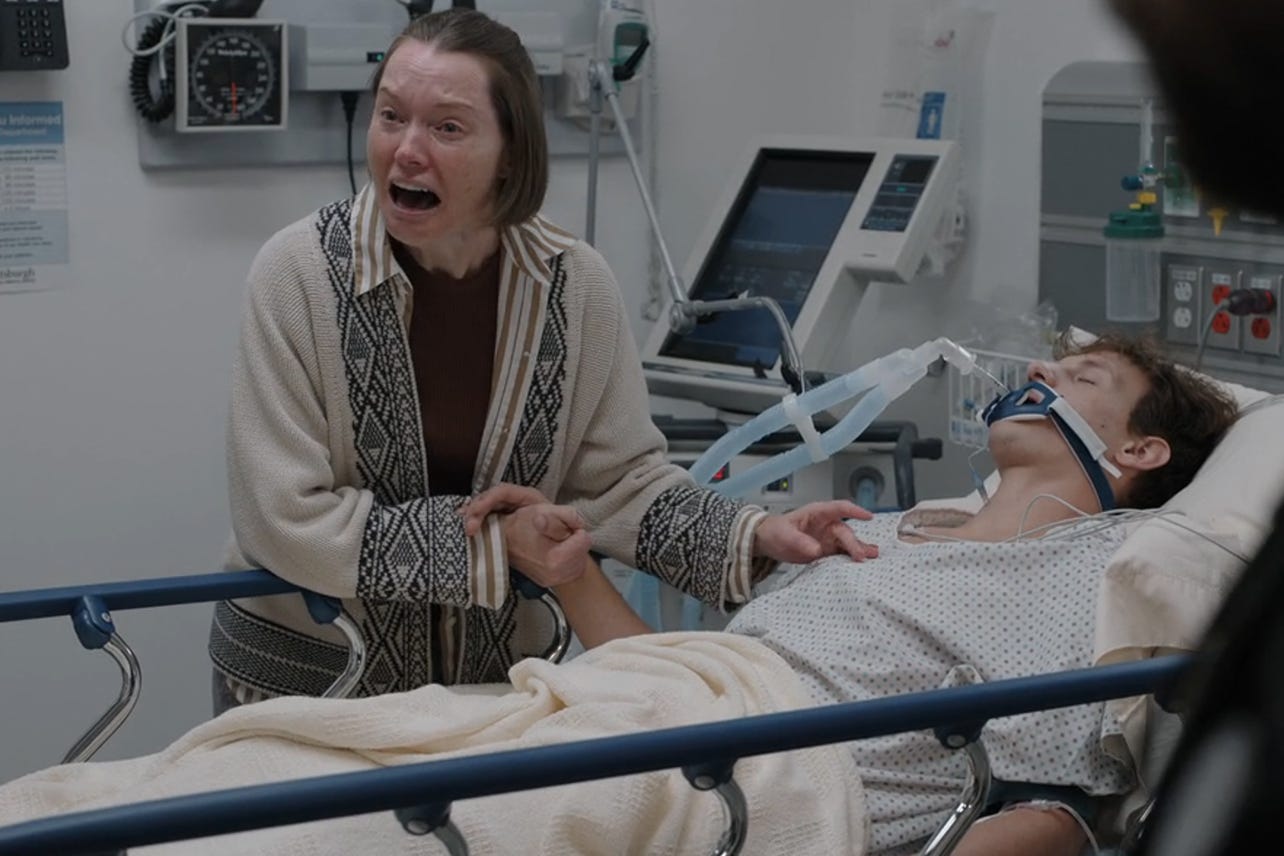
The mood changes when an elderly father’s children realize he’s not going to make it this time.
The mood changes when an Emergency Department is filled with incoming victims from a mass shooting.
The mood changes because human beings are not medical props. They are people. And sometimes the room has to recognize that.
Sexual assault does not require the same kind of care as a broken arm, a stomach bug, or an absurd foreign-object case destined for the ER gossip hall of fame. It requires medical care, forensic care, emotional support, consent-centered practice, and legal awareness. That is not The Pitt giving rape special treatment. It is the show refusing to treat rape like an inconvenience.
And that seems to be the actual offense.
The problem is not that the episode was unrealistic, or that the private room was impossible, or that the staff were too gentle. The problem is that The Pitt treated a sexual assault survivor seriously without first making her prove she deserved care. It showed care without suspicion. It treated her as a patient, not a morality test.
So no, The Pitt did not suddenly become solemn because a sexual assault survivor entered the ER. It became specific. It showed that rape is a medical event, a legal event, a bodily violation, a consent crisis, and often the beginning of a long negotiation with institutions that may or may not do their jobs.
It showed that privacy is not privilege. Slowness can be ethical. Asking permission matters. Date rape is rape.
And if someone sees a patient receiving privacy, advocacy, evidence collection, emergency contraception, STI prevention, and basic dignity and thinks, “Why is everyone being so dramatic?” then the problem is not with The Pitt. It is with a worldview that finds women’s pain believable only after it has been stripped of context, dignity, and rights.
Anti-woman rhetoric does not become more reasonable because a woman is delivering it.
That is what makes Bettina Arndt’s piece so grotesque. Every institutional kindness shown to a sexual assault survivor becomes suspicious. Privacy becomes indulgence. Consent-centered care becomes feminist preaching. A rape kit becomes moral theatre. A survivor saying her body was used against her will becomes, somehow, a threat to men.
This is not skepticism. It is not nuance. It is the same old bad-faith machinery, polished up and handed to us by a woman so it can pretend not to be misogyny.
And it is not exactly new territory for Bettina. SBS reported that sexual-assault survivor advocates objected to her Australia Day honour because the citation included her “Fake Rape Crisis” university speaking tour, and because she had called university sexual-assault prevention efforts a “rape crisis scare campaign.”
So this Pitt piece does not read like a one-off bad television take. It reads like the same project in miniature: find a story where a woman says she was violated, then redirect sympathy toward the man, the accusation, the ambiguity, the alleged overreaction, the danger of believing her too quickly.
Rename rape as “regret sex.” Rename trauma-informed care as feminist preaching. Rename privacy as privilege. Rename consent as confusion. Rename basic dignity as ideological capture.
At some point, we should stop pretending this is an argument and call it what it is: bad-faith hatred of women’s autonomy.
Because that is the rotten little center of the piece. It is not really about The Pitt. It is about the unbearable possibility that a woman might say, “My body was used against my will,” and someone might respond with care instead of cross-examination.
That is what Bettina Arndt objects to.
That is what The Pitt got right.
Resources
The Pitt’s Rape Kit Storyline Is a Quietly Revolutionary Depiction of Sexual Assault
How The Pitt portrayed a rape kit exam with the help of experts
A National Protocol for Sexual Assault Medical Forensic Examinations: Adults/Adolescents
National Intimate Partner and Sexual Violence Survey Report on Sexual Violence
Sexual assault survivor advocates outraged over Bettina Arndt’s Australia Day honour
Rape survivor urges Governor-General to cancel Bettina Arndt’s Australia Day award
I’ve always bristled at the “regret” sex argument. That scenario is only rendered possible if you have deep shame about the event and are trying to cover that up. They are the ones creating conditions of shame and sin. I’ve had regrettable sex but it was consensual. Since I think consenting adults can have sex when they want to even if they are unmarried, there’s no reason for further action. Clutch pearls here. The false allegation is very rare and the idea that you’d put yourself through an invasive exam just to screw some guy over is ridiculous and shows how much we hate women.
My rapist was a friend. I was 11. He was 14. I never told anyone until I was an adult.
I was assaulted by people known to me. Groped. Kissed non consensually. Coerced into uncomfortable situations.
In the dozen times over my lifetime (I’m now 52) only ONCE was a stranger.
A customer where I worked.
And I was fired for defending myself.
That episode had me in tears. Dana’s breakdown in the bathroom also showed just how much these cases affect the SANE nurses. This was an adult woman. Imagine these nurses having to do this with a child.
I can not imagine how anyone can see this as “feminist propaganda”.