
The Bride Fantasy Was the Propaganda. The Witch Soup Was the Truth.
What a thread about childhood make-believe reveals about gender, imagination, and the very suspicious myth that girls naturally dream in white lace.

Every so often the internet does something useful, by which I mean it accidentally produces a tiny archive of women admitting what they were really like as children.
This one started with a question about whether anyone else never pretended to be a bride as a little girl. The expected cultural script is obvious: little girls dream about weddings. Little girls wrap pillowcases around their heads like veils. Little girls practice walking down the aisle because, apparently, heterosexual matrimony is supposed to descend upon the female imagination sometime between learning to tie your shoes and developing opinions about horses.
And then the replies arrived.
“I made witch soups in my garden.”
“I literally pretended to be an assassin.”
“I pretended to be a horse, a knight, and Robin Hood. Not at the same time.”
“I was always in the ravines near my home pretending to be a sorceress or a warrior navigating tense politics between rival nations.”
“I used to play gender flipped Star Trek with my Barbies. Captain Jane Kirk and Ms. Spock!”
Reader, this is not a comment section. This is an feminist academic archive.
What appeared, almost immediately, was not a chorus of women confessing that they had somehow failed girlhood because they did not spend their childhoods rehearsing for David’s Bridal. It was a full parade of feral girlhood world-building: spies, witches, knights, survivalists, orphans, warriors, assassins, pioneers, Starfleet officers, political negotiators, and at least one child conducting what appears to have been a Barbie-based sacrificial religion in the backyard.1
So perhaps the real historical question is not, “Why didn’t some girls pretend to be brides?”
Perhaps the better question is: why were adults so invested in pretending that bride was the default setting?
Because the bride fantasy was the propaganda.
The witch soup was the reality.
Girlhood Was Never as Small as They Told Us
One of the most persistent lies about gender is that femininity reveals itself naturally through play. Girls play house because they are naturally domestic. Girls play with dolls because they are naturally maternal. Girls dream about weddings because they are naturally oriented toward marriage. Put a plastic baby in her arms and, allegedly, biology lights up like a Christmas tree.
But this is not how culture works. This is how culture hides its own fingerprints.
In Catherine Driscoll’s work on girlhood she treats “girlhood” not as a simple biological stage but as a cultural category, one shaped by psychology, education, media, consumer culture, and the marketplace of feminine expectation. In Girls: Feminine Adolescence in Popular Culture and Cultural Theory, Driscoll traces how modern culture made “the girl” increasingly visible while also surrounding her with theories, images, and markets that claimed to explain what she was and what she would become.
That matters because “the girl” is not simply discovered by culture. She is narrated by it.2
And one of the most durable narratives is this: girlhood is a waiting room for wifehood.
This is where the bride enters. The bride is not just a person getting married. She is one of the great symbolic endpoints of traditional femininity. The girl becomes the maiden, the maiden becomes the bride, the bride becomes the wife, the wife becomes the mother, and the whole thing gets presented as a soft-focus life cycle rather than an ideological conveyor belt.
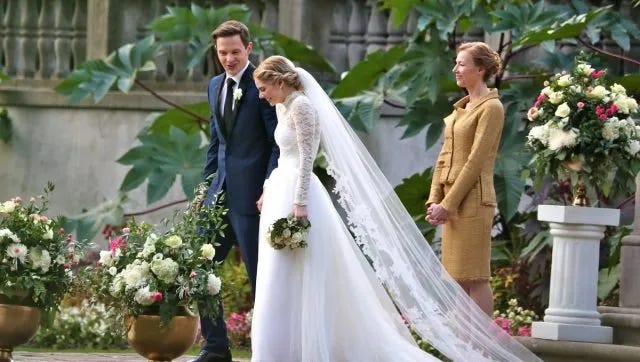
Driscoll even has a chapter titled “Becoming Bride,” which is almost too perfect. The bride, in this framework, is not merely a wedding figure. She is a cultural role through which feminine adolescence gets organized, aestheticized, and disciplined.
In other words, the question “You never pretended to be a bride?” is not neutral. It carries a whole worldview inside it.
It assumes that bridal fantasy is normal girlhood.
It assumes that girls naturally rehearse heterosexual domestic futures.
It assumes that a child who does not imagine herself chosen, displayed, admired, and ceremonially transferred into marriage is somehow unusual.
Meanwhile, half the replies are women saying, “Actually, I was in the yard making mud-based potions and preparing for siege conditions.”
Which, frankly, feels historically important.
Domestic Play Became Destiny. Everything Else Became “Kids Being Weird.”
The trick is not that girls never played bride, house, or mother. Of course some did. Plenty of children play domestic games because children use the materials around them to make meaning, and domestic life is one of the first worlds children observe.
Of course, when I and my friends got control of the playhouse at recess, I was always married to my wife (my best friend). Because even domestic play isn’t constrained by heterosexuality.
The trick is that adults have long interpreted domestic play as destiny while treating every other kind of play as temporary weirdness.
A girl pretends to be a bride, and adults say, “Look, she already knows.”
A girl pretends to be a mother, and adults say, “It’s instinct.”
A girl pretends to be a witch-priestess conducting Barbie sacrifices in a backyard altar system of unclear theological origin, and adults say, “Children are strange.”
But all play is strange. That is the point. Play is rehearsal, experimentation, mimicry, invention, and rebellion wearing a costume made out of whatever was in the closet.
Barrie Thorne’s Gender Play: Girls and Boys in School treats children not as passive recipients of gender but as active participants in making, negotiating, and sometimes disrupting it. Her ethnographic work looked at how children’s everyday social interactions shape gender identities, especially in classrooms and playgrounds.
Children do not simply receive gender like a package left on the porch. They open it, misread the instructions, trade parts with other children, and sometimes use the box as a spaceship.
That is what makes the replies so revealing. Girls were not just failing to absorb the bride script. They were actively producing other scripts.
The ravine became a geopolitical battlefield.
The closet became the setting for a rescue narrative.
The garden became a potion laboratory.
The Barbie collection became Star Trek, but corrected.
And yet when we talk about girlhood, adult culture keeps returning to the same narrow evidence: dolls, dresses, weddings, motherhood, nurturing, domesticity. Patriarchy grades on a curve. It notices the data points that confirm the conclusion and files the rest under “adorable nonsense.”
But the nonsense is where the truth leaks out.
Dolls Were Supposed to Teach Domesticity. Girls Had Other Plans.
This is where doll history becomes delicious.
Miriam Forman-Brunell’s Made to Play House: Dolls and the Commercialization of American Girlhood, 1830–1930 traces how dolls became tied to domesticity, maternity, materialism, and the toy industry’s effort to define proper American girlhood. The book’s description notes that dolls have often been perceived as symbols of domesticity and maternity, but Forman-Brunell shows that the history is more complicated than that.
That complication is the whole point.
Adults and industries handed girls dolls and imagined them rehearsing being tiny mothers. Girls received the dolls and, in several documented anecdotal cases, immediately formed religions, staged wars, invented dramas, conducted medical experiments, reenacted television shows with gender flipped characters, or removed the dolls’ heads for reasons known only to God and second-grade girls.3
Forman-Brunell’s broader work in doll studies emphasizes that dolls are not trivial. They are cultural objects, and their meanings are contested. In interviews about dolls and American girlhood, she describes how her research uncovered girls’ unconventional doll play and the ways girls both accepted and rejected dominant ideals of girlhood.
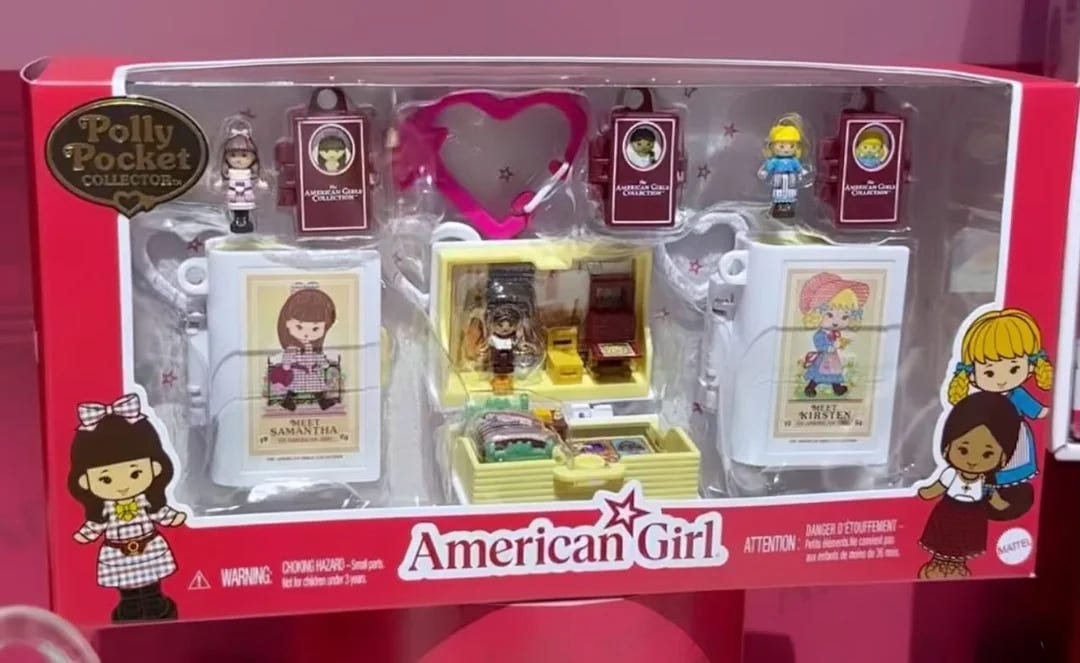
This matters because dolls are often treated as the smoking gun of natural femininity. See? Girls like dolls. Therefore girls are naturally maternal. Therefore women belong with children. Therefore the entire apparatus of gendered labor is just biology in a tiny bonnet.
Except, no.
A doll is not a destiny. A doll is a prop.
The meaning comes from the play.
One girl might rock a doll like a baby. Another might make the doll president. Another might cast the doll as Ms. Spock. Another might sacrifice the doll to the backyard powers, which I am not endorsing, but I am acknowledging as a bold rejection of domestic passivity.
The adult fantasy was that dolls trained girls for motherhood.
The girlhood reality was often that dolls became whatever the story required.
The Bride Waits at the Altar. The Witch Builds One.
This is why the “witch soup” comment is so perfect.
The witch soup is not just funny, although it is very funny. It is practically a thesis statement with mud in it.
The bride fantasy asks a girl to imagine being chosen.
The witch fantasy lets her imagine having power.
That distinction is everything.
The bride is looked at. The witch looks back.
The bride is arranged, dressed, presented, admired. The witch gathers ingredients. The bride walks toward an institution. The witch makes one in the yard out of leaves, dirt, flower petals, and a bowl she was absolutely not supposed to take outside.
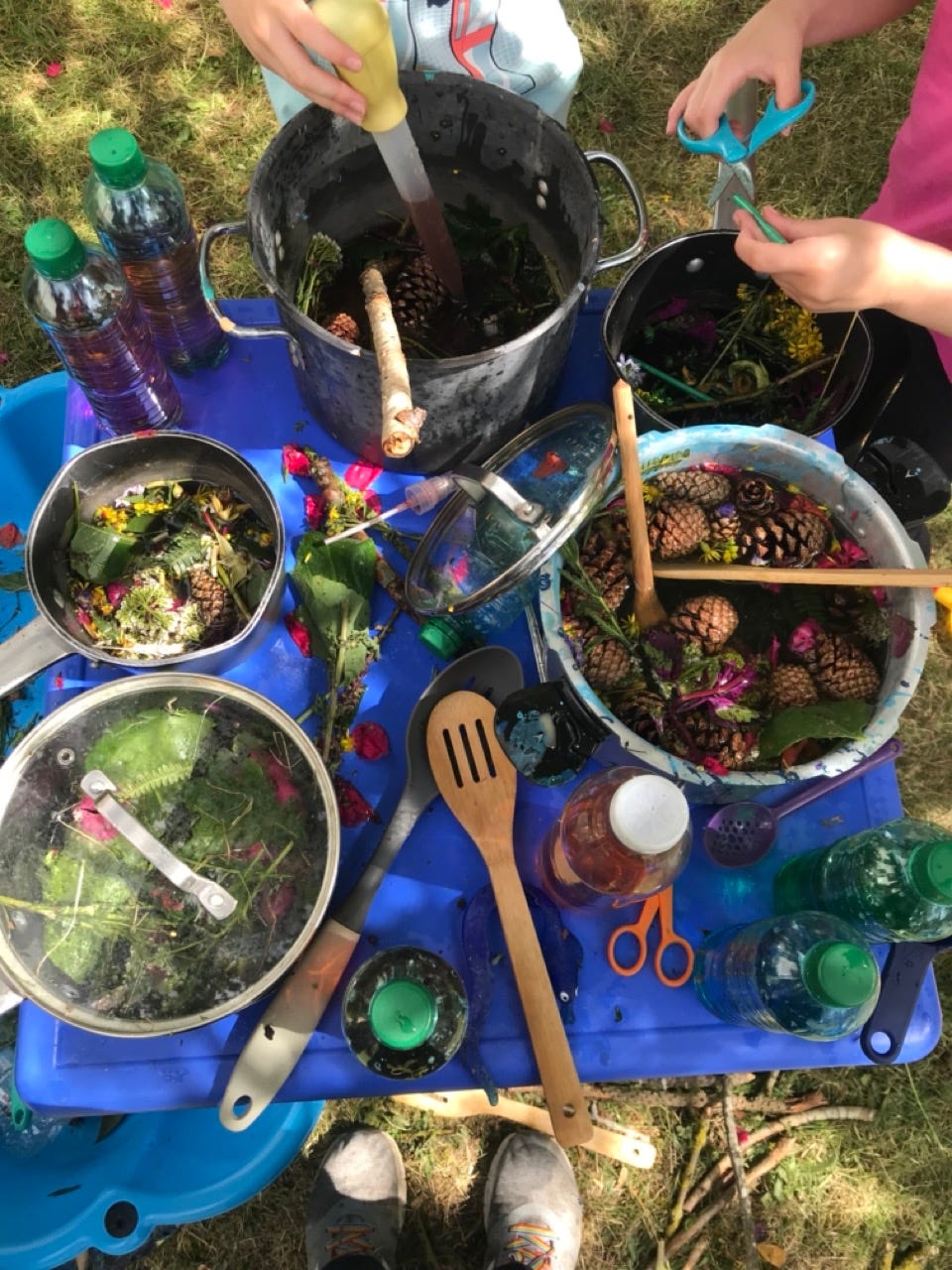
The bride is legitimate power, but only after it has been sanctioned by family, church, law, romance, and the approving gaze of everyone who wants femininity to behave itself.
The witch is unauthorized power.
She knows things she is not supposed to know. She touches what is messy. She makes things happen. She is suspicious, excessive, disruptive, and always one bad harvest away from being blamed for the village’s problems.
No wonder girls like her.
Contemporary scholarship on witches in girls’ and young adult literature often frames the witch as a figure of subversive or reclaimed power. Recent work on witches, gender, and identity in young adult literature argues that witch figures often allow teenage girls to reclaim forms of power historically associated with otherness, suspicion, and oppression.
That does not mean every child making garden soup was secretly doing feminist praxis. Sometimes children are just mixing grass and water and dirt because the forbidden texture compels them. But culturally, witch play gives girls access to something the bride script withholds: agency without permission.
The witch does not wait to be picked.
The witch does the picking herself.4
The Survival Girl Fantasy Was About Competence
Then there were the survival girls.
The Island of the Blue Dolphins girls. The Hatchet girls. The Boxcar Children girls. The My Side of the Mountain girls. The Little House on the Prairie girls. The girls making food stores, building imagined shelters, rationing supplies, preparing for winter, and turning childhood into a low-budget apocalypse drill.
I understand these children on a spiritual level.
I should probably confess something here: the Island of the Blue Dolphins girl was me.
Not literally, obviously. I was not stranded alone on an island off the coast of California with a pack of wild dogs, which is disappointing only in the sense that childhood me had absolutely considered the logistics. But I was one of those girls who read survival stories and absorbed them with the intensity of a religious text.
I did not just read Island of the Blue Dolphins. I mentally moved in.
I was fascinated by Karana’s competence. The food stores. The shelter. The weapons. The careful watching of the world around her. The way survival required attention, memory, patience, and skill. It was not enough to be brave in the abstract. You had to know things. You had to make things. You had to prepare.
And apparently, based on the replies to that thread, I was not alone.
A striking number of women remembered childhood fantasies that revolved around isolation and survival. Not just adventure. Not just “running away.” Survival. Building shelters. Storing food. Learning the woods. Pretending to be orphaned, shipwrecked, stranded, hidden, or otherwise forced into self-reliance.
There is something funny about that, in the way childhood is often funny because children are tiny goblins with elaborate contingency plans. But there is also something quietly devastating about it.
Because why did so many girls find those stories so magnetic? Especially when so many of them were written by male authors, about boys, for boys.
Why did so many of us fantasize not simply about adventure, but about preparedness?
Why did the idea of being alone and capable feel so powerful?
Part of the answer, I think, is that girls learn very early that the world is not necessarily built to help them. Not always consciously. Not in a fully articulated political theory with footnotes and a sensible bibliography. But children notice things. Girls notice who gets protected and who gets blamed. They notice who is expected to be careful. They notice who is told to watch their tone, their clothes, their bodies, their surroundings, their ambitions, their appetites, their anger.
They notice that “safety” often arrives as a list of things they should have done differently.
Don’t walk alone. Don’t dress like that. Don’t be rude. Don’t be too trusting. Don’t be too cold. Don’t be dramatic. Don’t make a scene. Don’t expect anyone to read your mind, but also don’t be too direct. Don’t get yourself into trouble. Don’t need too much saving.
At some point, even before we have the language for it, the lesson gets through: help may not arrive. And if it does, it may arrive late, judgmental, and carrying paperwork.
So the survival fantasy becomes more than a fantasy of escape. It becomes a fantasy of readiness.
There is something powerful about survival fiction when you are a girl. Not because being abandoned is fun. Not because starvation is whimsical. Not because every child yearns to be orphaned in the woods, although children’s literature has certainly tested that theory with commitment.
The appeal is competence.
Survival stories tell children, including girls, that fear does not make you helpless. You can learn the land. You can make tools. You can gather food. You can build shelter. You can observe, adapt, endure.
You can be alone and still be capable. Because if society isn’t going to protect you, at least you can learn to protect yourself.
That is a very different fantasy from the bridal one.
The bride fantasy is built around arrival: the ceremony, the dress, the gaze, the moment of being chosen.
The survival fantasy is built around process: preparation, knowledge, skill, improvisation, self-possession.
Karana was alone, but she was not helpless. That was the part that mattered. She knew where food came from. She knew how to make shelter. She knew how to defend herself. She grieved, adapted, observed, endured. Her isolation was frightening, yes, but it also stripped away the social noise. No one was telling her to be pleasing. No one was measuring her femininity. No one was asking whether she was pretty enough, agreeable enough, marriageable enough, soft enough, quiet enough.5
The question was simpler and harder: can you live?
For girls raised in cultures that often reward beauty, agreeableness, dependence, and being pleasing, competence can feel like contraband.
The publishing history of Island of the Blue Dolphins makes this even more interesting. Scott O’Dell’s novel, published in 1960 and awarded the Newbery Medal in 1961, centered Karana, a girl surviving alone on an island. Even basic accounts of the book’s background note that O’Dell faced resistance because a publisher thought the protagonist should be male.
Of course they did.
Adventure was supposed to be for boys. Survival was supposed to be for boys. Wilderness competence was supposed to be for boys. Girls could be brave, perhaps, but usually in support of someone else’s plot.
And yet girls found these stories and made them their own. They read survival fiction and then went into the yard to prepare food stores, as if suburbia might collapse by dinner.
This is ridiculous.
It is also revealing.
The comments were funny, yes, but they also showed how many girls were drawn to stories where the central emotional promise was not romance, beauty, or belonging. It was self-sufficiency. It was the possibility that if the structures failed, if the adults disappeared, if society turned out to be useless or hostile, you could still make a plan.
You could build the shelter.
You could store the food.
You could learn the landscape.
You could save yourself.
Maybe that is why so many of us remember those books so vividly. They did not just tell us we could be brave. They told us bravery was practical. Bravery had a pantry. Bravery knew how to make a spear. Bravery was not waiting around in white lace hoping the institution of marriage came with a rescue boat.6
The survival girl fantasy sits uneasily beside the bride fantasy because they offer completely different forms of selfhood.
The bride fantasy says: prepare to be chosen.
The survival fantasy says: prepare to survive whether or not anyone chooses you.
That is not a small difference.
Childhood me loved Island of the Blue Dolphins because Karana’s competence felt like freedom.
Adult me looks back and thinks: of course she did.
Of course a girl would be drawn to the fantasy of being able to rely on herself in a world that was already teaching her not to rely too much on anyone else.
Victorian Domesticity Tried Very Hard to Make This Not Happen
None of this is new. The effort to domesticate girlhood has a long, heavily upholstered history.
Victorian gender ideology sharpened separate spheres into a whole worldview. Men belonged to the public world of work, politics, competition, and empire. Women belonged to the private world of home, morality, piety, motherhood, and decorative emotional labor. Femininity was imagined as physically weak but morally superior, which is a very clever way to put women on a pedestal and then act shocked when they ask why the pedestal has no stairs.
The Victorian ideal did not simply say women were different from men. It built an entire social order around those differences.
Girls were trained accordingly. Their education often emphasized accomplishments, refinement, manners, beauty, and the skills that would make them suitable wives. Marriage was not simply one possible future. It was the central organizing expectation.
This is why the bride fantasy has such deep historical roots. It belongs to a much larger tradition of treating girls as future wives before they are allowed to be full people.
But even Victorian girlhood was not as obedient as the ideology wanted. Scholarship on Victorian doll stories has argued that doll narratives could present girlhood as a distinct stage of life marked by friction with adult expectations, rather than merely a smooth apprenticeship into domestic femininity.
In other words, even under the thick upholstery of Victorian domestic ideology, girlhood kept wriggling around underneath.
Because girls have always done this.
They take the available scripts and revise them. They take the doll and change the story. They take the dress and become a sorceress. They take the stick and become a knight. They take the ravine and invent foreign policy.
The culture says, “Here is how to become a lady.”
The girl says, “What if I become d’Artagnan?”
“Girls Naturally Like This” Is Usually Marketing Wearing a Lab Coat
One of the most annoying things about gender essentialism is how often it points to evidence that has been heavily manufactured and then calls it nature.
Girls like pink. Girls like dolls. Girls like weddings. Girls like princesses. Girls like domestic play. Therefore, femininity is innate.
But by the time a child can choose a toy, the world has already been shouting instructions at her through clothes, colors, cartoons, toy aisles, relatives, picture books, birthday cards, advertisements, and the quiet social punishment that follows any child who plays the “wrong” way.
Gendered toy marketing has been especially blatant about this. Recent work on gendered toy marketing notes that dolls marketed to girls often present idealized constructions of womanhood, including explicitly bridal and hyper-feminized versions of girlhood fantasy.
So when a girl chooses the bride doll, culture calls it instinct.
Historians call it a receipt.
This does not mean children have no preferences. It means preferences develop in a world already organized by gender. The question is not whether girls ever enjoy bridal play, domestic play, or dolls. The question is why those forms of play are treated as proof of nature, while all the witches, spies, survivalists, warriors, and tiny Starfleet officers are treated as exceptions.
That is the ideological sleight of hand.
Girlhood contains multitudes. Patriarchy highlights the ones that serve it.
What Gets Trained Out of Us
The most important thing is not to replace one essentialist story with another.
The argument is not that girls are naturally witches instead of brides, although this would make preschool graduations much more interesting.
The argument is that girlhood is capacious.
Girls can play bride, mother, knight, witch, horse, spy, pirate, astronaut, orphan, warrior, sorceress, farmer, captain, detective, and deeply underqualified cult leader. Sometimes in the same afternoon. Sometimes with the same doll. Sometimes while wearing a tutu and carrying a stick.
The damage comes when one script is rewarded as proper femininity and the others are treated as things girls are supposed to grow out of.
In later reflections on In a Different Voice, Carol Gilligan describes adolescence as a period where girls often confront a tension between human psychology and patriarchal culture, especially as they learn to subordinate their own desires, perceptions, and voices to preserve relationships or meet expectations.
That is where the narrowing happens.
Not always. Not completely. But often enough to feel familiar.
The girl who once made witch soup learns to be less strange.
The girl who played knight learns to be less loud.
The girl who made food stores learns to make herself smaller instead.
The girl who invented tense politics between rival nations learns that being “too much” is unattractive.
The girl who gender-flipped Star Trek with Barbies learns that rewriting the canon makes certain people very nervous.
The tragedy is not that some girls played bride.
The tragedy is how many girls were taught that bride was the only costume they were supposed to keep.
The Girl With the Stick Sword Was Telling the Truth
This is why that thread stayed with me.
Yes, it was funny. Children are bizarre little myth-making engines with poor safety standards. Given a robe, a stick, a bucket, and ten unsupervised minutes, a child can invent a religion, a monarchy, a hostage crisis, or a maritime supply chain.
But it was also evidence.
Evidence that girlhood imagination was never naturally small.
Evidence that many girls did not spend childhood rehearsing submission, romance, or domesticity.
Evidence that even when culture handed girls dolls, dresses, kitchens, and bridal scripts, girls frequently used them incorrectly, which is to say brilliantly.
Some girls did pretend to be brides. That is fine. But many of us were making witch soup. Some of us were building food stores. Some of us were hiding in closets with plastic buckets. Some of us were interrogating neighbors about whether they were Norman or Saxon. Some of us were playing Captain Jane Kirk and Ms. Spock with Barbies because apparently even at age seven we knew canon could use some help with representation.
And maybe that is the part of girlhood worth taking seriously.
Not the fantasy of being chosen.
The fantasy of becoming powerful enough to choose for ourselves.
I am scared and also intrigued about how I join this religion.
The same is true about “the boy,” but I’ve spent enough time on threads coddling the issues of how patriarchy messes up boyhood for this month.
I cut all the hair off multiple Barbies and gave them sharpie tattoos, like I was rehearsing to be an early 2000s grunge punk singer. I now own a tweed blazer and say things like “the hegemonic influence of…” unironically…I’m not sure if that means I was rehearsing my womanhood correctly or incorrectly.
Usually petals off the flowers in the front garden, which they are absolutely not supposed to touch, but young girls are feral and cannot be contained.
For the record, I hate how the book ends. Nothing hurt me more than reading “The dress reached from my throat to my feet and I did not like it, either the color of it or the way it scratched. It was also hot. But I smiled and put my cormorant skirt away in one of the baskets to wear when I got across the sea, sometime when the men were not around.”
That’s not the say I never liked Cinderella or Sleeping Beauty as a girl, I did. But I never lay in bed pretending I was Aurora waiting to be kissed, I was too busy mangling the bushes in the front yard for “survival supplies” and building shelters out of dead tree branches.
Goodness, I always thought that being a bride would be tbe most awkward and embarassing thing ever. I created a model riding school in my parents' attic with small plastic horses (all named, painted, height recorded with a scale model stick) and made stables, indoor arenas, jumping courses, etc.
As a girl I was always better at making emergency bug out kits for the alien invasion than a hope chest for my future marriage. In my adult life the emergency bug out kits knowledge has helped me plan ahead for just about anything. Never married, never plan to so the hope chest would have just sat there
Until I needed the linen sheets to make a rope or bandages.