
The Myth of Male Logic and Other Fairy Tales About History

I woke up to a comment this morning that was such a rage-inducing little artifact of the patriarchy that I briefly considered throwing my phone into the nearest body of water like an offering to the sirens of Greek mythology that drown men.
Context matters: this was under my episode about Quaker women being persecuted, jailed, beaten, and, in at least one famous case, hanged for the audacity of speaking publicly with conviction. Mary Dyer was executed in Boston in 1660 after repeatedly defying Massachusetts Bay’s anti-Quaker laws.
So, naturally, a guy heard “women punished by the state for having a voice” and decided the correct response was… nostalgia for the boot.
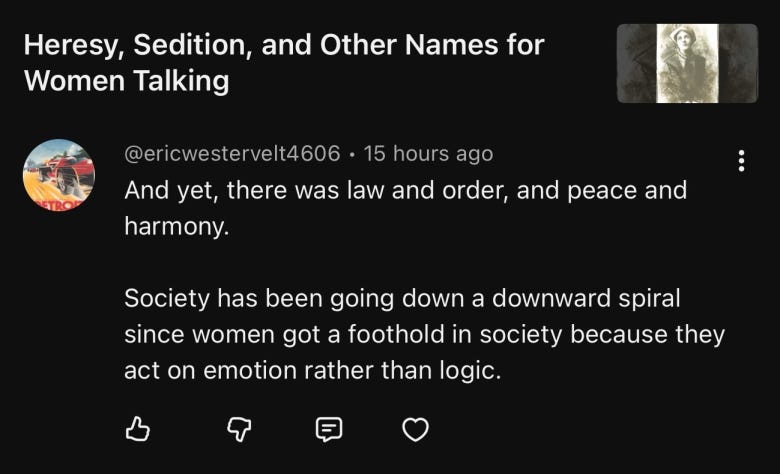
Ah yes. The ancient genre of historical analysis known as I miss when women were property and I didn’t have to compete.
Let’s take this apart, fairy-tale by fairy-tale, because the only thing more fragile than this argument is the ego it’s trying to protect.
Cool. So we’re doing the fairy tale where history used to be a calm, rational utopia run by Logical Men™, and then women got rights and everything went to hell.
Love that story. It’s not true, but it’s very comforting to the kind of man who mistakes “not being challenged” for “being correct.”
Let’s start with the biggest lie in the comment.
Fairy Tale #1: History Was Mostly Peace, Law, Order, and Harmony
It’s giving:
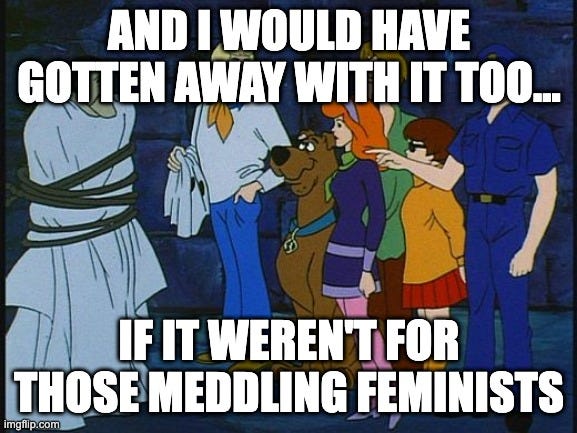
If history were mostly peace, law, and harmony, there would be no empires, no colonization, no transatlantic slavery, no religious wars, no forced labor systems, no mass conscription, no state terror, no pogroms, no genocides, no endless succession crises, no conquest-as-a-career path.
Instead, history is basically: men acquire power, do violence to keep it, write laws to sanctify it, and then call the result “order.”
This is the part that makes the “men are logical” claim so funny it becomes medically concerning. If men are the guardians of logic, why does the historical record look like a centuries-long bar fight where everyone brought flags and dick measuring tapes?
Fairy Tale #2: “Law and Order” Was a Neutral Good
“Law and order” is not a synonym for safety. It’s a slogan that usually means “the state will protect the hierarchy.”
Under English common law, coverture folded a married woman’s legal identity into her husband’s. Blackstone describes husband and wife as “one person in law,” with the wife’s legal existence “suspended” during marriage.
That isn’t “order” in the abstract. It’s order with a target.
Continental Europe wasn’t doing any better. The Napoleonic Code explicitly framed marriage as hierarchy: husband protection, wife obedience.
And yes, reforms recognizing married women’s independent property rights arrive late. The UK’s Married Women’s Property Act 1882 affirmed that married women could own and control property as their own.
So when someone says “we used to have law and order,” what they often mean is: the law made sure women stayed dependent and punishment was available if they didn’t.
Fairy Tale #3: The Past Was Harmonious Until Women Started Speaking
This one is especially grotesque given the comment’s placement under an episode about Quaker women.
Because the Quaker persecution story is a perfect reminder that “harmony” has often meant “women stay silent or suffer consequences.”
Mary Dyer’s execution in 1660 wasn’t a glitch in an otherwise peaceful system. It was the system functioning as designed: dissent punished, obedience enforced, women disciplined for public presence.
So no, I’m not taking “peace and harmony” lectures from someone who hears “women were hanged for speaking” and responds with nostalgia for the era’s supposed calm. That’s not calm. That’s coercion.
Fairy Tale #4: Women Are Emotional; Men Are Logical
This trope is patriarchy’s emotional support blanket. It lets men dismiss women without engaging what women say.
Historically, women’s distress and dissent were medicalized as pathology. The long, gendered history of “hysteria” is Exhibit A: women framed as irrational and unstable by default.
Modern scholarship describes “women are more emotional” as a powerful cultural assumption, a “master stereotype” that shapes perception. And research on emotional variability does not support the idea that women are uniquely volatile. University of Michigan reporting on this work notes that women are not more emotionally variable than men in the way stereotypes suggest.
But honestly, the historical record is already a complete rebuttal. Men have not been calmly piloting the ship of civilization with pure logic. Men have been lighting the ship on fire and calling it strategy.
The Moral of the Story: Mediocre Men Miss the Handicap
Here’s what that comment actually means when you scrape off the fake concern for “order”:
“I miss when women weren’t competition.”
Because when women gain rights, the playing field levels. And when the playing field levels, some men discover they are not “naturally superior.” They were just propped up by a system that made women legally smaller, economically dependent, and socially punishable.
So they call equality a “downward spiral.” They call women emotional. They call autonomy chaos. They call losing male default dominance “the death of peace.”
They’re not mourning history.
They’re mourning their own mediocrity.
If Your Golden Age Requires Women’s Subordination, It Wasn’t Golden
History was never mostly peace and harmony. It was hierarchy, violence, and power, often organized and enforced by men who then congratulated themselves for “civilization.”
And the “peaceful past” some men want back? It wasn’t peaceful. It was quieter, because women had fewer rights, fewer resources, fewer exit routes, and far more punishment for refusing the script.
If your “order” requires women’s obedience, legal erasure, and enforced silence, then what you want is not order.
It’s control.
And I’m not interested in resurrecting fairy tales that treat women’s subordination as a man’s happy ending.
Appreciate this ! I grew up with a father who pontificated about men being logical and women being emotional🙄
He even took it a step further, women are closer to animals, double eye roll