
The Patriarchy Has Crystals Now
New Age beliefs aren't outside the Patriarchy - Leaving one cage does not mean you stopped building others.

I recently posted what I thought was a fairly straightforward point: if femininity were natural, it would not need this many etiquette manuals. Or sermons. Or laws. Or men yelling on podcasts.
This should not have been controversial, but the internet is where nuance goes to die a gruesome death at the hands of wellness influencers and men with podcast mics, so naturally someone responded by explaining that all humans have “female energy” on the left side of the body and “male energy” on the right side. This, apparently, was meant to prove that I was wrong.
It did not.
It did, however, demonstrate the exact problem I was talking about. Because “female energy” and “male energy” may sound softer than “wives submit to your husbands,” but the structure underneath is often painfully familiar. Human traits are sorted into a masculine/feminine binary. That binary is treated as ancient, cosmic, natural, or spiritually obvious. Then people organize themselves around it and call the result balance.
That is not liberation. That is complementarianism with crystals.
And yes, I know. Some people will immediately insist that this is not what they mean. They will say everyone has both masculine and feminine energy. They will say this is about wholeness, not hierarchy. They will say this is ancient, not patriarchal. They will point to Reiki, acupuncture, Wicca, goddess worship, polarity, yin and yang, or whatever spiritual language happens to be nearest the incense holder.1
But the problem is not that people use metaphor. Humans use metaphor because we are meaning-making little goblins trying to survive consciousness. The problem is when metaphor gets mistaken for nature, and nature gets used to discipline people.
Once we start saying that softness, receptivity, intuition, emotionality, nurturing, surrender, fertility, and flow are “feminine,” while structure, action, logic, protection, discipline, penetration, and leadership are “masculine,” we are not outside patriarchy. We are giving patriarchy a moon phase calendar.
Oppression Is Not a Loyalty Program
That matters because rejecting one dominant narrative does not magically free someone from every other one.
Gay men can be misogynistic. Lesbians can have bizarre and rigid ideas about butch/butch relationships, femme legitimacy, gold-star purity, or who is “doing lesbianism correctly,” as though sexuality comes with a homeowner’s association. Queer people can be racist. Black people can be homophobic. Women can uphold patriarchy. Leftists can be sexist. Feminists can be transphobic. Religious trauma survivors can recreate authoritarian dynamics in secular spaces. And New Age, pagan, Wiccan, witchy, goddess-centered, spiritually deconstructed people can absolutely reproduce patriarchy.
Liberation in one area of your life is not a vaccine against domination in another.
That is annoying, because it means nobody gets to graduate from self-examination. There is no final boss battle where you defeat one oppressive system and receive a certificate declaring you Officially Free of Bullshit. Power is not that tidy. It gets into language. It gets into ritual. It gets into aesthetics. It gets into what we call natural, what we call sacred, what we call healing, and what we refuse to question because it makes us feel special.
This is why “but I’m not Christian” is not an accountability framework. It is a bumper sticker.
Leaving Church Does Not Mean Patriarchy Left You
Leaving evangelicalism, Catholicism, conservative religion, or any other patriarchal religious system can be profound. It can be life-saving. It can give people room to breathe after years of being spiritually waterboarded by purity culture, male authority, submission theology, and whatever fresh horror youth pastors were doing with duct tape and object lessons in 2004.2
But leaving organized religion does not automatically mean patriarchy left you. Sometimes it comes with you. Quietly. In the luggage.
A lot of people in New Age, pagan, Wiccan, and witchy spaces treat patriarchy as something that belongs to “organized religion,” especially Christianity. And listen, Christianity has absolutely earned its own haunted mansion of gender nonsense. I am not here to pretend otherwise. Christianity has been used to justify women’s subordination, control reproductive bodies, limit women’s authority, enforce marriage hierarchies, police sexuality, demonize queer people, and make entire generations of women believe that being exhausted, self-erased, and smiling through it was a divine calling.
But patriarchy is not denominational.
It is cultural. Legal. Economic. Political. Medical. Domestic. Sexual. Spiritual. Linguistic. It does not require a church building. It does not need a cross. It does not even need a male God, although that has certainly been convenient for patriarchal PR. Patriarchy can survive perfectly well in a coven, a retreat center, a yoga studio, a tarot reading, an astrology account, or a “feminine embodiment” course taught by someone charging $777 because apparently even enlightenment has surge pricing as long as they can market it as spiritually significant.
A person can reject “wives submit to your husbands” and still believe women need to “soften into their feminine.” A person can reject Father God and still reduce women to wombs, fertility, beauty, nurturing, emotional labor, and mystical receptivity. A person can reject biblical gender roles and then recreate those same roles through “divine masculine” and “divine feminine” discourse. A person can leave purity culture and then wander directly into polarity culture, where the language is different but the assignment is suspiciously familiar: men act, women receive; men lead, women surrender; men structure, women flow.

Complementarianism, But Make It Moonlit
Complementarianism, in its most basic form, is the idea that men and women are equal in worth but naturally designed for different roles. In conservative Christianity, that usually means men lead and women submit. Men protect, women nurture. Men are rational, women are relational. Men are built for authority, women are built for support. The rhetoric is usually wrapped in language about love, order, creation, design, and the beauty of difference, because patriarchy rarely walks into the room announcing, “Hello, I am here to restrict your autonomy.”
It prefers branding.
Now compare that with a lot of New Age gender language. Masculine energy is action, logic, direction, discipline, structure, protection, strength, focus, and leadership. Feminine energy is intuition, softness, receptivity, emotionality, sensuality, nurturing, flow, surrender, and healing.
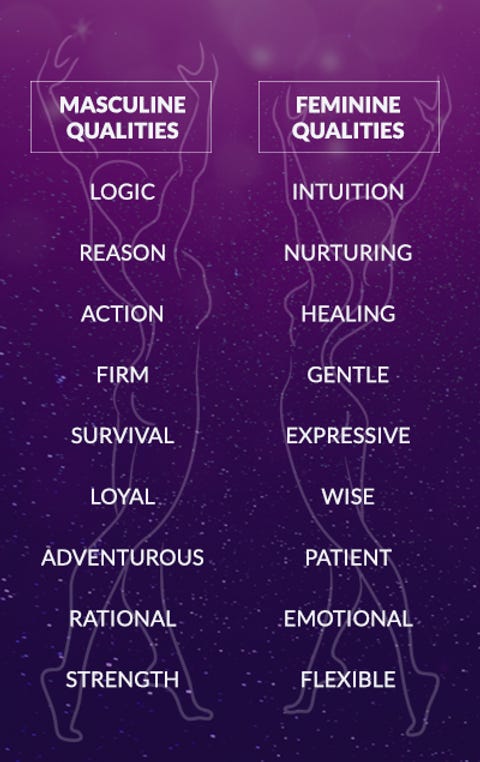
We are often told that these energies exist in everyone, which sounds expansive until you notice that the filing system has not changed. The same traits are still being sorted into the same binary. And once traits are sorted into masculine and feminine categories, those categories start doing social work. They tell people what is expected. They tell people what is natural. They tell people what is spiritually healthy. They tell people when they are out of alignment.
The moment someone tells a woman she is “too in her masculine” because she is ambitious, intellectual, assertive, angry, direct, skeptical, career-focused, sexually autonomous, or not interested in being a warm emotional marshmallow for everyone around her, we are no longer talking about balance. We are talking about gender discipline.
The binary always claims it is just organizing the closet. Then somehow men end up with the keys to the house.
Ancient Does Not Mean Liberated
One of the common defenses of masculine/feminine energy language is that it is ancient, as though “ancient” ends the conversation. It does not. Ancient does not mean liberatory. Ancient does not mean feminist. Ancient does not mean free from hierarchy. Ancient does not mean immune from critique. Child marriage is ancient. Slavery is ancient. Misogyny is ancient. Some very old things are also very bad ideas. Humanity did not wait until podcasts to invent nonsense.
As much as some people might like to claim, capitalism didn’t invite the flaws in humanity.
There is also a second problem: modern Western New Age culture often takes complex ideas from Asian, Indigenous, African diasporic, esoteric, and other religious or philosophical traditions, filters them through Western individualism, capitalism, self-help, and gender essentialism, then sells them back as “ancient wisdom.” So when someone says, “This is ancient,” the better questions are: ancient where, according to whom, translated by whom, interpreted through what assumptions, commercialized for what audience, and how did we get from a complex cosmology, medical system, ritual practice, or metaphysical framework to “women are soft and receptive, men are active and structured” on Instagram?
This matters because citing “ancient wisdom” can become a way to avoid responsibility for what a concept is doing now. Maybe a source tradition has a much richer understanding of balance, life force, embodiment, or polarity. Maybe it does not map neatly onto Western gender roles at all. Maybe the version currently circulating in wellness spaces has been stripped for parts and rebuilt into something that looks suspiciously like 1950s gender ideology in a recycled jar from Etsy.
This is not about dismissing every spiritual framework that uses duality, balance, polarity, or energy. It is about refusing to treat “old” as synonymous with “beyond patriarchy.”
Patriarchy is old, too. That is kind of the problem.
Wicca Was Not Born Outside History
This is where Wicca and modern paganism get especially interesting, because many of these traditions do have real feminist significance. Modern pagan and Wiccan communities have often offered alternatives to male-dominated religion. Goddess imagery can be powerful for people raised with an all-male God, male clergy, male prophets, male theologians, male church boards, male heads of households, and male podcast hosts explaining why women are happiest when they have fewer rights and more sourdough starter.
The presence of goddesses matters. Priestesses matter. Ritual authority for women matters. The sacredness of bodies, sexuality, nature, cycles, pleasure, and embodiment can be deeply meaningful for people harmed by Christian shame, purity culture, and the idea that bodies are basically sin machines with body hair.
But Wicca was not born in an untouched feminist meadow outside history.
Modern Wicca emerged in the twentieth-century West. It drew on occultism, ceremonial magic, folklore, Romantic3 claims about ancient witchcraft, ritual polarity, and the gender assumptions of its own time. That means patriarchy was already in the room. Probably holding a candle and explaining that actually the athame goes here because symbolism.
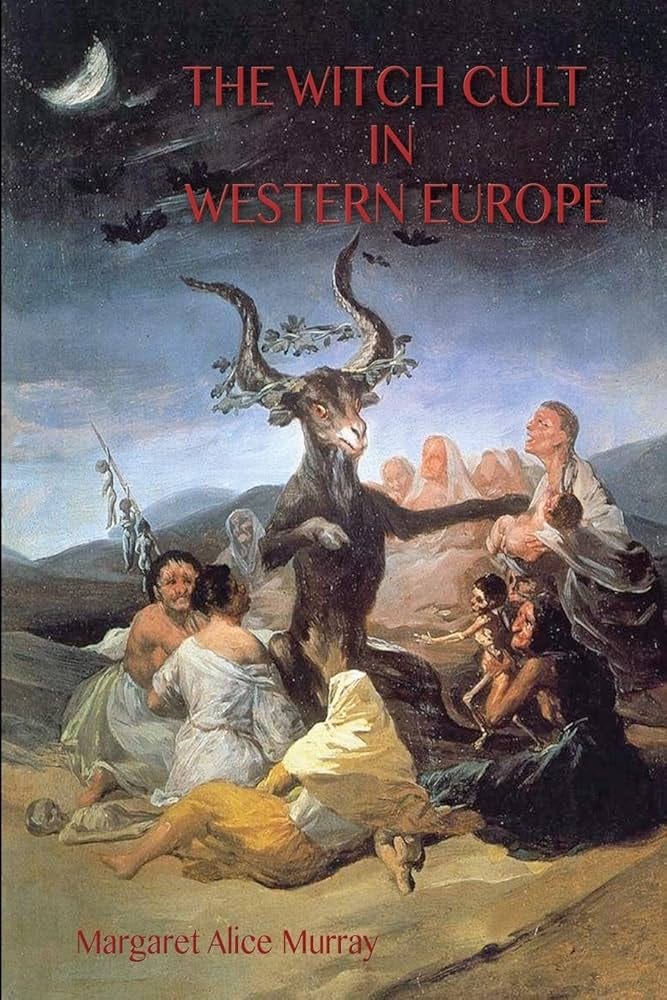
Gerald Gardner, often treated as a founding figure of modern Wicca, did not transmit some pristine, untouched, pre-patriarchal spiritual system. He created and compiled rituals within a specific historical context, drawing from earlier occult traditions, folklore, ceremonial magic, and his own imagination.
Doreen Valiente, one of the major figures in early Wicca, famously challenged parts of Gardner’s material, including the so-called Ardanes or “Old Laws,” which critics have long pointed to as containing authoritarian, patriarchal, and misogynistic elements.4
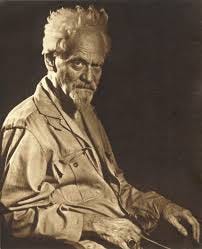
That matters because it shows the internal tension from the beginning. Wicca contains feminist possibilities and patriarchal residue at the same time.
That is not a contradiction. That is history.
Traditions are made by people. People carry assumptions. People argue. People revise. People resist. People inherit harmful ideas and sometimes sanctify them before realizing someone has put misogyny in the ritual text.
Feminist witchcraft and goddess spirituality did not simply emerge because paganism was automatically feminist. They emerged because women and queer people pushed, revised, challenged, created, and sometimes split off to build spaces that better reflected their politics. Starhawk’s The Spiral Dance became a major text in feminist spirituality and goddess-centered witchcraft because it offered a language of power, embodiment, ecology, and spirituality that many people found radically different from the religious worlds they had inherited.5 Zsuzsanna Budapest and Dianic Wicca represent another strand, one that centered women’s spirituality more explicitly, sometimes through separatist practice.6
That history is important. It is also complicated, because some “women’s mysteries” frameworks have excluded trans women or reduced womanhood to biology, menstruation, wombs, and reproductive capacity. Again, the point is not that Wicca or paganism is uniquely sexist. The point is that no tradition is outside history. A pentacle is not a force field against bigotry.
The Goddess Can Still Be a Cage
This is where goddess language can become both powerful and dangerous. For people raised in patriarchal religion, the Goddess can be a revelation. She can offer a way to imagine divinity beyond maleness. She can make the body sacred instead of shameful. She can give women and queer people spiritual authority in traditions that told them authority belonged elsewhere.
That matters.
But the Goddess can also become a pink prison.
If “the feminine” is always associated with fertility, menstruation, motherhood, softness, sensuality, intuition, receptivity, beauty, emotional wisdom, and healing others, then we have not escaped restrictive gender roles. We have made them sacred.
Not all women menstruate. Not all women can get pregnant. Not all women want children. Not all women are nurturing. Not all women are soft. Not all women are intuitive. Not all women are spiritually fulfilled by womb talk. Not everyone with a womb is a woman, and not every woman has a womb.
The moment womanhood gets collapsed into reproductive symbolism, we are back in the same ideological swamp as conservative religion. The signs are different, but the terrain is familiar: anatomy becomes destiny, biology becomes identity, and anyone who does not fit the model becomes an exception, a problem, or a footnote.
This is why some “divine feminine” discourse makes me want to walk directly into the sea.
It is not that feminine imagery is always bad. It is not that fertility symbolism is always oppressive. It is not that people cannot find meaning in cycles, bodies, goddesses, motherhood, menstruation, sexuality, or earth-based spirituality. The issue is what happens when these become the approved template for womanhood.
If your divine feminine requires a very specific relationship to wombs, softness, fertility, beauty, emotional labor, and service, congratulations. You have reinvented patriarchy in a flower crown.
Paternalism Without a Pulpit
Another mistake people make is assuming that because New Age and pagan spaces are often decentralized, they cannot reproduce the authority problems of organized religion. But power does not need a pulpit. Power can sit with coven leaders, gurus, teachers, retreat leaders, charismatic elders, male occult experts, authors, influencers, spiritual healers, and self-appointed guides who claim they are simply helping people access their truth.
Sometimes that help looks a lot like control.
Paternalism shows up when a male teacher claims he can initiate women into their feminine power. It shows up when a spiritual leader tells women their trauma is stored in their womb because apparently even pain needs a gender reveal party. It shows up when assertiveness is called blocked feminine energy, anger is called low vibration, boundaries are framed as fear, and skepticism is treated as spiritual resistance. It shows up when a woman’s illness, anxiety, infertility, pain, or trauma is treated as evidence that she is out of alignment with her natural feminine. It shows up when men position themselves as protectors, guides, warriors, guardians, or divine masculine containers for women’s softness, surrender, and healing.
I cannot stress this enough: a man calling his control “holding space” does not automatically make it less controlling.
Alternative spiritual communities can create the same conditions for manipulation as mainstream religious communities when authority is charismatic, accountability is weak, and critique is treated as spiritual failure. This is especially true in spaces where everything gets individualized. If every problem is a vibration, a manifestation, a karmic lesson, an energy blockage, or an unhealed feminine wound, then structural oppression disappears. Patriarchy becomes your personal homework assignment. Racism becomes a mindset problem. Trauma becomes a lesson you attracted. Poverty becomes scarcity thinking. Abuse becomes a failure to maintain energetic boundaries.
How convenient for power.
How absolutely delightful for every system that would prefer you blame your aura instead of asking who benefits.
Misogyny in Soft Lighting
Misogyny does not always look like open hatred of women. Sometimes it looks like praise. Women are natural healers. Women are more connected to the earth. Women are more intuitive. Women are life-givers. Women are softer. Women are meant to receive. Women are sacred.
That last one is especially slippery, because being told you are sacred can sound better than being told you are inferior. But sacred things are still often controlled. Sacred things are put on pedestals. Sacred things are guarded, protected, purified, interpreted, restricted, and punished when they fail to remain sacred in the approved way.
Women do not need to be sacred to deserve autonomy. We do not need to be goddesses to deserve rights. We do not need to be life-givers, healers, mothers, muses, priestesses, or embodiments of the earth to be fully human.
Misogyny is not only “I hate women.” Misogyny is the policing of women. It is punishing women who refuse the approved performance of womanhood. It is revering women when they are beautiful, nurturing, sexually available, emotionally useful, spiritually pure, or symbolically convenient, then turning on them when they become angry, intellectual, ambitious, skeptical, childfree, disabled, queer, trans, old, fat, loud, exhausted, or uninterested in being someone else’s healing journey.
That is why the language of “feminine energy” deserves scrutiny. When a woman is told she is “too masculine,” what that often means is: too direct, too ambitious, too rational, too angry, too independent, too defended, too unavailable for emotional extraction. And when a man is told to embrace his “divine masculine,” what often gets smuggled in is leadership, strength, protection, direction, authority, and sexual dominance.
This is not neutral. Binaries are rarely neutral. They almost always become hierarchies, even when they begin as poetry.
Nobody Gets a Free Pass
Now, this is where some people will get defensive and insist that paganism, Wicca, goddess spirituality, and New Age practices are still better than conservative Christianity. And maybe, in many cases, yes. In some ways, absolutely.
But “better than evangelical patriarchy” is not the finish line. That bar is on the floor. Possibly under the floor. Possibly in a church basement next to a purity ring display and a youth pastor with a guitar that he knows precisely three chords on.
The point is not that paganism is the enemy. The point is not that Wicca is bad. The point is not that goddess spirituality has no value. The point is not that every person who uses masculine/feminine symbolism is secretly auditioning for a job at Focus on the Family.
The point is that no community gets a free pass.
A community’s self-image is not the same thing as its politics.
A movement can challenge patriarchy in one breath and reproduce gender essentialism in the next. That is not hypocrisy unique to paganism. That is the general human condition.
What Accountability Actually Looks Like
So what do we do with all of this?
I am not saying everyone must immediately stop using every form of masculine/feminine language forever. I am a historian, not the gender police, and frankly the gender police already have too much funding. But I am saying we need to ask better questions.
When a spiritual framework uses masculine and feminine categories, we should ask what traits are being coded masculine or feminine, who benefits from that coding, who gets shamed by it, and whether the framework expands human possibility or shrinks it. We should ask whether it includes trans and nonbinary people as full participants, or only as awkward exceptions. We should ask whether it reduces women to wombs, cycles, fertility, softness, beauty, nurture, or care. We should ask whether it implies that assertiveness, rationality, leadership, anger, ambition, or structure are masculine. We should ask whether it makes trauma into a personal energy failure, whether it excuses male control as protection or guidance, and whether it challenges hierarchy or simply renames hierarchy “balance.”
Most importantly, we should ask whether the framework can survive critique.
Because if asking these questions is treated as negativity, blocked energy, masculine overthinking, lack of spiritual openness, or an attack on the sacred, then the problem is not the question. The problem is the system protecting itself.
Your Altar Is Not a Force Field
The issue was never that someone personally finds meaning in energy work, balance, embodiment, ritual, goddess worship, or alternative spirituality. People are allowed to find meaning. People are allowed to build rituals that help them survive. People are allowed to leave religions that harmed them and create new practices that feel more honest, more embodied, more beautiful, more alive.
I am not interested in ripping meaning away from people. I am interested in asking what that meaning is built on, who it serves, and who it leaves trapped in another supposedly natural role.
Because rejecting Christianity does not automatically free you from patriarchy. Rejecting organized religion does not automatically free you from hierarchy. Rejecting heterosexuality does not automatically free you from misogyny. Rejecting capitalism does not automatically free you from racism. Rejecting gender norms in one area does not mean you are not enforcing them somewhere else. And rejecting “dominant religion” does not mean your spiritual practice is automatically liberatory.
Patriarchy does not care whether you call it God’s design, natural polarity, divine balance, male and female energy, sacred masculine and feminine, or ancient wisdom. It only cares that you keep believing the roles are natural.
So yes, if femininity were natural, it would not need this many etiquette manuals. Or sermons. Or laws. Or men yelling on podcasts. And it would not need endless spiritual rebrands telling women to soften, surrender, receive, nurture, heal, flow, mother, bleed, birth, and embody the feminine while men get structure, action, logic, direction, and leadership.
That is not liberation.
That is the same old cage only now it comes with incense, shadow work, and quartz crystals.
The goal is not to replace Father God with Mother Goddess and call the work done. The goal is to stop mistaking hierarchy for harmony just because someone softened the lighting.
Your altar is not a force field. Patriarchy can walk through incense smoke just fine.
This is not to say that these concepts don’t have much more depth and meaning in their original concepts, but modern New Age practitioners often flatten complex non-Western religious concepts into pancakes for their own benefit.
THEY TAPED ME TO A WALL AND LEFT ME HANGING THERE. I’m not kidding. I’m still mad about it. It was weird. Let me be bitter.
And usually bullshit, do not start with me about Margaret Murray, we will be here all day and I’ll be cursing for most of it.
Don’t give her too much credit though, she was a member of several white nationalist far Right organizations in the 1970s.
It also contained a metric ton of historically inaccurate bullshit, but…
Unfortunately, both Budapest and Dianic Wicca also have a history of transphobia.
It's very interesting reading this from the perspective of a Christian who has left behind evangelical thinking. I was raised by a mother who was a strong feminist, and even though I spent over 20 years of my life inside conservative evangelical churches, there was a lot of sitting in my pew with my arms crossed, angrily listening to a sermon about gender and thinking, "What a load of bullshit!"
Having come out of that not entirely unaffected, I see the need to deprogram patriarchal thought patterns that creep into every corner of our society. You make it clear how difficult it can be though, because even outside of Christianity (and the New Testament especially is a lot more egalitarian than people give it credit), these patterns emerge time and time again in new guises. Sometimes attributing gender to even the supernatural (come on, the God of Abraham doesn’t have a body, so "he" certainly doesn't have a penis) can be more troublesome than useful to get a handle on spirituality.
Anyway, I continue to find your writing enlightening. Thank you.
Yes! Polarity culture - the binary plays into the oppression we are trying to overcome. Thank you for writing this. As a person who loves symbols, mysticism and yes, incense, I completely appreciated your take on this issue.