
The Perfect Woman Has No Body, No Rights, and Excellent Battery Life
Patriarchy keeps trying to invent the perfect woman, and now it’s calling her AI.

A British AI company recently ran an ad campaign that managed to compress several centuries of misogyny into a few cheerful marketing slogans. Narwhal Labs’ campaign for an “AI employee” featured a female figure alongside lines like “She outworks everyone” and, more to the point, “She’ll never ask for a raise.” It prompted complaints to the UK’s Advertising Standards Authority and criticism from labor and women’s rights groups, who correctly identified the whole thing as less “future of work” than “misogyny with a marketing budget.”
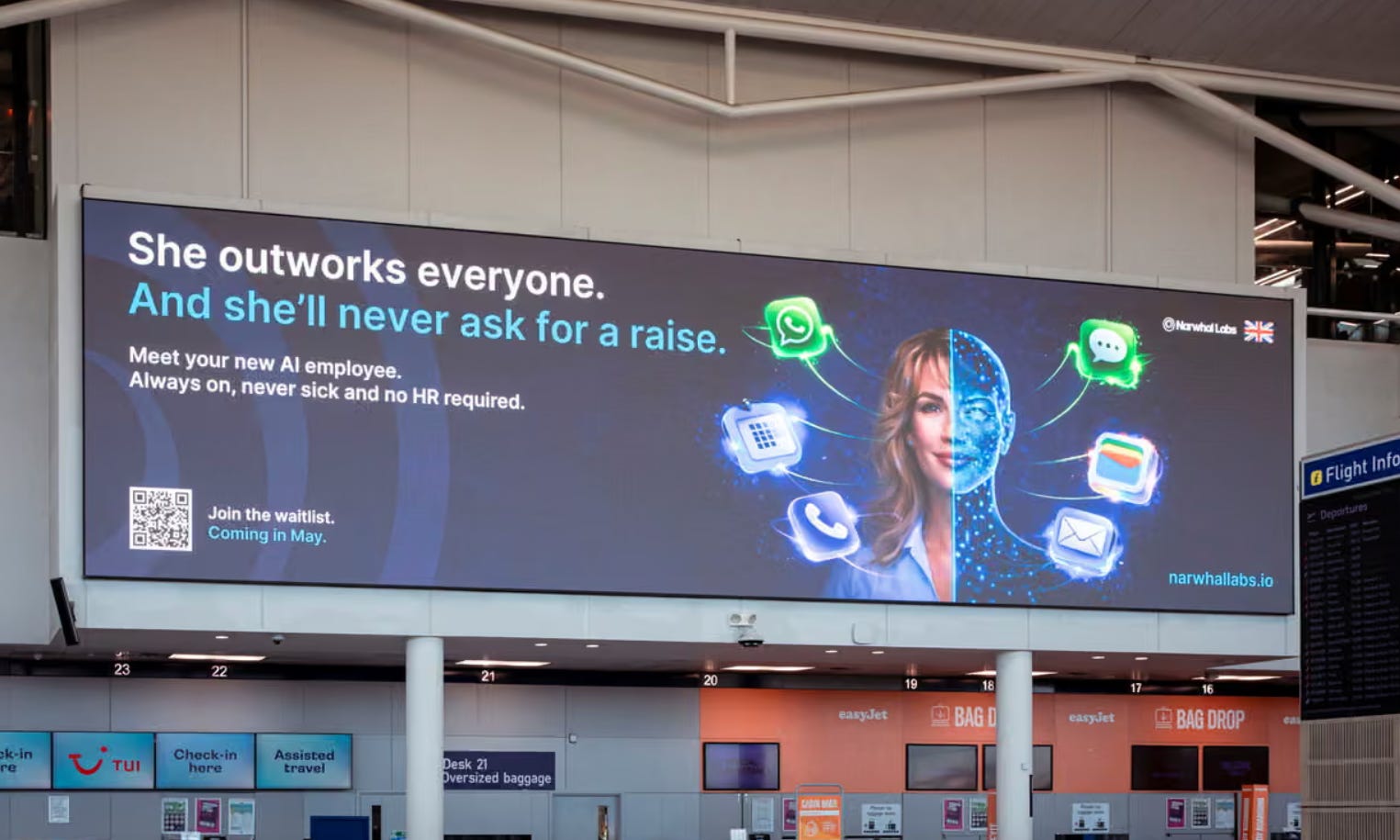
Which, points for honesty and clever wording on that one.
Because that ad did not invent anything new. It just said the quiet part loud.
For all the breathless talk about disruption, optimization, and innovation, what a lot of AI marketing is actually selling is a very old fantasy: a woman who works constantly, asks for nothing, soothes everyone around her, and never develops the inconvenient sense that she is a human being with needs. The fantasy is not intelligence. The fantasy is obedience.
Patriarchy keeps trying to invent the perfect woman, and now it’s calling her AI.
The thing about “ideal womanhood” in the historical imagination is that it was never only about beauty, virtue, or femininity in the abstract. It was always, at heart, a labor arrangement. Women were praised as morally superior, naturally nurturing, and uniquely suited to care for others, but those so-called compliments worked like handcuffs with lace trim. Even the gentler forms of sexism, the ones dressed up as reverence, still defined women by service, patience, and sacrifice. As one of my podcast episode puts it, women have long been both revered and demeaned at the same time, praised for special virtues that just so happen to keep them in subordinate roles.
The Victorian version of this was especially efficient in its hypocrisy. Men belonged to the public world of competition, commerce, and action. Women were assigned the domestic sphere, where they were expected to function as spiritual guardians, decorative proof of male success, and managers of the emotional climate. They were framed as physically weak but morally superior, too pure for public struggle and therefore perfectly suited to the endless unpaid labor of making private life possible.
In other words, the ideal woman was never just a person. She was infrastructure.
Once the twentieth century really got going, that arrangement did not disappear. It just changed outfits. The domestic servant became the typist, the secretary, the receptionist, the office wife, the girl Friday, the pleasant voice on the switchboard, the human buffer between the boss and the chaos of ordinary life. Women entered wage labor in larger numbers, but often in roles coded as support rather than authority. They organized, remembered, soothed, scheduled, transcribed, hosted, absorbed tension, and kept the whole machine from flying apart, while men continued to collect most of the titles, pay, and public credit. Even when industrialization and reform expanded women’s presence beyond the home, those older assumptions about usefulness, deference, and gendered service remained stubbornly intact.
Then came the great mid-century backlash, one of patriarchy’s all-time favorite sequels. After women proved beyond any reasonable argument that they could do industrial labor, military service, clerical work, and professional work at scale, postwar culture tried to shove them back into domesticity with the emotional subtlety of a falling piano. By the late 1940s and 1950s, American culture was busy insisting that women were fulfilled by housework, marriage, motherhood, and staying pleasantly out of the way. Betty Friedan would later call this “the feminine mystique,” but before Friedan named it, a whole apparatus of experts, magazines, advertisers, and moral scolds had already built it.
The backlash was not subtle. Modern Woman: The Lost Sex, a 1947 bestseller, argued that modern women were psychologically disordered, that women’s independence was socially destructive, and that working outside the home threatened proper family order. The message was simple: if women wanted too much, if they pursued achievement, if they did not gracefully disappear into service, something had gone wrong in their heads.
That is what makes the AI employee fantasy feel so familiar. It is not a rupture. It is a digitized update of an old patriarchal wish list.
Look at what is being promised. No illness. No childcare conflicts. No sick leave. No boundaries. No union. No harassment complaint. No burnout. No need for rest. No rent. No body. The AI woman is not simply efficient. She is frictionless. And “frictionless,” in labor terms, means stripped of personhood.
That is the real appeal. Not intelligence, but compliance. Not creativity, but availability. Not emancipation from drudgery, but the fantasy of extracting labor without having to negotiate with a laboring human being.
And when that fantasy gets coded as feminine, the whole thing becomes even more revealing. Because now we are not just automating work. We are automating a very specific idea of womanhood: cheerful, low-maintenance, always on, emotionally smoothing, and exempt from the kinds of rights that make exploitation more difficult. Tech did not invent that woman. It inherited her.
This is also why so many digital assistants, service bots, and AI interfaces feel woman-shaped even when nobody explicitly says so. Their work is to help, guide, reassure, and absorb frustration. They are sold as competent but never threatening, efficient but never domineering, available but never demanding. They do not merely perform tasks. They perform a social role women have been forced into for generations: the role of making life easier for other people while asking very little in return.
A lot of AI branding is less “future of intelligence” than “what if the office wife had been uploaded to the cloud and legally prevented from resenting you.”
And here is where the article gets darker, because this would already be ugly if it stopped at sexist marketing. It does not.
The same culture that keeps fantasizing about compliant synthetic women also keeps failing to clearly name misogyny when actual women are harmed by it. A major global media analysis published this week found that only 1.3% of all global online stories in 2025 referred to misogynistic abuse, the lowest level since 2017, despite the scale of violence against women and girls and the rise of AI-facilitated abuse. The study analyzed 1.14 billion articles over nine years and found a stunning absence of gender-based analysis even in coverage of major abuse scandals.
So on one side of the culture, we get obsessive, detailed, investor-friendly fantasies about the ideal woman as infinite labor source. On the other, when real women are threatened, silenced, deepfaked, stalked, or abused, public language suddenly develops a tragic case of passive voice. Images “circulate.” Abuse “sparks controversy.” Women “face backlash.” Harm “goes viral.” Somehow the sentence structure always seems to misplace the men, the systems, and the ideology doing the damage.
This is not just a stylistic problem. It is a political one.
UNESCO’s latest global survey found that 75% of surveyed women journalists experienced online violence while doing their jobs in 2025, up from 73% in 2020. Forty-two percent linked online attacks to offline abuse, harassment, or assault, more than double the 2020 level. Twenty-four percent of all respondents reported AI-assisted online violence, and among women journalists and media workers specifically, 19% reported it. UNESCO’s framing is blunt: online violence is increasingly spilling into the real world, and coordinated digital abuse is now a major barrier to women’s participation in journalism, public debate, and democratic life.
There it is. The same technological culture that sells the fantasy of woman-as-service is helping intensify the punishment of women who are too visible, too vocal, too opinionated, too present in public. The perfect woman is the one who helps you organize your inbox without ever developing class consciousness. The unacceptable woman is the one with a byline, a political opinion, or a body that refuses to stay inside the story patriarchy assigned her.
That is the throughline.
Patriarchy does not hate women because it finds them useless. Quite the opposite. It is obsessed with women’s usefulness. It wants women as workers, carers, emotional regulators, assistants, mothers, symbols, interfaces, fantasies, and support systems. What it resists is women as human beings. Women with agency. Women as people whose labor is not naturally available for extraction. Women as people whose pain is political, not incidental. Women as people who get to say no.
So yes, that AI ad was grotesque. But what made it striking was not its originality. It was its honesty. It took a fantasy that is usually wrapped in softer language, productivity, innovation, convenience, personalization, and laid it out in public where everyone could see it. A woman who works all the time, costs less, asks for nothing, and does not need rights. Some people heard “future of work.” The rest of us heard the housewife industrial complex booting back up with better graphics.
The future, it turns out, is not always new. Sometimes it is just patriarchy with a startup valuation.
I could have restacked so many parts of this but I didn’t want to be creepy 😂
Great great great piece!! And exactly why I started sharing all the BS I went through and named my book Yet Another Survivors Story. This is far far too common.
https://jmeleepharmd.substack.com/p/she-was-thirteen?r=76912d&utm_campaign=post&utm_medium=web
Sharing this for my work community so UX content strategy folx can add these concerns to our toolkit.