
The State Always Has an Opinion About Your Body
The Orville, Topa, and the Institutions That Decide Who Gets to Exist

To close out Pride month, have an essay based on a paper I wrote for my MA in gender studies, titled - Beyond “About a Girl”: Gender Governance, Institutional Recognition, and Topa’s Embodied Knowledge in The Orville
Science fiction is at its best when it takes a real-world horror, puts it in space, adds prosthetic foreheads, and then politely asks the audience: “Now that you are no longer defensive, can we talk about what this actually is?”
That is one of the things The Orville does surprisingly well. Yes, it is Seth MacFarlane’s loving, occasionally goofy, very obvious homage to Star Trek. Yes, sometimes the show is silly. Yes, sometimes the jokes make you feel like the writers’ room was briefly hijacked by someone’s divorced uncle. But when The Orville decides to go serious, it can go very serious. The Moclan arc, especially Topa’s story, is one of the clearest examples.
On the surface, Topa’s story is about gender. More specifically, it is about a child born female in a society that insists it is entirely male. But the story becomes much more than a “prejudice is bad” episode, or even a straightforward trans allegory, though that reading is present and clearly part of the writers’ intent. What makes the arc interesting is that The Orville does not leave gender in the realm of personal identity. It drags medicine, law, family, culture, diplomacy, military alliances, and state violence into the room and says: everyone show your hands.
And everyone’s hands are filthy.
Topa is the child of Bortus and Klyden, a Moclan couple serving aboard the USS Orville.
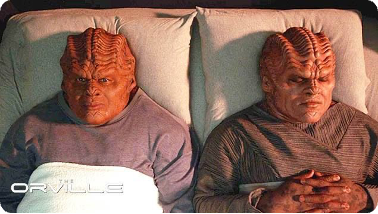
The Moclans are one of the Planetary Union’s most important military allies, supposedly a single gender society, but actually built around denying that female births are less rare than they claim. When Bortus and Klyden’s child is born female in the episode “About a Girl,” the question immediately becomes whether the baby should undergo a procedure to be surgically altered to male according to Moclan custom.
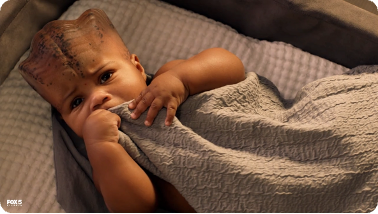
Already, we are in nightmare territory. But the show is not just asking, “Should this happen?” It is asking, “Who gets to decide what this child is?” Parents? Doctors? Courts? Culture? The state? The military alliance that depends on Moclan weapons? The answer, apparently, is “all of the above,” which is precisely the problem.
The line that really gives the whole game away comes early, when Bortus explains that he and Klyden want the procedure performed “to conform our child.”
Not heal. Not protect. Not treat.
Conform.
That word is doing the kind of work graduate students usually need three theorists and a stress migraine to explain. Because “conform” is not medical language. It is social language. It tells us that the problem is not Topa’s body. The problem is that Topa’s body does not fit the world Moclan society has built.
This is where the show moves from “space gender episode” into “oh good, the institutions are here to ruin everything.” Dr. Claire Finn refuses to perform the procedure because Topa is a healthy newborn. From Finn’s perspective, there is no illness to treat. But Moclan society has already defined femaleness itself as the problem. Medicine becomes the first battleground, but it is not the only one. When Dr. Finn refuses, the conflict moves to law.
And law, as usual, arrives wearing a serious outfit and pretending it is neutral.
The Moclan tribunal is one of the most important parts of “About a Girl” because it makes the social threat explicit. The argument for the procedure is not only that femaleness is considered biologically undesirable. It is that Topa will be condemned to social exclusion if she remains female. The prosecutor makes it clear that a female Moclan child would face shame, disgust, and isolation. In other words, Moclan society will make her life unlivable, and then uses that unlivability as the argument for surgery.
That is the entire patriarchal scam in one elegant little courtroom package.
The violence of the procedure is disguised as protection from the violence of the society demanding it.
This is why Topa’s story is not just about individual prejudice. It is about governance. Gender is not simply something Moclan society believes. It is something Moclan society administers. It has doctors. It has courts. It has family rituals. It has cultural myths. It has state secrecy. It has diplomatic consequences. It has, because science fiction refuses to be subtle when it is really cooking, black sites.
The first episode frames female Moclan birth as rare, almost a biological fluke. That matters. If Topa is an exception, then Moclan society does not have to interrogate itself. Exceptions can be corrected. Exceptions can be explained away. Exceptions do not threaten the structure.
But then “Sanctuary” happens.
In “Sanctuary,” the Orville crew discovers a hidden colony of female Moclans. Suddenly, the official story collapses. Female Moclans are not nearly as rare as Moclan society claims. They have been hidden, altered, exiled, or erased. Topa is no longer just an exception. Topa is evidence.
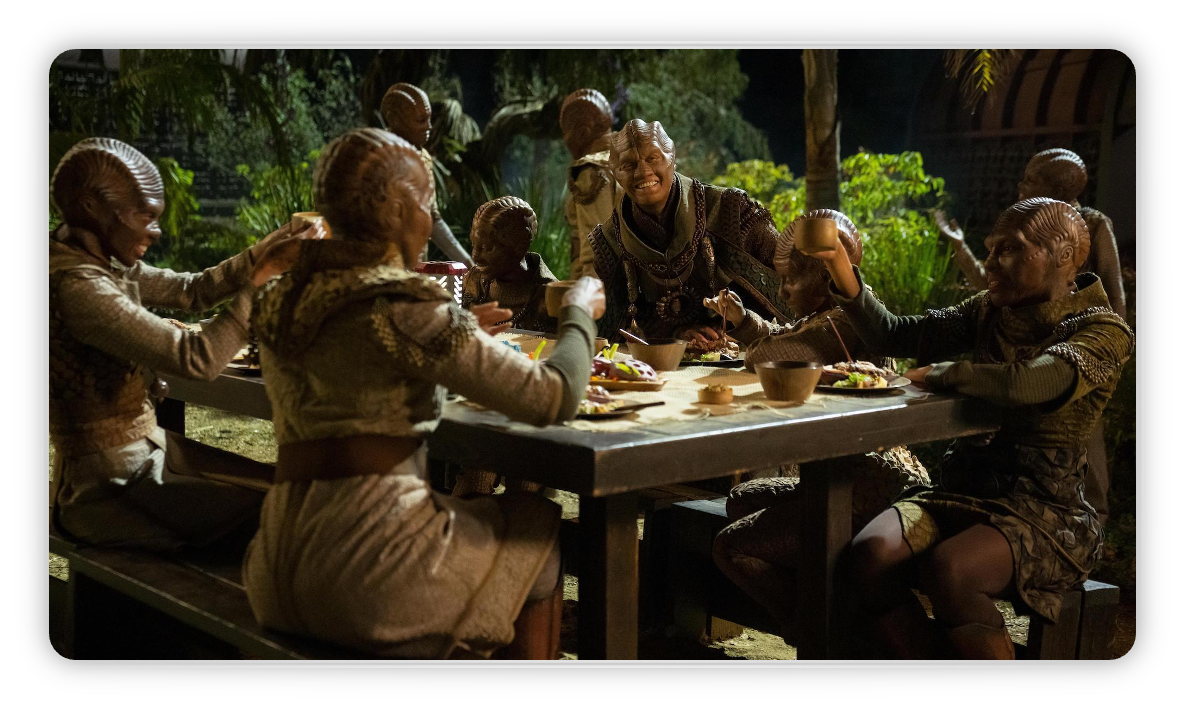
That shift is huge. “About a Girl” is about one child’s body. “Sanctuary” is about a suppressed population. The issue moves from the surgical table to the state. This is what makes the arc so much stronger than a single “issue episode.” It shows that gender oppression is not simply a matter of bad attitudes. It is infrastructure. Moclan masculinity depends on disappearance. Female life must be made invisible so that the official story can keep pretending it is natural.
This is also where Heveena becomes crucial. Heveena is a female Moclan who survived outside the system and became one of Moclan society’s most respected writers while publishing under a male identity. Which is just painfully on the nose in the way reality often is. Moclan society can admire her words when it believes those words came from a man. Once those same words are attached to a female body, they become dangerous.
The content did not change. The authorized body did.
That is the thing about oppressive systems: they are not just afraid of people existing. They are afraid of what those people reveal. Heveena reveals that female Moclans are not weak, defective, or impossible. The sanctuary colony reveals that female Moclans are not rare anomalies. Topa reveals that surgery does not erase the truth of a person’s embodied life. Their existence makes Moclan “nature” visible as construction.
And constructed systems hate being caught with the scaffolding showing.
The family is another major part of this. Moclan gender ideology does not just live in the court or the clinic. It lives at home. In “Sanctuary,” Topa, who was born female and altered as an infant, has already been taught to repeat Moclan misogyny. She refuses to share with a girl and says her father told her females are weak.
That is devastating. The child harmed by the system is being trained to speak for it.
This is how gender norms survive. They are not only enforced from above. They are repeated at home, at school, in jokes, in bedtime stories, in “traditional values,” in all the small daily rituals that teach children what kind of person they are allowed to become. The state does not need to stand over every child if parents have already learned to reproduce its categories at the breakfast table. Patriarchy, unsurprisingly, has a nursery wing.
Klyden is the most painful version of this. He is awful to Topa. Let’s be clear about that. He says things that truly make him deserve to be launched directly into the sun. But he is not randomly awful. Klyden was also born female and altered as an infant. He is not outside the violence. He is one of its products.
That makes him more complicated, not less responsible.
Klyden has built his life around the belief that what happened to him was necessary. If Topa’s alteration was wrong, then his alteration was wrong too. That possibility is unbearable, so he defends the system that harmed him. He calls the wound salvation because admitting it was a wound would unravel the story he has used to survive.
This is one of the most brutal parts of patriarchal systems. They do not only harm people. They recruit the harmed into enforcement. They teach people to protect the very structures that injured them because the alternative would mean admitting how much was stolen.
Klyden is not simply “bad alien dad in space.” He is what happens when a system harms someone, tells them the harm was love, and then hands them a child to repeat the past on.
And then we get “A Tale of Two Topas.”
This is the episode where the arc becomes something more than the original “About a Girl” setup. Topa is older. She is preparing for the Union Point entrance exam. She wants a future. She wants to serve. She wants to become something. But she also feels incomplete. She knows something is wrong before she knows the history of what was done to her.
That matters. Topa’s knowledge begins in the body. Before she has access to the records, before anyone tells her the truth, before the official archive is opened, she knows something. Not in a neat, institutional, paperwork-approved way. She knows through distress, discomfort, incompleteness, and the sense that the person she is supposed to be does not match the person she is.
This is where Susan Stryker’s work on trans knowledge hums underneath the whole episode. Trans people are often told that their knowledge of themselves is not real knowledge. It is confusion, delusion, immaturity, ideology, influence, attention-seeking, anything except what it actually is: embodied knowledge. Topa’s body has been trying to tell her the truth in a world built to hide it.
When Topa finally learns she was born female and altered as an infant, the issue is not just the surgery. It is the lie. Bortus and Klyden hid her history from her in the name of protection. But protection can become concealment. Love can become control. Parents can become agents of institutional violence not because they hate their child, but because they have accepted the institution’s definition of survival.
And then Topa says the sentence that reverses the whole arc:
“I am female.”
That moment matters because in “About a Girl,” everyone speaks over Topa. Parents, doctors, courts, officers, cultural authorities. Everyone has something to say about what Topa is, what Topa should be, what Topa will suffer, what Topa must become. But Topa is an infant. She cannot speak.
In “A Tale of Two Topas,” she speaks.
That is the turn. Topa moves from being an object of institutional knowledge to being the authority on her own body. She does not step outside power entirely, because no one does. She still needs medical care, legal permission, parental consent, Union protection, all the bureaucratic goblins of institutional life. But she interrupts the system that claimed the right to define her before she could define herself.
And this is why the arc cannot be reduced to a single neat metaphor. Topa’s story is clearly intended, at least in part, as a trans allegory. It is also about intersex medical violence. It is also about misogyny. It is also about reproductive control, cultural nationalism, family secrecy, and state power. Those layers sometimes blur in ways that require careful handling, but no complex metaphor can be perfect. Especially not one trying to carry gender, medicine, family, law, diplomacy, and black-site violence across several seasons of television without collapsing into a pile of prosthetic foreheads and trauma.
But the messiness is also part of why the story is useful. Real gender governance is messy. Real institutions do not harm people in one clean category at a time. They pile on. They medicalize, legalize, moralize, bureaucratize, and then, if necessary, militarize.
Which brings us to “Midnight Blue,” the episode that essentially says: congratulations, you recognized her identity. Now what are you going to do about the institutions that made recognition necessary in the first place?
Because recognition is not safety.
By “Midnight Blue,” Topa has been recognized as female by her family and the crew of the Orville. But Moclan power still treats her existence as a threat. She visits the female Moclan colony, and her presence immediately becomes politically explosive. The colony has “protective status,” but that protection comes with inspections, agreements, surveillance, and the constant shadow of Moclan authority. Protection and control arrive holding hands, because institutions simply cannot help themselves.
Heveena, meanwhile, has restarted an underground network to rescue female Moclan infants from being altered. Morally, she is right about the stakes. The violence has not stopped. Babies are still being surgically “corrected.” Families are still fleeing. The compromise that preserved the colony did not end the system. It merely made survival conditional.
But Heveena also recruits Topa into that work by appealing directly to her trauma. She tells Topa that the story of those infants is her story too.
That is powerful. It is also unfair.
This is where the show becomes more interesting than a simple heroic resistance narrative. Heveena is right to resist Moclan violence. But she is wrong to instrumentalize Topa. Topa is a child, a survivor, and someone who reveres Heveena. Asking her to take on that risk is not just “giving her agency.” It is loading a traumatized child with revolutionary obligation and calling it choice.
History is full of liberation movements with questionable onboarding practices.
When Topa is abducted and tortured at a Moclan black site, the arc reaches its darkest point. Moclan power has moved from surgery, to law, to family secrecy, to population suppression, to state violence. The body once “corrected” by medicine is now punished by the state for revealing what correction failed to erase.
That progression matters. It shows that recognition is necessary but insufficient. Topa can say “I am female,” and that matters. It matters enormously. But her declaration does not dismantle the institutions that made her life precarious in the first place. Being seen is not the same thing as being safe.
The Union also does not get to glide through this arc as the pure liberal savior. Obviously, the Union is better than Moclus. The Union is not the one surgically altering babies because their society has decided women are a design flaw. But the Union repeatedly compromises with Moclus because Moclus is militarily useful. Moclus supplies weapons. Moclus is strategically important. Moclus is politically inconvenient to challenge.
Human rights, apparently, are very important until the weapons supplier gets annoyed.
That is one of the smartest parts of the arc. It shows that liberal recognition can be sincere and still conditional. The Union can recognize that Topa is being harmed and still hesitate because doing the right thing threatens the alliance. That does not make the Union the same as Moclus, but it does expose the limits of institutional morality when ethics runs into military strategy.
Or, to put it less politely: the machinery of justice starts making weird grinding noises the second someone mentions the defense contractor might not like your version of social liberation.
Topa’s body ultimately becomes an archive of institutional violence. It carries the history of the original surgery, the tribunal’s ruling, parental silence, cultural propaganda, hidden records, medical reversal, diplomatic compromise, and state torture. Her body is not just where violence happens. It is where the lie of Moclan naturalness finally breaks.
The arc can be condensed into three moments.
First: “To conform our child.”
Then: “I am female.”
Finally: the state punishes her for what her existence reveals.
That is the story. Correction, self-knowledge, backlash.
And it is not just science fiction. It is how gender governance works. Institutions decide which bodies are normal, which bodies are suspect, which bodies need correction, which bodies deserve protection, and which bodies can be sacrificed for the greater good. They call it medicine. They call it law. They call it culture. They call it tradition. They call it national security. They call it family values.
They always have a nice name for the cage.
What The Orville does through Topa’s arc is make that cage visible. It shows gender oppression not as a matter of individual cruelty, though there is plenty of that, but as architecture. It has doctors, parents, judges, archives, diplomats, weapons contracts, inspection protocols, and black sites. It is not one bad man saying one bad thing. It is an entire system producing the conditions under which some lives become livable and others become problems to be solved.
Topa survives by speaking back to a system built to speak over her. Her self-knowledge matters not because it magically frees her from power, but because it interrupts the institutions that claimed the right to define her before she could define herself.
That is what makes the Moclan arc so good. Not because it is perfect. It is not. No complex metaphor can carry all of gender, transness, intersex medical violence, misogyny, family trauma, diplomacy, and state violence without wobbling a bit under the weight. But the wobble is worth it, because the arc gets at something true.
Gender norms love pretending they are natural.
Meanwhile, they require clinics, courts, family discipline, propaganda, diplomacy, and apparently black sites to stay upright.
Very natural. Very organic. No scaffolding detected.
And yet, because The Orville apparently wanted to make sure no one escaped this storyline emotionally intact, Klyden comes back.
Not fixed. Not absolved. Not magically transformed into Father of the Year after one heartfelt hallway apology and a tasteful orchestral swell. But changed enough to do the thing he failed to do when it mattered most: see his daughter. He comes back to Topa, apologizes, and chooses her over the system that taught him to hate what she was. And that matters, because repair is not erasure. Klyden hurt her. He defended the violence done to both of them. But his return refuses the bleakest version of this story, the one where everyone harmed by a brutal tradition is doomed to become its permanent little foot soldier.
Citations/Recommended Reading
“Queer Feelings.” In The Cultural Politics of Emotion. - Sara Ahmed
Gender Trouble: Feminism and the Subversion of Identity. - Judith Butler
“Punks, Bulldaggers, and Welfare Queens: The Radical Potential of Queer Politics?” - Cathy J. Cohen
The History of Sexuality, Volume 1: An Introduction. - Michel Foucault
“Normalized Transgressions: Legitimizing the Transsexual Body as Productive.” - Dan Irving
Terrorist Assemblages: Homonationalism in Queer Times. - Jasbir K. Puar
“(De)Subjugated Knowledges: An Introduction to Transgender Studies.” - Susan Stryker
“My Words to Victor Frankenstein Above the Village of Chamounix: Performing Transgender Rage.” - Susan Stryker
Episodes of The Orville
“About a Girl” Season 1, Episode 3
“Sanctuary” Season 2, Episode 12
“A Tale of Two Topas” Season 3, Episode 5
“Midnight Blue” Season 3, Episode 8
I've never even heard of The Orville, but you're right, based on your synopsis this is a brilliant, complex, thoughtful storyline. Kudos to the writers room. Makes me wonder how many women are in the room. And thank you, I'm sure I'll be thinking about this all day.
I really enjoyed The Orville, and the episodes about Topa were really well done. I hope more people watch the show in it’s entirety.