
The Work of Women Is the Work of Civilization
Civilization does not require women’s subordination. It requires women’s work, which is exactly why patriarchy worked so hard to control it

I should begin with an apology, or at least the closest thing to an apology I am emotionally equipped to offer: I am not, by training, a historian of ancient civilizations.1 My work tends to live closer to modern gender, media, politics, and the long miserable afterlife of patriarchal bullshit in contemporary culture. So, if you came here expecting a specialist in ancient Greek law to gently walk you through the oikos with the soothing voice of a museum audio guide, I regret to inform you that this is not that tour.2
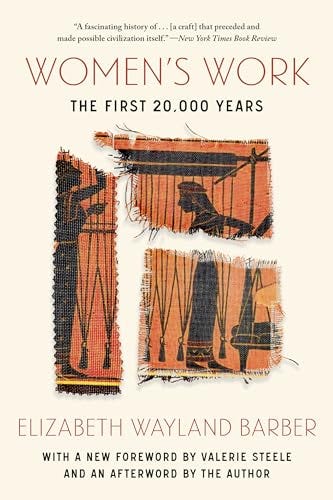
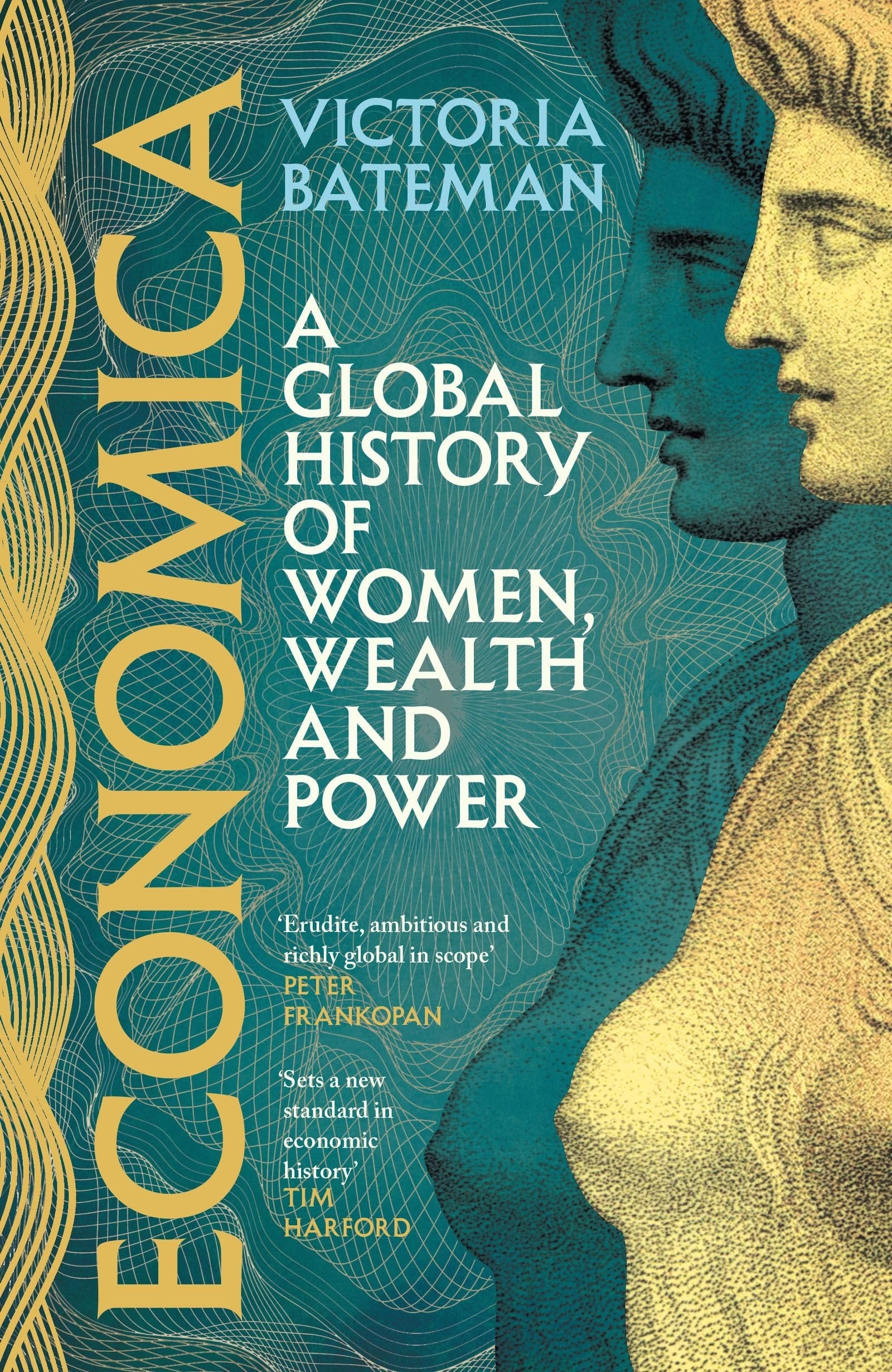
What I do have is access to academic search engines, a copy of Elizabeth Wayland Barber’s Women’s Work: The First 20,000 Years: Women, Cloth, and Society in Early Times, a copy of Victoria Bateman’s Economica: A Global History of Women, Wealth, and Power, and enough historical training to know when someone is abusing Aristotle in public.3
Add in the motivating power of being pissed off, and suddenly I am knee-deep in ancient household structures, textile production, women’s labor, matrilineal kinship systems, fertility panic, and the long-standing human habit of pretending women’s work is not work until society collapses without it.
This began, as too many regrettable things do, with a man on the internet.
He had been reading Aristotle and wanted to argue, more or less, that the ancient household worked because the wife was ruled by the husband “for her benefit.” The man, in this formulation, served as the public-facing representative of the household, while the woman’s subordination was not quite equality, no, but perhaps something more practical. More ordered. More stable. More “defendable.”
When I pointed out that what he was describing was a household organized around dependency and male gatekeeping, he responded by asking how a lack of “dependency” would have benefited the Greek world. Were these “strong independent women,” he asked, going to get a college education and work in downtown Athens?
Later, when I pointed out that women’s legal subordination was not the same thing as “households exist,” he escalated into the usual patriarchal escape room: farming, war, physical strength, fertility rates, “pairbonding,” and the allegedly practical question of how society could function without male household rule. At one point, he asked how women would contribute economically in a world based on farming and war, graciously granting me “textiles and perhaps a few other crafts.”
Textiles and perhaps a few other crafts.

I nearly had an aneurysm, because what do you mean ‘textiles and perhaps a few other crafts?’
The work of women is the work of civilization and always has been.
The mistake here is assuming that because patriarchy organized many civilizations, patriarchy therefore created civilization. It did not. Civilization required women’s work. Patriarchy just put men in charge of it.
The first lie is that stable means good.
The household, in his telling, was “stronger” because it was organized through male authority. The husband represented the household in the public realm. The wife’s subordination was framed as responsibility, protection, order, and social function. This is a very old trick: hierarchy puts on a little moral play in which it is the benevolent one just providing ‘care’ to the poor weak womanfolk.
But the household was “stronger” because women had fewer legal and economic ways to leave it. Prisons are also very strong. We do not usually cite that as evidence that everyone inside is thriving.
A household can be stable, affectionate, productive, and unjust at the same time. People loved one another inside patriarchal systems. They built homes, raised children, sacrificed, grieved, survived, and made meaning inside structures that denied women equal legal, economic, sexual, and civic personhood. That is part of what makes patriarchy durable. It doesn’t always operate through overt cruelty. It embeds power inside intimacy. It wraps hierarchy in affection, calls dependence “protection,” calls domination “responsibility,” and then looks wounded when women notice the door has a lock on it.
Cooperation and hierarchy are not opposites. A husband could love his wife and still possess legal power over her. A household could function and still be unjust. A society can run smoothly while resting on coercion. Slavery functioned. Empire functioned. Child labor functioned. “It produced an outcome” is not the same as “it was necessary, natural, or good.”
Function is not justice.
This is especially important because patriarchal arguments almost never present themselves as “we would like to control women because it benefits us.” Too vulgar. Too honest. Instead, the argument is usually that women are sacred, valuable, delicate, morally superior, naturally nurturing, biologically destined, spiritually elevated, or socially indispensable.
Lovely.

When I taught women’s history, I used the framework of women being both “revered and demeaned” in society. That is exactly what happens here: women are praised for the value they bring, especially reproductively and socially, while still being treated as less than in daily life. Benevolent sexism does this with a smile. It values feminine-coded traits like nurturance and care, but uses that “valuation” to limit women’s roles through paternalism, protection, and the idea that traditional gender roles are naturally complementary.
“Ruled for her benefit” is benevolent sexism with a ‘I took one Philosophy 101 class in undergrad and it’s now my entire personality’ sticker slapped on it.
Women are the heart of the home, so naturally they cannot control the home. Women are the moral guardians of society, so naturally they cannot govern society. Women are too precious for politics, too pure for public life, too nurturing for property rights, too delicate for autonomy, and somehow simultaneously responsible for everything that goes wrong with men, children, sex, family, morality, and civilization itself.
Funny how women are always most sacred exactly where they are least free.
This is the basic con behind the “men provide for women” argument. First, you build a world where women are barred from owning property independently, excluded from political life, denied education, kept out of most professions, restricted in contract law, and made legally dependent on male guardians or husbands. Then, once you have structurally routed money, citizenship, protection, status, and survival through men, you point at women and say: look how dependent they are.
Nature has spoken.
Only nature did not speak. The law did. Custom did. Property structures did. Male violence did. Religious authority did. The household economy did. Men with a vested interest in controlling women’s labor and reproduction did.
Tiny difference.
And this is where “textiles and perhaps a few other crafts” becomes useful, because it is not just stupid. It is revealing.
Textile production was not macaroni art. Barber’s Women’s Work is built around the fact that, for thousands of years, fiber arts were an enormous economic force and were primarily associated with women. The jacket copy itself makes the central point beautifully in case you are too busy for the full book: for more than 20,000 years, until the Industrial Revolution, fiber arts belonged primarily to women and functioned as a major arena where women were mothers, providers, workers, entrepreneurs, and artists. It also points out why this labor disappears so easily from historical memory: women produced perishable necessities, especially food and clothing, while archaeology more easily preserves houses, tombs, temples, stone sculpture, and other durable artifacts. Economic histories that omit cloth and clothing are not neutral. They are leaving out a vast female-produced portion of the economy.
The archive has a “men did everything” filter because stone survives better than pajamas.
Cloth is not decorative fluff on the edge of civilization. Cloth is clothing, warmth, bedding, sacks, sails, tents, storage, bandages, shrouds, ritual objects, dowry goods, trade goods, military supply, household wealth, and status display. A civilization without textiles is not a civilization. It is a crowd of cold, naked people trying to carry grain in their hands.
The importance of fiber technology goes even deeper. The Invisible Sex discusses what Barber called the “String Revolution,” arguing that fiber technologies such as cordage, nets, and woven materials had profound effects on human survival. String made snares, fishlines, tethers, leashes, carrying nets, handles, packages, and more complex tools possible. The authors argue that these humble-looking fiber artifacts were far more important than their appearance suggests, but also note that fiber items are highly perishable and often neglected by archaeologists trained to see stone, bone, shell, and other durable materials.
So when someone says, “I’ll grant you textiles,” what they are actually saying is, “I will grant you one of the foundational technologies of human society, but I will say it in a tone that makes it sound like women were making potholders and lace doilies while men invented history.”
No.
Women were not economically irrelevant. Their work was simply made economically illegible.
And textiles were only one piece of it. Women processed food, ground grain, brewed beer, preserved food, hauled water, tended children, cared for the sick, managed households, performed ritual labor, participated in markets, gathered plants, worked fields, supervised servants, made clothing, washed bodies, delivered babies, nursed infants, mourned the dead, transmitted culture, and maintained kinship networks. In Vivante’s Women’s Roles in Ancient Civilizations, the index alone is a quiet little detonation under the myth that women only did “a few crafts”: women’s economic activities across ancient societies included agriculture, animal husbandry, brewing, business and commerce, childcare, cloth production, cooking, domestic service, estate management, food distribution, gathering, household management, hunting and trapping in some societies, market work, medicine, and more.
This is not side-quest labor. This is the game.
Men could go farm, fight, trade, govern, philosophize, and compose tedious arguments about women’s natural inferiority because someone else was producing the material conditions that allowed them to do so. Armies do not march unless someone grows, grinds, cooks, packs, washes, mends, births, raises, and buries the society behind them.
Civilization was not built by men with spears alone. Someone had to make the clothes they were wearing while they congratulated themselves for killing the other guys more violently.
This also matters because the “household” is doing a lot of sneaky work in these arguments. Modern people tend to imagine the household as a private family unit: two adults, children, maybe a mortgage, maybe a dog with anxiety.4 But the household was not a snow globe. It was not a little sealed domestic ornament, shaken gently by Father’s loving hand.
The ancient Greek oikos was an economic, legal, reproductive, and religious institution. It organized property, production, inheritance, legitimacy, enslaved labor, citizenship, ritual, and gender authority. Women’s work within the oikos was not irrelevant to the wider world. It was the foundation that made men’s participation in the polis possible. Vivante’s reference guide notes that in fifth-century BCE Athens, women were confined to the oikos, where they had some authority in the home while being excluded from public life. Women maintained household rituals, wove, directed household servants, and performed the labor that made men’s public role in the polis possible.
So when a man says the husband was the “external-facing diplomat” of the household, that is not a neutral administrative detail. That is deliberate, structural political exclusion.
The household decided who worked, who owned, who obeyed, who inherited, who reproduced, who got leisure, who got legitimacy, and who got called dependent after doing all the work. This is why the feminist slogan “the personal is political” still matters. Radical feminism’s key insight was that power does not only exist between citizens and the state. It exists in marriage, sex, childrearing, domestic labor, reproduction, and family structure. Personal experiences in marriage, sex, and childrearing have political consequences because power relations between men and women shape women’s larger position in society.
The home was never outside politics. It was politics with laundry.
Calling patriarchal marriage “men providing for women” is generous. Men were often providing women access to resources women were legally prevented from accessing directly. That is not provision. That is a hostage situation.
The point is not that men did nothing. I cannot emphasize this enough because the “but men are useful too” chorus always comes skittering out of the walls like a haunted Roomba. Yes, men contributed to society. Men farmed, built, hunted, traded, governed, fought, repaired, herded, fished, traveled, invented, carried, risked, and labored. Wonderful. Have a biscuit.
But men do not need to own the household in order to contribute to it.
This is where my interlocutor asked, “In what matrilineal or non-patriarchal society is male labor mobilized to sustain advanced economies?” Which is a fascinating question, mostly because of what it smuggles in under the floorboards.
First, do you think men simply stay home eating bonbons all day if they are not legally in charge?
Second, what exactly do you mean by “advanced”?
If your definition of a successful society is maximum resource extraction, capital accumulation, manufacturing capacity, mechanized infrastructure, expansion, and military force, then fine, yes, patriarchal states are very good at producing that sort of thing. They are good at hierarchy, ownership, coercion, surplus extraction, labor control, militarization, and domination. That is not a neutral definition of success. That is a very specific value system.
It is also a value system patriarchy happens to flatter.
A society is not automatically “better” because it extracts more, accumulates more, centralizes more, conquers more, or builds larger monuments to the men at the top. Those are forms of power, not universal measurements of human flourishing. His argument treats patriarchal, state-based, militarized, surplus-producing societies as the obvious endpoint of human development, then asks whether non-patriarchal systems can reproduce those exact outcomes. That is not analysis. That is rigging the test and then acting impressed when you are the only one that gets an A.
Has it possibly occurred to him that non-patriarchal societies look different because they do not organize themselves around the same priorities?
A society that values cooperation, sustainability, kinship, subsistence, relational obligation, and ecological balance over conquest, surplus, domination, and imperial administration is not automatically “less advanced.” It is just not built to satisfy his personal Civilization VI victory conditions.

This is where comparative examples matter, but carefully. I am not interested in inventing a matriarchal fairyland where women ruled benevolently while men peacefully braided flax and no one was annoying. That is not history. That is possibly a cult.
But matrilineal, matrilocal, avuncular, and non-nuclear household systems do show that patriarchal wife-subordination is not biology. It is one historical arrangement among many. Vivante’s introduction makes this point in a useful way: patriarchy refers not just to individual men being bossy, but to an entire social framework of laws, customs, and thinking that supports male rule and prevents women’s full participation in public and domestic arenas. The same introduction also notes that many societies described as matriarchal do not simply mirror patriarchy by putting women at the top of the same hierarchy. Their structures often differ considerably from patriarchal ones.
That distinction matters. If you define civilization as “who conquered the most territory and built the biggest state apparatus,” then yes, you will privilege the societies best at conquest and state apparatus. Shocking. But if you ask how humans organize survival, kinship, care, descent, labor, land, sexuality, inheritance, and obligation, the answers are much wider than “husband owns wife, otherwise everyone dies.”
Men do not need patriarchy to contribute to society. They need patriarchy to confuse contribution with command.
The most revealing thing about patriarchal labor arguments is how flexible women’s supposed natural limitations become whenever the state needs them. If women are naturally unsuited to hard labor, it is remarkable how often societies discover their strength during wars, revolutions, industrialization campaigns, labor shortages, and national emergencies.
The Chinese Iron Girls are a useful, complicated example. During the Cultural Revolution, “Iron Girls” referred to women who performed demanding hard labor previously coded as male: repairing high-voltage wires, working farmland, welding, and other heavy physical labor.
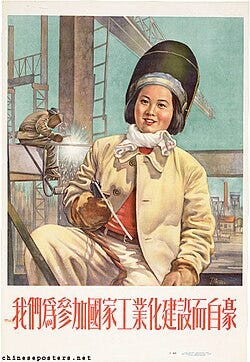
This was not a pure feminist liberation project. The Chinese state did not wake up one morning and say, “Perhaps women are fully human, let’s explore.” Feminism was treated as bourgeois and Western, while industrialization and state development were the real motivating forces behind bringing women into more “masculine” forms of labor.
Still, motives are not the same as lived consequences. Women can experience real openings inside exploitative systems. Guo Fenglian, known as the “Mother of the Iron Girls,” later described the previous generation of women in her village as having bound feet, no freedom to choose marriage partners, and no status at home. For Guo’s generation, work became a way to imagine liberation from being “men’s appendages.” Even though they performed intense physical labor, she remembered their spirit as free.

That is the complication. The Iron Girls were not simple liberation. They were not simple exploitation. They show how quickly “natural” gender limits can shift when a society needs labor, and how women can take state projects and make different meanings out of them.
The “natural” limits of women’s labor have a suspicious habit of vanishing when the state needs crops harvested, factories staffed, uniforms sewn, ammunition made, revolutions performed, or economies rebuilt.
Then, when the crisis passes, everyone gets very concerned about femininity again. Women were strong enough for the fields, factories, workshops, and war effort when needed. Then suddenly, when male status feels threatened, the delicate flower discourse returns from its smoke break holding a clipboard.
This is not ancient history only. It is a recurring pattern. Women’s labor is needed, mobilized, exploited, praised, disciplined, and then shoved back into “nature” once men want the status hierarchy restored.
The fertility panic works the same way.
After being unable to prove that women’s subordination was morally or historically necessary, my interlocutor dragged in modern fertility rates, because apparently no patriarchal argument is complete until someone starts muttering about “pairbonding” like a divorced podcast host given unrestricted access to a microphone.
He claimed the fertility crisis proves the current system is not working.
The actual evidence is much less flattering to the “women stopped being governable” theory of civilization. Pew Research Center’s 2024 study of U.S. adults without children found that adults under 50 who say they are unlikely to have children cite multiple reasons: 57 percent say they simply do not want children, 44 percent want to focus on other things, 38 percent cite concerns about the state of the world, and 36 percent say they cannot afford to raise a child. Women under 50 in that group are more likely than men to say they just do not want children, 64 percent compared with 50 percent.
The OECD’s 2024 Society at a Glance report similarly does not say, “Have we tried putting husbands back in charge?” It notes that the average total fertility rate across OECD countries fell from 3.3 children per woman in 1960 to 1.5 in 2022, and points to later childbearing, economic and financial security, the cost of children, labor market conditions, housing costs, global crises, and the ability to combine work and family life as relevant factors. It also states that fertility rises when women can combine work and family life on an equal footing with men, supported by paid parental leave, affordable childcare, financial supports, and a fairer sharing of work and childrearing.
So no, the solution to fertility decline is probably not rebuilding the household monarchy and hoping women are too legally cornered to object. People need housing, healthcare, childcare, income security, bodily autonomy, time, social trust, and partners who do not treat women’s equality as civilization’s tragic software update.
Children are not raised by two abstract “pairbonded” mammals floating in a vacuum. They are raised through cooperation, kinship, labor-sharing, law, resources, care networks, social norms, and material support. The modern nuclear family is not the default human structure across history. It is modern, specific, and politically useful to people who want the family to absorb the costs that society refuses to carry collectively.
A workable household model does not require male domination. It requires reciprocal obligation, shared resources, legal personhood for adults, enforceable responsibilities to children, and a social structure that values care instead of pretending it appears magically from the Wife Goblin under the floorboards.
Patriarchal systems often denied women control over the products of that labor. That does not prove women were naturally dependent. It proves their labor was valuable enough to control.
Patriarchy is not men contributing to society. Men can contribute to society perfectly well without being handed a wife as a domestic appliance without legal personhood. Patriarchy is the system that turns contribution into entitlement. It says: because men plow, they rule. Because men fight, they own. Because men provide access to resources, women owe obedience.
But that only works after women have already been pushed away from land, law, wages, education, and public authority.
It is not provision. It is enclosure.
A man read Aristotle and thought he had found a natural law. What he found was a historical arrangement that treated women’s labor as necessary and women’s autonomy as negotiable. There is a difference.
Civilization does not collapse when women are not subordinate to men. What collapses is a very specific fantasy of civilization: the one where men imagine themselves as builders, defenders, thinkers, and rulers while women appear in the background as wives, mothers, servants, wombs, and suspiciously self-cleaning support infrastructure.
The work of women is not peripheral to civilization.
It is civilization.
Patriarchy did not create that work. It organized itself to own it, devalue it, naturalize it, and pretend it had been male genius all along. And if your model of social order only functions when half the species is legally managed by the other half, the problem is not feminism.
The problem is that your civilization is a hostage situation with Corinthian columns.
Recommended Reading and Resources
Women’s Work: The First 20,000 Years: Women, Cloth, and Society in Early Times by Elizabeth Wayland Barber
Economica: A Global History of Women, Wealth, and Power by Victoria Bateman
The Invisible Sex: Uncovering the True Roles of Women in Prehistory by J. M. Adovasio, Olga Soffer, and Jake Page
Women’s Roles in Ancient Civilizations: A Reference Guide by Bella Vivante
The Creation of Patriarchy by Gerda Lerner
Goddesses, Whores, Wives, and Slaves: Women in Classical Antiquity by Sarah B. Pomeroy
Shockingly historians are not experts in all history. I know a lot about three things, women’s history/gender history, 20th century American history (and adjacent Cold War shenanigans), and the witch trials as an international subject. Please do not ask me about the Renaissance. I know it involved a lot of art and the Medicis were there and the Borgias were nominally victims of anti-Spanish propaganda. That’s it.
To this day the absolute best museum audio tour guide I ever experienced was the one for the Gravensteen castle in Ghent, Brussels. More audio guides need to be recorded by comedians.

This is based on an argument I had in my notes section WEEKS ago.
Maybe that’s just my dog…

As an archaeologist specializing in ancient textiles, I thank you for highlighting this essential and nearly invisible aspect of all civilization everywhere! Interesting side note: pottery is also likely to have been made almost exclusively by women in ancient times. Think about everything ceramics made possible, and you find another way in which women's work has been undervalued or simply claimed by men.
I love your writing. Thank you for sharing your research and doing it with nuggets of pointed humor that makes assimilating these painful truths possible without entirely losing my mind into fury.