
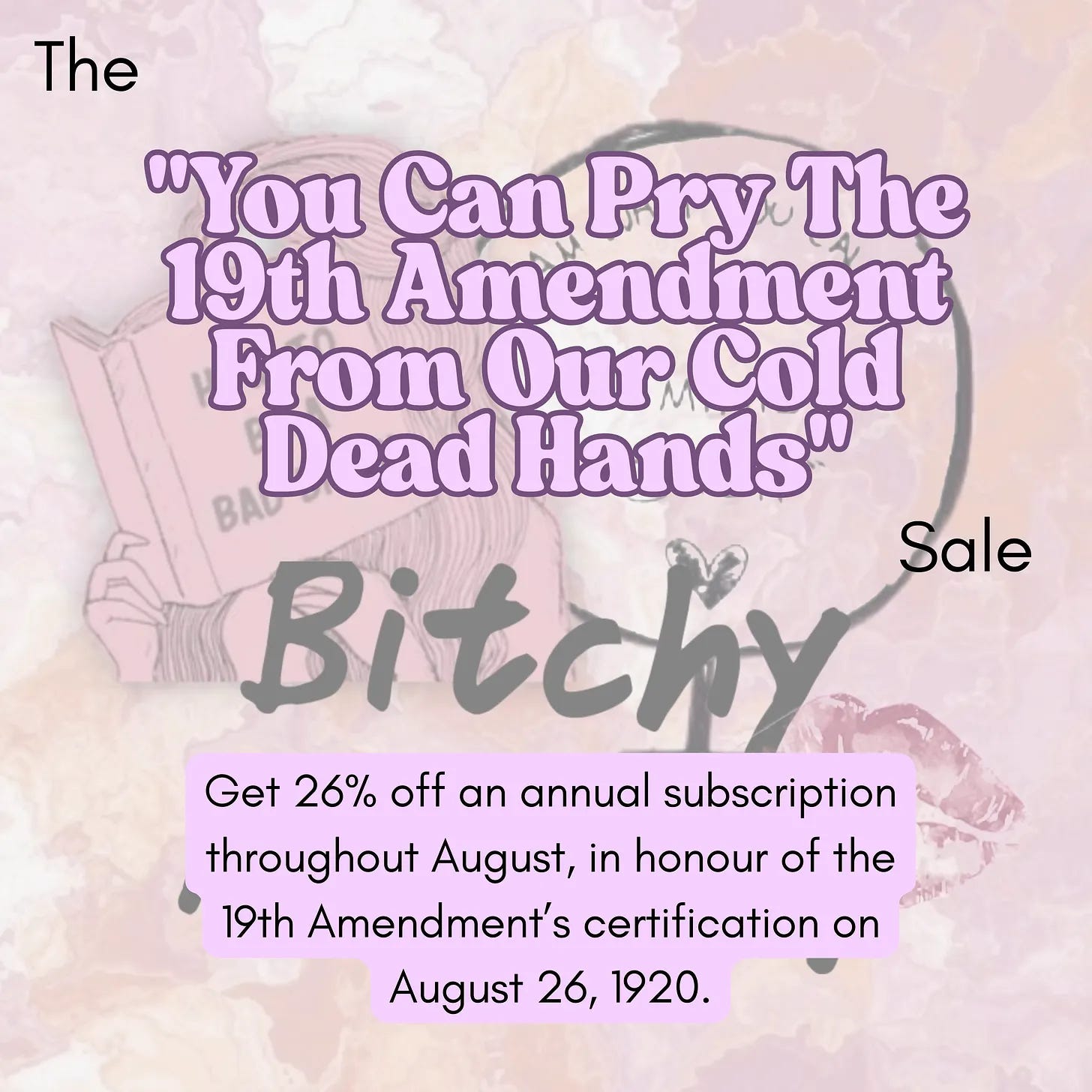
The “You Can Pry the 19th Amendment From Our Cold Dead Hands” Sale
Get 26% off an annual Bitchy History subscription throughout August, because apparently “women are individual citizens” remains a controversial political position.

Yes, the discount is historically themed. I have never encountered a political crisis I could not make slightly more manageable with a deeply specific joke.
Unfortunately, the sale’s name is becoming less hyperbolic by the day.
The 19th Amendment was ratified after Tennessee became the necessary thirty-sixth state to approve it on August 18, 1920. Secretary of State Bainbridge Colby formally certified it eight days later. The amendment declared that the right to vote could not be denied “on account of sex.” (National Archives)
It was the culmination of generations of organising, petitioning, marching, lobbying and civil disobedience. Suffragists were mocked, arrested, beaten, imprisoned and force-fed. They were told women did not want the vote, did not understand politics and would destroy the family if permitted opinions outside the approved household supply.
Political discourse was very sophisticated in 1920.
A Constitutional Victory, With Several Enormous Asterisks
The 19th Amendment mattered enormously. It also did not instantly enfranchise every woman in America.
It prohibited governments from explicitly denying the vote because of sex. It did not eliminate Jim Crow, poll taxes, literacy tests, citizenship restrictions, intimidation or violence. Black women across the South remained subject to racial voter suppression. Many Native American women were not recognised as citizens until 1924, and Asian immigrant women continued to face naturalisation restrictions. (Brennan Center)
The suffrage movement itself was also deeply compromised by racism. Black women including Ida B. Wells, Mary Church Terrell and Frances Ellen Watkins Harper challenged white suffragists who were willing to appeal to white supremacy in exchange for political support.
That does not make the amendment meaningless. It makes the lesson more important.
A constitutional right can be transformative without being complete. It can exist clearly on paper while hostile governments build a bureaucratic obstacle course around it.
The right is not the same thing as access to the right.
The Anti-Suffrage Argument Has Put On a New Bonnet
The deeper objection of the anti-suffrage movement was not simply that women were too emotional or uninformed to vote. It was that women were not independent political citizens.
Anti-suffragists defended the male-headed household as the proper unit of political representation. A husband voted for the family. His wife could influence him privately, presumably while handing him dinner and avoiding opinions forceful enough to disturb his digestion.
Giving her a separate ballot meant recognising that she possessed political interests and legal personhood independent of him.
That was the dangerous proposition.
This is why modern proposals for “household voting” are not innovative conservative thought experiments. They are nineteenth-century anti-suffrage politics with a podcast microphone.
Christian nationalist pastor Doug Wilson has described the 19th Amendment as a mistake and advocated a system in which the male head of a household normally casts the family’s vote. In 2025, Defence Secretary Pete Hegseth shared a video featuring pastors from Wilson’s church network arguing that women should not vote. The Pentagon later said Hegseth supports women’s right to vote, but it remains significant that a Cabinet secretary amplified a movement openly hostile to women’s independent political citizenship. (PBS)
At a Turning Point USA women’s conference, some attendees also said they would surrender their own votes in favour of one household ballot controlled by a husband. Many conservative women reject that position, but the idea is no longer confined to anonymous men with Roman statue avatars. (Democracy Docket)
Calls to repeal the 19th Amendment remain fringe. There is no serious congressional repeal effort approaching passage.
But political ideas often spend years being described as jokes or provocations before anyone tries to make them policy. The purpose of repeating them is to make them familiar. Calling disenfranchisement “family voting” makes the removal of women’s citizenship sound cosy.
It is coverture with a campaign logo.
You Do Not Have to Repeal a Right to Restrict It
The more immediate threat is not a constitutional amendment announcing that women have had enough democracy.
It is legislation that makes voting harder while remaining formally neutral about sex.
The SAVE America Act would impose national documentary proof-of-citizenship requirements for voter registration and create new identification restrictions. Supporters describe these measures as election security. Noncitizens are already prohibited from voting in federal elections, and documented cases are rare. (White House)
The proposal does not say women may not vote. Modern voter suppression tends to have better lawyers.
Instead, registration would depend on obtaining and presenting specific documents. The Brennan Center estimates that more than 21 million American citizens lack ready access to qualifying proof-of-citizenship documents. Married women who changed their surnames could face additional burdens when the name on a birth certificate does not match their current identification. Young, rural, disabled and low-income voters could also be disproportionately affected. (Brennan Center)
Not every married woman would automatically be barred from voting. Supporting documents and alternative procedures may exist. The problem is that a right previously exercised through ordinary registration becomes dependent on paperwork, money, transport, time and the judgement of local officials.
Every additional hurdle creates another opportunity for an eligible citizen to be turned away.
You still possess the right. You simply need the correct certificate, accepted identification, proof of every name you have used and enough free time to navigate a system designed by a malevolent filing cabinet.
Congratulations on your equality.
Rights Are Not Heirlooms
There is a comforting version of American history in which rights are won in a neat sequence and then placed safely behind glass.
Women marched. Tennessee ratified. The secretary of state signed the paperwork. Everyone applauded. The end.
But rights are not heirlooms. They are political arrangements maintained through law, institutions, participation and collective insistence. They can be expanded. They can be restricted. They can be made inaccessible while remaining technically intact.
The women who fought for suffrage were not asking for another declaration that women were important. Society had spent centuries praising women’s sacred importance immediately before denying them property, education, wages, bodily autonomy and legal personhood.
They were demanding power.
The vote meant women could act upon their beliefs rather than whispering them into the ear of a husband who retained the final decision. It recognised women as members of the political community, not decorative dependants represented through someone else.
That is why anti-suffragists opposed it then.
It is why some people oppose it now.
So throughout August, Bitchy History annual subscriptions are 26% off in honour of the amendment certified on August 26, 1920.
Subscribe for feminist history, political analysis, cursed primary sources and regular reminders that no right was secured because the people holding power suddenly developed excellent manners.
The sale ends August 31.
The 19th Amendment is not a limited-time offer.