

Every time women talk publicly about feminism, sex, power, work, violence, medicine, motherhood, their lack of motherhood, or the apparently radical proposition that women are people, some man appears like patriarchy’s unpaid intern to announce that women are bitter, crazy, ugly, lying, or destroying civilization by typing.
This is not debate.
This is crowd control.
The goal is not simply to prove women wrong. Often, no one involved has even reached the point of understanding the argument, which would require reading, and we must all respect people’s natural limitations. The goal is to make women’s public speech expensive. Every rape threat, kitchen joke, appearance insult, bad-faith derailment, and demand that women be nicer to the men harassing them is doing the same work. It is trying to make public speech feel unsafe enough that women return to silence.
Online misogyny is patriarchy’s fire alarm. It goes off whenever women start comparing notes.
Because that is the real threat. Not women being angry. Not women being loud. Not women being mean to some poor man who wandered into a feminist conversation and somehow tripped over the point.
The threat is women talking to each other.
When women talk, they build community. They share knowledge. They give advice. They warn each other. They notice patterns. They turn private confusion into public analysis. They stop thinking their problems are unique personal failures and start recognizing them as structural conditions.
And that is when the machinery starts making terrible noises.
Patriarchy works best when women experience structural problems as private failure. The bad marriage becomes her poor choice. The workplace harassment becomes her misunderstanding. The medical dismissal becomes anxiety. The exhaustion becomes weakness. The violence becomes something she should have prevented.
But then she says it out loud.
And ten other women say, “Wait. That happened to me too.”
That sentence is the beginning of political consciousness.

This is the point Carol Hanisch was making when she defended women’s consciousness-raising groups in the essay that became known as “The Personal Is Political.” Hanisch argued that what women were told to treat as personal problems were actually political problems, rooted in systems of power rather than individual failure. Women were not gathering to whine, navel-gaze, or indulge in therapeutic frivolity. They were identifying structures. They were naming patterns. They were taking the private experiences that had been used to shame them and turning them into shared knowledge.
Patriarchy loves a woman alone with her shame. It becomes noticeably less enthusiastic when she opens a group chat.
Women talking has always been dangerous
There is nothing new about men treating women’s speech as a threat. The platforms are new. The panic is vintage.

Women’s public organizing has often emerged through spaces that were initially treated as morally acceptable, domestic-adjacent, or harmless. In the nineteenth century, women entered abolitionist, religious, charitable, temperance, and reform work through roles supposedly connected to feminine morality. But once women began organizing, petitioning, fundraising, writing, and speaking, those activities became politically dangerous. Women learned how power worked by practicing on the edges of the public sphere.
Antebellum reform work helped build the infrastructure that later fed abolitionism and suffrage. Seneca Falls did not drop from the sky like a feminist meteor. Many early women’s rights activists had already been shaped by abolitionist organizing, where they encountered both the possibilities of reform and the limits men placed on women’s public authority. Women were expected to labor for justice, but not to claim authority for themselves.
In other words, one minute women were organizing moral reform. The next minute they had political consciousness.
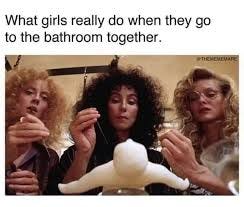
This is why patriarchy is so suspicious of women going to the bathroom in groups.
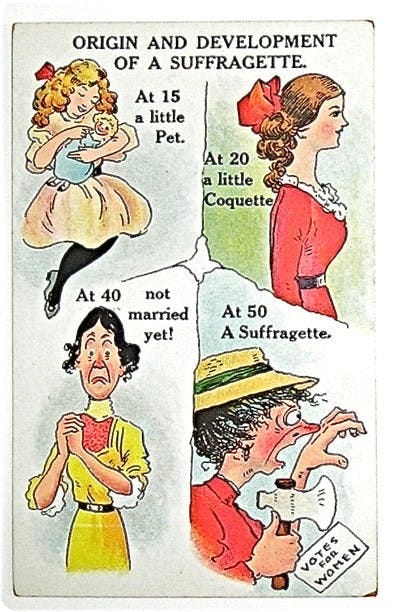
Suffrage opponents understood that women’s political speech threatened more than the ballot box. It threatened the household order. Anti-suffrage rhetoric depended on the idea that women belonged in the private sphere, and that public political participation would make them unfeminine, selfish, sexually improper, or dangerous to the family. The insult has barely changed. Today, women who speak publicly about feminism are still framed as bitter, deviant, hysterical, unnatural, unfeminine, or dangerous to civilization. The meme got Wi-Fi, but it did not get smarter.
The same logic powered resistance to second-wave feminism. Radical feminists did not merely ask for formal legal equality, although that mattered. They asked women to re-examine the intimate architecture of daily life: marriage, sex, child-rearing, domestic labor, medical authority, rape, sexuality, and power. “The personal is political” became a defining idea because it challenged the fiction that politics only happened in legislatures, workplaces, courts, and voting booths. It insisted that power also lived in kitchens, bedrooms, doctor’s offices, marriages, classrooms, and family structures.
That mattered because women were already inside movements for justice. They were already doing the work. And still, male colleagues ridiculed them, dismissed them, and treated women’s subordination as a side issue. So women created their own spaces and realized the disrespect was not incidental. It was structural.
That is what men fear online now.
Not because every man is consciously trying to prevent feminist counterpublics. Most are not producing villain monologues with footnotes. But they know enough to interrupt, mock, and punish. They know enough to make the room unpleasant when women begin discovering that what happened to them has happened to others.
The problem was never that women were gossiping. The problem was that gossip kept turning into political theory with refreshments.
“Just log off” is not adequate
The standard response to online harassment is usually some version of “just ignore it,” “don’t feed the trolls,” “block and move on,” or “why do you care what strangers think?”
This is charming in the same way a paper umbrella is charming during a hurricane.
Online harassment is not merely a collection of mean comments. It is a system of punishment attached to public participation. It is designed to make women pay a higher price for speaking than men do.
The evidence is not subtle. A UN Women-supported report based on more than 6,900 participants across 119 countries found that more than two-thirds of women journalists, activists, and human rights defenders surveyed had experienced online abuse, and 41% reported subsequent offline harassment or attacks. The report described this escalation as abuse moving from “screen to street,” which is a polite institutional way of saying the internet is not an imaginary kingdom where real-life consequences politely wait outside.
A 2026 UN Women report also warned that women in public life face increasingly sophisticated online violence, including AI-enabled abuse, deepfakes, nonconsensual image-sharing, unsolicited sexual advances, and coordinated harassment. The Guardian’s coverage noted that this abuse drives women to self-censor or withdraw from online spaces, eroding women’s rights and public representation.
That is the point.
Harassment does not need to silence every woman directly. It only needs to make enough women hesitate before posting, naming abuse, sharing expertise, entering public debate, or saying, “This happened to me too.”
A platform can technically allow women to speak while making the cost of speaking high enough that silence starts looking like self-care. It’s a gag order in an evening gown.
A nationally representative UK study found that women and men reported seeing online harms at roughly similar rates, but women were more fearful of being targeted and less comfortable participating online. Only 23% of women said they were comfortable expressing political views online, compared with 40% of men. The authors argued that women may do more “safety work” to protect themselves.
The comment is the visible part. The labor it creates is the trapdoor.
Women block, mute, document, report, archive, change privacy settings, avoid topics, soften language, delay publishing, and calculate whether this is the day some stranger escalates from insult to threat to address-hunting. That labor is political. It drains energy from public speech and redirects it into survival administration.
And then men call women too emotional.
Because “please stop threatening to rape me in the comment section” apparently lacks the cool rationality expected of debate.
The marketplace of ideas is apparently allergic to women having ideas
There is a particular kind of man who loves free speech right up until a woman uses hers.
He believes in open debate, by which he means his right to enter a conversation about misogyny and explain that actually men have feelings too. He believes in intellectual rigor, by which he means women should provide peer-reviewed evidence that being told to ‘shut up and die’ is unpleasant. He believes in viewpoint diversity, by which he means every feminist discussion should include a man patiently misunderstanding the first sentence.
But when women talk to each other without organizing the conversation around male reassurance, this man loses his tiny procedural mind.
Because women’s speech creates community, shares survival information, gives language to experiences women were taught to minimize, and makes “I thought it was just me” collapse into “oh, so this is a system.”
Nancy Fraser argued that subordinated groups create alternative publics where they develop their own interpretations of their identities, interests, and needs. In plain English: people pushed out of dominant public life create their own rooms, their own language, and their own analysis.
Feminist digital spaces can work this way. They are not just “content.” They are counterpublics. They are places where women develop frameworks for understanding what institutions, families, workplaces, media, medicine, politics, and men have taught them to minimize.
That is why dismissing women’s speech as gossip matters. “Gossip” is one of the oldest ways to trivialize women’s knowledge-sharing. Women warning each other about abusive men, predatory bosses, unsafe workplaces, dismissive doctors, coercive partners, or institutional cover-ups are not merely being dramatic. They are circulating informal risk assessment.
Men call it gossip because “distributed feminist intelligence network” sounds harder to mock.1
Women’s speech is treated as frivolous until the lawsuit arrives. Then suddenly everyone wants to know why no one said anything.
We did. You called it gossip.
The insults are not random
The language of online misogyny is repetitive because patriarchy is not especially imaginative. It has a short playlist and absolutely refuses to update it.
Women who speak publicly are not simply told they are wrong. They are dragged back to the body. A woman says something about policy, and he comments on her face. She says something about rape culture, and he comments on her sex life. She says something about reproductive rights, and he comments on her fertility. She says something about labor, and he asks who would ever marry her.
She says something about misogyny, and he proves the thesis in real time, like a lab rat with a podcast.
This is not accidental. Women’s public speech has long been disciplined through bodily judgment. If a woman can be reduced to her desirability, her maternal status, her weight, her age, her voice, her clothes, her sexuality, or her supposed emotional instability, then her argument never has to be engaged.
This is where hostile and benevolent sexism work together. Hostile sexism is open contempt: women are irrational, inferior, manipulative, dangerous, or deserving of punishment. Benevolent sexism is the prettier trap: women are delicate, morally pure, naturally nurturing, and in need of male protection. It sounds complimentary until it becomes a cage.
Online misogyny often uses both at once. A man will threaten a feminist with sexual violence, then insist good women would never be spoken to that way. He will call women irrational, then demand emotional caretaking from the women he is harassing. He will claim men are natural protectors, then spend three hours in the replies proving women need protection from him specifically.
The pedestal and the punishment are two rooms in the same house.
Sara Ahmed’s feminist killjoy is where I like to turn for this, not just because I have a necklace that proudly proclaims me one or because I have a signed copy of the book, but because women who name the problem are so often treated as the problem. Ahmed’s work on complaint and feminist killjoys shows how people who expose inequality are frequently treated as the source of discomfort. When a woman names sexism, she is accused of ruining the atmosphere, making things uncomfortable, being divisive, or failing to be pleasant enough while describing her own degradation.
That is exactly how online harassment works.
The woman who says “this is misogynistic” becomes the issue. Not the misogyny. Not the threat. Not the abuse. Her tone becomes the scandal. Her anger becomes the evidence. Her refusal to be pleasant becomes the crime.
The system does not need women to be silent all the time. It just needs them to understand that speaking will be used against them.
Some women are punished more
Any serious discussion of online harassment has to be intersectional because the internet did not invent misogynoir, racism, homophobia, transphobia, antisemitism, Islamophobia, ableism, classism, or xenophobia. It just gave them Wi-Fi and a reply button.
Women are targeted for being women, but not all women are targeted in the same way or with the same intensity.
Amnesty International’s Troll Patrol study, which analyzed tweets sent to 778 women journalists and politicians in the U.S. and U.K. in 2017, found 1.1 million abusive or problematic tweets, averaging one every 30 seconds. Black women were 84% more likely than white women to be mentioned in abusive or problematic tweets.
Patricia Hill Collins’s work on Black feminist thought helps explain why this matters. Collins emphasizes self-definition, collective consciousness, and the need for spaces where Black women can define their own realities against controlling images and dominant narratives. That is not a side issue. It is central.
If feminist spaces simply say “women are harassed online” without asking which women, how, by whom, and through what histories of race, sexuality, class, disability, religion, and nationality, then the analysis turns into a whitewashed group project and we have all suffered enough.
The goal remains the same: isolate, shame, exhaust, and remove.
But the tools are customized.
Patriarchy may be lazy, but oppression has departments.
Why men panic when women advise each other
The phrase “women supporting women” sounds harmless only because people drain it of its political content.
Women supporting women is not just complimenting each other’s outfits, although yes, the boots are excellent and I want to know where she got that jacket. It means telling each other the truth: that was harassment, that was coercion, that doctor dismissed you, that boss has a pattern, that husband is not “helping” with the children, that fear is information, and that anger is not a diagnosis.
It also means passing along names: a lawyer, a doctor, a union rep, a reporter, a hotline, a friend with a truck.
That is what harassment is trying to interrupt.
Women advising each other is dangerous to systems that depend on women not knowing what options exist. A comment section, group chat, Substack newsletter, TikTok stitch, podcast episode, or hashtag can become an informal political and social education. It can be where younger women hear older women say, “I have seen this before.” It can be where someone learns the word for what happened to her. It can be where one woman says, “Here is what they will say next, and here is what you should do in response.”
That is not oversharing.
That is survival with citations.
And men know it. Enough men know that women who compare notes are harder to manipulate. A woman with language for coercion is harder to convince she is imagining things. A woman with a network is harder to isolate.
So they try to poison the network.
Sometimes that looks coordinated. Sometimes it is just one man with a username, a podcast microphone, and the self-awareness of a gerbil eating its young. But whether it is organized or casual, individual or collective, the effect is the same: women learn the rules of online speech quickly.
Be visible, but not too visible. Confident, but not arrogant. Angry, but not mean. Personal, but not messy. Political, but not divisive. Attractive, but not vain. Funny, but not unserious. Correct, but not condescending.
The acceptable woman online is always shrinking herself to fit a room she did not create.
That is the impossible bargain. Women are told they are free to speak, but every form of speech is made punishable. The goal of harassment is not always to devastate one woman in one moment. The goal is to narrow the range of acceptable speech. To make women pre-edit themselves before anyone else has to do it.
The research bears this out. A UN Women report warned that online violence against women in public life drives self-censorship and withdrawal from digital spaces, especially for journalists, activists, and women human rights defenders.
The result is a digital public sphere where men can be wrong loudly and women have to be correct defensively.
A man can say something wildly inaccurate with the confidence of a colonial mapmaker and still be treated as part of the debate. A woman can cite sources, provide context, acknowledge nuance, and still be told she is too emotional because somewhere between the third citation and the historical framework she apparently failed to smile.
This is not “just the internet.”
This is gendered social control.
And it is not a marketplace of ideas.
It is a marketplace where women pay a gender surcharge.
They are afraid because talking works
The funny thing is, for all the effort spent mocking women’s conversations, the people doing the mocking seem to understand perfectly well that women talking has consequences.
Women talk, and bad men lose access. Institutions lose plausible deniability. Medical dismissal gets named. Workplace harassment becomes a pattern. Younger women get warned. Older women get believed. “That’s just how things are” begins to sound less like wisdom and more like a hostage note.
This is why feminist speech is so often framed as dangerous.
Not because it is inaccurate.
Because it travels.
A private complaint can be ignored. A public pattern is harder to bury.
Mockery tells everyone else what will happen if they join in. It makes the speaker look ridiculous, the topic seem unserious, and solidarity feel socially risky. Women’s speech becomes “drama.” Feminist analysis becomes “man-hating.” Warnings become “gossip.” Anger becomes “hysteria.” Refusal becomes “bitterness.”
Fine.
Call it gossip if you want.
Some of the most important things women have ever known started as gossip.
A warning. A whisper. A screenshot. A message saying, “Do not be alone with him.” A thread saying, “Here is what happened to me.” A comment saying, “Me too.”
That is knowledge.
That is community.
That is politics.
And yes, sometimes it happens in bathrooms.
Men have always been suspicious of women gathering in groups. Reform societies. Abolition meetings. Suffrage conventions. Consciousness-raising circles. Zine collectives. Women’s shelters. Rape crisis centers. Group chats. Comment sections. Bathrooms.
They think we are gossiping.
Sometimes we are.
But we are also building parallel institutions, distributing field intelligence, reviewing red flags, lending lip gloss, and deciding which systems, men, bosses, platforms, and politicians need to become someone else’s cautionary tale.
No wonder they are scared.
They do not hate women talking because it is pointless.
They hate women talking because it works.
Resources
Carol Hanisch, “The Personal Is Political”
Nancy Fraser, “Rethinking the Public Sphere: A Contribution to the Critique of Actually Existing Democracy”
Sara Ahmed, Living a Feminist Life
Sara Ahmed, Complaint!
Patricia Hill Collins, Black Feminist Thought: Knowledge, Consciousness, and the Politics of Empowerment
“New report shows rise in violence against women journalists and activists linked to digital abuse”
“UN warns women in public life face increasingly sophisticated online violence”
“Understanding gender differences in experiences and concerns surrounding online harms”
“Women’s Perspectives on Harm and Justice after Online Harassment”
“Behind the Deepfake: Surveying public exposure to and perceptions of deepfakes in the UK”
“The Chilling: Global trends in online violence against women journalists”
“Online violence against women journalists: a global snapshot of incidence and impacts”
“Online and ICT-facilitated violence against women and girls during COVID-19”
My mom told me to make that line into merch and I rarely ignore my mom: https://www.teepublic.com/t-shirt/92792854-distributed-feminist-intelligence-network?store_id=3010664
Wow this is powerful. Even before the internet I had spent a lifetime censoring my speech but this truly illuminates why I have removed myself from all social media platforms except this one. Never felt safe to share. But you are beautifully articulating the concerted effort to keep us quiet and this is totally f’d up. Thank you❤️
Absolutely nails it….simply brilliant and so clearly written. Thank you for identifying something we all feel in our bones.