
TV Only Lets You Have an Abortion If You’re Dying

Author’s note:
This piece started life as a graduate school paper. It was carefully researched, politely phrased, and written in the calm, neutral voice academia prefers when discussing abortion, bodily autonomy, and state-sanctioned harm.
I hated writing it like that.
Because academic prose has a way of turning fury into “patterns,” and real people into “case studies,” and by the end I realized the argument was solid but the tone was lying. This is the same research, the same conclusions, just freed from the requirement to sound reasonable about something that absolutely does not deserve it.
Welcome to the version with the footnotes removed and the teeth put back in.
This is Bitchy History, after all.
Medical dramas are incredibly prolific and distressingly popular. When I think of the number of hours I’ve wasted watching fictional doctors solve fictional health problems, rather than getting any of my own physical health issues looked at, I experience a brief but intense desire to sue television as a concept.
We love these shows. We mainline them. We binge entire seasons while muttering things like “that’s not how hospitals work,” as if that disclaimer somehow absolves them of responsibility. But here’s the thing: medical dramas don’t just entertain. They teach. They rehearse morality. They tell us who deserves care, what counts as an emergency, and which kinds of suffering are legible enough to matter.
Which is why abortion storylines in medical dramas are never just plotlines. They’re instruction manuals.
Abortion shows up on TV more than it used to. Characters say the word. Doctors “offer options.” Networks congratulate themselves for bravery. Somewhere, a press release uses the phrase “timely conversation.”
And yet.
If you want an abortion on television, you generally need to be actively dying, recently assaulted, or standing one legal technicality away from catastrophe. Ideally all three. Otherwise, the story gets nervous. The music swells. The camera lingers. And suddenly, everyone is looking for a miracle instead of a clinic.
You can talk about abortion on TV. You just can’t have one unless the universe itself agrees you’ve suffered enough.
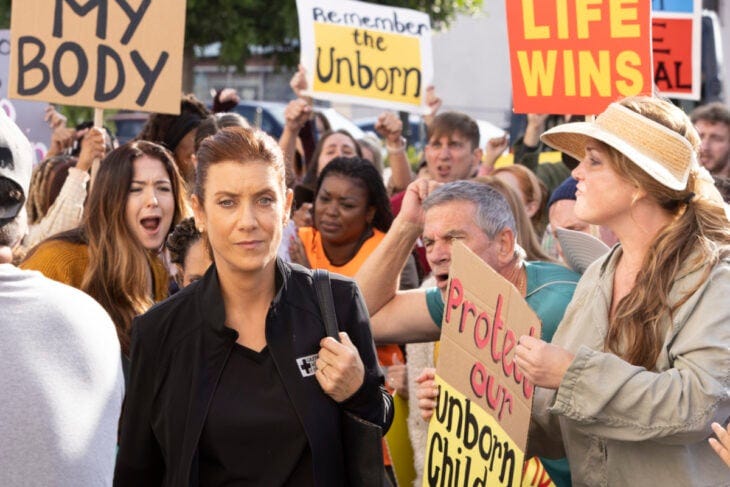
The Exception Olympics
Medical dramas love rules. Not medical rules, moral ones.
You can have an abortion if:
the pregnancy is ectopic and might kill you (Chicago Med, “Look Closely and You Might Hear the Truth,” S8E19, 2023),
you were raped (Chicago Med, “Take a Look in the Mirror,” S10E13, 2025),
the fetus is incompatible with life,
or the state has tied doctors’ hands so tightly someone bleeds out for the lesson (Grey’s Anatomy, “When I Get to the Border,” S19E5, 2022).
These are the “good abortions.” The respectable abortions. The ones that come with suffering baked in so the audience doesn’t have to feel weird about it.
Which is why Chicago Med keeps returning to ectopic pregnancy like it’s a comfort blanket. Different women, same setup. Termination framed as rescue. Choice neatly sidestepped. Everyone nods solemnly and agrees this is Very Serious Medicine, Not Politics (see again “Look Closely and You Might Hear the Truth,” 2023; “Take a Look in the Mirror,” 2025).
Clinically, ectopic pregnancies are dangerous. Narratively, they’re a cheat code.
They let shows depict pregnancy termination without admitting that abortion is something people choose for normal, boring, life reasons. You know. Money. Kids. Mental health. Survival.
Ectopic pregnancy is the narrative hand sanitizer. It cleans abortion of autonomy.
When TV Pretends It’s Progressive…Then Blinks
Grey’s Anatomy is particularly good at this sleight of hand.
The show will absolutely say “abortion” out loud. It will have doctors calmly explain it. It will act like it’s being very grown-up about the whole thing (see Grey’s Anatomy, “I Can See Clearly Now,” S21E3, 2024).
And then, it will blink.
Take the episode where abortion is medically safer before surgery. Everything is set up for an honest reckoning. And then, miracle! Surgery works! Everyone lives! The baby survives! Cue the swelling music and collective sigh of relief (“I Can See Clearly Now,” 2024).
The message is subtle but clear: abortion is an option… unless you’re brave enough not to need it.
This is how TV has learned to handle abortion in the post-Dobbs era: mention it, but don’t let it happen unless the universe itself insists.
Abortion becomes a test of character. If you’re strong enough, selfless enough, lucky enough, you won’t need it after all.
Which is a lovely fantasy. And a deeply dishonest one.
The One Episode That Actually Gets It Right
There’s a reason one Grey’s Anatomy episode stands out so sharply once you start paying attention.
A Latina mother of two. Overwhelmed. Exhausted. Honest about loving her kids and knowing she can’t do this again. Worried about postpartum mental health. Asking the most real question imaginable:
“How much is an abortion?” (Grey’s Anatomy, “All Star,” S19E8, 2023)
No miracle saves. No moral punishment. No tragedy required.
She gets the abortion. It’s calm. It’s routine. She’s relieved.
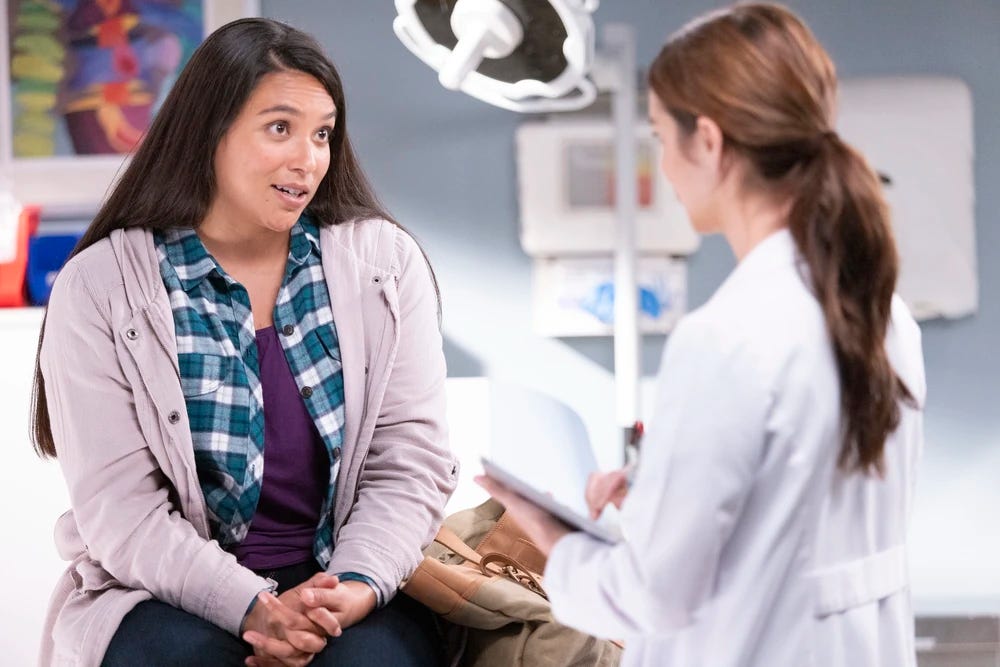
That’s it.
And that’s exactly why it feels radical.
Because it treats abortion as healthcare, not a moral referendum. Because it centers parenting labor and mental health instead of romanticized sacrifice. Because it shows what abortion actually looks like for a huge percentage of real people (“All Star,” 2023).
And because it refuses the lie that women need to be destroyed a little in order to deserve autonomy.
Why This Matters More Than TV Writers Want to Admit
Medical dramas like to pretend they’re just telling stories. But they aren’t.
They’re teaching audiences what kind of pain counts. What kind of person deserves care. What kind of abortion is socially forgivable.
When abortion is almost always framed as catastrophe, audiences absorb the idea that abortion is inherently tragic, even when they support the right in theory.
When parenting, money, work schedules, and mental health barely appear, audiences learn to see abortion as a personal moral failing instead of a structural necessity.
And when the only “safe” abortion stories are emergencies, the people who don’t meet that threshold quietly disappear.
That’s not neutral representation. That’s cultural training.
The Lie at the Center of All This
The biggest lie TV keeps telling about abortion is this:
That the problem is choice.
It isn’t.
The problem is conditions.
Money. Time. Safety. Childcare. Mental health. Whether the system will let you survive the process without punishment.
When shows refuse to tell those stories, they’re not being apolitical. They’re preserving a fantasy where autonomy exists in a vacuum and suffering is the price of legitimacy.
And when they do tell those stories, even once, it’s obvious how much has been missing.
Which tells us something important.
TV absolutely knows how to do better.
It just usually chooses not to, unless someone is bleeding out first.
And in a post-Dobbs America, where abortion access already depends on zip code, luck, and survival, TV’s obsession with “acceptable” abortions isn’t harmless, it’s conditioning.
As someone who studies abortion on TV and film, just wanted to say a huge THANK YOU for this!
There a storyline of The Pitt with a teenaged girl that might fit the bill. There’s conflict with the mom but she eventually gets it. No mitigating circumstances. A terrified girl, a sympathetic aunt, a moralistic mom, and doctors who are ready to help.
Refreshing.