
We Were Not Being Hysterical
A look back at May 3, 2022, when the leaked Dobbs draft made clear that Roe was not the end of the fight, but the opening shot in a much larger war over privacy, autonomy, and power.

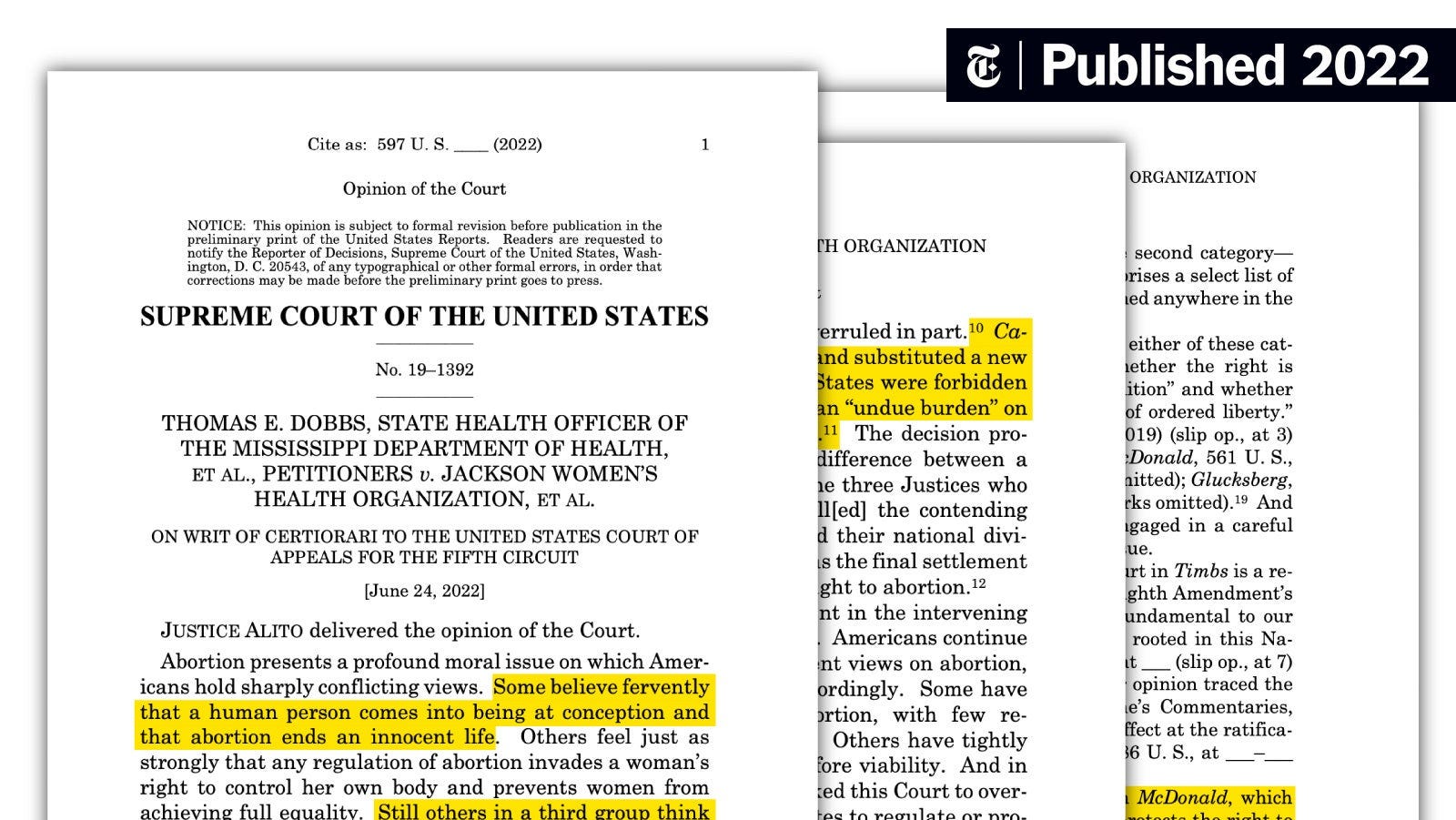
The night the Dobbs draft leaked in May 2022, I wrote that I was terrified not only because of what it meant for abortion, but because of what it meant for the entire legal framework of privacy, bodily autonomy, sex, marriage, and family life.
I’m a lesbian. The chance that I will ever personally need an abortion is low. Not zero, because life is messy and violence exists, but low.
And I was still horrified.
Because reproductive rights were never only about abortion.1
They were about whether women and pregnant people are full legal persons with the right to make decisions about their own bodies. They were about whether the state can force pregnancy, punish sex, and call it morality. They were about whether privacy actually means privacy, or whether your most intimate decisions exist only until five justices decide someone else’s theology matters more.
Women were already unequal in this country. Losing Roe shoved us another rung down.
And I said then that this was the first step in something much worse. That Griswold, Lawrence, and Obergefell were next in the ideological firing line. Maybe even Loving, if they ever got bold enough to stop pretending this was only about abortion.
That was not paranoia.
That was reading the room while the room was actively on fire.
Because Roe was not some isolated abortion case floating alone in constitutional space. It was part of a larger framework around privacy, bodily autonomy, contraception, intimacy, marriage, and family life. The right to access birth control. The right to marry across racial lines. The right to have consensual sex without being criminalized. The right for same-sex couples to marry.
These cases were not identical, but they were connected by a basic question: does the government get to invade your private life and dictate what you can do with your body, your partner, your marriage, your family, and your future?
The answer, for decades, was supposed to be no.
Then came Dobbs.
And suddenly, the answer became: well, it depends who you are, what state you live in, what your body is capable of, and how much your private life offends the people currently holding power.
Which is not exactly a comforting constitutional doctrine.
It is worth remembering, too, that the current anti-abortion position was not handed down on stone tablets between the Ten Commandments and a casserole recipe.
The Southern Baptist Convention supported abortion access in the 1970s, including after Roe v. Wade. In 1971, the SBC passed a resolution calling on Southern Baptists to support legislation that would allow abortion in cases of rape, incest, severe fetal deformity, and “carefully ascertained evidence” of likely damage to the emotional, mental, or physical health of the mother.
So no, the absolutist anti-abortion politics we see now were not some eternal, unchanging Christian consensus. They were built. Revised. Politicized. Fundraised off of. Weaponized. Then sold back to the public as if Jesus personally drafted the GOP platform in a church basement with bad coffee.
Even within Christianity, the question of when life, personhood, or ensoulment begins has not been as simple or consistent as modern religious conservatives like to pretend. Thomas Aquinas believed in delayed ensoulment, not ensoulment at conception. That does not make Aquinas pro-choice, because history is not a vending machine where you insert one quote and receive a modern political platform.
But it does make the absolutist claim that “everyone has always known life begins at conception” historically flimsy.
And that matters.
Because if your own religious tradition has debated this for centuries, and your denominations have changed their position within living memory, then what right do you have to use the state to force your theology onto everyone else?
Especially onto women and pregnant people who may not share your religion at all.
This is the part that so often gets buried under the rhetoric of “life.” Anti-abortion politics are framed as moral clarity, but in practice they produce legal chaos, medical danger, and state-enforced suffering.
Banning abortion does not stop abortion. It stops medically safe abortion.
It turns pregnancy into a legal hazard and miscarriage into a crime scene. It forces doctors to call lawyers before treating patients. It makes desperate people more desperate, and then pretends the suffering was an unfortunate side effect instead of the policy doing exactly what it was built to do.
Every woman denied lifesaving care because a hospital is afraid of prosecution?
Every pregnant person forced to carry a nonviable pregnancy while politicians congratulate themselves for “protecting life”?
Every woman trapped in poverty because childbirth bankrupted her, derailed her education, or tied her more permanently to an abusive partner?
Every child pushed into an already underfunded, overburdened system by the same people who will not fund healthcare, childcare, housing, food assistance, public schools, or paid leave?
That is not a tragic accident.
That is the bill coming due.
And we all know the people screaming “life” the loudest are not about to build the systems that actually help people live. They are not lining up to expand welfare. They are not fighting for universal healthcare. They are not demanding affordable childcare, paid parental leave, safe housing, better schools, or protection from intimate partner violence.
They want forced birth, followed by austerity, followed by moral lectures about “personal responsibility.”
Because this was never really about life.
It was about power.
And the minute they start coming for Griswold, Eisenstadt, Lawrence, Obergefell, and maybe even Loving, they will prove the point they keep insisting we are hysterical for making.
They will not be able to help themselves.
Because the goal was never simply to “save babies.”
The goal was to decide who gets autonomy. Who gets punished for sex. Whose families count. Whose bodies become public property. Whose private life can be dragged into court and disciplined by someone else’s religion.
And yes, when the draft leaked, people said we were overreacting.
They said we were being dramatic.
They said we were catastrophizing.
Years before they had said the Court would never actually overturn Roe.
Then it did.
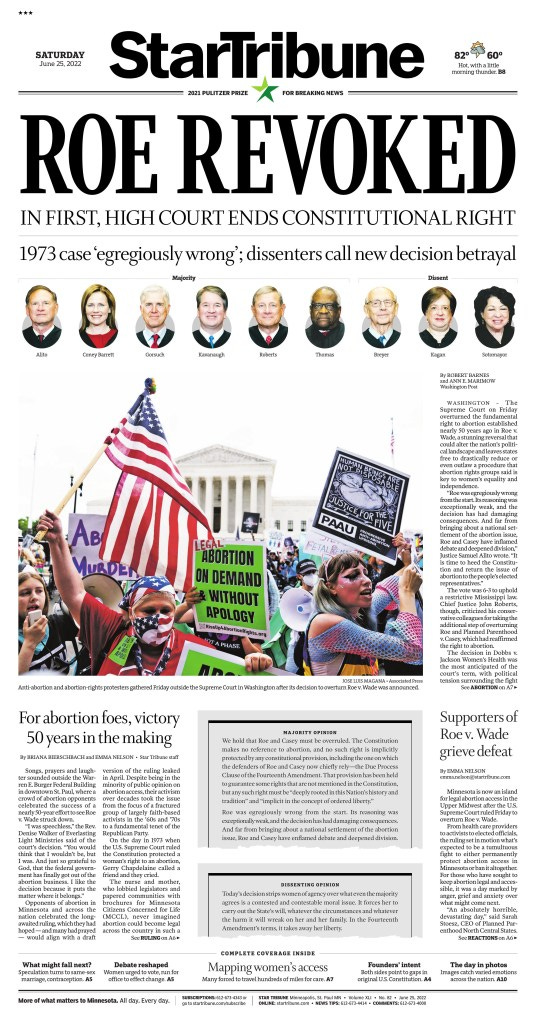
So I’ll say now what I said then:
I dare anyone to tell me I was being irrational.
I fucking dare you.
Because “hysterical” is what people call women when we notice the knife before it lands.
And I noticed.
So did millions of others.
The tragedy is not that we were wrong.
The tragedy is that we were right.
The tragedy is that we have continued to be right.
And even if it were and I never needed that form of healthcare, many people I dearly love and many I don’t know have needed and will continue to need it and that is enough to be terrified by the loss.
In the early 2000s, I told my Psychology of Women students that the fight over abortion was just the shot across the bow, that they'd be coming for much more, including birth control. My students told me they'd never come for birth control, that it was too well-established. Uh huh. Sometimes it really hurts to be right.
Nope we weren’t being hysterical then and we are not being hysterical now.