
What Ready or Not 2 Understands About Women, Power, and Satanism (AKA: The Patriarchy)
This will have spoilers.

Before we go any further, we need to establish one thing: in the world of Ready or Not 2, Satanism is less a religion than a metaphor for patriarchy.1
That does not mean the metaphor always works, but it does mean the film makes more sense when you read its rituals, hierarchies, and violence as a gendered power structure rather than just spooky rich-people nonsense.
And once you do that, the film becomes much more interesting.

Because Ready or Not 2 is not just interested in bad men (and women) doing bad things. It is interested in systems. In inheritance. In the way power survives by turning itself into tradition, obligation, and inevitability. It is interested in what happens when people stop asking whether a structure is moral and start asking only how to survive inside it.
That is where the film is at its sharpest.
It is also where it is most frustrating.
Because while the movie clearly understands that the problem is systemic2, it keeps displacing that system onto a shadowy cabal, a cursed elite, a family structure so grotesque and ritualized that it can be safely contained within the logic of horror. Which is useful for the movie, aesthetically speaking, but limiting politically. The implication is that the evil is hidden, secret, extraordinary. And sometimes, yes, it is. There is something undeniably Epstein-esque in the film’s understanding of power as a closed network of wealthy people protecting violence through secrecy, status, and mutual benefit. But patriarchy does not require a robe, a ritual, or a goat sacrifice. Most of the time it looks much more normal than that.
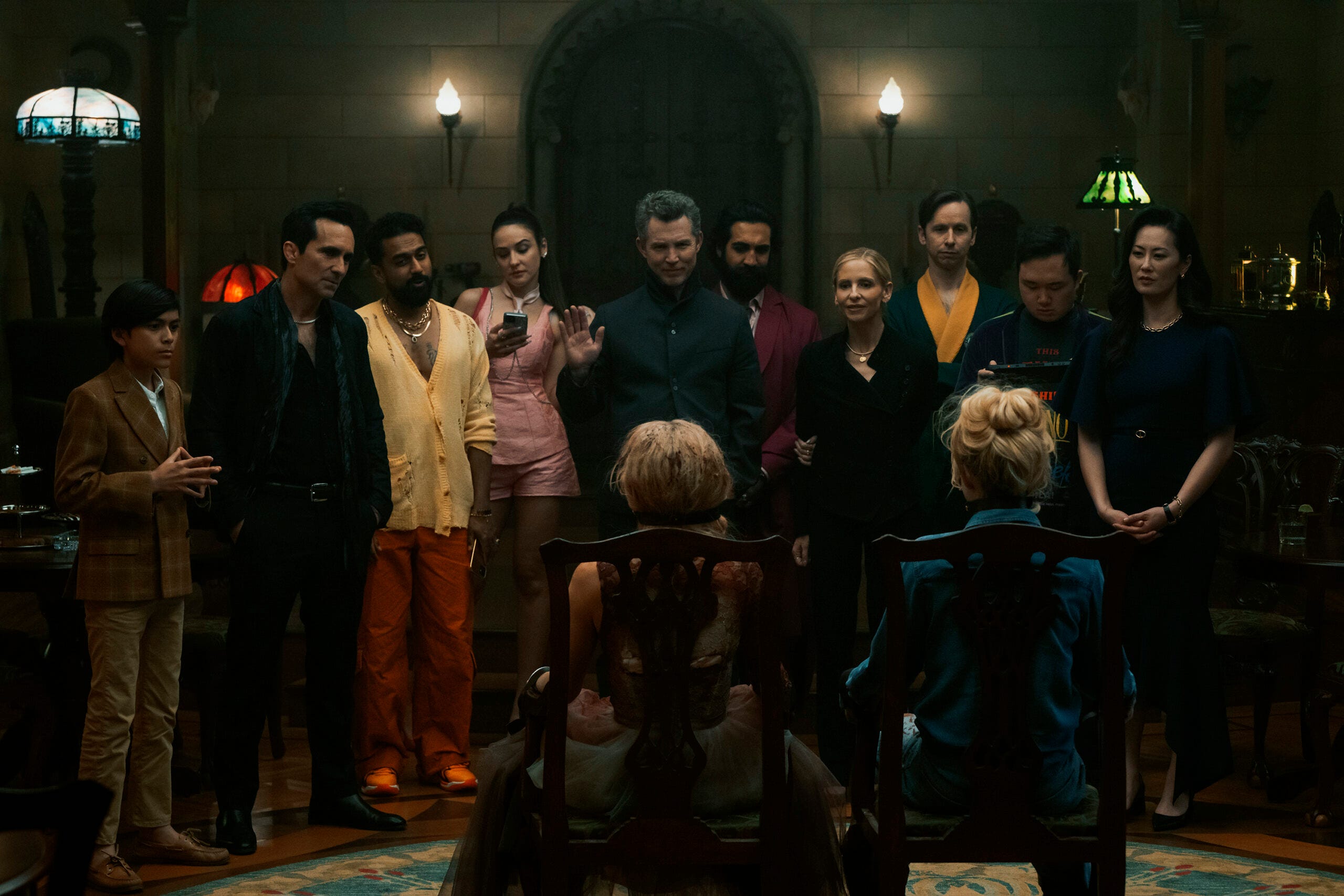
Still, the film knows enough to keep tugging at that larger truth, even when it does not fully follow it.
The clearest example of that is Ursula Danforth.

Ursula is not a true believer in the sense that Titus is. She is not driven by the same naked, ecstatic entitlement and bloodlust. What she is, instead, is a manager. An interpreter. A woman who has convinced herself that the system can be handled if the right people are sitting close enough to the center of it. She does not deny that it is violent. She does not pretend it is just. But she seems to believe it can be moderated. Softened. Steered. At one point, she suggests that between herself and Grace, they could control Titus. That they could use the high seat to keep him from becoming the system at its most openly monstrous.
And that is such a recognizable patriarchal fantasy that it almost hurts.
It is the fantasy that women can survive proximity to power by becoming indispensable to it. That if they are smart enough, disciplined enough, useful enough, they can take the structure built to dominate them and learn to operate it in a less brutal way. Not destroy it. Not escape it. Manage it.
Then the film kills her.
And that death matters.
Because Ursula does not fail because she misunderstands the system. She fails because she understands it and still thinks that understanding will protect her. That competence will buy her safety. That usefulness will translate into authority.
It doesn’t.
Her death makes brutally clear that women are allowed to help stabilize the structure, rationalize it, and even administer it, but that is not the same thing as actually possessing power within it. She can manage the machinery. She cannot own it.
Ursula is not alone in that delusion, either. Wan Chen Xing operates with a different style, but the same underlying logic. Her response is immediate: go to the rules, go to the lawyers, go find a harm-mitigation strategy. On paper, that strategy helps Grace. In practice, it is also about Wan Chen Xing securing advantage for herself, preserving her family’s position, and using Grace as the vehicle to get closer to the high seat by marrying her off to Xing’s hapless manchild gamer son. Grace is not being freed from the system. She is being rerouted through it in a way that is more profitable to someone else.
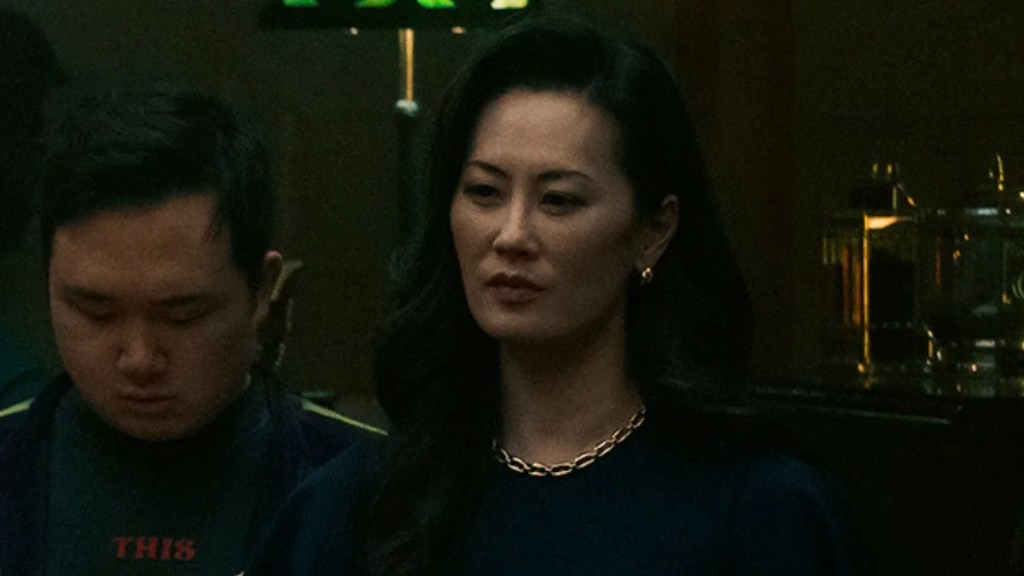
That is what makes both Ursula and Xing so interesting. Neither imagines liberation. Both imagine management. Both believe the structure can be worked, negotiated, softened, or strategically redirected. And the film keeps showing, over and over, that this is not the same thing as control.
The high seat is still a trap.
You can see that same logic elsewhere in the film, particularly in the way men redistribute danger while holding onto power. Madhu Rajan selling out his wife by making her head of the family so he does not have to hunt is such a perfect little example of patriarchal sleight of hand that I almost have to admire its audacity. On paper, it looks like elevation. A promotion. A woman placed in charge. In practice, what he is actually handing her is exposure. Liability. Risk. The title changes; the structure does not. He gets distance from the violence while she inherits the consequences.

That is not empowerment. That is outsourcing.
And that pattern sits right next to the film’s other big idea: that within patriarchal systems, women are never just excluded from power. Very often, they are folded into it in ways that require them to administer their own subordination.
That is where Francesca becomes so interesting.
Because yes, on a basic character level, her anger at Grace rather than Alex is maddening. Alex is the one who betrayed her. Alex is the one who made the promise and broke it. Alex is the man in the middle of the whole thing. And yet Francesca’s rage lands on Grace. On the woman. On the rival. On the female body nearest at hand.3
Patriarchy has always been extraordinarily efficient at redirecting women’s anger away from the men who built the problem and toward the women forced to survive it. It turns women sideways, against each other, while the structure that harmed them remains intact and weirdly unbothered. Francesca does not invent that logic. She inhabits it.
So does Ursula, in a different way. She wants Grace not to destroy the system, but to help govern it. To become legible within it. To join her in the fantasy that if the right women are allowed close enough to power, they can make it less violent.
The film, to its credit, does not reward either strategy.
Then there is Titus, who is what happens when patriarchal entitlement stops bothering to dress itself up as chivalry, romance, or order and just comes stomping into the room covered in blood. Titus is not subtle. He does not have Ursula’s belief in management or reform. He is the system in its most openly misogynistic form: possessive, punitive, ecstatic in its own cruelty.

His treatment of Faith makes that especially clear when he corners her. The overkill matters because it is not necessary. It is expressive. She is not even the woman he needs to kill to win the game, and it does not matter. She’s a woman that has defied him. Emasculated him. The violence exceeds function because the point is not simply elimination. The point is domination. Punishment. Display.
And the way he speaks to Grace carries the same logic. When he says, in essence, that he would be the one to get her, the line collapses marriage and murder into the same possessive framework. To “get” a woman, in this film, can mean to marry her, own her, catch her, kill her. The distinctions start to blur because from Titus’s perspective they were never especially meaningful to begin with. All are forms of acquisition. All are expressions of control.
That is why the object language in the film matters so much.
When the men refer to Grace and Faith as things rather than people, the dehumanization is not incidental. It is not just cruelty for flavor. It is the language of ownership. Of handling. Of inventory. Women in this world are not subjects moving through the plot with full personhood; they are targets, vessels, prizes, liabilities, bargaining chips. Some are put on pedestals, some are put in charge, some are marked for death, but all remain trapped within the same basic logic of possession.
And that is what makes the Satanism metaphor work, even when it also fails.
It works because the rituals do successfully dramatize something real about patriarchal power: that it reproduces itself through inheritance, loyalty, coercion, and the constant reframing of violence as duty. It works because it makes visible the machinery of gendered hierarchy. It works because it shows how women can be invited close to power without ever being safe from it.
But it also fails because it risks making patriarchy feel too theatrical. Too niche. Too secretive. Too easy to locate in a gothic elite network rather than in the broader social world that made that network possible in the first place.
That is the film’s central contradiction.
It understands that the system is the problem. It just gives that system a face strange enough that the audience can keep a little distance from it.
Beneath the blood and ritual and mansion-gothic madness, Ready or Not 2 is circling a much uglier, more familiar idea: that women can be permitted access, influence, titles, and responsibility within patriarchal systems without ever being given real control over them. They can keep the machine polished. They can feed it. They can explain it. They can even be asked to defend it.
But they cannot save themselves by serving it.

That is what Ursula never understands in time. It is what Francesca cannot see. It is what Madhu’s wife is forced to embody. And it is what Titus, in all his grotesque transparency, makes impossible to ignore.
The film’s horror is not just that women are treated as property.
It is that some of them are invited to help manage the auction and are taught to mistake that for power.
At least as far as I’m concerned, was that the intent of the film’s directors…idk. Could be.
Ursula Danforth’s little speech in the woods while hunting Grace is almost too on the nose.
Admittedly it would be harder for her go after Alex as he’s now a congealed puddle of blood from his…exploding at the end of the first movie, but even if he was around, I get the feeling Francesca would still be out for Grace instead of him.
Or how the Five Nights at Freddy’s Franchise is a metaphor for slavery, mind control and child sex traffickers…it seems that we have allegory everywhere because this pdf cult runs the world.