
Why College Girls Dressed “That Way”
How a 1946 newspaper article turned college women’s comfort into a postwar gender crisis.

I love a cursed primary source. Not necessarily an evil one. Not always a dramatic one. Sometimes the best historical artifacts are not the official speeches, the manifestos, or the laws written by men who sound like they were upholstered in mahogany. Sometimes the really revealing sources are the little throwaway pieces. The mildly amused newspaper columns. The fashion commentary. The cultural observations written in the tone of someone peering over a teacup and saying, “Isn’t it funny how girls are these days?”
That is where history gets wonderfully nosy.
Because a cursed primary source is often not cursed because it is unusually hateful. It is cursed because it is ordinary. It says the quiet part politely. It reveals the assumptions everyone was already breathing in. It does not announce itself as ideology. It arrives wearing a hat, makes a few jokes, compliments a girl’s figure, and quietly drags the furniture of patriarchy back into place.
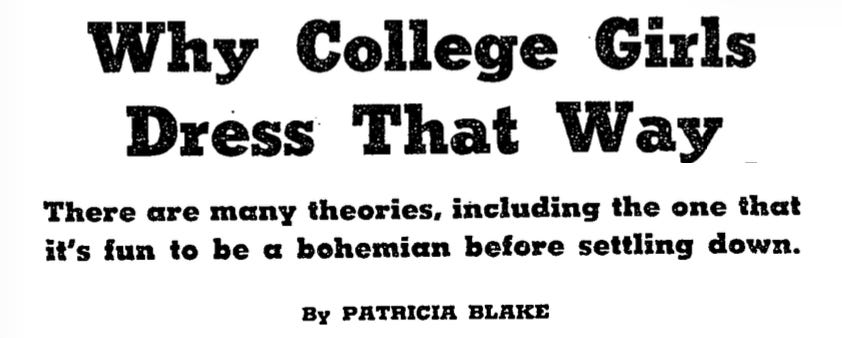
Which brings us to Patricia Blake’s 1946 New York Times article, “Why College Girls Dress That Way.” The piece was published on April 7, 1946, less than a year after the end of World War II, and it asks one of the great urgent questions of the postwar age: why are college girls wearing sweaters, slacks, men’s shirts, old coats, jeans, moccasins, military castoffs, and generally dressing like they have a body they intend to use rather than display? The article’s subtitle offers several explanations, including the apparently comforting idea that it is “fun to be a bohemian before settling down.”
There it is. The whole cultural situation, folded into a single sentence like a cursed napkin swan.
The article presents itself as a light little study of campus fashion. It is not screaming that women belong in the home. It is not a fire-and-brimstone sermon about the collapse of womanhood. It is not one of those anti-feminist texts that bangs pots and pans while warning that if women get too much education, civilization will immediately slide into a ditch. It is softer than that. Smilier. More amused. It looks at young women on college campuses and treats their clothes as a charming anthropological puzzle.
But that is exactly what makes it useful. This is not just an article about clothes. It is an article about containment.
The opening image of the article is doing a lot of work. Blake describes spring arriving on ivy-covered campuses, but instead of finding young women eagerly assembling Easter outfits, she finds them shedding winter layers into a new costume: old jeans, men’s shirts, broken-down moccasins, and various garments that suggest utility, comfort, and indifference to polish. It is a very funny visual, but the comedy depends on treating these women as a spectacle. Their clothes become evidence of a campus civilization operating by its own rules, one that apparently requires translation for the ordinary newspaper reader.
That translation matters. The women in this piece are not treated as women. They are treated as girls. Calling them girls makes their independence feel temporary. It makes their choices seem playful rather than deliberate. A woman in slacks might be making a choice about comfort, mobility, practicality, money, gender, sexuality, aesthetics, or indifference to male approval. A girl in slacks is just going through a phase. Nothing to see here. She’ll grow out of it. Probably when someone puts a ring on her finger and gets her pregnant.

This is the article’s central trick. It notices women’s autonomy and immediately turns it into youthful experimentation. College becomes a kind of supervised rebellion zone, a place where young women can try on strange clothes and stranger selves before they return to the real business of life: marriage, domesticity, respectability, and being pretty in the approved direction.
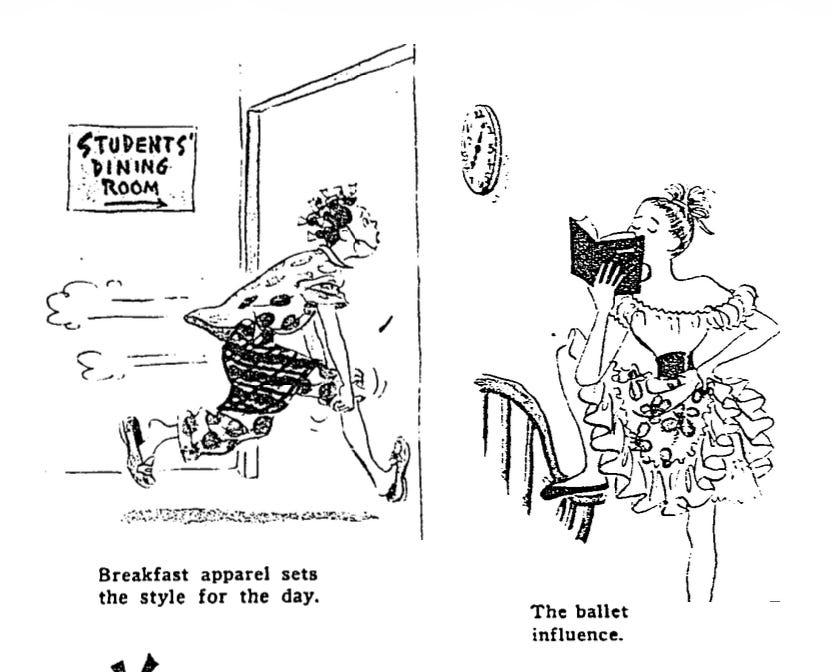
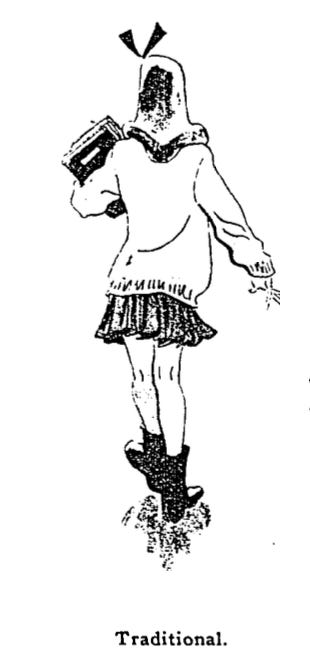
Blake’s campus is full of transformations. Professors, she suggests, might feel as if they have wandered onto a movie set, because the women’s clothing changes so dramatically depending on season, weather, day of the week, and social occasion. Rain turns students into seafaring figures. Winter turns them into bundled arctic creatures. May apparently produces farm-girl overalls. Sunday dinner produces a ballet influence. The point is not merely that their clothes are varied. The point is that their dress is theatrical, excessive, and unstable. These women are not presented as choosing outfits so much as performing identities.
That is important because performance is safer than politics. If women’s clothing is a costume, then their eccentricity can be dismissed as play. If their clothes are practical or expressive, however, then we have to start asking what needs those clothes are meeting. Are they dressing this way because they are moving around campus? Because they are living among other women? Because they are tired? Because they are cold? Because they are students rather than ornaments? Because they like not being pinched, polished, powdered, arranged, and displayed every second of the day?
The article comes close to some of these answers, but it keeps steering the reader back toward psychology and spectacle.
Blake is particularly fascinated by the weekend metamorphosis. The women who appear casual, sloppy, strange, or deliberately unpolished during the week reappear on Saturdays as elegant, groomed, date-ready beings. Parents visiting on weekends supposedly wonder where all these lovely students have been hiding, not realizing they are the same women they passed earlier in the week in campus garb. A historian, Hans Kohn, is even invoked as someone who can understand European historical movements but not recognize his students off campus.
This is funny, but it is also doing ideological labor. The article reassures readers that conventional femininity remains available. The same women who wear jeans and men’s shirts to class can become fashionable when the occasion demands it. They have not abandoned beauty. They have only put it on a schedule.
And notice what causes that schedule to change: weekends, parties, football games, dates, men. During the week, at women’s colleges, they dress for campus life. On weekends, when male attention becomes more central, they transform. Blake makes this dynamic especially explicit when she discusses coeducational colleges, where women are said to dress carefully because of:
“the omnipresent male.”
That phrase is both a fashion theory and a threat assessment.
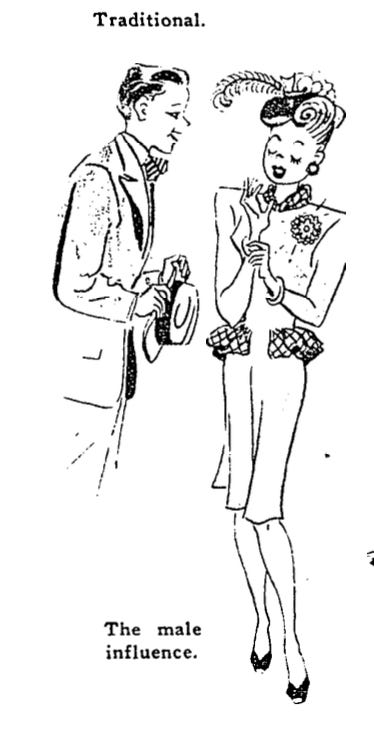
The underlying assumption is obvious: women’s dress is supposed to be tethered to male approval. When that tether slackens, things get suspiciously comfortable. The article wants to treat women’s clothes as bizarre, but what seems to bother it is not actually bizarreness. It is self-direction. The young women are not always dressing to be looked at by men. They are dressing for breakfast, bicycles, dorm life, weather, classrooms, friends, floors, deadlines, and themselves. They are dressing like people who have places to go and things to do. Apparently this required national explanation.
That matters because 1946 is not just any year. World War II had just ended. During the war, women had been recruited into factories, offices, farms, military auxiliaries, volunteer services, and technical work. They had been told, with patriotic urgency, that the nation needed their hands, brains, stamina, and labor. Then the war ended, and suddenly the culture discovered that this had all been a temporary emergency arrangement.
After the war, many women were let go because their jobs were again understood as belonging to men.
That is the larger world sitting behind this little fashion article. Women had been mobilized, then demobilized. They had been invited into public life, then nudged back toward private life. They had worn uniforms, work clothes, trousers, coveralls, practical shoes, and whatever else made sense when the task was welding, typing, driving, nursing, transporting, organizing, producing, or simply getting through the day. Then peacetime arrived and American culture began the delicate work of pretending that none of this had changed anything fundamental.
So when Blake describes college women adopting military garments, pilots’ helmets, pea jackets, insignia, and borrowed uniforms, she is not just describing a campus fad. She is describing the afterlife of wartime gender disruption. These young women were wearing the symbols of mobility, authority, service, and public seriousness.
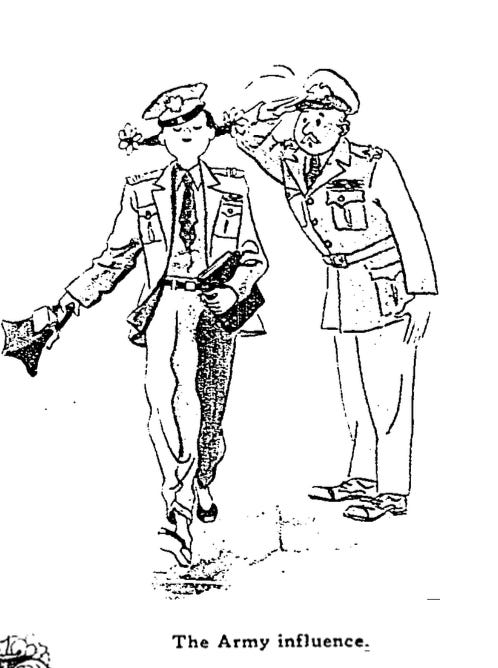
The article tries to make that funny. It presents the military influence as an odd reverberation of the war, something that looked especially careless next to properly uniformed WAVES on campus.
A military jacket on a college woman in 1946 is not just a quirky garment. It is a reminder that women had participated in the war effort, that women had taken up space in institutions previously defined as male, and that women’s proximity to uniforms was no longer entirely ornamental. Even if the jacket was borrowed from a returning man, the effect was still gender trouble in wool.
The article also treats casual dress as a class performance, a way for privileged women to play at artistic poverty without experiencing actual precarity. Blake suggests that students enjoy looking like intellectuals, artists, or poor people precisely because they are not actually any of those things in any material sense. College becomes a theater where elite young women can borrow the aesthetics of bohemian life while remaining protected from its discomforts.
This is one of the sharpest moments in the article, even if Blake does not draw out all its implications. The “college girl” here is not an everywoman. She is elite-coded, northeastern, white by implication, and cushioned by respectability. The world of the piece includes Wellesley, Vassar, Smith, Yale fathers, Dartmouth weekends, ski clothes, house parties, and the assumption that these students will eventually settle into socially approved lives. Their rebellion is permitted because it is class-buffered. A wealthy college girl in slacks is eccentric. A working-class woman in practical clothes is often just judged.
That distinction matters. The article is amused by these women because it assumes their deviance is temporary and manageable. Their families can afford the experiment. Their institutions can absorb the eccentricity. Their future respectability is presumed. The slacks are not allowed to mean too much because the marriage plot is waiting in the wings with a wedding dress and an apron.
There is a real critique there, but the article bends it back toward the marriage plot. These women can play at being unconventional because they will eventually return to convention. Their flirtation with bohemianism is framed not as the beginning of an adult intellectual life, but as a story they can tell themselves before marriage and children. They can imagine they have experienced life fully, then settle down with the satisfaction of having briefly worn the costume of rebellion.
That is the emergency exit. Whenever college women’s choices start to look too autonomous, the piece reassures the reader that this will all end. The bohemianism is temporary. The sloppiness is temporary. The unfeminine comfort is temporary. The campus is a little holding pen for experimentation before young women are returned to the softer cage of domestic normalcy.
This is why the subtitle matters so much. It tells readers how to interpret women’s experimentation without fearing it. Yes, students may dress strangely. Yes, they may look intellectual, artistic, careless, masculine, military, or defiantly comfortable. Yes, they may live among other women and develop styles that are not organized around male approval. But do not panic. It is only temporary. It is only college. It is only youth. It is only a costume.
Marriage will fix it.
Blake also frames campus clothing as group identity. The women, she argues, want to be recognized as college women, almost as if their clothing works like a label attached to luggage. Their sweaters, skirts, moccasins, jeans, and eccentric combinations become a visual declaration of institutional belonging. This is where the article moves from fashion commentary into amateur psychology, describing campus style as:
“academic exhibitionism”
It is such a useful phrase because it reveals how quickly women’s group identity becomes suspicious. Men’s collegiate clothing traditions can be interpreted as school spirit, institutional culture, or youthful masculinity. Women’s collegiate clothing traditions become exhibitionism, insecurity, instability, competition, and conformity. The article is not entirely wrong that clothing can be about belonging. Of course it can. Fashion is social. But the interpretive generosity is not equally distributed.
This is one of patriarchy’s most reliable party tricks: when men develop a group aesthetic, it is culture. When women do it, it is neurosis.

That neurosis framing becomes even clearer when Blake discusses what happens to individuality. She argues that mass dress gives the college woman confidence on campus, but that once she returns home to the admiration of family and friends, she can abandon:
“herd psychology”
Again, the point is not that Blake has invented the idea that young people dress like their peers. Of course they do. College students still do this. Humans are social animals with laundry. The issue is that the article interprets women’s collective style as a failure of selfhood, while also insisting that the proper restoration of individuality happens at home, under the admiring gaze of parents and friends. In other words, the campus community of women is treated as destabilizing, while the family home is treated as secure and individuating.
That is not subtle. That is domestic ideology.
Deirdre Clemente’s Dress Casual helps flip the article’s premise on its head. Clemente argues that the modern casual American wardrobe emerged from college spaces: classrooms, dormitories, gyms, fraternities, and sororities. In other words, the students being treated as odd little fashion goblins were not failing to dress properly. They were helping invent American casual style.
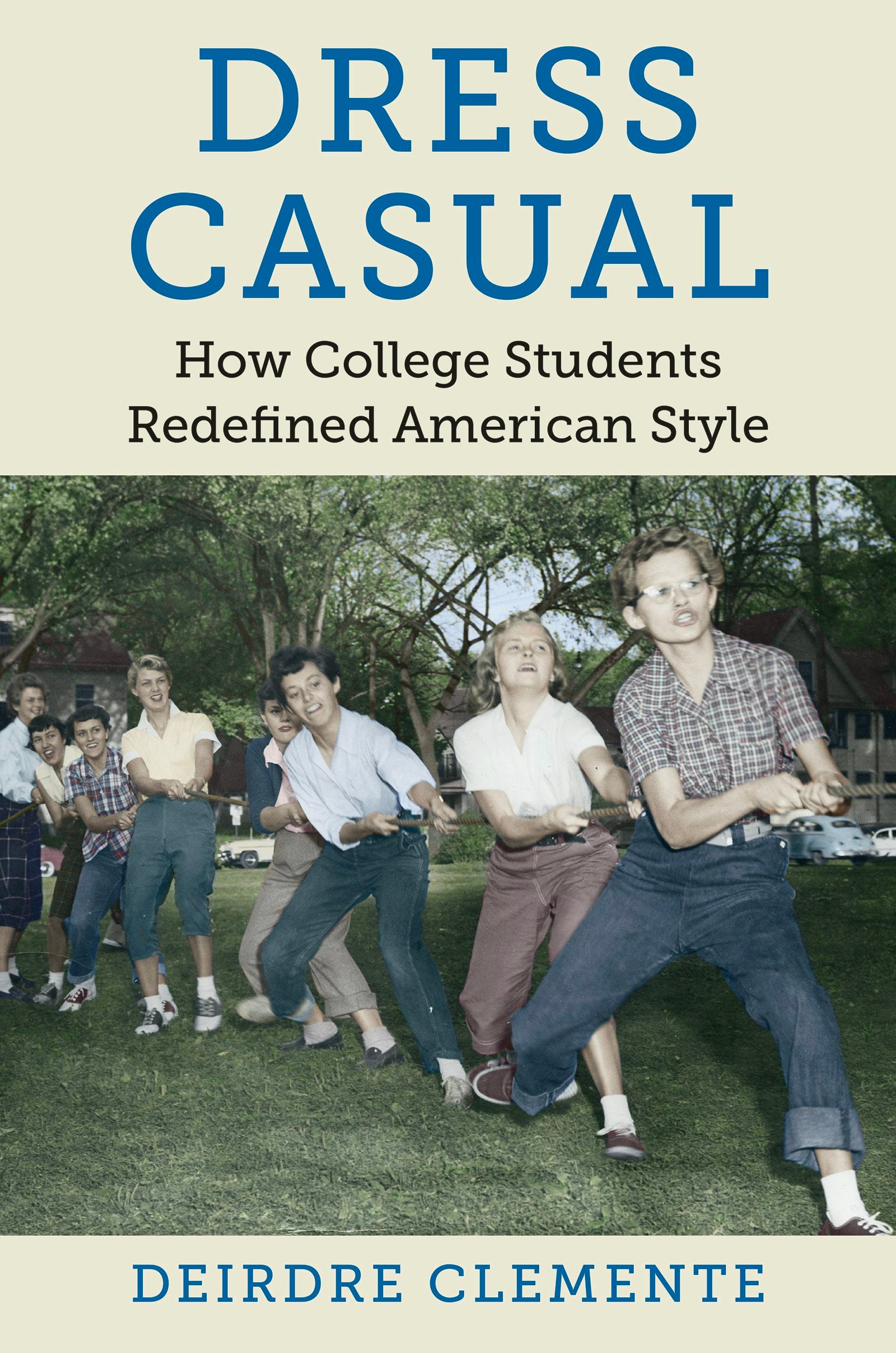
That makes Blake’s article even better as a primary source. It captures a cultural shift while pretending it is only observing a campus nuisance. Casual clothing was not simply laziness. It was practical. It was comfortable. It suited bodies in motion. The scandal, then, was not that college women dressed badly. The scandal was that they dressed usefully and for themselves.
The article even admits this, though it tries not to linger on the implications. Campus life required clothes that worked: for bicycling, for sitting in unladylike positions, for rushing into dining halls, for studying, for moving through the day without dedicating every available minute to decorative maintenance. At one point, Blake gives the stock student defense of campus clothing:
“free and comfortable.”
A horrifying confession. Comfort. In public. During daylight hours. Civilization wobbles.
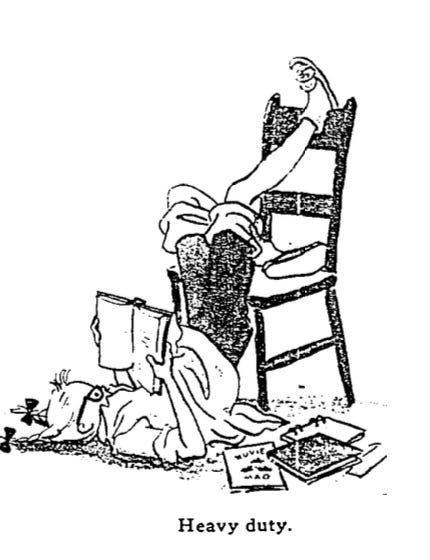
This is the danger of casual clothing in this source. Not that it makes women unattractive, though the article certainly circles that possibility with the nervous energy of a 1950s housewife separated from her tranquilizers. The danger is that casual clothing lets women prioritize something other than being seen correctly. It gives them speed, ease, warmth, looseness, and the ability to sit on the floor without turning into a morality play.
Blake tries to undercut the freedom argument by saying the students have merely exchanged one stereotype for another. Many came from strict boarding schools where uniforms had been compulsory, she explains, and now they have simply embraced a new campus uniform of casual disorder. There is truth there. Campus casual clothing had its own expectations, rules, and hierarchies. The article notes that the person who truly wants to be different from the group is not necessarily celebrated.
But this is where the source becomes especially revealing. Blake is right that campus style could be conformist. She is right that “freedom” does not magically appear because a woman changes from serge to denim. But the article uses that observation to dismiss the whole possibility that comfort could still matter. Clothing can be both conformist and liberating. A uniform can be freely chosen and socially enforced. A pair of slacks can be a trend and still be more useful than the alternatives. Women do not need to achieve perfect philosophical autonomy before they are allowed to enjoy freedom of movement.
The timing also puts this article right before the postwar fashion world swings hard toward a renewed ideal of emphasized femininity. During World War II, fashion was shaped by rationing, uniforms, and practical design. Dior’s 1947 “New Look” helped define a postwar turn toward fuller skirts, rounded shoulders, and a more elaborate feminine silhouette.
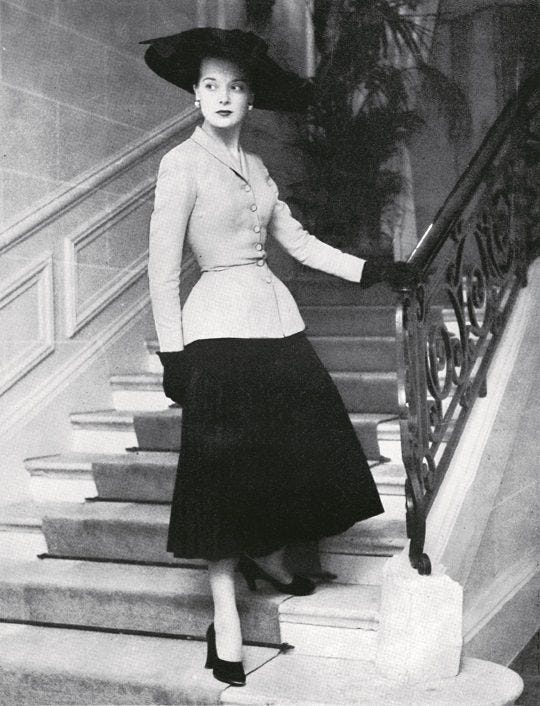
Blake’s article sits in that fascinating in-between moment. The war has ended, but the full domestic fantasy machine has not yet finished reassembling itself. The women in the article are still wearing the residue of wartime practicality: slacks, jackets, layers, uniforms, sturdy shoes, and clothes that prioritize movement over display. They are not yet fully folded into the later 1940s and 1950s ideal of the polished domestic woman, but the article is already doing some of that folding rhetorically. It is smoothing the wrinkles of autonomy out of the garment before the decade hangs it back in the closet.
Linda Eisenmann’s work on women’s higher education after World War II helps clarify the stakes. Her study of postwar advocacy for women’s higher education emphasizes that this advocacy had a distinct relationship to the expectations of the era, and she links women’s wartime activism to the later women’s movement. That is exactly the tension Blake’s article accidentally reveals. Women’s colleges could be places of real intellectual and social development, but the culture around them often tried to interpret that development as preparation for better wifehood or as a temporary detour before domesticity.
That tension would become central to Betty Friedan’s critique in The Feminine Mystique. Friedan later argued that postwar American culture insisted women should find fulfillment in housework, marriage, sex, and children. This was part of a wider Cold War culture of anxiety and security, in which Americans tried to create an idealized home life with father as breadwinner and mother as housewife. The “feminine mystique” rested on the assumption that women should not want work, education, or political opinions if they were truly feminine.
The 1946 article is not making Friedan’s argument, obviously. It is doing the thing Friedan would later help name.
It treats college women as if their education, friendships, self-expression, and bodily comfort are all slightly unserious because their real adult lives are presumed to begin after they leave campus and become wives. It is not hostile in the obvious sense. It is not ranting. It is not angry. It is worse in some ways because it is affectionate. It likes these girls. It finds them charming. It enjoys their oddity. It just cannot imagine that their oddity might be meaningful beyond the courtship-and-marriage timeline.
That is the curse of this primary source. It is not trying to be villainous. It is trying to be cute.
And yet it reveals a culture trying to laugh women back into place.
The article’s final reassurance is that college women can still be pretty:
“when they want to be.”
That ending is doing the work of a tiny ideological border guard. After all the slacks, sweaters, military jackets, moccasins, jeans, and campus eccentricity, the reader is comforted with the knowledge that conventional femininity has not been destroyed. The girls are still pretty. They still know how to perform attractiveness. They have not become permanently unfeminine. Nobody needs to alert the authorities.
It is a strange little compliment with a leash attached.
Because the question was never really whether these women could be pretty. The question was whether prettiness would remain compulsory. Whether women’s bodies would remain public property for judgment. Whether education could become a route to adult selfhood rather than a scenic road to marriage. Whether clothes could serve women’s lives rather than organize women’s lives around being seen.
That is why this article matters. Not because slacks liberated anyone by themselves. Not because a borrowed pea coat was a revolution. Not because every college woman in 1946 was consciously engaged in some grand feminist project through the medium of denim and slacks. History rarely works that neatly, and clothing is never just one thing.
But clothes are also never just clothes.
They are rules, aspirations, anxieties, permissions, refusals, class signals, gender scripts, and little wearable arguments with the world. In 1946, college women’s casual dress carried the memory of wartime practicality, the culture of women’s campuses, the emergence of modern American casual style, and the unsettling possibility that young women might enjoy moving through life without constantly arranging themselves for male approval.
The article looks at all of that and says, essentially: how funny. How charming. How temporary.
And that is the point. Postwar America did not only send women back home through laws and employment policies. It did it through newspaper features, fashion commentary, advertising, psychology, sitcoms, marriage advice, campus rules, beauty standards, and an endless supply of cultural throat-clearing about what women were really supposed to become.
The slacks were not the scandal.
The scandal was that, for a few years on campus, young women looked almost comfortable in their own lives.
Absolutely spot on. And it hasn’t changed much. My daughter was reprimanded in elementary school for wearing a sleeveless dress for picture day. She was 10. It was her favorite dress. Apparently her arms were already a distraction.
I just overheard a college-educated woman colleague gush to a student intern who was clicking down the hall in high heels, “Oohh! You even sound pretty!”
Lots to unpack there.
Child-like, demure, quiet. I don't think I'm alone as an adult woman for having felt this way in some contexts by the weight of expectations around me. I can't even imagine how hard it must have been in the 40s. Fantastic essay.