
You Look Like Stevie Nicks in '75
Or: Why Patriarchy Keeps Making Women Compete With Themselves

A few days ago, someone responded to one of my posts about sexism in the twentieth century with a meme.
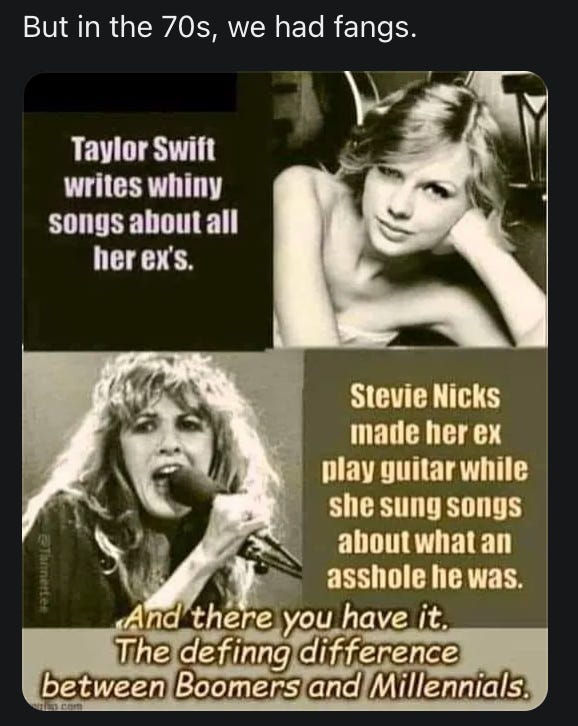
The meme contrasted Taylor Swift and Stevie Nicks.
Taylor Swift, according to the meme, writes “whiny songs about all her exes.”
Stevie Nicks, meanwhile, made her ex play guitar while she sang songs about what an asshole he was.
“And there you have it,” the meme concludes. “The defining difference between Boomers and Millennials.”

The joke is supposed to be that women used to be tougher. Cooler. Less emotional. Less self-absorbed. More willing to bite back.
The problem is that the meme accidentally reveals something much more interesting. It demonstrates one of patriarchy’s favorite tricks. Women are always being pitted against other women.
Sometimes older women.
Sometimes younger women.
But always other women.
Women are found wanting in comparison to the women who came before them. At the exact same time, they are expected to replace those women because the culture has decided the previous generation is too old to remain useful. A younger woman is told she will never be as good as Stevie Nicks. Meanwhile Stevie Nicks is informed that she’s old now and the industry has found a newer model.
It’s a remarkable scam.
Women are simultaneously judged against previous generations and expected to supersede them. The standards contradict each other entirely.
That doesn’t matter, because the point was never consistency of message, the point was to put women in competition with each other. It’s a strategy where patriarchy convinces women to mean-girl each other into dust so it has to do far less work keeping us in our place. Why bother wasting energy reinforcing cages yourself when you can convince the people inside them to police each other?
So women spend our time ranking each other:
Who is prettier.
Who aged correctly.
Who is too emotional.
Who is not emotional enough.
Who is empowered.
Who is cringe.
Who is authentic.
Who is manufactured.
Who is a feminist icon.
Who is secretly ruining feminism.
And while we are busy sorting women into acceptable and unacceptable categories, the system that created those categories gets to sit back and enjoy the show.
Women fighting women has always been one of patriarchy’s favorite labor-saving devices.
That is why this kind of comparison matters, because it isn’t really about music. It’s about teaching women that every other woman is the competition. Ironically, Taylor Swift understands this perfectly.
In fact, she wrote an entire song about it.
The song is called Clara Bow.
Most commentary around Clara Bow focused on fame. Certainly fame is part of it. But the song is really about replacement.
The song begins with Clara Bow, the silent film star who became one of Hollywood’s first “It Girls.”
Then it moves to Stevie Nicks.
Then it moves to Taylor Swift herself.
At every stage, a young woman is told she resembles the woman who came before her. She is assured that she is the next version. The better version. The newer version. The woman who will finally get it right. What sounds like praise is actually a warning, because every woman being compared is also being replaced.
The executive who says, “You look like Clara Bow,” is not celebrating Clara Bow. He is telling a young woman that Clara Bow is old news.
The executive who says, “You look like Stevie Nicks,” is not celebrating Stevie Nicks. He is telling a young woman that Stevie Nicks can be replicated.
And when the song finally reaches Taylor Swift herself, the message becomes obvious.
Taylor Swift is not the end of the process, she is merely the latest woman to pass through it. Someday another young artist will be told she looks like Taylor Swift. A point Taylor Swift has made before in songs she wrote earlier in her career.
I know someday I'm gonna meet her
It's a fever dream
The kind of radiance you only have at seventeen
She'll know the way and then she'll say she got the map from me
I'll say I'm happy for her then I'll cry myself to sleep
- Nothing New, Taylor Swift
The cycle will always begin again. The song explicitly uses Clara Bow, Stevie Nicks, and Taylor Swift as examples of how women are continuously compared, marketed, and replaced by the entertainment industry.
That is exactly what this meme is doing.
The meme thinks it is celebrating Stevie Nicks.
It isn’t.
It’s using Stevie Nicks as a stick to hit another woman with and if you genuinely admire Stevie Nicks, then you should probably listen to what Stevie Nicks actually says.
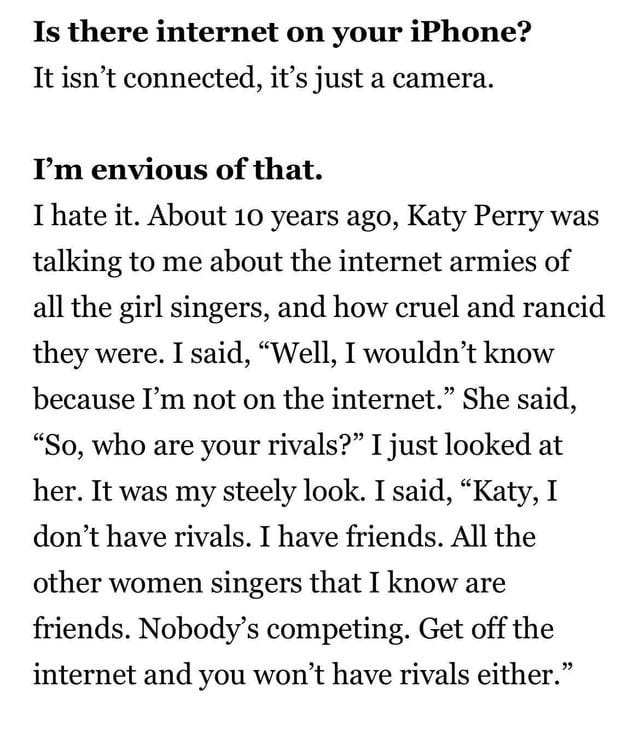
Stevie Nicks also explained that she was Stevie Nicks, Perry was Katy Perry, and that the entire idea of women competing with each other was ridiculous.
Which makes sense.
Because Stevie Nicks remembers how people talked about Stevie Nicks.
“Yes it’s 1977 and Stevie Nicks is the most popular, most visible, woman in rock. And she’s a joke. She’s an airhead, a puffball. … Stevie is a California girl prone to writing songs about witches, mysticism, and all the other shit one would conjure while sautéing in a Jacuzzi.”
The most frustrating thing about nostalgia is that it tends to erase the unpleasant parts.
People now talk about Stevie Nicks as though she emerged from the Pacific Ocean in a cloud of moonlight, immediately recognized as one of the greatest songwriters of her generation.
That is not what happened.
Lester Bangs…referred to her 1981 solo album Bella Donna as “emetic narcissism” — an album that, interestingly enough, kick-started the only successful solo venture for a member from Fleetwood Mac.
Stevie Nicks spent years being criticized for being emotional, writing about her relationships, being “dramatic,” making music that was “too personal.”
Sound familiar?
It should.
Those are precisely the criticisms now directed at Taylor Swift.
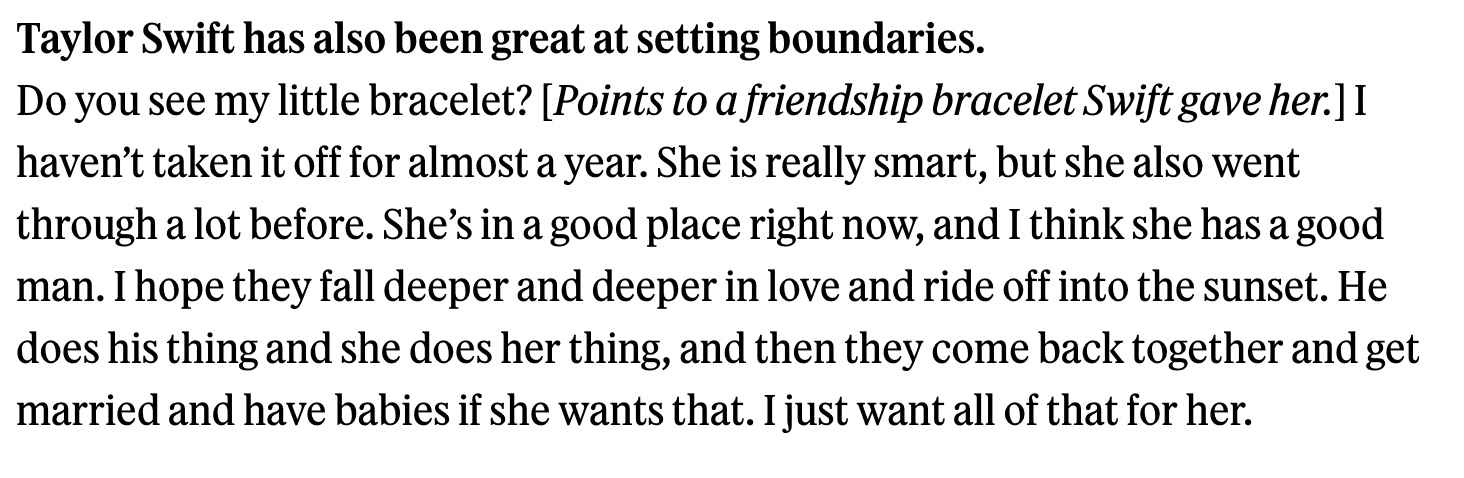
The meme also relies on a nostalgic fantasy of the 1970s that bears very little resemblance to the actual 1970s. The decade did not consist of fearless women effortlessly humiliating men while society applauded.
The 1970s were still deeply misogynistic. Women faced workplace discrimination, routine sexual harassment, media sexism, and constant scrutiny of their appearance, relationships, and ambitions. Female artists were not exempt from those dynamics. They lived inside them.
Stevie Nicks was not somehow liberated from the gendered criticism that follows female artists. The difference is that forty years later people have forgotten.
Fleetwood Mac’s Rumours is often treated as one of the greatest albums ever recorded because the members transformed their collapsing relationships into art. Stevie Nicks wrote Dreams. Lindsey Buckingham wrote Go Your Own Way. The band effectively conducted an emotional civil war through songwriting while standing on the same stage.
Today we call that genius.
Yet somehow when Taylor Swift writes about heartbreak, relationships, resentment, grief, or memory, we are still treated to endless conversations about whether women should really be talking about their exes.
The double standard becomes obvious the moment we introduce male musicians. Nobody hears Bruce Springsteen write about heartbreak and concludes he is emotionally unstable. When Bob Dylan wrote about relationships no one said he was “obsessed” with his exes. Don Henley, Paul McCartney, Billy Joel, or half the history of rock music has been writing about love and loss for decades and no one has concluded that men should maybe stop writing about romance.
That criticism is reserved almost exclusively for women.
Taylor Swift herself has pointed out that male artists write about former partners constantly without attracting the same scrutiny. When men do it, it is art. When women do it, it becomes evidence against their character.
“No-one says that about Ed Sheeran. No-one says that about Bruno Mars. They’re all writing songs about their exes, their current girlfriends, their love life and no-one raises a red flag there.”
What’s particularly absurd is that Swift and Nicks are not opposites in any meaningful way. They both belong to a very similar artistic tradition, in fact. Both are narrative songwriters who use autobiographical material that transforms their personal experiences into stories about ambition, power, memory, love, loss, aging, and identity.
Both have spent decades having journalists ask questions that male songwriters rarely receive and repeatedly had their achievements reduced to their relationships.
The difference is largely chronological.
Stevie Nicks is old enough to be remembered fondly.
Taylor Swift is contemporary enough to still be irritating.
One day that will reverse.
Some future twenty-two-year-old singer will be described as “the next Taylor Swift.” And somewhere in the comments, a person who currently hates Taylor Swift will explain that young women today simply aren’t as good as Taylor Swift was back in the day.
Because patriarchy is profoundly uncreative. It recycles the same stories over and over.
The women change. The script does not.
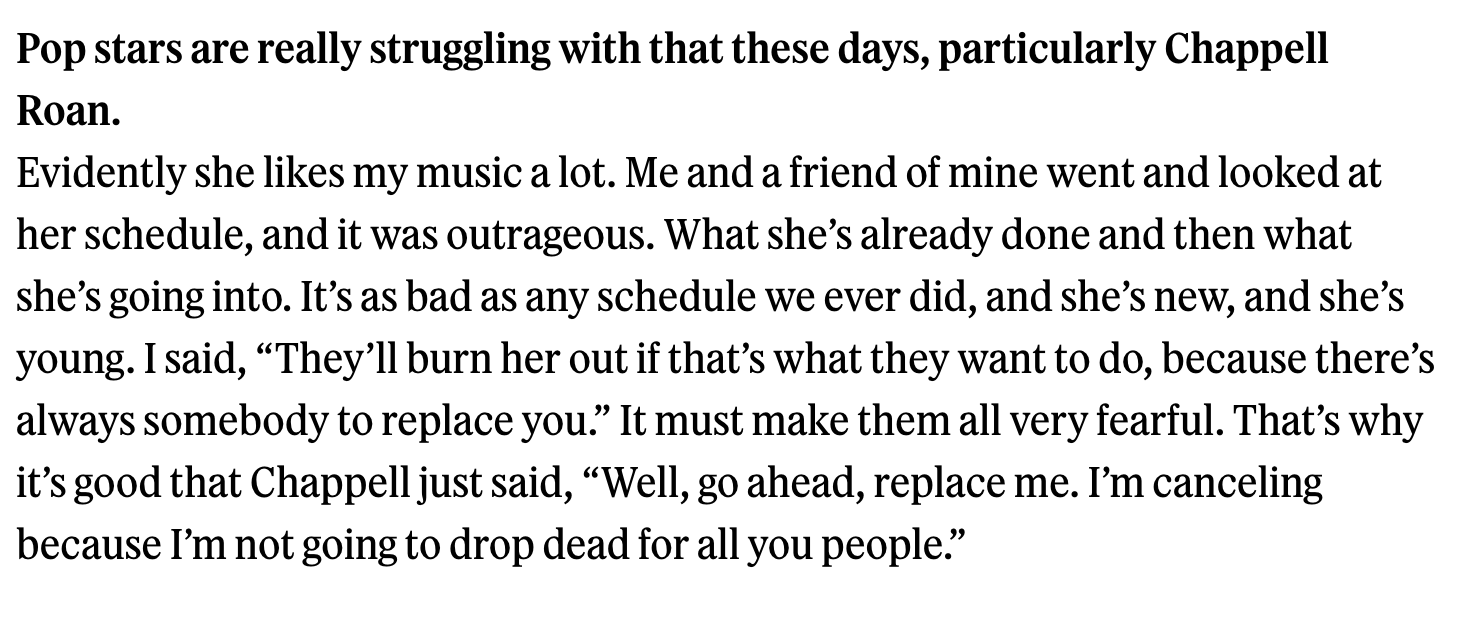
That is why I refuse to participate in these comparisons. Taylor Swift is not lesser than Stevie Nicks because she is younger. But she is also not better than Stevie Nicks because she arrived later.
Stevie Nicks remains Stevie Nicks.
Taylor Swift remains Taylor Swift.
The need to rank them is the problem.
And women, especially, need to stop doing that work for patriarchy.
The culture already spends enough time telling women they are too young, too old, too emotional, too ambitious, too loud, too soft, too sexual, not sexual enough, too successful, not successful enough.
It does not need our help.
Every minute spent fighting other women is a minute not spent challenging the structures that benefit from that fight. The competition is rigged, no one wins it except the patriarchy that set it up in the first place.
The meme’s greatest irony is that it chose the one artist who literally wrote a song explaining why the meme is nonsense.
The joke wasn’t on Taylor Swift, it was on everyone who didn’t realize Clara Bow had already explained the trick they missed.
“Women fighting women has always been one of patriarchy’s favorite labor-saving devices.” Danggg.
Even being a feminist in the 90s. It was very polarizing and I didn’t talk about my feminist ideas to anyone not already on the train because the culture wars against feminism had already started that plus the sexism we all ingest. So I took all the classes that I could have these discussions and voraciously read everything I could get my hands on. Now it’s gone mainstream but without the foundational mind shift away from patriarchy we end up exactly where the patriarchy wants us.