
A Man Explains Gender Theory to Me (Incorrectly)
Or: How Women’s Holiday Labor Became Their "Nature"

One unexpected perk of studying gender theory is that sometimes the case studies don’t come from archives, books, or carefully designed research projects. Sometimes they show up in your replies.
Translation: a man was sexist to me on Threads, and now I’m making it everyone’s problem.
Recently, I made what I thought was a fairly harmless observation online: that many traditions are basically marketing campaigns that got wildly out of hand. Once you start studying cultural history, it becomes difficult not to notice how aggressively corporations manufacture rituals. Holidays seem to expand and multiply, arriving earlier every year. Halloween decorations appear in August. Christmas merchandise materializes before the pumpkins are even carved. Valentine’s Day candy shows up while the New Year’s champagne is still flat.
Capitalism loves a ritual.
Apparently, according to a man who replied to my post, the real phenomenon here is something else entirely. In his observation, American women “seem to live from one holiday to the next.” Women, he suggested, are the diehard fans of this whole system. The implication was that if holidays have grown into these massive cycles of decorating, gifting, hosting, and themed consumption, it must be because women enjoy them so much.
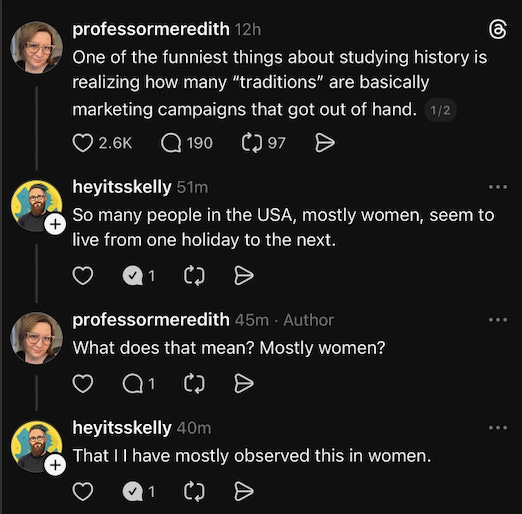
According to this man’s field research, women exist in a permanent state of pumpkin spice, twinkle lights, and decorative throw pillows. We live for it.
And just like that, my notifications turned into a perfect miniature demonstration of something gender theorists have been talking about for decades.
Because what he was actually observing wasn’t women’s personalities.
He was observing women’s labor.
But deciding it was their nature.
When women do work long enough, society stops calling it work.
This misunderstanding has a long history. In fact, it’s one of the most persistent tricks embedded in the way societies talk about gender. Over time, work that women are expected to perform quietly transforms into something women are said to naturally enjoy doing. The labor fades into the background, and what remains is a personality trait.
How to Be a Woman (Victorian Edition)

The Victorian “Angel in the House” was supposed to be gentle, pure, domestic, and self-sacrificing. She was praised endlessly for her virtue, placed on a pedestal, and told she was the moral center of the family and the nation.
Cooking becomes evidence that women “love being in the kitchen.”
Childcare becomes proof that women are naturally nurturing.
Managing the emotional climate of families becomes a sign that women are simply more empathetic than men.
And organizing holidays becomes evidence that women live for them.
Patriarchy has been running the same public relations campaign for centuries: assign women the work, wait a generation or two, and then announce that it’s their favorite hobby.
Historian Joan Scott famously argued that gender is not simply a description of differences between men and women. It is a system that organizes expectations about labor and authority. Gender structures who is assumed to be responsible for particular forms of work so thoroughly that those expectations begin to feel natural rather than socially constructed.
Holidays are a perfect example of how that system operates.
The Holiday Industrial Complex
To be fair to the man in my replies, he wasn’t entirely wrong about one thing. Corporations absolutely market holidays aggressively. Retailers depend on them. Holidays function as reliable engines of consumer activity, each one bringing its own ecosystem of decorations, themed products, seasonal foods, and gift guides.
The retail calendar moves steadily from one celebration to the next because each holiday provides another opportunity to sell things.
Retailers love holidays because they are the closest thing capitalism has to a renewable natural resource.
But corporations do not actually run the holidays. They sell the materials of celebration, not the labor required to produce it. Someone still has to organize the gathering, plan the meal, decorate the house, remember which relative prefers which dish, buy the gifts, wrap them, coordinate travel schedules, and somehow make the entire event look effortless to everyone else.
Target can sell you seventeen varieties of Christmas lights, but it cannot make your uncle stop bringing political arguments to Thanksgiving dinner.
Historically, the person responsible for managing all of this coordination has very often been the woman in the room.
Feminist theorist Silvia Federici has written extensively about what scholars call social reproduction: the unpaid labor that sustains households and communities. Cooking, cleaning, organizing, caring, maintaining relationships, planning social rituals. All the work that quietly keeps everyday life functioning.
This labor is often treated as if it exists outside the economy, but Federici and others have argued that it is actually foundational to it. The smooth operation of households and social networks helps sustain the broader systems of production and consumption that define modern economies.
Holidays offer a particularly vivid example of this dynamic. Retailers can profit from decorations, gifts, and themed merchandise, but the rituals themselves rely on an enormous amount of unpaid coordination work.
That work doesn’t magically appear when the calendar turns to December.
Someone has to do it.
The Mental Load
Sociologist Arlie Hochschild famously described a related phenomenon in her book The Second Shift. Even when women work full-time jobs, they often perform the majority of domestic labor once they return home. After the paid workday ends, a second shift begins—one filled with cooking, cleaning, organizing, and managing the small logistical tasks that keep families functioning.
But domestic labor isn’t only about visible chores. It also involves remembering, anticipating, and coordinating the countless details of daily life. More recently, this phenomenon has been widely discussed as the mental load.
Women often become the default project managers of family life, responsible not just for doing tasks but for ensuring that the tasks exist in the first place. They are the ones remembering that the groceries need to be bought, that the school forms need to be signed, that someone needs to plan the holiday dinner before twenty people show up expecting to eat.
The mental load is essentially invisible project management.
And holidays are where that project management becomes particularly intense.
Planning a holiday gathering involves weeks of coordination. Travel arrangements must be managed. Menus must be planned. Shopping lists must be assembled. Dietary restrictions must be remembered. Gifts must be purchased and wrapped. Schedules must be negotiated. Emotional diplomacy must sometimes be deployed when relatives with long-standing disagreements are placed in close proximity to one another.
From the outside, what people see are decorated homes and festive gatherings.
From the inside, it often feels more like running the invasion of a small third-world country.
Enjoyment vs. Labor
That’s not to say I don’t enjoy the holidays. I absolutely do. I enjoy good food, good drinks, time with family and friends, and the fun of giving and receiving gifts.
Those moments of celebration are the payoff that makes the effort worthwhile.
But notice what I didn’t mention.
I didn’t say I enjoy decorating the house.
I didn’t say I love the grocery shopping.
I didn’t say I enjoy the endless menu planning, the food prep, or the complicated scheduling required to coordinate who needs to be where and when.
That part stresses me the fuck out.
I do it because I want the celebration to happen. I do it because gathering people together matters. Ideally, I also do it with other people pulling part of the weight, because holidays work best when the labor is shared rather than quietly absorbed by one person.
But that labor disappears remarkably quickly when someone says something like:
“They love holidays.”
“They live for that stuff.”
The stereotype works because it removes all the guilt for not helping. As long as women’s labor can be reframed as enthusiasm, everyone else gets to sit back and enjoy the party.
It’s a bit like watching someone build an entire house and concluding that they must simply be passionate about holding hammers.
The Thread, Revisited
Which brings us back to the man in my replies.
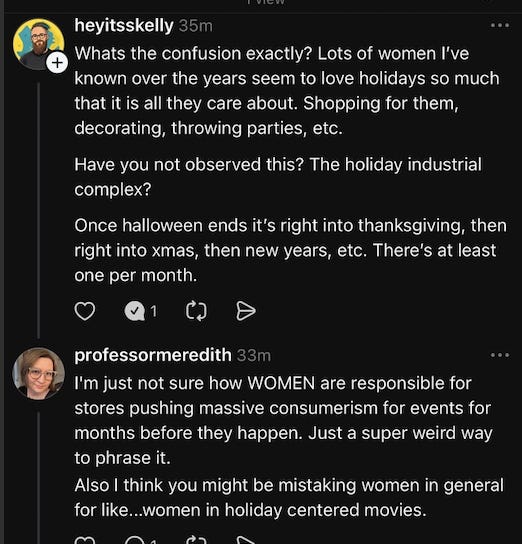
His initial instinct, that corporations aggressively market holidays, was actually correct. But somewhere along the way, he made a very familiar leap.
Instead of asking who actually runs the holidays and why they are socially expected to do so, he decided the explanation must be that women simply love them more.
When I pointed out the role of gendered labor in all of this, he responded by saying that women “get roped into it.”
Which is an interesting way to phrase it, because that little sentence is doing a lot of work. “Women get roped into it” sounds neutral, almost accidental, as if holiday logistics simply drift toward women the way loose balloons drift toward the ceiling.
But that framing conveniently skips over the fact that the original claim was that women live for holidays.
And those two statements are not the same thing.
“Women get roped into it” describes a system of expectations and social norms that quietly assign women responsibility for maintaining family rituals.
“Women live for holidays,” on the other hand, is the same centuries-old trope that portrays women as shallow consumers while men position themselves as the rational observers of culture.
That’s not media criticism.
That’s just misogyny wearing a slightly more polite hat.
Because the reality is that many of the same men who claim women “live for holidays” also very much expect the holidays to happen. They want the tree. They want the tinsel. They want the dinners, the gifts, the decorations, the family gatherings, and the atmosphere of festive magic.
What they don’t want is the labor required to make any of that appear.
The planning.
The shopping.
The coordinating.
The cooking.
The wrapping.
The endless logistical management that turns an abstract “holiday” into an actual event.
If women can be framed as people who love doing all that, then everyone else gets to enjoy the results without feeling any responsibility for the work behind them.
“She lives for this stuff.”
Which is a very convenient story to tell if you’d like to sit on the couch while someone else runs the entire operation.
Capitalism markets to everyone. It markets aggressively, relentlessly, and with remarkable sophistication. Entire industries are built around convincing people that certain moments of the year require particular purchases, decorations, or experiences.
Men are not somehow standing outside that system as neutral analysts. They are consumers inside it like everyone else.
The difference in this conversation was not that women were being marketed to.
The difference was that women’s participation in those rituals was framed as a personality trait instead of what it often is: work.
And when women point out the gendered labor behind those rituals, the response is often to dismiss the critique as personal baggage. Suddenly the conversation shifts away from social expectations and toward the supposed irrationality of the woman raising the issue.
Right. Generations of gender roles and social norms are apparently just a “me thing.”

Women totally aren’t assigned the role of arranging holidays. There’s definitely no social pressure involved in making sure the decorations appear, the gifts are purchased, the meal is cooked, and the gathering runs smoothly. No one has ever been quietly judged for “ruining Christmas” by failing to produce the right atmosphere of festive magic.
Clearly, the real issue is just that some hysterical, irrational woman on the internet is overthinking things and bringing her own individual baggage into the “rational” discussion a man was trying to have.
At which point, the only honest response left is the simplest one.
Fuck off.
What’s actually happening here is that women are being blamed for a system that relies heavily on their unpaid labor. The decorations, the meals, the gatherings, the gifts, the carefully curated atmosphere of festive magic; none of that appears automatically. It exists because someone spent hours planning it, organizing it, shopping for it, cooking it, decorating it, and making sure everything runs smoothly.
And historically, that someone has been a woman.
Women don’t “live for holidays.”
They run them.
But pretending that women just love doing all that is incredibly convenient, because it means nobody else has to feel responsible for the work behind it. The labor disappears. The obligation becomes personality. The consumerism becomes their fault.
And yes, they could just stop. Stop buying the decorations, the groceries, the endless gifts for husband, children, and in-laws.
But that then raises an interesting question.
If women collectively stopped running the holidays tomorrow, what would actually change faster: consumer culture, or the emotional and social backlash they would face at the very next family gathering?
Because we all know how that experiment would play out.
The decorations wouldn’t appear. The tree wouldn’t go up. The gifts wouldn’t organize themselves under it. The carefully coordinated meal wouldn’t somehow materialize on the table. And before long someone would inevitably start asking why the holiday felt “ruined.”
Not why no one else stepped in to help.
Not why the work suddenly stopped.
Why she didn’t make it happen.
Because the expectation was never really that women enjoy the holidays, just for sake of “living for them.” The expectation is that they maintain them. The lights, the gifts, the food, the atmosphere of festive magic that everyone else gets to enjoy all require an enormous amount of planning, organizing, and emotional labor.
Which means women aren’t the driving force behind holiday consumerism.
They are just the unpaid operations department keeping the entire thing running, while assholes on the internet explain that actually women are just vapid and shallow and too easily lead by consumerist marketing because they just love the holidays so much.
This was a long way to say this.
heyitsskelly, you show a remarkable level of confidence for someone who has managed to identify capitalism and still miss the entire structure of gendered labor sitting right in front of them.
But that’s the thing about gender theory.
It’s not just about what people do.
It’s about who is expected to do the work and who gets to stand back and pretend they’re the only one thinking critically about it.
So if you find yourself feeling very proud for noticing that corporations market holidays aggressively, congratulations. You have discovered capitalism.
The next step is noticing who’s actually running the holidays.
And if you still think the answer is “women just love that stuff,” then you haven’t cracked the code of gender theory.
You’ve just rediscovered misogyny and given it a thinkpiece.
I would be very interested to know if he is straight and partnered with a woman, because I'm sure he brushes off her anxiety about the season or most events as "babe its not that big a deal" because he's not the one who gets the blowback when the house is a mess or the presents aren't wrapped right or Grandma's pudding isn't on the table.