
Feminism Didn’t Steal Your Glass Slipper
A historian takes on choice feminism, anti-feminist nostalgia, and the claim that women’s freedom ruined women’s lives.

There is a very specific genre of anti-feminist writing that I have come to think of as the Christopher Columbus School of Intellectual Discovery.
A writer arrives breathlessly at a conclusion other people have been discussing for decades, plants a flag in it, and announces that they have discovered a new continent. The locals, who have been living there the entire time, are expected to applaud politely while someone explains their own terrain back to them with the confidence of a man holding a map upside down.
That is more or less what happens in Zarina Macha’s article “No, Feminism Is Not About Choice,” published under her Substack The Rational Female.
Macha’s central argument is that feminism is not really about women choosing whatever they want, but about dismantling patriarchy and restructuring society. This is presented as a devastating revelation, the sort of thing that should make modern feminists clutch their tote bags and whisper, “My God, she’s cracked the code.”
The problem is that many feminists have been making this exact point for decades. Feminism is not, and has never been, simply the belief that every decision made by a woman becomes feminist because a woman made it. That is not feminism. That is the political philosophy of a scented candle.
In fact, if anything, modern feminism occasionally leans a little to hard the other way on the topic of women being allowed to make choices and remain feminists.
To be fair, Macha is criticizing something real. Choice feminism, the idea that any individual decision made by a woman should be affirmed as feminist simply because it is hers, has been a problem. It has allowed corporations to slap “empowerment” on products, advertisements, sweatshop fashion, and the occasional razor commercial while doing very little to challenge the actual conditions under which women live and work. It has made criticism difficult because any attempt to ask why women are making certain choices, what pressures shape those choices, or who profits from those choices can be dismissed as “judging women.” In that sense, Macha is not wrong to say that “feminism is about choice” is an inadequate definition. The issue is that she mistakes an existing feminist critique of ‘choice feminism’ for a critique of feminism itself.
That distinction matters. Feminists have long argued that choice is not meaningful unless we also talk about power, law, money, culture, violence, sexuality, race, class, and the social consequences attached to refusing the role assigned to you.
Liberal feminists, radical feminists, Marxist feminists, Black feminists, queer theorists, postcolonial feminists, and cultural feminists have disagreed with each other about nearly everything except the basic fact that women’s lives are shaped by systems larger than personal preference. Feminism is not the claim that every choice is feminist. Feminism is the insistence that women should not be structurally coerced into lives designed for male comfort and then told their compliance was a preference.
This is where Macha’s argument begins doing that peculiar anti-feminist shuffle where one true point is asked to carry several false conclusions on its exhausted little back.
She says women have always been able to make choices because choice is part of the human condition.
On the most literal level, yes.
Of course women have always made choices.
Women under coverture made choices. Women denied property rights made choices. Women denied the vote made choices. Women denied divorce made choices. Women denied contraception made choices. Enslaved women made choices. The existence of choices has never been evidence of equality. If your options are “obey” or “suffer,” then congratulations, you technically have choices.1
You do not, however, have meaningful freedom.
This is a basic distinction, and yet the article repeatedly treats it as though feminism is confused because feminists talk about constraints.
The question has never been whether women possess the metaphysical capacity to make decisions. The question is what options are available, who controls the terms, what happens when women refuse, and whether the consequences are distributed equally.
A woman who can choose between economic dependency and social ruin is making a choice.
A woman who can choose between an unwanted pregnancy and a dangerous illegal abortion is making a choice.
A woman who can choose between staying with an abusive husband and losing her children is making a choice.
But only someone very committed to winning an argument with a cardboard cutout would confuse that with liberation.
The article’s historical claims become even shakier when Macha turns to gender roles. She argues that men and women developed complementary roles based on biological differences and mutual cooperation, which sounds tidy if you skim human history with one eye closed. Certainly biology influences social organization. Human beings are not floating brains piloting meat suits through neutral space. Pregnancy, childbirth, lactation, physical strength, vulnerability during reproduction, and survival conditions all shaped social life in different places and periods. But the leap from “biology influences social norms” to “gender hierarchy was natural cooperation” is where the argument starts hoping nobody asks follow-up questions.2
Gender roles were not simply the result of men and women sitting down around a communal fire and amicably dividing tasks according to vibes. They were enforced through law, religion, property systems, inheritance structures, political exclusion, education, employment restrictions, and marital authority. This was true before “modern” history and it’s true today.
In English common law, coverture meant that a married woman’s legal identity was effectively subsumed under her husband’s. She could not freely own property, make contracts, control wages, or maintain an independent legal existence in the way an unmarried man could. In the United States, women had to fight for married women’s property acts, access to higher education, suffrage, professional entry, legal contraception, equal credit, workplace rights, and legal protection from discrimination. These were not minor lifestyle preferences. They were structural limits, not biological. Women didn’t develop hives when given access to credit cards in their name.
The word “cooperation” does a lot of laundering in Macha’s argument, as well. Men and women have certainly cooperated throughout history. Families cooperated. Couples cooperated. Communities cooperated. People loved one another inside patriarchal systems, sacrificed for one another, built homes together, raised children together, grieved together, survived together.
But cooperation and hierarchy are not opposites.
A Victorian husband might genuinely love his wife while still possessing legal and economic power over her. A plantation mistress might feel affection for her husband while also existing within a racial and gender hierarchy that positioned white men as masters of households, wives, children, and enslaved people. A medieval noblewoman might wield influence while still being constrained by dynastic marriage, inheritance law, and male guardianship.
When historians describe systems of power, we generally do not stop calling them systems of power simply because people inside them occasionally loved each other.
This is one of the recurring problems in both “No, Feminism Is Not About Choice” and Macha’s later essay “How Feminism Made My Life Worse.”
Feminist critiques of power are repeatedly interpreted as attacks on love, marriage, motherhood, femininity, softness, romance, and men as a group. But feminism is not saying that every heterosexual marriage is a hostage situation with nicer curtains. It is asking why so many institutions made marriage women’s primary route to survival, respectability, sex, motherhood, legal identity, and economic security.
If traditional family roles are so naturally fulfilling that women would choose them anyway, why did societies spend so much time legally compelling women into them and punishing those who resisted? That is the question hovering over this whole debate like historically literate Victorian ghost.
Then we arrive at the technology argument, which is always popular in anti-feminist writing because it sounds clever until you actually think about it. Macha argues that modern women have more choices because of technology: birth control, washing machines, central heating, electric ovens, and other inventions that freed people from the constant grind of survival.
This is true as far as it goes, but it does not go nearly as far as she wants it to.
Technology creates possibilities. Politics determines access. Law determines legitimacy. Culture determines stigma. Economics determines distribution. A washing machine is helpful only if you can afford one, access electricity, and live in a society where reducing domestic labor does not simply mean women are expected to do more unpaid work elsewhere.
Birth control is transformative only if people can legally obtain it, afford it, understand it, and use it without punishment. The birth control pill did not float down from heaven accompanied by a choir of pharmaceutical angels. Its development, distribution, legalization, and normalization were shaped by activists, doctors, patients, lawyers, reformers, and feminists. In the United States, contraception existed before the Supreme Court recognized a constitutional right to marital privacy in Griswold v. Connecticut, but existing is not the same thing as being legally accessible. Even after Griswold, unmarried people still faced restrictions until Eisenstadt v. Baird. This is why saying “technology liberated women, not feminism” is like saying elevators created disability rights. Elevators matter. But if the building owner can still lock the door, you have not solved the problem.
Macha also argues that feminism has made men and women adversarial rather than complementary. This is one of the oldest tricks in the anti-feminist recipe book: observe conflict, blame the people who named the conflict, and then accuse them of destroying a harmony that was often maintained through women’s silence.
Feminism did not invent gender conflict. It exposed the fact that the old arrangement was not equally beneficial to everyone. A woman who could not vote, could not control her property after marriage, could not reliably access divorce, could not obtain contraception, could not enter many professions, and could not count on equal pay may still have loved her husband and children.
But her love does not prove the system was fair. It proves human beings build meaning even inside constraints.
The “feminism is a religion” argument is similarly theatrical but thin. Macha suggests that feminism operates like a worldview with doctrines and rules. But feminism contains liberal feminists, radical feminists, Marxist feminists, socialist feminists, Black feminists, womanists, cultural feminists, queer feminists, ecofeminists, postcolonial feminists, and enough internal disagreement to power a small argumentative city.
The history of feminism is not a single church with a pope in sensible shoes issuing doctrine from the Vatican of Not Shaving. It is an intellectual and political tradition defined by debate. Feminists have argued about sex work, pornography, motherhood, marriage, capitalism, race, gender identity, the state, wages, sexuality, kink, domestic labor, essentialism, separatism, liberal rights, and whether anyone should ever have trusted Freud with a metaphor. Calling that a religion does not refute it. It just gives the author permission to dismiss it without doing the work of engaging it.
Her Cinderella example has a similar problem. Macha argues that if feminism were simply about women choosing, then Cinderella should be considered a feminist icon because she chooses marriage and domestic happiness. But feminist criticism of fairy tales has never been primarily about marching into the Disney vault and arresting Cinderella for crimes against liberation. The question is what stories teach.
Why are beauty, passivity, endurance, heterosexual marriage, and rescue so often presented as female fulfillment? Why are some ambitions rewarded and others punished? Why does the heroine’s goodness so often appear through suffering quietly enough to be recognized by someone more powerful? A feminist reading of Cinderella is not “no woman may like this story.” It is “what cultural work does this story perform, and why has it been told this way so many times?”
The Scullery’s Revolt

Once upon a time, a scullery maid who was kind and beautiful and hard-working was given glass slippers and a gown, and her grace and virtue won the heart of a prince. She rose from the ashes to the palace in a single night.
This same confusion appears when Macha discusses liberal feminism, choice feminism, and the waves of feminism. She is correct that liberal feminism is not the same thing as choice feminism. Liberal feminism has historically focused on legal equality, political reform, educational access, workplace opportunity, and rights within existing institutions, while choice feminism is more of a flattened cultural slogan that often treats agency as an individual consumer product. But again, she takes a legitimate distinction and turns it into a smoking gun.
Feminists already know these distinctions exist. In fact, feminist history is largely the story of feminists arguing with each other about exactly these distinctions while anti-feminists periodically wander in, point at the argument, and announce that disagreement proves the whole thing is fake.
The most revealing line in the first article may be the closing question: if feminism is about giving women choice, does that include the choice not to be feminist?
The answer, obviously, is yes. Women can choose not to be feminists. Women can reject the label. Women can disagree with feminist theory. Women can marry, stay home, have children, homeschool, bake bread, wear floral dresses, attend church, adore their husbands, and post about the joys of traditional femininity. 3
What they cannot reasonably expect is that feminists will treat every political claim attached to those choices as beyond criticism. Choosing a life is not the same as turning that life into a universal prescription.
You can choose the apron. You do not get to pretend the apron has no history.
This is where the second essay, “How Feminism Made My Life Worse,” becomes reveals the emotional architecture underneath the theoretical argument. In that piece, Macha describes how feminism encouraged women to prioritize independence, education, career, and sexual freedom, and she connects those messages to her own difficulty finding lasting romantic fulfillment.
I want to be careful here because personal pain is not a punchline.
She describes bullying, depression, suicidal ideation, panic attacks, being sectioned, abusive sexual experiences, and difficulty forming long-term relationships. Those are serious experiences, and I do not doubt the sincerity of her account. But sincerity is not the same thing as causation.
The structure of the second essay is essentially autobiographical: I absorbed feminist messages; I pursued independence and self-development; I became unhappy in love; therefore feminism made my life worse. But autobiography is not, by itself, historical proof. If individual unhappiness were enough to discredit an ideology, then every miserable housewife of the 1950s would prove that traditional gender roles were a disaster, something I feel Macha would have a problem with.
In fact, that was precisely the observation Betty Friedan made famous in The Feminine Mystique. Friedan did not argue that every housewife was miserable or that motherhood was inherently degrading. She argued that a culture insisting women should be completely fulfilled by marriage, children, and domesticity left many women unable to explain their dissatisfaction except as personal failure. The difference is that Friedan did not stop at “I feel bad, therefore the system is wrong.” She examined education, advertising, magazines, psychology, domestic ideology, and postwar culture.
She turned private misery into a political question.
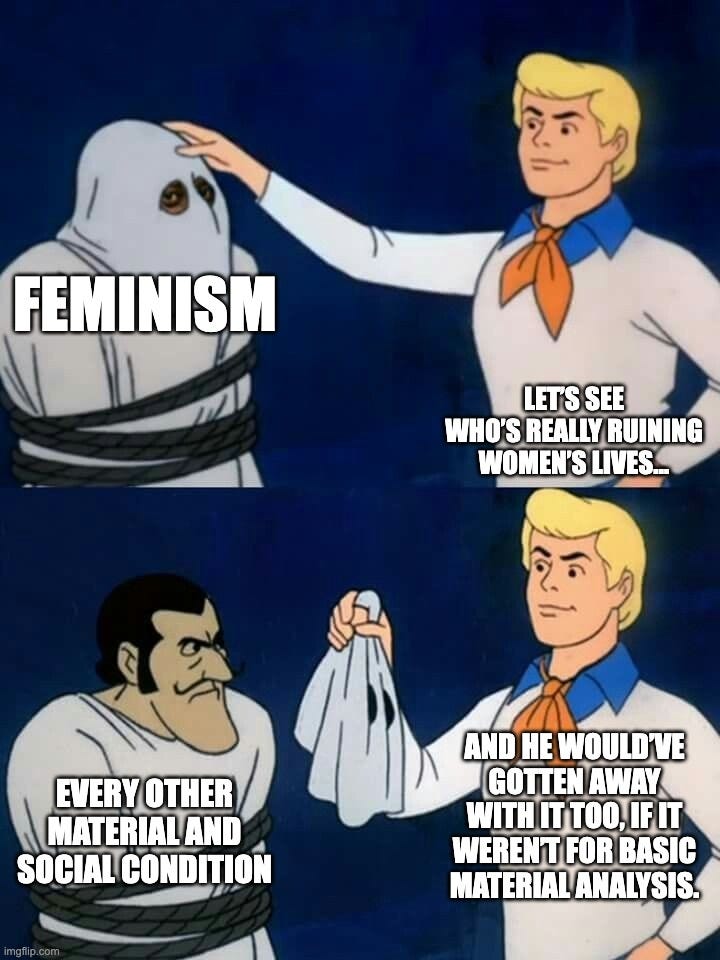
Macha does something narrower. She experiences pain in a world shaped by individualism, unstable relationships, consumer culture, changing gender expectations, economic precarity, mental health struggles, romantic media fantasies, dating app culture, and the general emotional landfill of modern life, and then identifies feminism as the villain in the rubber mask.
This is less historical analysis than Scooby-Doo causation. The gang has not investigated capitalism, social media, housing costs, childhood trauma, mental health systems, sexual violence, romantic fantasy, patriarchal dating expectations, or the fact that modern heterosexuality often looks like a group project where half the class refuses to open the Google Doc. No, the culprit is feminism. Case closed. Someone get the van.
The nostalgia running beneath both essays is that women were once prepared for relationships, marriage, and family in a way they no longer are. There is something worth discussing there. Modern life often does leave people emotionally underprepared for intimacy. A culture that tells everyone to be self-sufficient while also selling romance as salvation is going to produce confusion. Women are told to be independent but desirable, ambitious but not intimidating, sexually liberated but not “too much,” emotionally available but not needy, romantic but realistic, feminine but not weak, successful but not selfish. Men are often given even worse emotional training, which is to say they are handed a toolbox containing silence, porn, resentment, and maybe one podcast microphone. There is a real problem here. But blaming feminism for it is at best ridiculous and at worst shouting ‘pick me’ at the top of your lungs because there’s nothing patriarchy likes more than a woman who will do the “brave” thing and say “actually feminism is evil!”
The past did not offer women a universally healthier relationship culture. It offered many women fewer exits. It offered legal and economic pressure to marry. It offered stigma against divorce. It offered limited contraception. It offered fewer employment options. It offered the romantic security of being told that your husband was your provider while the law, church, and economy made sure you needed one. That may have produced more marriages, but more marriages do not automatically mean better lives.
A locked room has excellent retention rates.
Macha’s essay also relies on broad claims about what “most women” want: most women want love, marriage, romance, a dream man, and family more than career. Perhaps many do. Many women do want marriage and children. Many also want work, creative achievement, education, friendship, sexual autonomy, political voice, solitude, community, travel, money, art, pleasure, and the ability to leave a bad situation without being thrown into destitution.
Feminism does not require women to want careers more than relationships. It requires that women not be forced to organize their lives around dependence because society cannot imagine them as full adults otherwise.
Her discussion of softness, gentleness, and femininity also deserves more care than the article gives it. Macha argues that softness should be respected and that Cinderella represents a kind of strength through kindness and gentleness. Fine. Softness can be beautiful. Gentleness can be strong. Care can be powerful. Nurture matters. The problem is not softness. The problem is compulsory softness, selectively enforced softness, and the long history of defining women’s virtue through their willingness to absorb harm gracefully. Feminism does not need to sneer at gentleness to ask why women have so often been praised for enduring pain quietly.
Cinderella may be kind and resilient, but she is also trapped in an abusive household until outside recognition saves her. If that is your model of feminine strength, we should at least be honest about the price of admission.
The same goes for Macha’s comments about women being cruel to other women. Women can be cruel. Women can be manipulative, competitive, passive-aggressive, and vicious. Anyone who has survived a middle school girl’s bathroom knows that. But again, the existence of female cruelty does not disprove structural sexism.
In fact, some of the strongest feminist work has examined how women enforce patriarchal norms on each other, how respectability politics works, how mothers teach daughters survival through compliance, how women police other women’s sexuality, and how proximity to male approval can become a form of social currency. “Women can be awful too” is not a refutation of feminism. Feminists have been saying that with footnotes.
The real contradiction between the two essays is this: in the first, Macha criticizes feminists for supposedly making feminism too much about choice. In the second, she criticizes feminism because women have made choices that she believes have harmed them. Women choosing domesticity are treated as authentic. Women choosing career, independence, sexual freedom, or delayed marriage are treated as victims of feminist indoctrination. This means the argument is not really about whether women should have choices. It is about which choices are considered legitimate and which choices must be explained away as brainwashing.
That is why her proposed alternative, “women’s advocacy” without feminism, sounds less like a new framework and more like feminism with the structural analysis surgically removed. Of course we should care about women’s well-being without hating men. Of course we should value motherhood, care work, gentleness, relationships, and emotional life. Of course feminism should be critiqued where it becomes elitist, racist, consumerist, cruel, essentialist, or indifferent to women whose desires do not fit the professional-class empowerment script. But a women’s advocacy that refuses to discuss patriarchy, law, economic dependence, reproductive control, domestic violence, sexual coercion, political exclusion, and cultural scripts is not more rational. It is just less equipped.
In the end, Macha is right about one thing: feminism is not simply about choice. But this is not the devastating revelation she thinks it is. Feminism is about power. It is about the forces that shape choice before a woman ever experiences it as personal preference. It is about who gets resources, who gets credibility, who gets safety, who gets protected, who gets paid, who gets forgiven, who gets punished, who gets believed, and who gets told that their suffering is just the natural order of things.
Feminism was never merely about choosing. It was about making sure women had something meaningful to choose from in the first place.
A Brief Note From Someone Who Also Once Thought She Had Outgrown Feminism
This is the part where I want to be careful, because I do not think the useful critique here is “she is young, therefore she is wrong.” Young women are allowed to think seriously, write publicly, change their minds, reject labels, and argue themselves into intellectual corners with the same confidence as everyone else. Frankly, if being publicly wrong in your twenties disqualified you from later having useful thoughts, most of the internet would have to be placed under quarantine. I am not interested in patting a younger woman on the head and saying she will understand when she is older. That is condescending, and also the exact sort of thing women get enough of already.
But I do recognize the shape of this argument. In my early twenties, I also thought feminism was probably exaggerating. I believed in freedom, individual choice, personal responsibility, and the idea that I was somehow standing above the mess by being “rational.” I called myself socially liberal and economically conservative, which is one of those phrases people use when they want to sound morally decent without reading the fine print. So when Macha describes herself as “culturally classical liberal and economically social democrat,” I understand the appeal.
For me, it felt sophisticated. Balanced. Adult. Like I had found the sensible middle between hysterical partisans on both sides, which is very cute in hindsight, in the way baby raccoons are cute before they get into the trash or try to steal my sister’s chicken eggs.4
The problem is that this kind of self-description can also become a very attractive waiting room for people who do not want to admit that “neutrality” often has politics of its own.
Because here is the thing I had to learn the long and embarrassing way: freedom is not just a mood. Freedom has infrastructure. Freedom needs healthcare, housing, wages, education, childcare, legal protection, contraception, abortion access, workplace rights, public safety, disability access, and the ability to leave a bad marriage without falling through a trapdoor. You cannot meaningfully support women’s freedom while treating the systems that make freedom possible as secondary details. You cannot say women should be free to choose their lives while dismissing the structures that determine whether those choices are actually available.
So here is the advice-column part, from one older woman who once thought feminism was overreacting to a younger woman who now thinks feminism is the problem: Be suspicious when a framework tells you that the reason your life feels hard is because women became too free.
Sometimes a diagnosis feels powerful not because it is accurate, but because it gives shape to chaos. It says: here is the villain, here is the story, here is why you hurt. I understand the appeal. Truly. Sometimes a satisfying explanation is not true. Sometimes it is just tidy.
That does not mean Macha has to call herself a feminist. Nobody has to. Feminism is not a hostage situation with a reading list. But if the alternative is “women’s advocacy” that wants to support women while denying or minimizing patriarchy, then the question becomes: support women against what? Bad vibes? Personal disappointment? Dating confusion? Other women being mean? All of those things matter, but they are not enough. Women do not just need encouragement. They need rights. They need resources. They need bodily autonomy. They need economic security. They need protection from violence. They need historical memory. They need a politics that understands why individual pain keeps appearing in patterned ways.
That is what feminism, at its best, gives us. Not perfection. Not purity. Not a sacred text delivered by Gloria Steinem on stone tablets while Betty Friedan argues with bell hooks in the parking lot. It gives us a way to ask why so many private struggles have public causes.
You are not wrong to want love, softness, marriage, children, romance, domesticity, faith, gentleness, or a life that does not revolve around becoming a corporate productivity demon in ankle boots. But feminism is not the thing standing between women and those desires. Feminism is the reason those desires can be choices rather than assignments.
The tragedy is that anti-feminism often sells women a comforting lie: that if we can just undo the confusion feminism caused, we can return to something stable, meaningful, and whole. But the stability of the past was often built out of women’s dependency. The meaning was often enforced through shame. The wholeness often required silence from anyone who did not fit. Feminism did not destroy paradise. It interrupted a prison sentence.
I’m currently rewatching season 5 of the television show Alias. Gordon Dean technically had a choice between giving Sydney Bristow the information she wanted or being injected with LSD and interrogated. I don’t think Gordon Dean would think that was a very good choice, but it was a choice.
This is especially galling as it ignores most of recorded human history in anything outside a Western context. The so-called “natural” gender roles look remarkably different through the history of Asia and Africa.
This take also requires ignoring much of the modern anthropological and archaeological data that rejects a firm binary dichotomy between “hunters” as male and “gatherers” as female.
Women can also do many of those things and be feminists at the same time actually.
See, sis, I acknowledge that they are evil…they are just still too adorable.
I've been thinking about choice feminism a lot lately. Thank you for a very nuanced contribution to the topic, like always.
I wholeheartedly agree that feminism is not what is standing between women and a path of domesticity or family life. Feminism is what enables this kind of life to be a choice, and not a trap.
"Feminism is not, and has never been, simply the belief that every decision made by a woman becomes feminist because a woman made it. That is not feminism. That is the political philosophy of a scented candle."
This is my favorite of your essays. It is, in the end, not only about choices, but the framework - social, economic and political, in which those choices are made. One of the favorite tactics of authoritarians of every sort is the "magician's force," the illusion of choice in which the person presenting the choice controls all the available options. You need not fear someone's choice when you have limited them to only the choices that benefit your agenda.
As to "ruining" anything, well, surely, the person making that choice should have the right to choose what others would consider ruinous.