
Gender Roles Are Not a Chore Chart
Individual couples can divide labor however they want. That is not the same thing as a society telling women they were born to scrub pans and manage male feelings.

Men are menning in my comments today.
And not in a fun “someone has discovered a podcast microphone and a deep personal relationship with the Roman Empire” way. More in the aggressively stupid, intellectually bankrupt, “I have mistaken a half-formed thought for political theory” way.

So I wanted to push this out quickly, because apparently we need to review a basic point:
No one is saying individual couples never specialize.
That is not the argument.
In real relationships, people divide labor all the time. One person cooks because they enjoy cooking. One person handles bills because spreadsheets do not make them want to walk into the sea. One person is better at scheduling appointments. One person can fix the sink. One person remembers birthdays. One person has the emotional range necessary to call the dentist.
That is normal.
That is life.
That is two or more people trying to keep a household from becoming a small, expensive cave of laundry and resentment.
But that is not what people mean when they critique gender roles.
The problem is not “partners develop different skills.” The problem is when those skills are assigned before anyone’s actual personality, ability, interest, or circumstances are even considered.
Gender roles are not neutral household specialization. They are social prescriptions.
They say women are naturally suited to caregiving, emotional management, domestic labor, sexual availability, and self-sacrifice.
They say men are naturally suited to authority, financial control, public life, stoicism, and decision-making.
And then society rewards people who comply and punishes people who do not.
That is the difference.
A couple deciding, “You cook because you like it, and I’ll handle the car insurance because bureaucracy has not yet defeated me,” is specialization.
A society deciding, “Women belong in the kitchen and men who nurture their children are weak,” is patriarchy.
Those are not the same thing, even if they occasionally produce the same outward behavior.
A woman who loves homemaking is not the issue.
A man who likes being the breadwinner is not the issue.
A couple who freely choose a more traditional arrangement is not automatically the problem.
The issue is the cultural machinery that treats that arrangement as morally correct, biologically inevitable, and politically desirable, while treating every other arrangement as deviant, failed, unnatural, or evidence that civilization is personally being murdered by a woman with short hair.
Even where population-level averages exist, they do not tell us what any individual person should be trained for, allowed to do, expected to want, or punished for rejecting.
Averages are not destinies.
Human societies are not built by looking at a bell curve and then assigning everyone a life path based on their genitals at birth.
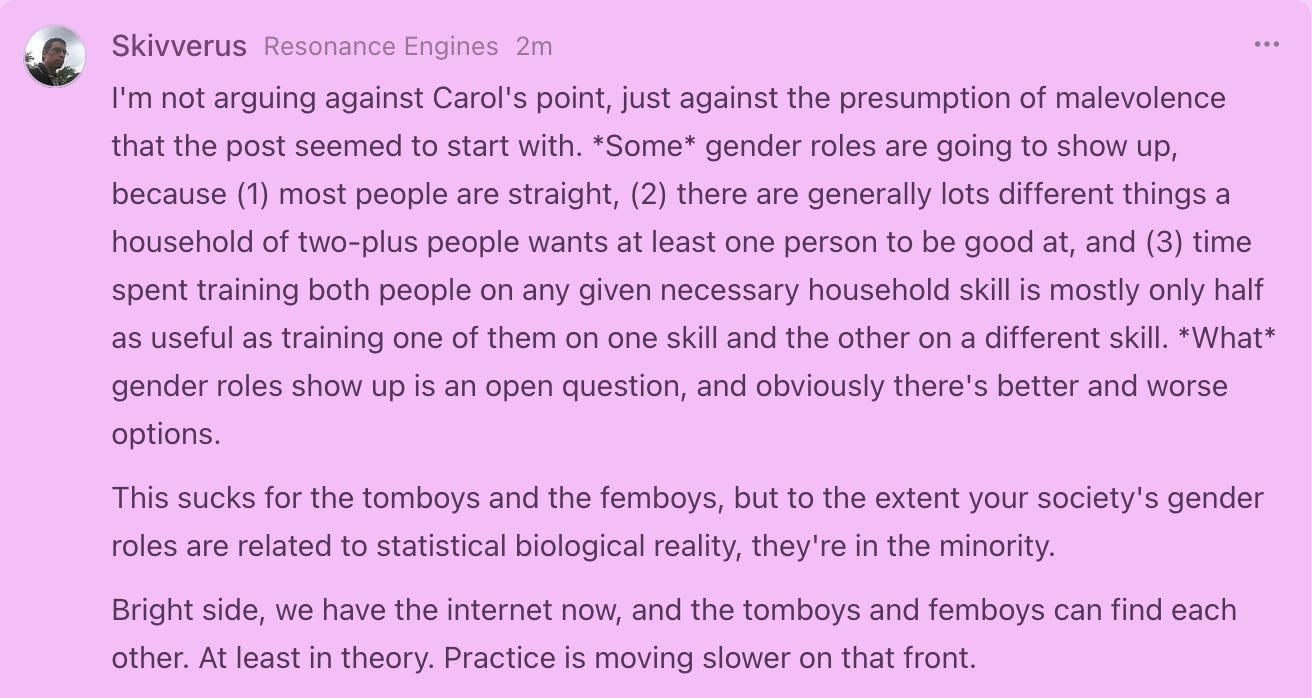
“But most people are straight,” someone will say, as if heterosexuality is a sorting hat that assigns one person to laundry and the other to financial authority.
Again: no.
Most people being straight does not mean women are naturally responsible for domestic labor. It does not mean men are naturally exempt from emotional literacy. It does not mean household work should be gendered before the actual people in the household have even entered the room.
And the “this sucks for tomboys and femboys, but they’re in the minority” framing is telling.
Because the solution to oppressive gender roles is not “well, the misfits can find each other online now.”
The problem is not that gender nonconforming people need better matchmaking.
The problem is that they should not have to flee into niche communities to escape a social order that treats them as defective exceptions to a supposedly natural rule.
Tomboys, femboys, queer people, trans people, gender-nonconforming people, women who hate homemaking, men who love caregiving, and every person whose soul curdles at the phrase “real man” are not glitches in the system.
They are evidence that the system is too small for actual human life.
The question is not whether couples can divide tasks.
Of course they can.
The question is who gets to decide.
If the answer is “the people actually living in the relationship,” great. That is an adult partnership.
If the answer is “tradition, religion, law, economic pressure, family shame, political propaganda, and some man in my comments explaining that tomboys are statistically inconvenient,” then we are not talking about household efficiency.
We are talking about patriarchy with a chore chart.
Love this so much!!! So clear…thank you…should be required reading.
Spot on! These days, it feels like one step forward, two steps back. Especially when thing like wife school keep popping up: https://theequitablehome.substack.com/p/wife-school-a-six-week-course-in?utm_source=share&utm_medium=android&r=5zf76s