
I Didn’t Abandon My Convictions. I Followed Them Out of the Republican Party
I was good at conservative media. Leaving meant admitting that the movement rewarding me did not believe in the values it had taught me to defend.

This piece is an extension of my prose slam, Working in the Myth Factory. That version was written to be performed aloud, which meant it had to move quickly. It turned years of political belief, professional ambition, denial, evidence, tequila, and ideological collapse into something I could read onstage in a few minutes.
It told the story of how I left conservative media, but it compressed that story down to four and a half minutes and left out a lot of the details and I firmly believe the details matter.

I sometimes describe myself as a former Republican because that is the easiest way to explain the broad shape of the story. It is also true. I changed my party registration. I changed my positions on numerous policies. I became a very loud feminist, which would have startled the younger version of me so badly that she might have required smelling salts and a reassuring pamphlet from Hillsdale College.1
But I do not think the most important change was that I acquired an entirely new collection of convictions.
I think I discovered that the convictions I already had were not represented by the party in the way I had been told they were.
By 2016, I was already persona non grata with the Tea Party.
I had failed their purity tests. I had publicly disagreed with the wrong people, including more than one person with political connections and a highly developed sense of personal grievance.2 I had demonstrated the dangerous tendency to treat policy questions as questions rather than opportunities to recite the approved answer.
My position inside the Republican ecosystem was already fragile. I knew that. I had accepted that I was unlikely to be welcomed into the more ideologically rigid corners of the movement unless I became much more obedient, and obedience has never been one of my most marketable qualities.3
Still, I held on.
I believed the Tea Party and related groups within the GOP represented a loud but containable faction. I believed the more theatrical elements of conservative media were embarrassing cousins rather than the people quietly rewriting the family will. I believed that responsible Republican leaders would eventually regain control because, surely, the adults understood that governing required more than outrage, slogans, and threats to set the federal government on fire unless everyone agreed to repeal legislation they disliked.4
Poor sweet summer child.
I was twenty-five, which is old enough to believe you are no longer naïve and young enough to assume the political facti
on you prefer must secretly be the authentic one.
I was also good at what I did.
That is important, because political transformation stories are often made tidier by converting the former self into an obvious failure. The person was unhappy, unsuccessful, confused, and secretly waiting for enlightenment to arrive carrying a tote bag full of progressive literature.
That was not my situation.
I had a following. People respected me. I knew how to communicate political ideas clearly and persuasively. I understood the rhythm of online political media before many traditional institutions had worked out what a retweet was. I could make arguments, build an audience, and speak with confidence.
I enjoyed being known as someone who had convictions, who could argue them articulately and with enough humor to get a few thousand people to repost my thoughts on Twitter or Tumblr or whatever wordpress site I was blogging for at the time.
I was not pushed out because I lacked talent. I was not fleeing a career that had collapsed.5 Leaving meant walking away from something I knew how to do, at precisely the point when becoming more compliant might have made it easier to keep doing it.
The system was not rejecting my abilities.
It was asking what I was willing to do with them.
The Purity-Test Economy
The Tea Party’s purity tests were not really about whether someone was conservative. They were about whether someone would demonstrate loyalty in precisely the approved form.
You could agree on taxes, regulation, national defence, spending, and healthcare, but disagreement on one culturally charged issue could contaminate your entire political file. A failure to express sufficient hostility toward the correct enemy was treated as evidence of concealed liberalism. Asking whether a tactic would work was interpreted as cowardice. Compromise was not judged by its results, but by whether compromise itself revealed spiritual weakness.
The point was not merely to persuade Republicans to move rightward.
It was to make departure from the movement’s line personally and professionally expensive.
Conservative organizations developed scorecards that translated complicated legislative records into numerical measures of ideological reliability. Heritage Action explicitly used votes and legislative sponsorships to measure how conservative members of Congress were, while alerting lawmakers and activists about designated votes. By 2013 and 2014, its efforts to pressure Republicans over healthcare, spending, and other legislation had become part of the internal struggle over who possessed the authority to define conservatism.
I experienced a smaller-scale version of the same political culture.
A person did not need to defeat you intellectually if they could classify you as insufficiently loyal. Once that classification took hold, your arguments no longer required answers. You had failed the test. The file was closed.
By 2016, I knew my own file was not clean.
What I failed to understand was that these mechanisms were not marginal irritations. They were helping reorganize the Republican Party around permanent ideological escalation.
The Republicanism I Thought I Believed In
The Republican Party sold itself to people like me through a vocabulary of freedom, restraint, responsibility, constitutionalism, and evidence.
The official 2012 Republican platform instructed the party to: “Trust the people. Limit government. Respect federalism. Guarantee opportunity, not outcomes.”
That language appealed to me. It sounded coherent. Government should be accountable. Power should be limited. People should be free to make decisions about their own lives. Policy should create the conditions for opportunity rather than dictate a single acceptable way to live.
The problem was that the same platform also supported a constitutional amendment that would have defined marriage exclusively as a union between a man and a woman. It endorsed a constitutional amendment extending legal protection to fetuses, opposed public funding for organizations that provided or advocated abortion, objected to medication abortion, and defended state voter-identification laws against federal intervention. The promised government restraint became considerably less restrained once the subject was sex, reproduction, marriage, or access to the ballot.
The contradiction was already sitting there in the party’s own document.
I just didn’t understand it as a contradiction…yet.
I believed these policies could somehow be fitted into a larger philosophy of freedom. I believed there must be a serious constitutional explanation that would reconcile the promise of individual liberty with the desire to control which relationships counted, which medical decisions women could make, and which citizens should face additional barriers when voting.6
I thought the framework was sound and that any inconsistency could be repaired through better reasoning.
What I eventually learned was that the inconsistency was doing political work.
Republican government was not actually meant to be universally limited. It was meant to be selectively absent and selectively omnipresent.
It was supposed to remain deferential toward employers, corporations, private wealth, and existing hierarchies. It was expected to become highly energetic when regulating pregnancy, sexuality, public education, voting, poverty, and the boundaries of respectable family life.
Liberty for the boardroom. Supervision for the body.
I did not abandon a coherent philosophy of limited government. I realized the philosophy had never been applied coherently in the first place.
The Autopsy That Diagnosed a Messaging Problem
After Mitt Romney lost the 2012 presidential election, the Republican National Committee commissioned its Growth and Opportunity Project, generally known as the Republican “autopsy.”
The report acknowledged that the party’s message was weak, that its campaign infrastructure was inadequate, and that it had failed to be inclusive. It recommended sustained outreach to women, Black voters, Latino voters, Asian voters, and gay voters. It also supported comprehensive immigration reform. RNC chairman Reince Priebus insisted that Republican principles remained sound, but that the party was communicating them badly.
At the time, this felt reassuring.7
The party appeared capable of introspection. It had lost an election, studied the evidence, and admitted that something needed to change. The existence of the autopsy allowed people like me to believe there was still an institutional Republican Party distinct from its most reactionary elements.
The adults had seen the electoral map.
They would surely correct course.
But the report’s central diagnosis was not that Republican policies were alienating people. It was that the party had failed to present those policies attractively enough. The proposed solution was broader outreach, a kinder tone, stronger technology, and better organization.
It was the same product with improved customer service.
The party wanted to reach women without fundamentally reconsidering its politics of reproductive control. It wanted gay voters while retaining opposition to their marriages. It wanted Latino voters while remaining unwilling to confront the nativism spreading through its base.
The autopsy assumed the Republican coalition could be expanded without changing what that coalition was being asked to support.
I wanted to believe it.
Believing it allowed me to classify every ugly development as a temporary deviation from the party’s real principles. The Tea Party was not the Republican Party. The conspiracy theorists were not the Republican Party. The people who treated compromise as betrayal were not the Republican Party.
They were simply loud.
Surely volume was not the same thing as power.
The Fringe Begins Governing the Party
In 2013, Tea Party-aligned Republicans helped force a federal government shutdown in an attempt to defund or delay the Affordable Care Act. The strategy did not repeal the law, but it did demonstrate how willing the movement had become to use basic government operations as leverage against policies it lacked the votes to overturn through ordinary legislation.
During the standoff, Pew found that 52 percent of Republicans and Republican-leaning independents who agreed with the Tea Party believed the debt limit did not need to be raised at all. Only 30 percent of Tea Party Republicans said they were very concerned about the shutdown’s economic effects.
This should have been clarifying.
The faction was no longer merely demanding conservative policy. It was treating refusal to acknowledge foreseeable consequences as proof of commitment.
If economists, civil servants, business leaders, or other Republicans warned that a tactic could cause serious harm, that warning became further evidence that the tactic was threatening the correct institutions.
Evidence could not defeat the argument because ignoring evidence was becoming part of the argument.
Then, in 2014, House Majority Leader Eric Cantor lost his Republican primary to Dave Brat, an obscure Tea Party-backed challenger who portrayed him as insufficiently conservative and too embedded in Washington. Cantor had a firmly conservative record and had been widely viewed as a future Speaker of the House. None of that protected him from an electorate trained to see established Republican leadership as suspect.
The message to other Republicans was obvious: there was no safe amount of conservatism.
You could move right and still be accused of betrayal by someone willing to move farther. You could help build the machine and still be fed into it.
By 2015, many veterans of the Tea Party movement had formed the House Freedom Caucus.8 It represented fewer than one-sixth of House Republicans, but its members acted as a disciplined bloc, giving them enough leverage to obstruct Republican leaders. The caucus helped push Speaker John Boehner toward resignation, refused to support Kevin McCarthy as his replacement, and used threats over government funding and Planned Parenthood to pressure the rest of the party.
At that point, calling these people “the fringe” required a creative definition of the word.
They did not need to represent most Republicans. They needed enough members, enough media attention, and enough willingness to sabotage routine governance that everyone else had to negotiate around them.
They had learned that a smaller faction could control a larger coalition if it was more comfortable with destruction.
I saw all of this.
I understood that the party was changing. I understood that the political environment around me had become hostile to anyone who resisted its purity rituals. I understood that my own place in it was precarious.
Yet I continued to believe the insurgents would eventually overplay their hand.
Responsible “adult” Republicans would reassert themselves. Voters would tire of chaos. The party’s donors, strategists, and elected leadership would decide that perpetual radicalization was electorally unsustainable.
The guardrails had been rattled, certainly, but they remained attached to the road.
That is what I told myself.
What Evidence Did to My Politics
While the party moved farther right, my own beliefs were being tested against the world they were supposed to explain.
I had called myself socially liberal and economically conservative. It sounded balanced, thoughtful, and independent. It also allowed me to divide social freedom from the economic conditions necessary to exercise it.
That separation did not survive scrutiny.
A person may formally possess the right to leave an abusive relationship, but the right is hollow without housing, income, legal assistance, childcare, and healthcare. A student may technically be free to pursue an education, but freedom means little when education is financially inaccessible. A worker may have the legal right to refuse dangerous conditions, but that right becomes theoretical when refusal means losing food, shelter, or medicine.
Rights are not made real by announcing that everyone possesses them.
They are made real through institutions, resources, protections, and enforcement.
Reproductive autonomy requires medical access. Disability rights require infrastructure. Workplace equality requires regulation. Voting rights require more than the absence of an explicit prohibition. Queer equality requires the state to recognize that private prejudice becomes public power when it governs employment, housing, education, healthcare, and family law.
Economic policy was not a separate, morally neutral category beneath social policy.
It determined who could use the freedoms society claimed to guarantee.
My views changed because the evidence changed my understanding of what freedom required.
The same thing happened with feminism.
I had been taught that feminism transformed individual unfairness into an exaggerated theory of systemic oppression. I believed sexism existed but was becoming increasingly marginal, and that feminists remained angry because recognizing progress would deprive them of a political identity.
Then I began studying history, law, labour, medicine, political representation, media, and family policy more seriously.
The same patterns kept appearing.
They appeared across institutions and across time. They determined whose work was valued, whose testimony was believed, whose bodies were regulated, whose ambitions were treated as selfish, and whose dependence was manufactured and then presented as natural.
Eventually, dismissing every pattern as coincidence required more ideological work than acknowledging the structure producing it.
I changed my conclusions because the evidence no longer supported the conclusions I had inherited.
That is not the abandonment of conviction.
It is what conviction looks like when it is accountable to reality.
We praise people for standing by their beliefs, as though consistency is automatically evidence of character. But consistency can also mean protecting yourself from information. A belief does not become principled simply because you preserve it after its explanatory value has collapsed.
Sometimes the most honest use of a conviction is to let it destroy the political identity built around it.
Trump Was Not an Invasion
Donald Trump announced his presidential campaign in June 2015 with a speech that characterized Mexican immigrants as criminals and rapists. In December, his campaign called for a “total and complete shutdown” of Muslims entering the United States. These were not obscure remarks uncovered after the election. They were central features of his public campaign.
And he kept winning.
For months, I held on to the comforting theory that Trump was an external contaminant.
He was a celebrity opportunist exploiting Republican voters. He was not a genuine representative of the movement. Once the field narrowed, voters would become serious. They would choose someone who could discuss policy without turning the entire campaign into a travelling resentment carnival.
That belief allowed me to avoid the harder question.
What if he was not changing the party?
What if he was revealing what the party had spent years cultivating?
Republican media had trained its audience to distrust expertise, resent compromise, treat demographic change as dispossession, and experience politics as an endless battle between virtuous insiders and threatening outsiders. Tea Party organizations had taught voters that established Republican leaders were traitors. The party had spent years rewarding figures who could convert anxiety into anger quickly enough to keep audiences watching.
Trump did not need to build a new emotional infrastructure.
He inherited one with excellent broadcast capabilities.
The Florida Republican primary took place on March 15, 2016. Trump received roughly 45.7 percent of the vote. Marco Rubio, a sitting senator from Florida and the candidate I had supported, received about 27 percent. Trump carried all but one Florida county and won every one of the state’s ninety-nine Republican delegates.
That was my breaking point.
Not because Marco Rubio’s defeat was a uniquely profound political tragedy. Time has been extremely busy sanding any remaining nobility off that particular memory of Rubio.
It mattered because Rubio represented the last version of the Republican Party I was still trying to believe existed.
He was conservative, but he presented himself as policy-minded and institutionally serious.9 He spoke in the language of optimism rather than permanent vengeance. I thought he demonstrated that the Republican coalition could still choose someone who belonged to its conservative tradition without surrendering completely to its appetite for spectacle and cruelty.
Florida Republican voters did not merely reject him.
They crushed him in his own state.
The result made it impossible for me to continue pretending that Trump had seized control of the party through some clever procedural accident. Voters had heard him. They knew what he was offering. They selected him precisely because the performance I found disqualifying was the product they wanted.
The fringe had not stormed the gates.
The gates had opened from the inside.
Leaving Something I Was Good At
The next morning, I changed my party affiliation.
The paperwork was simple. The meaning was not.
I was not leaving because I had lost every argument or because nobody wanted to hear from me. I still knew how to communicate. I still had people who respected my voice. I still enjoyed public political engagement.10
I was leaving because success within the Republican media ecosystem increasingly required me to defend claims I no longer believed, excuse tactics I considered dangerous, and treat people I knew were acting in bad faith as guardians of principle.
My political identity had become a negotiation between what I actually thought and what I was permitted to say without making my position even more fragile.
I could have adapted.
People do it all the time. They learn which objections to swallow. They allow strategic silence to become habitual silence. They tell themselves they are preserving influence for the moment when speaking out will matter more.
The moment never comes because influence obtained through silence can only be retained through more silence.
I had already irritated connected people and failed the Tea Party’s tests. I knew I was unlikely to rise very far without proving that I could be trusted to stop asking inconvenient questions.
Leaving was not an escape from failure.
It was a refusal to make ideological obedience the price of future success.
That distinction matters because propaganda does not recruit only the unintelligent, the hateful, or the obviously broken.
It recruits people by giving them roles they enjoy.
It offers status, community, professional opportunity, and a flattering account of their own intelligence. It tells them they are brave for repeating the consensus of the room. It transforms belonging into evidence that the worldview must be correct.
I was deceived, but I was also rewarded.
The system did not need me to be foolish. It needed me to be articulate and useful to the lie.
That is harder to admit because it leaves less room for innocence.
What Did Not Change
I did change my politics.
I became more supportive of public institutions, regulation, social welfare, reproductive rights, labour protections, and civil-rights enforcement. I changed how I understood feminism, capitalism, structural inequality, and the relationship between government and freedom.
But I did not change because I ceased to care about personal liberty, intellectual seriousness, responsibility, or evidence.
I changed because I began applying those standards to the Republican Party rather than accepting its claim to represent them.
I still believe people should be treated as moral agents capable of directing their own lives.
That is why I support reproductive autonomy.
I still believe government power should be constrained and accountable.
That is why I oppose using it to police sexuality, gender, speech, education, and private medical decisions.
I still believe people should take responsibility for their actions.
That is why I believe political movements must be judged by the consequences of the policies they produce, not merely the virtue of the intentions they claim they have.
I still believe evidence matters.
That is why I changed my mind.
The skills I developed did not vanish when I left conservative media. I still speak forcefully about my convictions. I still build arguments, tell stories, study political language, and examine how history is used to make power appear natural.
The difference is that I no longer confuse loyalty with integrity.
I no longer assume that a party owns a principle because it has printed the word on enough signs. I no longer think consistency is admirable when it can only be maintained by refusing to look at consequences. I no longer believe the most radical members of a movement are harmless simply because more respectable people continue insisting they are not in charge.
Republican Meredith was not a fictional character and she was not an idiot.
She was ambitious, capable, politically engaged, professionally growing, and deeply invested in an explanation of the world that made her feel principled.
She was also watching the evidence accumulate.
Eventually, she stopped asking how the Republican Party could be returned to the values she thought it represented and began asking whether it had ever represented them consistently at all.
I did not stop being someone who spoke publicly about what she believed.
I stopped allowing a political movement to decide what those beliefs were permitted to mean.
I did not abandon my convictions.
I followed them until they led me out.
I still can’t get off their damn mailing list, by the way. I’ve tried. So many times. My old address back in the United States still gets them in the mail.
There’s a folder in my old email account from those days titled “DSP Clusterfuck” which still contains the fallout of that little debacle. I won’t mention her name because I’m afraid her bleach blonde self will appear like Bloody Mary if I say her name too many times. Let’s just say she was a new media director for a Tea Party group back in the day and I had to threaten her with a lawsuit in 2014.
Ask my mom, she will attest.
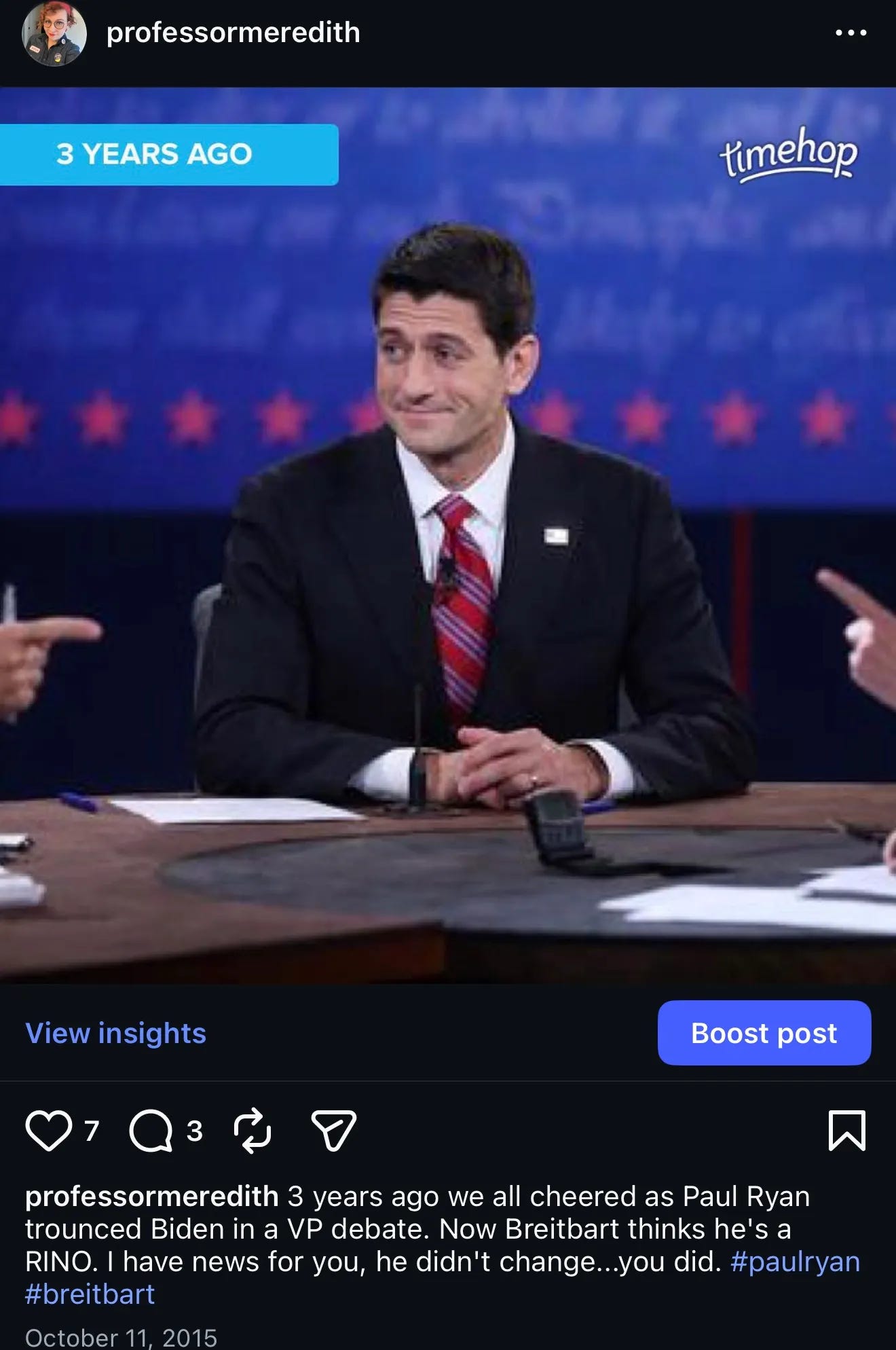
I still remember the reaction I got when I said “Paul Ryan’s budget proposal isn’t actually that bad, when you consider that politics only works when both sides can actually compromise.” It was…violent.
I should say that it had definitely had hiccups because of my beef with the Tea Party, but I had momentum.
I should clarify that I was consistently, if not loudly, pro-choice throughout this period.
Reassuring enough that I wrote a book about it and interviewed dozens of minority republicans on how the GOP could better communicate their policies.
Funny name, because it was neither an actual caucus nor did they give a shit about “freedom.”
That likely sounds hilarious given the man he is today, but it’s true. It’s one of the reasons that of every member of Trump’s cadre, Rubio pisses me off the most. Because he had convictions and he sold them for power.
And I actively used that platform to try to convince as many of my followers to vote for Hillary Clinton in that election as I could.
You may note that I have turned off AI detection for my posts. This is because I have individually tested the service that Substack is using and found that it inaccurately categorizes my writing as AI assisted, including work that I wrote before AI was a widespread tool, including some of my short stories, my first MA thesis, and a autoethnographic essay I wrote about the pandemic. This is a common I also fundamentally disagree with using AI to check to see if something is written by AI. If you enjoy my work and find it useful, that’s delightful. Use your own brain to analyze writing, rather than letting AI supply you with a flawed breakdown of “AI tropes” in writing.
In the above paragraph I used three words and writing techniques that Pangram would ascribe as being likely AI.
Nice work explaining your political transition. How times have changed...
Thank you for this. And thank you for speaking out about the dreaded AI so-called evaluation. The mere thought or mention of it turns me green around the gills.