
It Was Never About Merit: The USA Women’s Hockey Team and the Gendered Rules of Winning
Notes from the Trenches of a Gender Studies MA

I need to begin with a confession.
I do not know the rules of hockey.
I understand that there is ice. There are sticks. People glide around at alarming speeds and occasionally slam into each other with the confidence of Roman infantry. There are periods? Possibly power plays? That is the extent of my technical analysis. I had a girlfriend who dragged me to more than a few games when I was 20 or so, but I learned nothing substantial about the game.1
And I am, unapologetically, a girls’ girl.
And when women win, I pay attention.
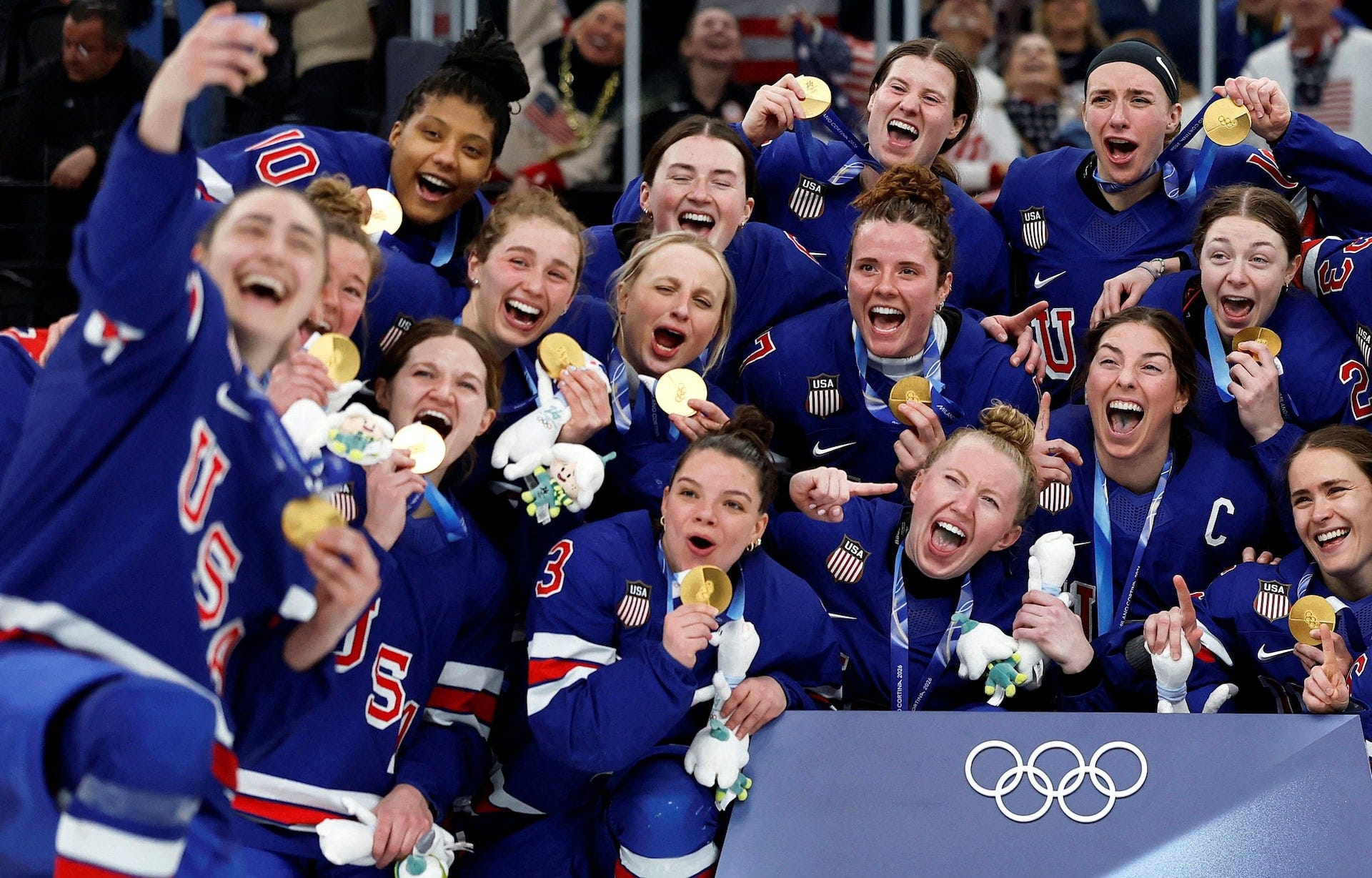
So when the United States women’s national ice hockey team won Olympic gold, in a game that reportedly became one of the most-watched women’s hockey broadcasts ever, my instinctive reaction was simple: they won. That should be the end of the story. In a culture that insists it values merit above all else, winning at the highest level ought to settle the question of legitimacy.
But it didn’t.
Instead, the reaction felt familiar. Not outright denial, not even explicit hostility, but that subtle recalibration that so often follows women’s excellence. The conversation drifted toward politics, personality, presentation. It carried that faint note of irritation that tends to accompany women who dominate too comfortably in spaces that were not originally built for them.
Because I am currently neck-deep in a Gender Studies MA2, my brain did what it does automatically now. It stopped seeing a sports story and started seeing an institution at work.
The Seminar That Made Me Side-Eye Meritocracy
This week we were reading Michael Warner and Lisa Duggan. On the surface, they are writing about LGBTQ politics and marriage, not hockey. But their frameworks have a way of traveling.
Warner argues that marriage is not merely a private romantic choice. It is a sorting mechanism. When health care, tax benefits, and social respect are routed through marriage, the institution quietly ranks relationships. Married intimacy is treated as legitimate and stable; other forms of life are tolerated, stigmatized, or left precarious. Dignity becomes something conferred by institutional recognition rather than something inherent.
Duggan builds on this by describing what she calls “new homonormativity,” a form of equality politics that offers inclusion without transformation. You can enter the institution, but you must not challenge its underlying hierarchies. Inclusion is permitted so long as it stabilizes the existing order.
As I read them, something clicked. Elite sport functions in much the same way. It does not simply measure physical skill. It distributes legitimacy. It decides who counts as a “real” athlete, who represents the nation, whose aggression is heroic and whose is unbecoming. Historically, those categories were coded male. They were designed around male bodies, male narratives, male mythologies of strength and conquest.
When women win in those spaces, they are not just achieving. They are unsettling a symbolic order that has long treated male dominance as natural.
World Champions, Still Negotiating Respect
Consider the 2017 standoff between the U.S. women’s hockey team and USA Hockey. These were world champions at the time, yet they had to threaten to boycott the IIHF World Championship in order to secure fair pay, adequate travel conditions, and basic institutional support. They were not asking for symbolic applause. They were demanding structural parity.
If meritocracy worked the way we are taught it does, their record would have spoken for itself. Excellence would have translated seamlessly into respect and investment. Instead, it required collective action and public pressure.
The pattern is not uniquely American. In 2019, Sweden’s women’s national hockey team went on strike over compensation and working conditions. Different country, similar dynamics. Women can participate. Women can even excel. But when they ask for the institution itself to change, the tone shifts. Warm celebration cools into skepticism.
This is precisely the kind of conditional inclusion Duggan describes. Access without redistribution. Applause without restructuring.
The “Why Not?” Question
Warner critiques the deceptively simple question “Why not marriage?” because it assumes that marriage is neutral and that access equals justice. We hear similar refrains around women’s sports: “Why not women’s hockey?”
The phrasing makes the answer seem obvious, but it obscures the deeper issue. The arena itself was built within a culture that coded physical aggression, public dominance, and national representation as masculine. The mythology of sport has long been intertwined with ideas of manhood, militarism, and frontier conquest. Men were cast as the natural occupants of that symbolic terrain.
So when women dominate in that space, the reaction is not purely evaluative. It is affective. It carries the friction of a script being disrupted. Aggression in men reads as tradition; aggression in women can read as transgression. Confidence in men signals leadership; confidence in women risks being labeled arrogance.
Excellence does not dissolve gender coding. It exposes it.
Alysa Liu and the Politics of Joy
The reaction to Alysa Liu dropping an F-bomb after winning gold in figure skating makes this dynamic painfully clear. In a moment of adrenaline and unfiltered joy, she swore on live television.
The backlash from parts of the right was swift and moralizing. It was framed as a failure of decorum, a sign of cultural decay.

 Tiktok failed to load.
Enable 3rd party cookies or use another browser
Male athletes swear on live broadcasts with astonishing frequency. Their profanity is read as passion, as evidence of competitive fire. Liu’s, however, was treated as a lapse in femininity.
The outrage was not really about language. It was about discipline. Women are allowed to win, but they are expected to do so gracefully, sweetly, in a way that reassures rather than disrupts. Their triumph must remain palatable. Their emotion must stay within acceptable bounds.
This is Warner’s sorting logic in action. Respectability becomes the gateway to legitimacy. You can dominate, but only if you remain compliant with the moral expectations attached to your gender.
Who Gets to Feel at Home
The story becomes even more layered when we consider that Laila Edwards became the first Black woman to win Olympic gold in U.S. hockey. Women’s hockey has historically been imagined as white and regionally specific. Her visibility expands the boundaries of who is imagined as belonging in that space, but it also reveals how deeply those boundaries were ingrained to begin with.
Institutions do not simply measure performance. They define who appears “natural” within their walls. When new bodies enter and excel, the institution adapts just enough to include them, but the sorting mechanism does not disappear. It recalibrates.
What the Gender MA Has Changed
Before this degree, I might have been content with a simpler narrative. Win enough and respect will follow. Exposure will fix it. Time will smooth the edges.
Now I am less convinced.
Meritocracy promises that skill produces legitimacy. Gender analysis suggests that skill is filtered through role expectations. Women are encouraged to work harder, be better, and prove themselves. Yet when they succeed in ways that contradict prescribed femininity, the reaction reveals the limits of that promise.
It was never solely about merit. It was about whether the performance aligned with the script.
Marriage ranks intimacy. Neoliberal politics ranks acceptable queerness. Sport ranks acceptable bodies. Media ranks acceptable ambition. In each case, the institution presents itself as neutral while quietly distributing dignity according to deeply embedded norms.
I may not understand the finer points of hockey strategy. But I understand this pattern when I see it. When women excel in male-coded spaces, the conversation does not simply celebrate the achievement. It expands to evaluate their tone, their politics, their demeanor, their conformity.
Winning is not the same as belonging.
And as long as legitimacy flows through role conformity rather than achievement alone, no number of gold medals will fully resolve the anxiety.
The Gender MA has not made me cynical. It has made me attentive. Once you see the sorting mechanism, you cannot unsee it, not in marriage debates, not in workplace politics, and not even on an ice rink.
Reading List
Michael Warner
The Trouble with Normal: Sex, Politics, and the Ethics of Queer Life (1999) Particularly Chapter 3, “Beyond Gay Marriage.”
Lisa Duggan
The Twilight of Equality? Neoliberalism, Cultural Politics, and the Attack on Democracy (2003) Especially Chapter 3, “Equality, Inc.”
Mary Jo Kane
“The Better Sportswomen Get, the More the Media Ignore Them”
Sara Ahmed
The Promise of Happiness (2010)
Iris Marion Young
I was there for an excuse to snuggle in the cold.
And I start my PhD in October, if you think I’m insufferable NOW, just wait until it’s DOCTOR Meredith writing these posts, not just Professor Meredith.