
Menopause, the Grandmother Hypothesis, and the Cultural Obsession with Women Being Useful

I hate the algorithm.
I hate the way it slices us into ideological charcuterie boards and serves us only the meats we already like. It’s engineered dopamine. It’s confirmation bias with an SEO optimization team. It feeds us versions of ourselves and then calls that “personalization.” It flattens nuance into factions and traps us in neat little us-versus-them narratives because we only see the corner of the internet that already agrees with us.
It is, however, occasionally useful.
Lately I’ve been reading about the “divine feminine” for an upcoming podcast episode. Which means my algorithm has decided I am now spiritually interested in womb energy, moon cycles, and the metaphysics of estrogen. Fair enough, I did that to myself.
And today, in the same scroll session, it served me two videos.
One was a man explaining evolutionary biology and the “grandmother hypothesis.” Menopause, he said, is proof of women’s evolutionary power. We evolved to go offline from reproduction so we could preserve our wisdom and educate the next generation. Nature, apparently, invented grandmothers on purpose.
The other was one of my favorite scenes from Fleabag.
In it, Kristin Scott Thomas delivers a feral, incandescent monologue about women being born with pain built in. Periods. Childbirth. Hormones. The cycle. And then menopause arrives, horrendous but magnificent. “No longer a slave, no longer a machine with parts,” she says. “You’re just a person…”
Two stories about the same biological event.
One says menopause is reassignment.
The other says menopause is release.
I am, at 35, in what appears to be the early stages of perimenopause. Or at least that’s what the symptoms suggest, despite my doctor raising an eyebrow at my age like I’ve skipped ahead in the life syllabus without permission.1
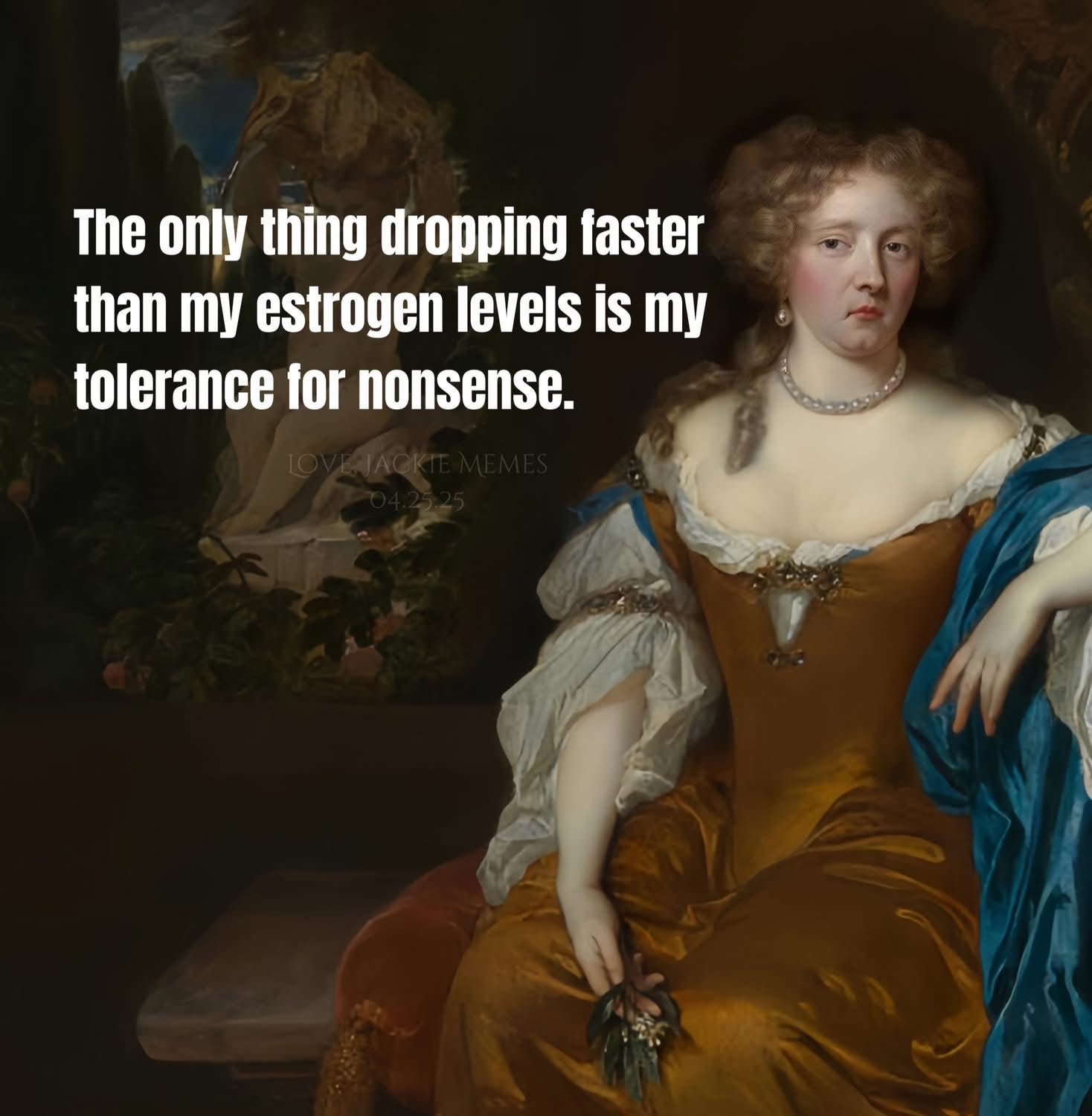
So these aren’t abstract narratives for me. They’re not just content. They’re not just theory. They’re my body. Right now. Sweating at 2 a.m. Googling phrases like “is [x] a sign of menopause” while nervously having NO idea when my my next cycle might start, because there’s no way it’s on a 28 day loop anymore. RIP my ability to predict when I need to buy tampons.2
But outside of my own intimate interest on the impacts of menopause, the first video gave me some feelings I needed to unpack and I’m taking you with me.

Women Must Always Be For Something
Here’s what bothered me about the evolutionary video. Not the science, exactly. Not even the tone. It wasn’t hostile or dismissive. It was reverent, admiring, almost romantic in its certainty: women are so powerful, it suggested, that evolution itself carved out a special quarter-century of life just to preserve our wisdom. Nature, apparently, invented grandmothers on purpose.
And yet the logic slid, almost invisibly, from description to assignment.
Menopause becomes meaningful not because it changes a body, but because it changes a woman’s function. In this framing, we go “offline” from reproduction not to gain autonomy, but to optimize the species. We are protected so that we can educate, preserved so that we can provide, extended so that we can transmit. The job description changes, but the requirement doesn’t: you are still here to serve the collective.
The grandmother hypothesis, as an evolutionary framework, isn’t inherently oppressive. It emerged through serious research, most famously in the 1990s work of anthropologist Kristen Hawkes and colleagues studying Hadza hunter-gatherers, where post-reproductive women’s labor and knowledge could contribute to the survival of grandchildren. Comparative examples in other “big brain” species get pulled into the conversation too, especially orcas and elephants, where older females can play important roles in group survival during ecological stress.
That’s the scientific claim at its most responsible: longevity can confer adaptive advantage.
But science does not tell you what a woman is for.
Culture does.
And popular retellings rarely resist turning adaptation into obligation. A hypothesis about selection pressure becomes a story about purpose. A descriptive account of survival advantage gets translated into a moral assignment: menopause exists so women can keep contributing. We are no longer reproductive infrastructure, we are educational infrastructure. Still infrastructure, still useful, still oriented outward.
It’s Evolution’s HR Department with better lighting.
The Utility Reflex
Once you see it, it’s hard to unsee. Women are narratively required to justify their existence through service, and that requirement persists across the lifespan with only minor rebranding.
Girlhood is promise. Fertile adulthood is reproduction. Motherhood is moral labor. Post-reproductive life becomes wisdom labor. The cultural logic doesn’t tolerate women as neutral beings who simply exist; it tolerates women as contributors. Value is tied to function, and function is usually tied to other people’s needs.
This is one reason aging is such a cultural crisis for women. Western societies don’t just fear women getting older; they fear women becoming harder to categorize. Margaret Gullette writes about how we are “aged by culture,” pushed into scripts of decline and diminishing worth unless we can be reattached to a socially legible role. Simone de Beauvoir observed, long before the current wave of menopause discourse, how older women can become socially ambiguous, half-visible unless tethered to family function. The point isn’t that older women have no power. It’s that cultures like ours panic when that power is not routed through service.
So menopause becomes a problem to solve, even when it’s framed as empowerment. If women are no longer fertile, we either medicalize them into a malfunction or we repurpose them into a new kind of usefulness. Either way, we struggle to imagine women who are simply done and units unto themselves.
The grandmother hypothesis, in its pop-evolutionary form, solves a cultural problem. It tells us older women are not obsolete. They are essential.
But essential to what?
Not to themselves.
To the group.
To the grandchildren.
To the species.
Notice what’s missing: autonomy.
Menopause and the End of Reproductive Surveillance
This is where the biology matters, but not in the way the algorithm wants it to matter.
From puberty onward, women’s bodies are tracked like public infrastructure. They are monitored, managed, moralized, legislated, and medicalized, often at the same time. Emily Martin’s work on reproductive metaphors shows how deeply we rely on mechanical language to describe female bodies: production, efficiency, failure, breakdown, decline. We become factories with monthly output reports, and then we spend decades being told how to optimize the factory.
Menopause interrupts that arrangement.
No ovulation. No fertility panic. No pregnancy risk. No “biological clock” rhetoric. No constant negotiation between bodily function and social expectation. The body exits the reproductive marketplace. That can be messy and brutal on the physical level, but structurally it also means something: a woman who cannot become pregnant is harder to discipline through pregnancy. Harder to coerce through motherhood. Harder to threaten with reproductive consequence.
If patriarchy relies on women’s reproductive vulnerability, menopause destabilizes one of its most reliable levers.
So of course our culture rushes in to narrate menopause into a new function. If you are no longer a reproductive machine, you become a machine meant to optimize the reproduction of others. You still produce. You still serve. You remain socially legible.
The surveillance ends, and the culture immediately tries to replace it with assignment.
The Counterargument We Don’t Know What to Do With
Here’s where things become genuinely complicated, because the grandmother hypothesis does not have to be read as soft reassignment. It can just as easily be read as a theory about power.
In orca pods, post-reproductive females are not sentimental figures drifting at the edge of the group; they are strategic leaders. They guide hunting routes during times of scarcity. They hold ecological memory. In elephant herds, matriarchs determine migration patterns and water access, and their decisions shape the survival of the entire group. Their authority is not decorative. It is infrastructural.
Anthropological research in some human societies suggests something similar: older women can exert significant influence over food distribution, kinship decisions, conflict mediation, and social cohesion. Longevity, in these contexts, does not simply preserve wisdom for others to borrow politely. It consolidates it. It allows knowledge to accumulate without the constant interruption of pregnancy, childbirth, and infant care.
That is not service. That is structural authority.
And structural authority is much harder to domesticate than caregiving.
If menopause reduces reproductive vulnerability, it also shifts the social calculus. Historically, childbirth has been dangerous, even lethal. Reproductive risk ties women’s survival to systems of male protection and social cooperation. A woman who can no longer become pregnant is no longer tethered to those risks in the same way. She can take political risks. She can challenge norms without the same biological stakes. She can withhold compliance. She can refuse domestic expectations without the looming threat of reproductive consequence.
That figure is not a grandmother in a rocking chair. She is a structural actor operating with a different kind of leverage.
And that is precisely the version we struggle to narrate.
Instead, we soften her. We translate authority into warmth. We package influence as sweetness. We say nature shaped her to help the next generation survive. We give her apron-coded leadership and call it “grandma wisdom,” and continue to tie her existence to her value as part of the reproductive process, as though the power of accumulated experience must always be filtered through maternal infrastructure to be socially acceptable.
We prefer our elder women comforting, not sovereign.
And you can see this anxiety play out in pop culture. The “fun grandma” is beloved as long as she exists as supplemental childcare, emotional support, and holiday infrastructure. But the grandmother who refuses full-time caregiving, who says she has her own life, her own ambitions, her own boundaries, is often framed as selfish, cold, even negligent. We talk about her as though she is failing a moral obligation rather than exercising a choice. The backlash is telling. It reveals how deeply we assume that post-reproductive women are still on call. The title “grandmother” becomes less a descriptor of kinship and more a job description. When she declines the job, the cultural script struggles to categorize her.
Notice what rarely provokes outrage: the grandfather who continues golfing, traveling, or disappearing into hobbies. His autonomy is expected. Hers is suspect. We have naturalized the idea that men age into individuality, while women age into availability.
The Divine Feminine Trap
And then there’s the other side of my algorithm: the “divine feminine” corner of the internet, where everything is moonlit and lavender-scented and somehow still ends up circling back to the womb. In this discourse, femininity isn’t just a social category; it’s a cosmic assignment. Your cycles are sacred. Your body is a portal. Menopause is framed as ascension, the final step from maid to mother to crone. A promotion into the wise woman era where you finally step into your power.
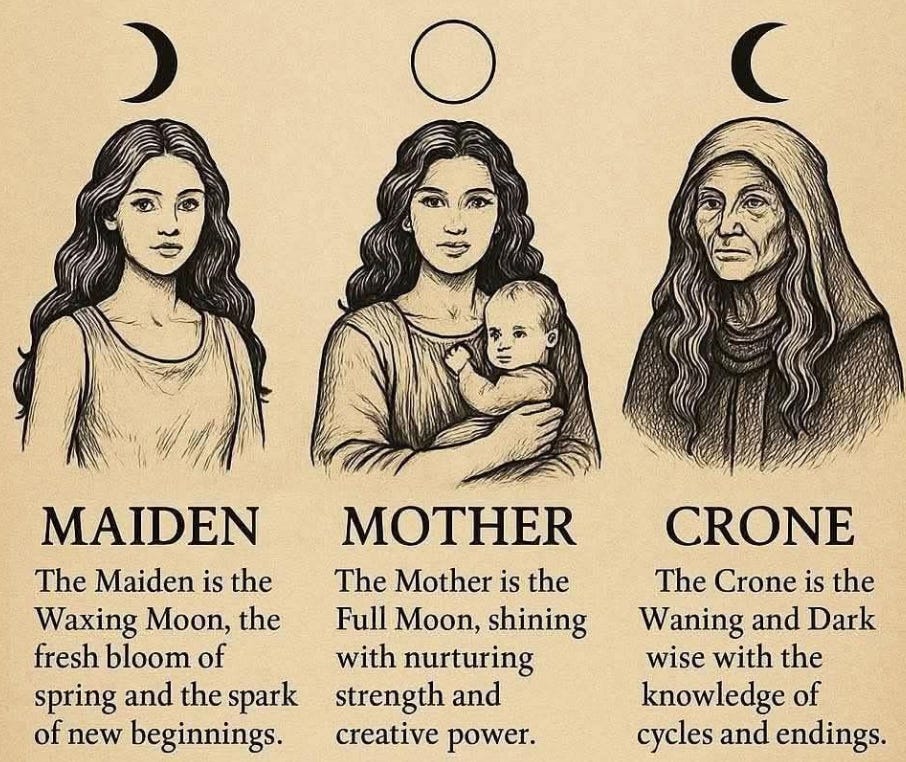
I understand why it hits. Compared to the medical story, which so often treats women as problems to manage, this language can feel like relief. It can feel like reclamation, like an antidote to the centuries-long habit of describing women as defective men with inconvenient hormones.
But even here, there is a trapdoor hidden under the crystals and tarot cards and crone iconography.
Because the divine feminine still makes women into conduits: vessels of energy, embodiments of life force, archetypes of cyclical wisdom. You are revered, yes, but you are also being drafted into symbolism. Reverence becomes another kind of extraction. It flatters while it confines, and it keeps the spotlight trained on what your body represents for everyone else.
Sacred is not the same as free. In fact for women, throughout history, sacred has almost always meant the exact opposite.
Reassignment vs. Release
Which brings me back to Fleabag, because it offers something both the evolutionary story and the divine feminine story keep dodging: the possibility that menopause doesn’t have to mean anything at all beyond what it is. Kristin Scott Thomas’s monologue doesn’t offer a new role, a new sacred purpose, or a new social function. It offers a brutal kind of honesty, and then, unexpectedly, a kind of liberation: “No longer a slave, no longer a machine with parts. You’re just a person...”
That’s the distinction I keep circling. The evolutionary video makes menopause into reassignment, a transfer from one form of reproductive labor to another. The spiritual version makes it a promotion, a cosmic upgrade into wisdom-keeper status. Fleabag calls it something else entirely: the end of being structurally leveraged. It’s horrendous, yes, but it’s magnificent precisely because it’s not narrating you back into usefulness.
My reaction to the grandmother hypothesis wasn’t anti-science. It was anti-obligation. It’s all well and good to hypothesize on the science behind why only three species on the planet have women that live past the age of child-bearing years, it’s another thing to romanticize that into something that traps women once again into an acceptable role meant to serve society.
Women are always being told what we are for: children, husbands, morality, civilization, wisdom transmission. Even our biological endpoints get converted into service, narrated into a social role so we remain beneficial and productive to society.
So here’s the question I can’t shake: what if menopause doesn’t need a purpose? What if it isn’t a tragedy, or a spiritual promotion, or a species-level optimization strategy? What if it’s simply the first time since puberty that a woman’s body is not automatically framed as a public resource?
What if the most radical thing about menopause is not that it preserves wisdom, but that it withdraws labor?
And what happens to a society built on women’s labor when women stop being machines with parts that serve someone else?
There’s some studies floating around that multiple COVID infections could start early menopause and that women with ADHD may have early menopause as well, so I got the DOUBLE WHAMMY.
Oh is this TMI? FUCK OFF. I wish I didn’t have to deal with this information either.
Personally, I was initially relieved after I realized had said goodbye to my last period. But there are definite challenges. Good luck if that’s what you’re facing !