
On Vampires, Feminist Rage, and the Death Penalty I Don’t Believe In
Notes from the Trenches of a Gender Studies MA

As someone who opposes the death penalty, I probably shouldn’t be all in for a vampire that kills bad men, but here we are.
This week in Gender & Film, we watched A Girl Walks Home Alone at Night. I always try to watch the film before I turn to the academic readings, because I want to see the film first as a viewer would. I suppose that’s already a bit difficult to do since I know I’m meant to be watching it through a lens of “gender theory” but what can you do?
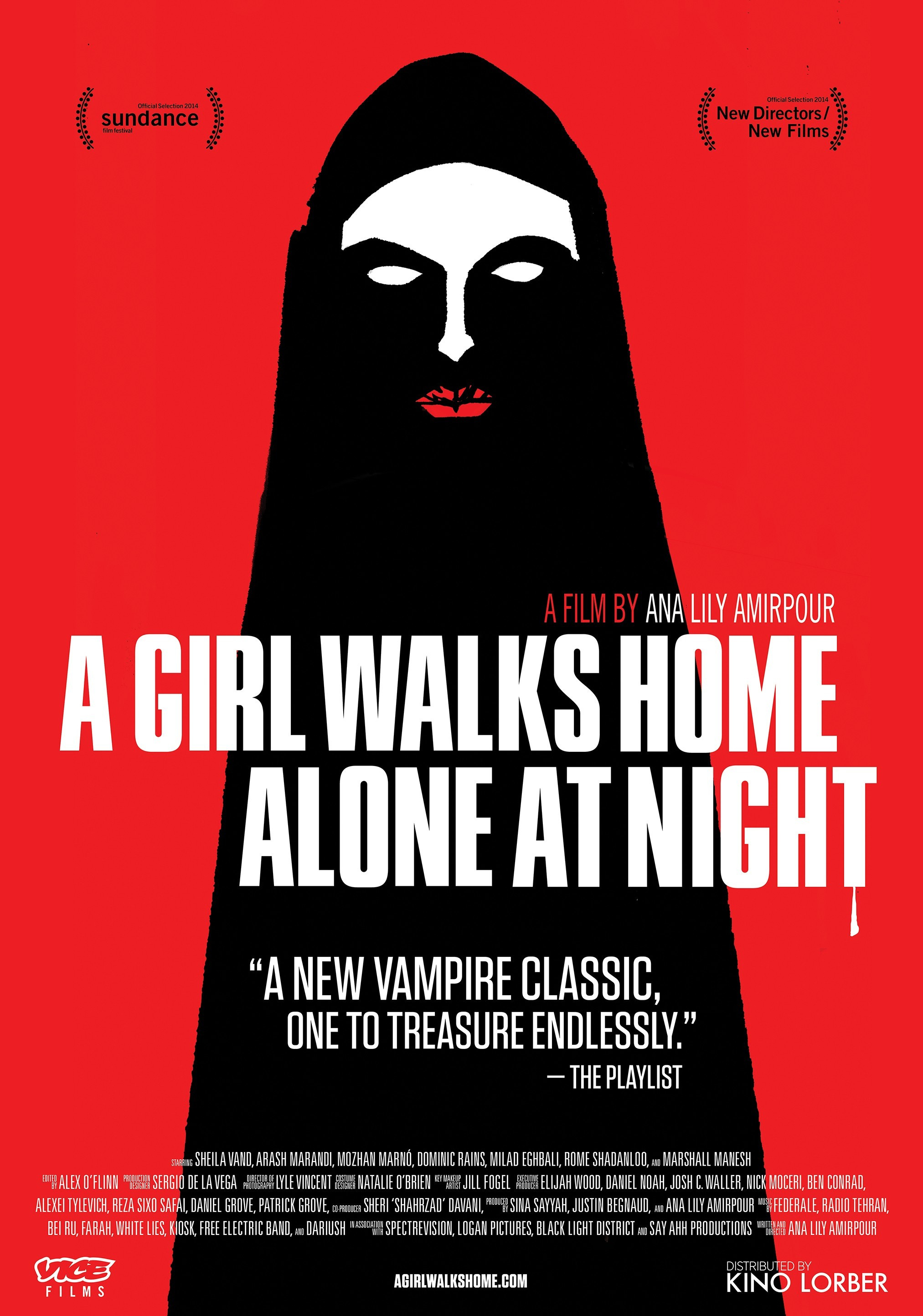
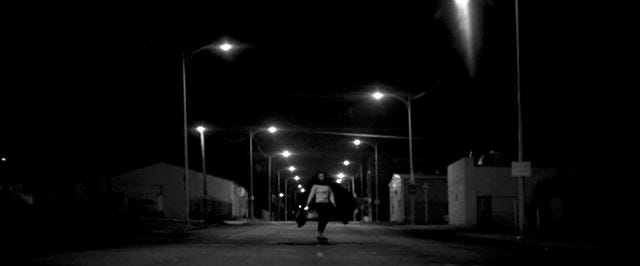
I sat with its black-and-white stillness, its oil pumpjacks bowing in mechanical rhythm, its desolate Bad City, its quiet menace. I watched a woman in a chador glide through empty streets on a skateboard. Watched a drug dealer with tacky tattoos terrorize a vulnerable woman. Watched a father unravel under addiction and try to force that addiction on a woman against her will.
I watched harm accumulate.
And when the Girl killed the drug dealer, Saeed, I didn’t recoil.
Another student in the class, who is notably a male (not a criticism, but it’s important to this analysis I’m doing here) and a ‘grizzled police veteran’1, said he found it “quite scary in places”, so I was prepared for jump scares when I watched it.
Instead, I had no fear at all…just an odd feeling of catharsis.
That unsettled me.
What unsettled me wasn’t that I failed some moral purity test by enjoying fictional violence. It was that the film's affective experience felt so gendered in a way I didn’t fully appreciate until that coursemate’s comment reframed it. If a man in our classroom found the film frightening, while I experienced it as clarifying and even relieving, what exactly was being activated for each of us?
My classmate experienced the film as frightening, and in a genre sense, that’s the expected response: it’s a vampire movie, it’s shot in noir monochrome, it’s full of empty streets and lurking silhouettes. You’re supposed to be on edge.
But I wasn’t.
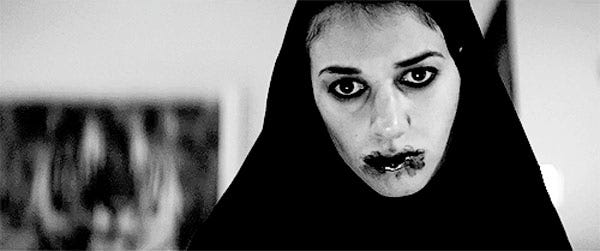
If anything, I felt a strange kind of safety inside the threat. The Girl wasn’t a danger I needed to anticipate. She was the thing that made danger hide under its covers. As a viewer, I wasn’t bracing for what she would do; I was waiting for who would finally get what was coming.
And that difference in response sits right at the intersection of gender, spectatorship, and lived experience. Men are often raised with the assumption that public space belongs to them by default. The street is neutral. The night is merely dark. Threat is an occasional event, not an atmospheric condition. For many women, it’s the opposite: danger is not an intruder into normal life; it’s something you learn to plan around. You do the math automatically. You catalogue exits. You keep an eye on your drink. You hold your keys between your fingers even though you know that “self-defense tip” was probably written by someone who’s never been grabbed. You learn to treat a stranger’s friendliness as a variable, not a comfort. Sometimes, even the treatment of friends or acquaintances can be a threat, because even those can be a threat.
So when a film builds a world where predatory men move through public space with entitlement, it doesn’t read as horror to me. It reads as Tuesday.
The horror, if it exists, is not the supernatural; it’s the realism. Saeed’s behavior isn’t terrifying because he’s a cinematic monster; it’s terrifying because he’s banal. He’s the kind of man who expects women’s fear to function as his social lubricant. He doesn’t even need to be violent all the time, because the possibility does the work for him. And the film understands that. It doesn’t construct him as an extraordinary villain. It constructs him as an ordinary expression of a system.
Which is why the Girl’s violence didn’t land as fear. It landed as interruption.
That’s the part I can’t shrug off as “I like revenge stories.” It’s more specific than that. The satisfaction I felt wasn’t really about blood, or punishment, or spectacle. It was about the reversal of a familiar power dynamic. Saeed spends the film moving through the world like consequences are a myth invented for other people. Then he meets someone who is not impressed by his entitlement, not seduced by his bravado, and not limited by the social rules that usually protect him. Watching him lose control doesn’t create suspense or fear for me. It creates a kind of quiet exhale.
And that makes me uneasy, because I am fundamentally opposed to the death penalty. I don’t believe the state should have the power to decide who deserves to die. I don’t believe violence produces justice. I don’t believe punitive systems make us safer. I can give you the political arguments and the moral arguments and the “the carceral state is a machine built to reproduce inequality” arguments, and I mean all of them.
So why did this feel good?
Part of the answer is that the Girl is not the state. She isn’t a judge or jury or executioner acting under the banner of legitimacy. She doesn’t stabilize Bad City. She exposes it. The death penalty is institutional power at its most concentrated, and it reinforces the authority of a system that already fails people. The vampire, by contrast, operates as a fantasy precisely because she does what the system won’t: she takes harm against women seriously, immediately, and without negotiation.
But that only pushes the question back a step, because it still leaves the central contradiction in place: why is violence the vehicle through which that accountability becomes imaginable?
And if I’m being honest, this is where my moral absolutism has a weak seam. I can oppose capital punishment in principle and still feel something ugly and human flare up when a certain kind of impunity enters the conversation, the kind that comes wrapped in money, connections, and sealed documents. My feelings about the death penalty don’t exactly apply to “the Epstein list” or the kinds of government employees who shoot an unarmed mother in her minivan on a frozen Minneapolis street, and I hate that I even have to admit that, because it’s not a policy position so much as a stress test. It’s what happens to your ethics when you watch powerful men evade consequences so completely that “due process” starts to feel like a euphemism for “nothing will happen.”
That flare-up doesn’t make the death penalty suddenly good. It makes the rage behind the fantasy easier to name.
This is where the readings that we had in conjunction with the film start to click into place. One of them frames feminist rage not as irrational excess, but as a form of clarity, a way of seeing what polite society insists on blurring. Another reads the Girl as “resistive monstrosity,” a figure who becomes monstrous in response to a world that has normalized women’s vulnerability. Taken together, they gave language to something I felt before I could name it: the film isn’t asking me to fear the vampire. It’s asking me to recognize the everyday monster we’ve been trained not to call monstrous at all.
Bad City is full of extraction: oil, money, drugs, sexuality, fear. The violence isn’t only in the killings; it’s in the ambient coercion that makes those killings feel like punctuation rather than disruption. In that sense, the vampire doesn’t import violence into a peaceful world. She reveals the violence that already structures it, then turns it back on the people who benefit from it.
And still, I can’t ignore the seduction of that turn.
Because if punishment feels like relief, it can start to feel like justice. That’s the trap door. That’s where “accountability” can quietly slide into “carcerality,” and where feminism can get recruited into punitive fantasies that ultimately leave patriarchal structures intact. If the only imaginable consequence is death, then we’re still thinking inside the logic of domination. We’ve just changed who gets to wield it.
What I keep returning to is that the film doesn’t end with triumphant closure. It ends with ambiguity, silence, and a car ride that feels like a held breath. The Girl doesn’t become a clean symbol of empowerment. She remains unsettling, not because she’s frightening, but because she forces the viewer to sit with what it means to find catharsis in violence when the world so often refuses women anything that resembles justice.
Maybe I don’t actually want a vampire justice system. Maybe I just want a world where harm against women isn’t background noise, where fear isn’t the default weather of every public (and sometimes private) space I inhabit, and where the thing that feels cathartic isn’t a killing, but the simple fact of being believed and a culture that doesn’t make excuses for male violence.
If feminist rage feels like justice in fiction, what does that say about the systems we’re living in? And what would it take to make the vampire unnecessary?
Reading For This Week
Queer utopias and a (Feminist) Iranian vampire: a critical analysis of resistive monstrosity in A Girl Walks Home Alone at Night - Shadee Abdi and Bernadette Marie Calafell
Female Desire and Feminist Rage: Ana Lily Amirpour’s Reworking of the Vampire Motif in A Girl Walks Home Alone at Night - Doro Wiese
Reclaiming the Marginalized Female Body in Ana Lily Amirpour’s A Girl Walks Home Alone at Night - U. Melissa Anyiwo
He told me to describe him thusly, but he is a retired police officer, which I think makes his finding the movie scary even more interesting in this case.
Thanks for being a good sport and letting me quote you!