
Patriarchy Created the Skill Issue. Women Are Not the Repair Shop.
Men’s emotional conditioning is real. So is their responsibility to unlearn it without turning women into unpaid therapists, trauma sponges, or customer service representatives for male disappointment

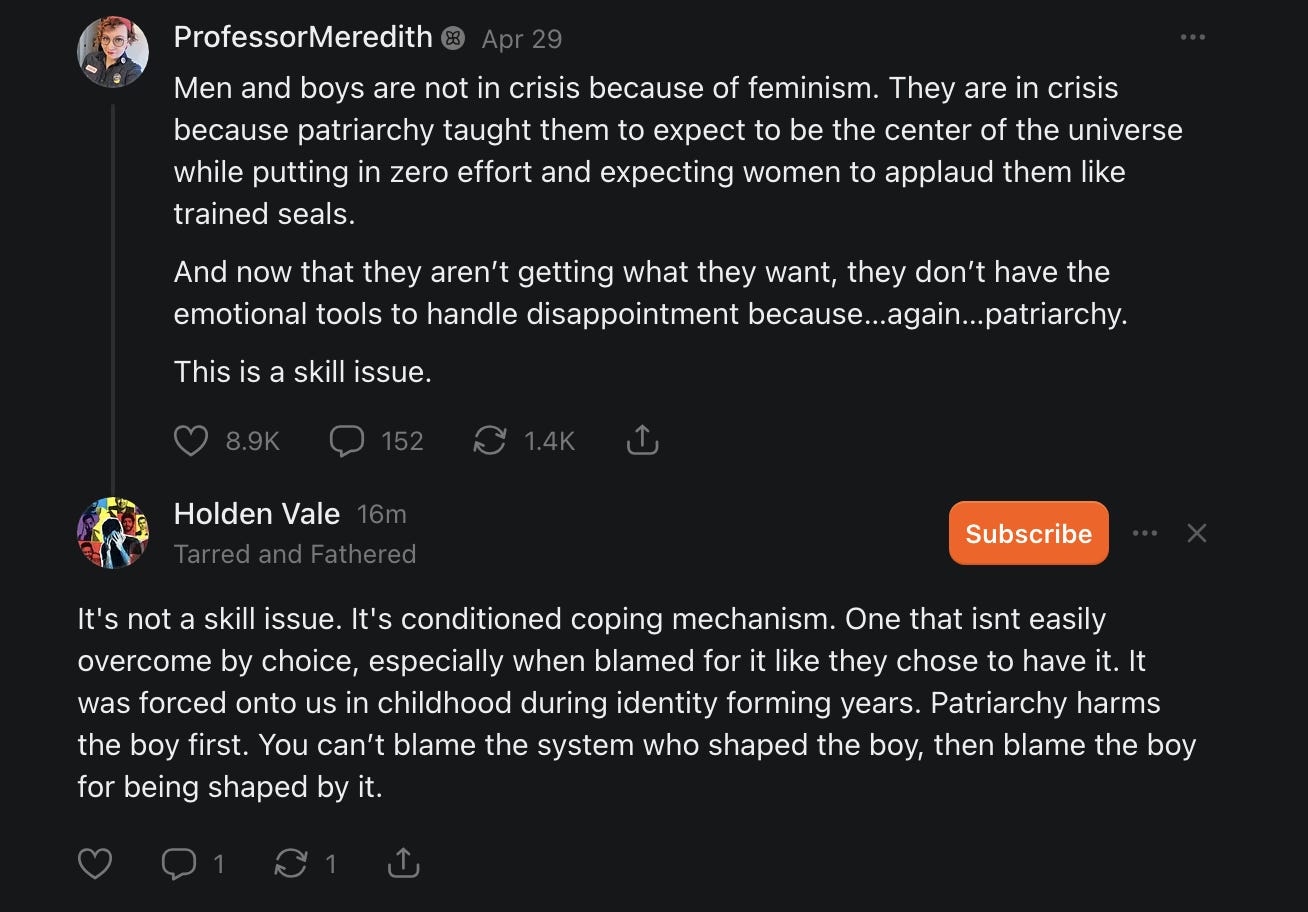
Apparently, “skill issue” has entered the discourse and immediately been escorted to the wrong table.
A few days ago, I wrote that men and boys are not in crisis because of feminism. They are in crisis because patriarchy taught them to expect to be the center of the universe while putting in zero effort and now that they are not getting what they want, they often do not have the emotional tools to handle disappointment.
I called this a skill issue.
This has been interpreted by some people as me saying men are personally, individually, morally defective for having been shaped by patriarchy. Which is not what I said. It is also not what “skill issue” means here.
A skill issue can exist because the skill was never considered important enough to teach. It can exist because someone was actively discouraged from learning it. It can exist because the culture around them treated the skill as shameful, feminizing, humiliating, or unnecessary.
That does not make the skill gap imaginary. It does not mean the consequences vanish. And it certainly does not mean everyone else is obligated to live inside the fallout.
A lack of skill is not always your fault.
But once that lack of skill starts hurting other people, it becomes your responsibility.
Patriarchy Is a Terrible Curriculum
Let’s be very clear: patriarchy harms boys.
It teaches them that vulnerability is weakness. It teaches them that anger is strength. It teaches them that sadness is shameful, fear is unacceptable, tenderness is suspect, and needing other people is a humiliation to be managed privately or disguised as rage.
It also teaches them that women are emotional infrastructure. We are supposed to soothe, soften, absorb, forgive, translate, wait, endure, explain, and then apologize for the tone we used while explaining.
That is not nature. That is curriculum. Bad curriculum. Lead-paint curriculum. Curriculum with arsenic in the sugar bowl.
The scholarship is not exactly coy about this. Connell and Messerschmidt’s work on hegemonic masculinity argues that masculinity is not a fixed biological essence, but a social formation connected to gender hierarchy, power, embodiment, and historical change. Masculinity is not simply something men “are.” It is something societies organize, reward, police, and reproduce.
The American Psychological Association’s guidelines for working with boys and men similarly frame masculinity as socially and culturally shaped, and they specifically encourage psychologists to help boys and men navigate restrictive definitions of masculinity.
So yes, when men say they were conditioned into emotional restriction, I believe them. When they say they were taught not to cry, not to ask for help, not to appear weak, not to need affection, not to admit fear, not to talk about pain until it has fermented into hostility, I believe them.
That is patriarchy doing what patriarchy does. It builds a cage, calls it manhood, and then sells everyone else tickets to watch the pacing.
But there is a difference between recognizing the cage and demanding women become the zookeepers.
“They Were Taught the Skill Was Bad to Learn”
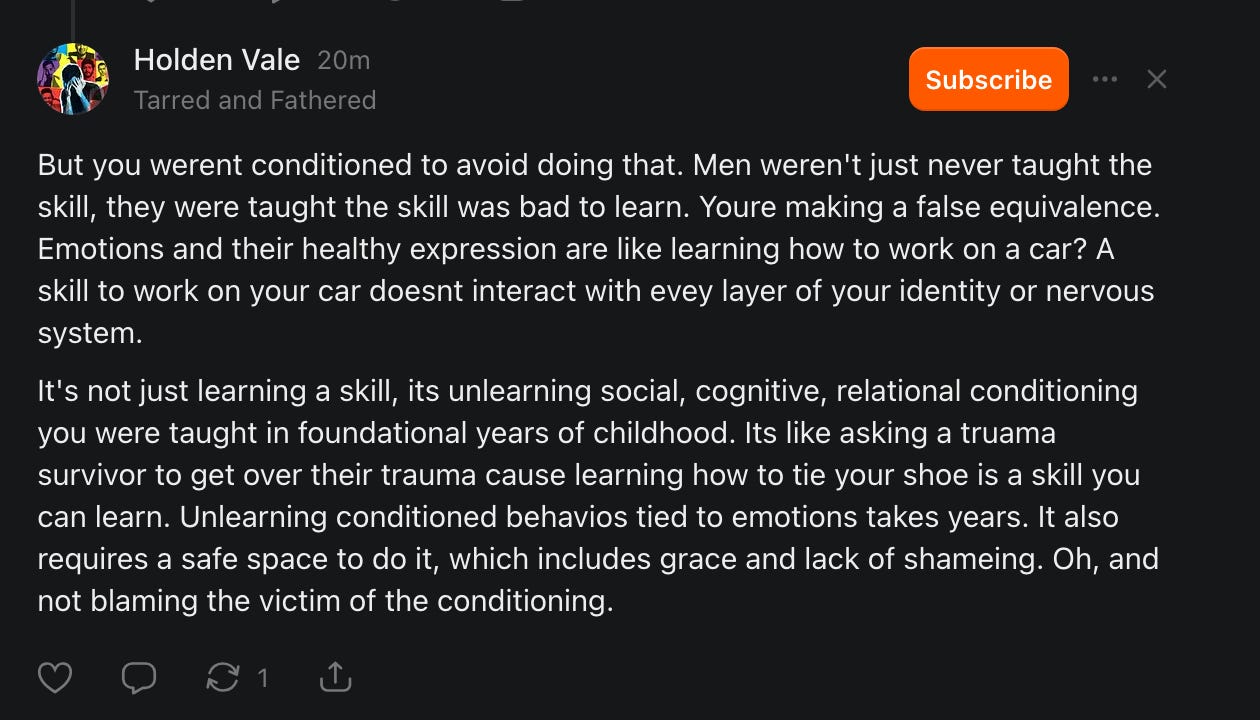
One of the objections I received was that emotional literacy is not like learning to maintain a car. Men were not simply “never taught” the skill, the argument went. They were taught the skill was bad to learn. Emotional expression interacts with identity, social conditioning, relationships, childhood, and the nervous system.
Fine.
That is true.
Emotional regulation is not exactly like learning to change a tire. It is deeper than that. It is more intimate than that. It is tangled up with shame, identity, family systems, friendships, culture, and the terrifying little filing cabinet in the brain labeled “things I refuse to feel because my father called them weakness.”
Research on men’s mental health supports this. “The Role of Masculinity in Men’s Help-Seeking for Depression: A Systematic Review” found that conformity to traditional masculine norms affects how men experience depression, how they manage symptoms, and whether they seek help. Norms such as stoicism, self-reliance, and restrictive emotionality can make it harder for men to recognize distress, communicate it, or access support.
So yes, men were often taught not to learn the skill.
That is not an escape hatch from responsibility.
If anything, it makes the responsibility more urgent. Because if patriarchy taught men that emotional literacy is shameful, then adult men have a choice to make. They can keep treating that shame as sacred inheritance, or they can decide that maybe the thing patriarchy told them to avoid is exactly the thing they need.
Therapy exists. Books exist. Support groups exist. Other men exist.
The internet exists, and not just for podcasts by men sitting in front of rented sports cars explaining that women over thirty are expired produce.
Men have options. Many of them have access to resources women were never offered when we were expected to become fluent in everyone else’s emotions just to survive.
Explanation Is Not Exemption
This is where people get slippery.
Because the second you say, “Patriarchy harms boys too,” someone inevitably tries to hand women the mop.
The move goes like this:
Patriarchy harms men.
Therefore men lack emotional skills.
Therefore women should be more patient.
Therefore women should be less angry.
Therefore women should be less suspicious.
Therefore women should soften their critiques.
Therefore women should help men grow.
Therefore if women refuse to do this, women are the real obstacle.
And just like that, patriarchy has performed its favorite magic trick: making men’s pain women’s assignment.
No.
Explanation is not exemption. Difficulty is not immunity. Trauma is not a coupon for harming other people.
You can blame the system that shaped boys and still hold adult men responsible for what they do with that shaping. That is not hypocrisy. That is accountability.
bell hooks understood this tension better than almost anyone. Her work on men, masculinity, and love takes male pain seriously without turning male pain into a permission slip. In a New Yorker interview, hooks discussed the need to understand how men are raised into violence, shame, and emotional disconnection, but her work never suggests that women must absorb domination because men were wounded by patriarchy first.
Patriarchy harms men.
Men still have to change.
Both things are true. Both things can sit in the same room without one eating the other.
Women Are Not the Remedial Classroom
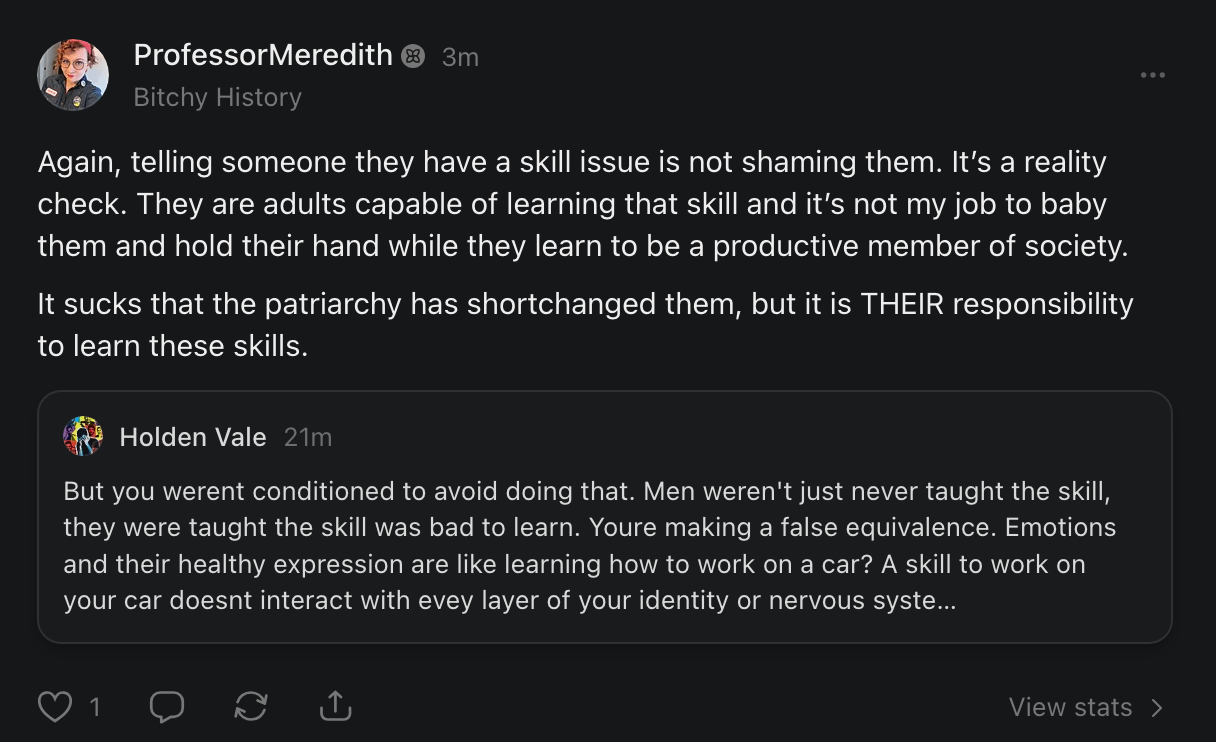
Here is the part that seems to cause the most distress: I am not here to coddle men about this.
I am not here to provide soft lighting and a guided meditation because grown men have discovered that being told to learn emotional regulation feels unpleasant. I am not here to rock patriarchy’s graduates gently in my arms and whisper, “There, there, it’s not your fault you never learned accountability.”
It may not be their fault.
It is still their responsibility.
Women are not the remedial classroom for patriarchy’s worst students. We are not the customer service desk for male disappointment. We are not the emotional crash mat for men who are just now realizing that “anger” is not a complete personality, despite what their emotionally stunted and PTSD riddled forefathers told them.
Arlie Hochschild originally coined “emotional labor” to describe paid emotion work, especially the management of feeling required as part of a job. But her broader concepts of emotion work and feeling rules help us think about how emotions are managed socially, not just privately. Her 1979 work on emotion work argues that feeling itself is shaped by social rules and interpersonal expectations.
And the gendered pattern is not imaginary. Research on emotion work in relationships has found that women in both same-sex and different-sex relationships often do more emotion work than men, including encouraging personal sharing and maintaining relational emotional climates.
So when men demand “grace” in response to feminist critique, we should ask a few questions.
Grace from whom?
At what cost?
For how long?
And why is women’s patience always treated like a public utility?
“Grace” Is Not a Debt Women Owe Men
One of the responses I received insisted that men need safe spaces, grace, and lack of shaming in order to unlearn patriarchal conditioning.
Okay.
Build them.
Fund them.
Join them.
Go to therapy. Read books. Talk to other men. Start support groups. Develop friendships where emotional honesty is not treated like a contagion. Practice vulnerability somewhere that does not require women to become the training wheels for your humanity.
What men are not owed is automatic trust from women who have every reason to doubt the safety of men.
What men are not owed is unlimited patience from women they have exhausted.
What men are not owed is the right to interpret every boundary as hostility and every critique as abuse.
This matters because the demand for grace often comes with a tiny little clause hidden in the contract: women must make men’s growth comfortable for men.
Absolutely not.
Growth is often uncomfortable. Accountability is often uncomfortable. Realizing you have harmed people, benefited from a system, or outsourced your emotional life to the women around you is uncomfortable. That does not make the person naming it abusive.
It makes the discomfort evidence that the nerve is still alive.
Healed Men Do Not Demand Automatic Trust
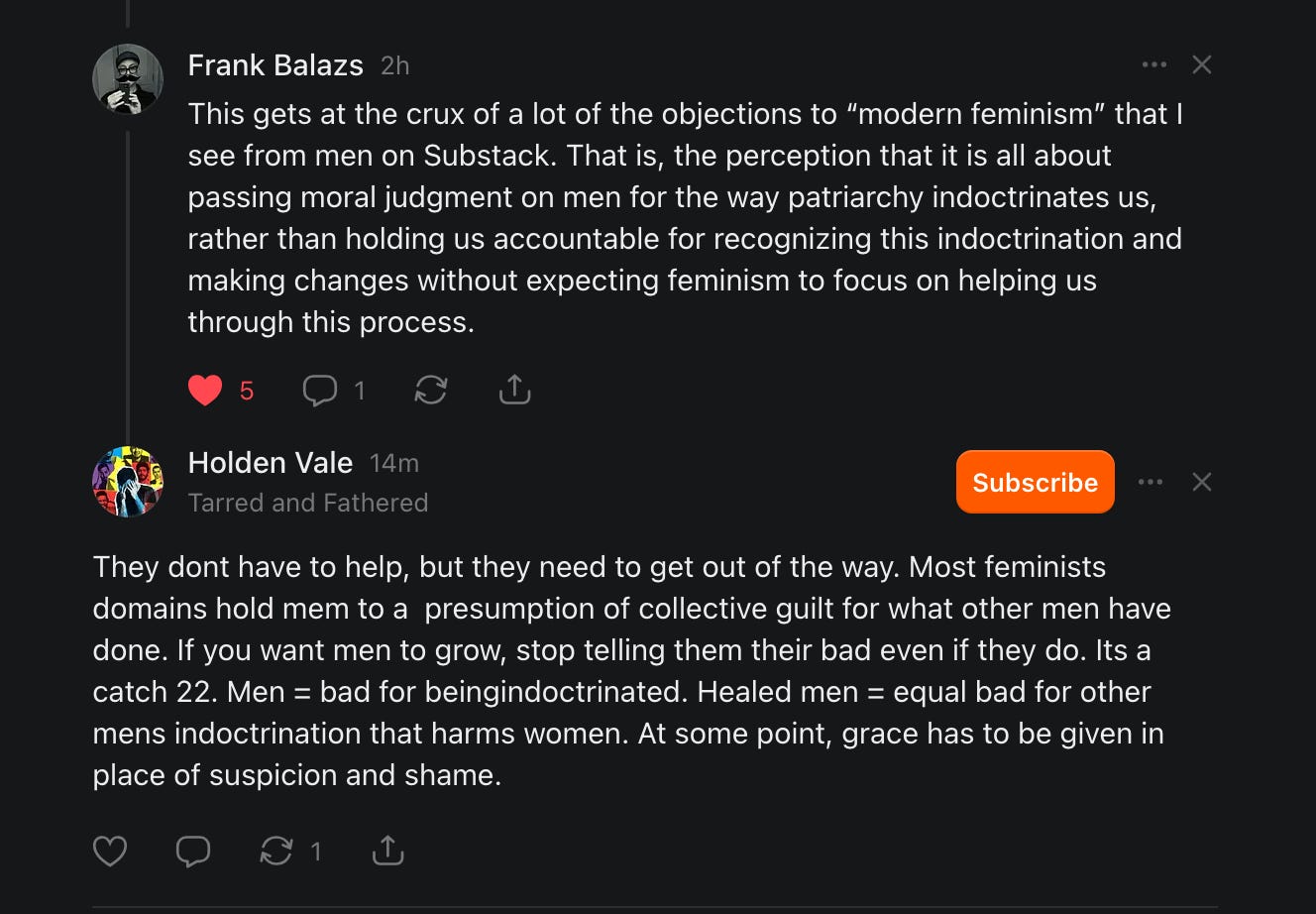
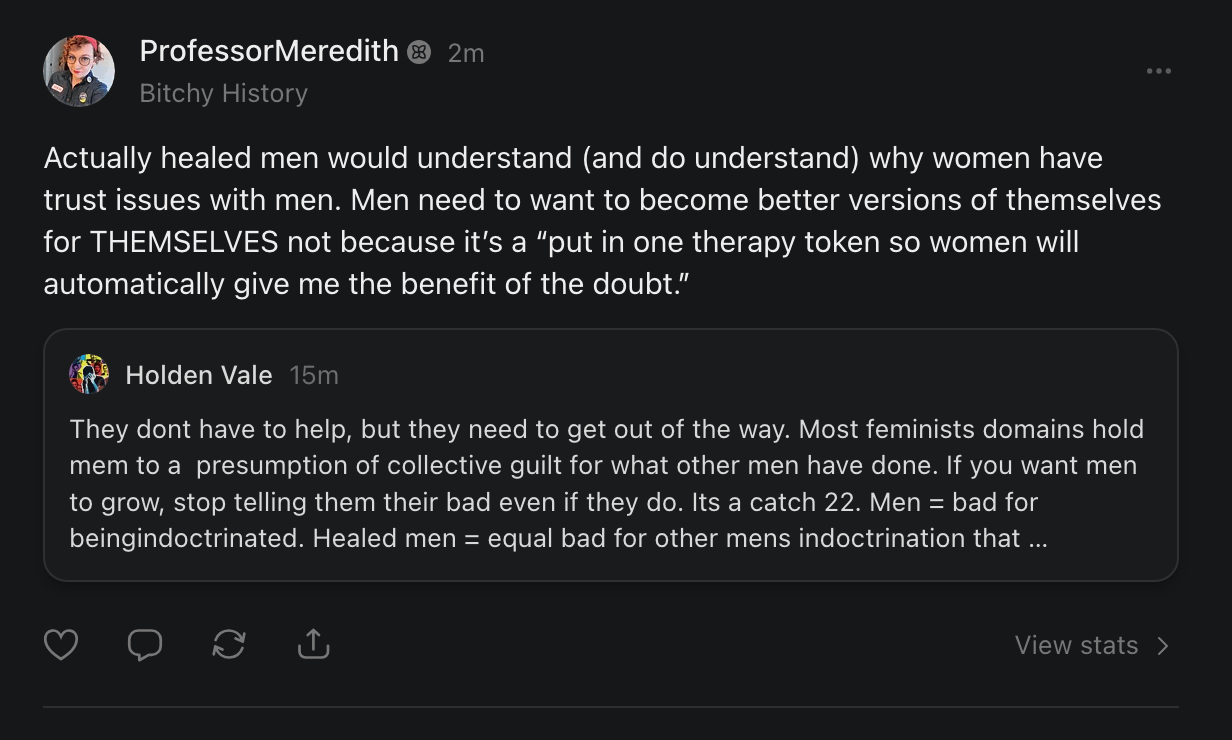
Another objection I received was that feminists treat men as collectively guilty. That even “healed men” are treated as bad because other men harm women. That at some point grace has to replace suspicion and shame.
This is one of those arguments that sounds reasonable until you notice the little entitlement goblin living inside it.
Because a healed man would understand why women have trust issues with men.
A healed man would not hear women’s caution and immediately make it about his wounded innocence. He would understand context. He would understand pattern recognition. He would understand that women are not being mean when we remember what men, collectively and individually, have done with women’s trust.
A healed man would not demand that women pretend the pattern does not exist so he can feel personally affirmed.
And frankly, men need to want to become better versions of themselves for themselves. Not because it gets them a cookie. Not because it earns them access to women. Not because it means women will automatically give them the benefit of the doubt.
Healing is not a vending machine where you insert one therapy token and women dispense trust.
If your growth depends on women immediately rewarding you with softness, access, forgiveness, or praise, you are not doing what you think you are doing. You are not healing, you are not trying to remove the Patriarchal residue from your life, you are simply trying to manipulate your way into women’s pants.
The Boys Deserve Better
This is where I want to be very clear: none of this means boys are doomed.
Boys are not born emotionally defective. Boys are not born allergic to tenderness. Boys are not born clutching a podcast microphone and muttering about “high-value females.”
They are taught.
And because they are taught, they can be taught differently.
Niobe Way’s work on boys’ friendships has shown that boys often do desire deep, emotionally intimate friendships, but those capacities are suppressed by masculine norms that teach vulnerability as weakness and emotional closeness as suspect. There is a crisis of connection among boys and young men, tied to cultural ideals of stoicism, autonomy, and self-sufficiency.
That is where collective responsibility belongs.
We are all responsible for refusing to feed another generation of boys into the same machine and then acting shocked when the machine produces men who cannot name sadness until it has already become rage.
Parents, teachers, coaches, media, communities, and men are all responsible.
Women are also part of the collective society that needs to raise boys differently, yes. But that is not the same thing as making individual women responsible for rehabilitating individual adult men who have access to help and refuse to use it.
Future generations need better emotional education.
Adult men need to do their own homework.
These are not contradictory claims.
The Conversation Eats Itself
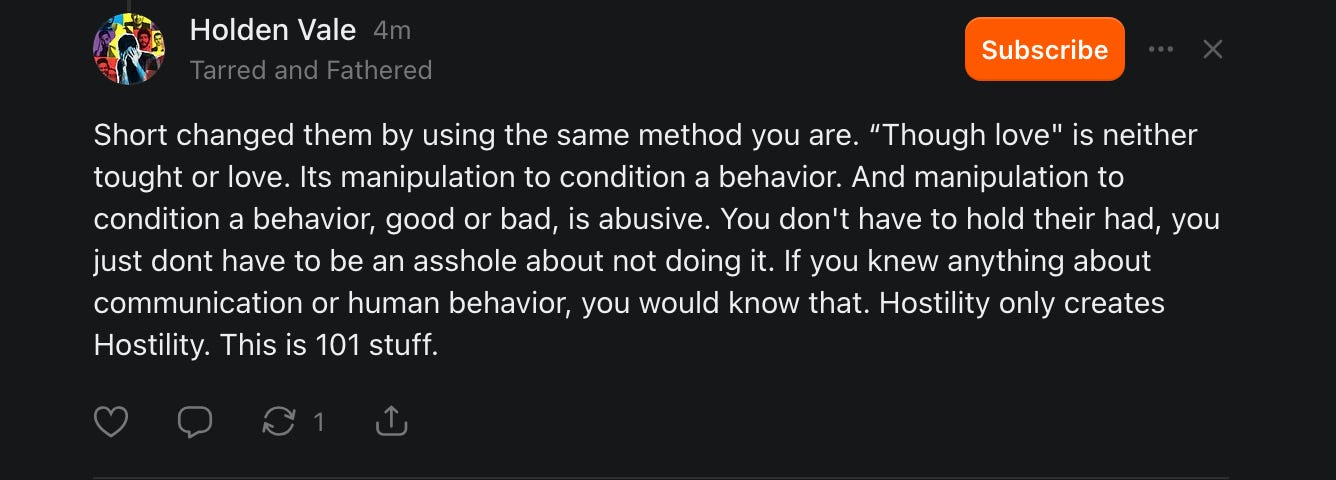
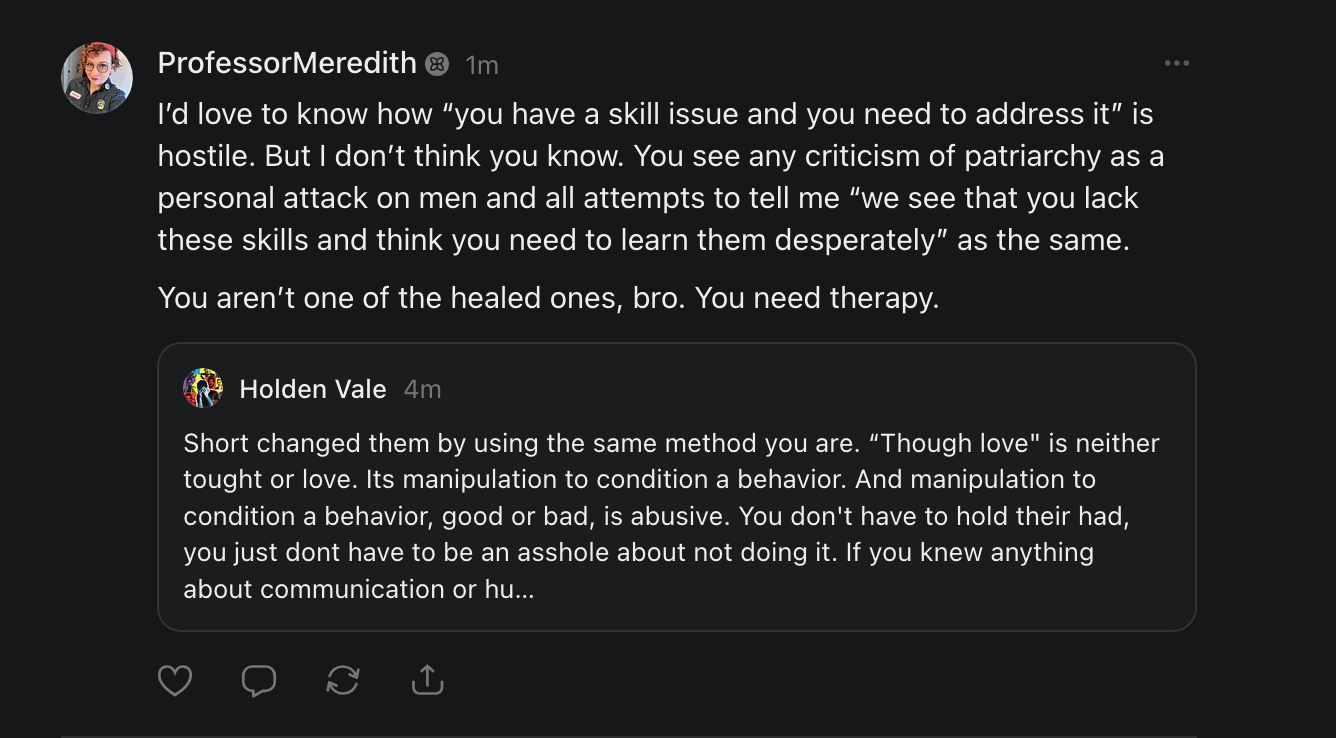
Eventually, the conversation did what these conversations always do. It curled into a tiny ouroboros of male grievance and swallowed its own tail.
I said men have a skill issue and need to address it.
I was told that this was hostile.
I clarified that women are not responsible for fixing it.
I was told that refusing to help is fine, but I should not be an asshole about it.
I said criticism of patriarchy is being treated as a personal attack.
I was told “tough love” is neither tough nor love, that it is manipulation, that manipulation to condition behavior is abusive, and that hostility only creates hostility.
Which is fascinating, because “you need to learn a skill” is not abuse. It wasn’t abuse when my dad told me I needed to learn to do the dishes. It wasn’t abuse when my mom taught me to hem pants and sew on buttons. It wasn’t abuse when my professors taught me to skim read so I wouldn’t drown in grad school reading lists.
“Women are not responsible for teaching it to you” is not manipulation.
“I am not going to coddle you through the process of becoming a safer, more emotionally competent person” is not hostility.
It is a boundary.
And that, I think, is the real problem.
For some people, a woman having a boundary feels indistinguishable from a woman being cruel. A woman refusing to soothe feels like an attack. A woman declining the role of emotional tutor feels like abandonment. A woman saying, “This is your responsibility,” feels like hostility because patriarchy has taught men that women’s emotional availability is the default setting of the universe.
So when that availability is withdrawn, it feels like violence.
It is not violence.
It is the end of a service they were never entitled to.
Not Your Fault Is Not the Same as Not Your Responsibility
Patriarchy created the skill issue.
It taught boys to fear emotional literacy, mock vulnerability, outsource care, and mistake women’s patience for a natural resource. It taught them that anger is masculine, sadness is weakness, and accountability is humiliation. It handed them a toolbox containing entitlement, shame, and one rusty wrench labeled “don’t be a pussy,” then acted shocked when adult men could not repair a relationship without setting the garage on fire.
That is real.
That matters.
But adult men are not helpless passengers in their own lives. They have books. They have therapy. They have support groups. They have friends. They have other men. They have search engines. They have choices.
Patriarchy may explain why men were not taught the skill.
It may even explain why they were taught the skill was shameful.
But it does not make women responsible for teaching it now.
Women are not required to coddle men through the process of becoming safer people.
Women are not required to make accountability feel like a warm cup of cocoa.
Women are not required to lower our boundaries so men can experience growth without shame.
We are all responsible for raising future generations differently. Boys deserve tenderness, emotional vocabulary, rejection tolerance, repair skills, intimate friendship, and models of masculinity that do not require them to amputate half their humanity before anyone calls them men.
But grown men?
Grown men are responsible for doing their own damn homework.
And if being told “you have work to do” feels like hostility, that is not proof feminism is cruel.
That is the skill issue talking.
Women have their own patriarchal/social conditioning/skills issues to grapple with.
They are also told that if they defy their social conditioning that they can never be partnered, never be valued, never be happy.
It’s what social conditioning is! It’s lies about who you are, and what you are for, what you’re capable of, and what your opportunities are.
Because women have fought so hard for their own progress, we now have a multitude of voices describing what women can be. Some of women’s social conditioning has been seriously eroded. It took centuries. But most women in the US are not raised to believe women can’t exist in the public sphere. Hoorah! Nobody held our hands and murmured encouraging words during those centuries. No one offered us the liberation from that conditioning.
They still don’t. The fight isn’t over, and our social conditioning is still used against us. To trap us and keep us in our cages. But some of us legitimately freer of our social conditioning than those who came before. Perhaps you’ve seen that freedom and felt jealous. If so, know that it was hard won. Know that women built it for themselves from wisdom we carried inside ourselves the whole time. Just as the wisdom to fight patriarchy exists, hidden under the shit, in men too.
For any men who are ready to embark on the journey of introspection, who are ready to do their homework, I will say: It is so worth it. No, you don’t get a cookie, or ready access to the woman who’s rejected you. You get something better - yourself. The capacity to be empowered by your own integrity. An expanded imagination about what’s possible for you and possible for society. So worth it.
'Grown men are responsible for doing their own damn homework' A wonderfully succinct summary.Thank you for another really interesting post, it helps with the homework.