
Scott Galloway and the Myth of the “Modern” Dad
This rebranded patriarchy is what makes the Scott Galloways of the world infinitely more dangerous than the Andrew Tates.

One of the biggest mistakes people make when talking about misogyny is assuming it always arrives screaming.
We have become very good at recognizing the cartoonishly obvious version. The Andrew Tate version. The version that comes wrapped in sunglasses, sports cars, podcast clips, and declarations about alpha males and female submission. Most people can look at that and immediately understand what they are seeing.

The problem is that patriarchy has survived for centuries precisely because it is adaptable.
When one form becomes socially unacceptable, it evolves.
It learns new language.
It hires better marketers.
It discovers therapy vocabulary.
And eventually it reappears wearing the costume of reasonableness.
Which brings us to Scott Galloway.
Galloway has built an enormous audience by positioning himself as a commentator on the crisis facing modern men. He talks about loneliness, declining social mobility, economic instability, social isolation, and the emotional struggles many men experience in contemporary society. Unlike the loudest corners of the manosphere, he presents himself as thoughtful, data-driven, and intellectually serious.
That is exactly why his recent comments about paternity leave matter.
Because when Galloway argued that fathers are largely unnecessary during infancy, described dads as “mostly a waste of time or space” during the first months of a baby’s life, questioned the value of paternity leave, and suggested men do not really belong in delivery rooms, he revealed something important.
Not because the comments were shocking.
Because they were familiar.
Underneath all the modern branding sits one of the oldest patriarchal assumptions in Western culture: that caregiving is fundamentally women’s work.
Andrew Tate sells patriarchy as domination.
Scott Galloway sells patriarchy as pragmatism.
Tate says women belong beneath men.
Galloway says women are naturally better suited to caregiving.
Tate argues that men should focus on power, status, and provision.
Galloway argues that fathers are simply less necessary during infancy because mothers are biologically equipped for the role.
The language changes.
The hierarchy remains remarkably intact.
Historically, patriarchal systems rarely survived by openly declaring women inferior. More often they survived by declaring women naturally responsible for certain forms of labor. Victorian gender ideology framed women as naturally domestic, morally nurturing, and suited for caregiving, while men were associated with work, competition, and public life. Men achieved recognition through economic success while women were expected to create stability within the home.
The modern version sounds less overtly restrictive, but the structure is familiar.
Women are not being told they must stay home.
They are being told they are naturally better at early caregiving.
Men are not being told to avoid parenting.
They are being told their role is less essential.
Women become the default parent.
Men become the auxiliary parent.
And because this version sounds reasonable, many people fail to recognize it as ideology at all.
That is what makes it more influential than the loudest parts of the manosphere.
Most people are not taking life advice from Andrew Tate.
They are taking it from podcast hosts, business influencers, self-described masculinity experts, and public intellectuals who present traditional gender arrangements as evidence-based realism.
The packaging is different.
The assumptions are not.
There is another part of the Scott Galloway conversation that I think deserves scrutiny, and it is not actually Galloway himself.
It is the reaction.
Specifically, the number of men responding with some version of: “Normally I like Scott Galloway...”
And every time I hear that, I think about the students and young men who say the same thing about Andrew Tate.

Not because Scott Galloway and Andrew Tate are the same person.
They are not.
But because people keep trying to separate the “good ideas” from the worldview underneath them without asking whether that worldview is shaping the ideas in the first place.
The question is not whether someone occasionally says something true.
The question is whether the framework underneath it keeps leading back to the same destination.
Because when someone spends years talking about men’s emotional lives and then casually reveals that he sees fathers as largely unnecessary during infancy, that is not some random glitch in the system.
It is a receipt.
And that is precisely why comments like Galloway’s matter.
Not because they are shocking.
Because they reveal the termite riddled foundation underneath the brand.
What makes Galloway’s argument especially frustrating is that it completely misunderstands what is actually happening during the postpartum period.
The entire conversation is framed as though fathers are unnecessary because mothers are biologically equipped to care for newborns.
But childbirth is not some mystical process that transforms a woman into a self-sustaining caregiving machine.
She has just gone through something that is, for many women, one of the most physically demanding and medically significant events of their lives.
Pregnancy and childbirth involve blood loss, tissue damage, hormonal upheaval, sleep deprivation, physical pain, breastfeeding challenges, recovery from surgery or tearing, and significant psychological adjustment. In the United States, maternal mortality remains dramatically higher than in other wealthy nations, and postpartum complications are common.
Yet conversations like Galloway’s often treat maternal recovery as though it barely exists. Sure he gives a throwaway line that the husband is more there to support the wife during this period, but then he says paternity leave isn’t important. How, pray tell, is the husband supposed to support his wife if he’s not home to do it? Through vibes?
Instead, the mother is imagined as naturally capable of absorbing the entire burden of infant care because caregiving has been culturally framed as an extension of womanhood itself.
The reality is much less romantic.
A newborn is not simply a tiny bundle of joy.
A newborn is a cult leader using sleep deprivation to get their way.
They wake constantly. They feed constantly. They cry unpredictably. They require round-the-clock attention from adults who are often functioning on fragments of sleep and sheer stubbornness.
The father is not simply there for the baby.
He is there for the mother.
He is there to change diapers while she heals.
To bring food while she is recovering.
To hold the baby while she showers.
To manage household labor.
To take shifts at night.
To provide emotional support.
To act like a parent instead of a visiting dignitary inspecting the situation.
This is why modern research consistently finds that paternity leave benefits entire families. Fathers who take parental leave tend to remain more involved in childcare long term, couples divide labor more equally, mothers experience better recovery outcomes, and families report lower stress levels overall.
In other words, fathers become better parents by parenting. A truly shocking concept.

The truly strange thing is that Galloway spends a great deal of time discussing the loneliness crisis affecting men.
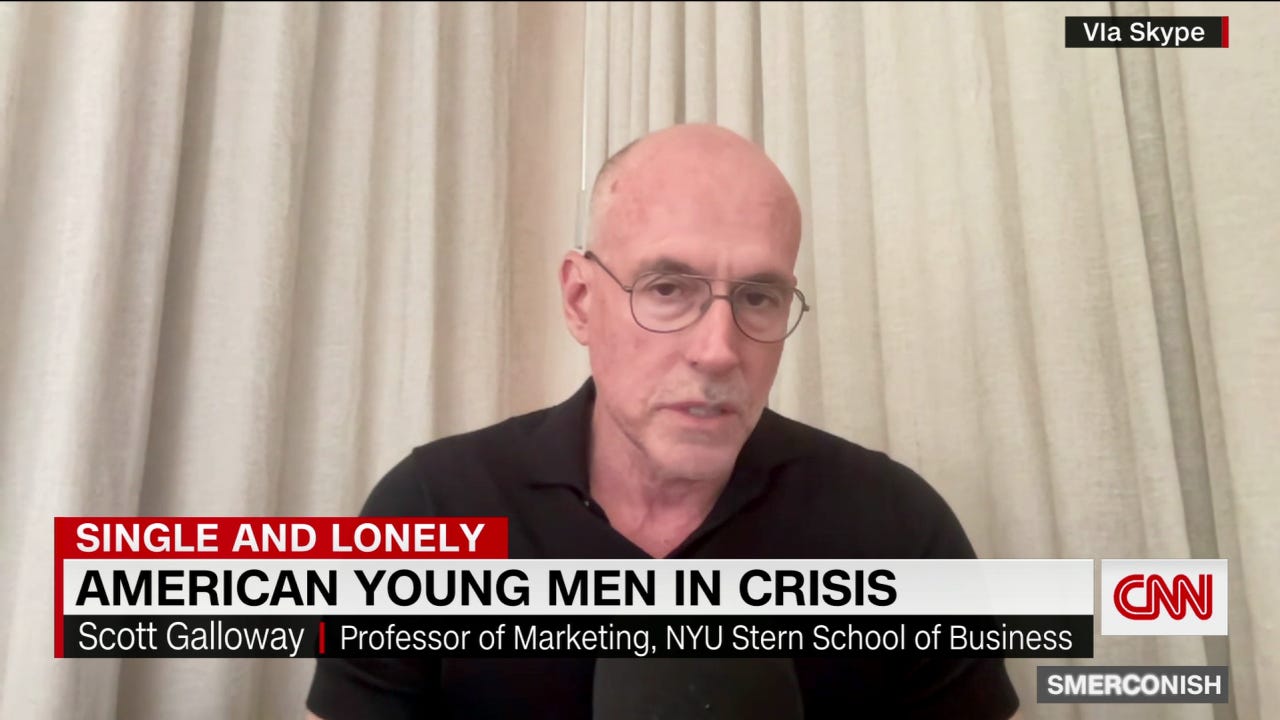
And he is not wrong about that crisis.
Men report increasing social isolation, declining friendship networks, and difficulty forming deep emotional connections.
What is striking is how often the proposed solutions ignore one of the most obvious opportunities for emotional attachment available in adult life.
Patriarchy does not just harm women.
It narrows men’s emotional worlds. It teaches men that caregiving belongs to women. It teaches men that nurturing belongs to women. It teaches men that emotional labor belongs to women.
Then it expresses confusion when men feel disconnected from family life.
If fathers are repeatedly told they are unnecessary during infancy, it becomes harder for them to imagine themselves as caregivers at all.
And this is where the overlap between respectable masculinity discourse and the manosphere becomes impossible to ignore.
The manosphere influencer who says there is “no ROI” in making sure his girlfriend orgasms and the public intellectual who argues fathers are largely unnecessary during infancy are not making the same argument.
But they are operating from the same underlying assumption.
That women’s labor is expected, her needs are secondary, and her body exists to provide a service.
One conversation is about sex.
The other is about parenting.
But both quietly position women as infrastructure, not human beings.
The woman becomes the person responsible for carrying the invisible labor, whether that labor is emotional, domestic, reproductive, or sexual.
One version sounds like a frat-house crypto scam.
The other sounds like a keynote speaker at a leadership summit.
One gets recognized as misogyny immediately.
The other gets described as common sense.
That is what makes the Scott Galloways of the world infinitely more dangerous than the Andrew Tates.
Because the most durable forms of patriarchy rarely present themselves as domination.
They present themselves as practicality, biology, realism.
And that is ultimately why Galloway’s comments deserve scrutiny.
Not because they are outrageous.
Not because they are uniquely offensive.
But because they are old.
They are the same assumptions that once insisted women were naturally suited to domestic life, translated into the language of neuroscience podcasts, productivity culture, and modern masculinity discourse.
The patriarchy did not disappear.
It got a rebrand. It learned how to cite statistics. It got a job at NYU.
And a surprising number of people mistook the new packaging for a different product.
Scott Galloway, professor of marketing.
That tells you everything you need to know about him.
When I was in college, we were asked in class one day to read an essay. It started out *sounding* nice and reasonable, but in its friendly tones it quickly became twisted and xenophobic, the entire time trying to sound like it was just a discussion of common sense. I remember thinking what the hell, checking the author, and it was an excerpt from Hitler’s Mein Kampf. Horrible, terrible ideas are often not expressed openly and nakedly. They are often couched and cloaked to appear to be calm, sensible conclusions, nothing radical or shocking. Too often we take meaning from tone, and that’s how the fundamentally reprehensible gets passed into public discourse.
Oh, and not everybody in the class figured out something was up.
I’m not saying Galloway is like Hitler. I’m not familiar enough with him to say he is or isn’t. I’m saying the means of delivery is awfully familiar.