
Still in Monroeville: Disenchanted, White Feminism, and the Suburban Dream That Refuses to Die
Disney asked what happens after happily ever after. The answer was apparently property ownership, emotional labor, and a community committee.

Based on a paper I wrote for my MA in Gender Studies, because believe in the principle of “reduce, reuse, recycle.”
When I wrote about Enchanted, I argued that the film was smarter than people gave it credit for because Giselle’s femininity was not simply a joke. Yes, she sang at pigeons. Yes, she wore enough tulle to qualify as a small fabric shop. Yes, she arrived in New York City with the survival instincts of a cupcake. But the film did not actually punish her for being soft, romantic, emotional, or sincere.
In fact, that was kind of the point.

Enchanted is a movie about a woman whose emotional openness disrupts a world that has mistaken cynicism for maturity. Giselle does not become more “real” by becoming bitter. She becomes more real by expanding. She learns anger. She learns disappointment. She learns that love may require more than a duet and a woodland creature labor force that has questionable payroll. But she does not have to abandon joy in order to be taken seriously.
That is why Disenchanted is such an interesting sequel, because it takes the thing that made Giselle magical and asks a much darker question:
What happens when joy becomes a job?
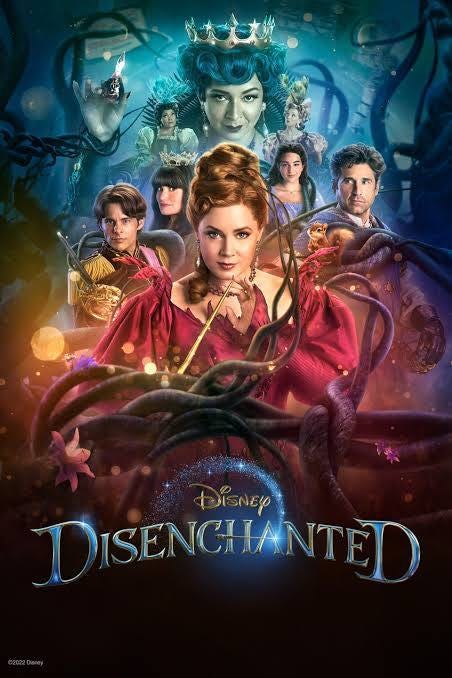
And, because Disney remains Disney, the answer is delivered with songs, gowns, sparkles, and the kind of suburban hellscape where everyone is aggressively cheerful in a way that suggests at least three people are one HOA meeting away from ritual combat.
Disenchanted begins where fairy tales usually sprint away from the premises, lock the door, and pretend not to hear knocking. What happens after the wedding? What happens after the kiss? What happens after “happily ever after” has been converted into childcare, teenage resentment, homeownership, commuting, and trying to keep a family emotionally intact while everyone keeps insisting you should feel grateful?
In Enchanted, Giselle is a whimsical outsider. She arrives in New York as a walking Disney archive, all sincerity, romance, and weaponized cheer. She restores wonder to Robert and Morgan’s lives. She proves that emotional openness is not the same thing as stupidity. She makes curtains out of old clothes and somehow this is charming rather than a cry for help.
But in Disenchanted, Giselle is no longer the strange magical girl who wanders into someone else’s life and fixes it by believing too hard. She is a wife. A mother. A stepmother. The household’s emotional project manager. She is responsible not only for being happy, but for making everyone else happy too.
The magic has not disappeared.
It has become domestic labor.
And honestly, that may be the most accidentally devastating thing Disney has done since making every millennial process parental death through animated animals.
The setup is simple enough. Giselle, Robert, Morgan, and baby Sofia move out of New York City because their apartment is too small, Morgan is now a teenager, and everyone seems to believe that the solution to family stress is a bigger house in a town that looks like it was assembled by a sentient Pinterest board.
Enter Monroeville.
Monroeville is supposed to be the answer. It is space. It is safety. It is community. It is porches and town squares and festivals and smiling neighbors. It is the fantasy that if the city is too hard, too expensive, too chaotic, too emotionally complicated, you can simply move somewhere with better countertops and become a better family.
This is not just a setting. This is an ideology with landscaping.
Monroeville is the “magic kingdom of suburbia,” which sounds adorable until you remember that suburbs have always been very good at turning social control into curb appeal. The whole place is built on the fantasy that everyone belongs because everyone has a role. There are committees. There are rituals. There are hierarchies. There is a queen bee. There are expectations. There are smiles that feel less like friendliness and more like compliance checks.
And into this very normal, very cursed environment comes Giselle, a woman already primed to believe that if she just tries hard enough, loves hard enough, sings hard enough, decorates hard enough, and emotionally manages hard enough, the family will become happy again.
This is where Disenchanted becomes fascinating as a postfeminist text.
Postfeminism does not usually show up wearing a sandwich board that says, “Hello, I am here to quietly neutralize structural critique.” That would be too honest, and therefore bad branding. Instead, postfeminism speaks in the language of choice, empowerment, confidence, self-expression, and personal fulfillment. It says women are free now, which means any remaining dissatisfaction must be an individual problem.
You chose the life.
You chose the house.
You chose the marriage.
You chose the move.
You chose the baby.
You chose the dream.
So if the dream is making you miserable, well, have you considered trying harder?
That is the trap Giselle falls into. She appears to choose Monroeville, but the choice is already shaped by a cultural script telling her what happiness is supposed to look like: domestic stability, family unity, good mothering, a beautiful home, community belonging, and the proper management of everyone else’s feelings.
In other words, Giselle does not move to Monroeville because she is shallow or silly. She moves there because she has absorbed the idea that a good woman can fix emotional distress by improving the domestic environment.
Which is bleak.
Sparkly, but bleak.
The house itself makes the metaphor almost insultingly obvious. It is a fixer-upper, because of course it is. The family is emotionally strained, so the house is physically broken. Giselle can renovate the house, therefore she can renovate the family. If she paints enough, scrubs enough, organizes enough, hopes enough, and believes enough, everyone will be happy.
This is the suburban dream in its most seductive form: structural discomfort repackaged as a lifestyle project.
Nobody needs to have a serious conversation about why Morgan is miserable. Nobody needs to examine why Giselle feels responsible for everyone’s happiness. Nobody needs to ask why Robert gets to be vaguely concerned while Giselle becomes the emotional engine of the household. No, no. The problem is the house. The vibes are off. Get that woman a paint swatch and a nervous breakdown.
This is where the film is both sharp and limited.
It recognizes that domestic happiness is work. It recognizes that fairy-tale roles can become traps. It recognizes that women are forced into available scripts: princess, mother, witch, queen, stepmother, good girl, bad woman. It even recognizes that women can become agents of other women’s discipline.
But then it stops short.
The film can critique the pressure to perform happiness, but it cannot really imagine a world beyond the structures that produce that pressure. It can show us that Monroeville is suffocating, but the answer is not to leave Monroeville. The answer is to make Monroeville nicer.
Which is very Disney. Very postfeminist. Very “the system is fine, babe, you just needed a better attitude and maybe a song in act three.”
The most revealing figure in all of this is Malvina Monroe, played with perfect weaponized suburban hauteur by Maya Rudolph. Malvina is not a traditional patriarchal villain. She is not locking women in towers or forcing them into marriages. She does not need to. She has social status, community authority, taste, confidence, and the ability to make other women feel like they have failed without technically raising her voice.
In Monroeville, Malvina is queen because she understands the rules. She knows belonging is conditional. She knows power can be exercised through committees, parties, pageants, and the terrifying social force of a woman who has decided your presence is inconvenient. She does not need a throne. She has civic respectability, which is often worse in the modern world.
And this is where Disenchanted quietly tells on itself.
When Monroeville becomes Monrolasia, the magic does not create a new hierarchy. It reveals the one that was already there. Malvina becomes a literal queen. Robert becomes a questing hero. Morgan becomes a put-upon maiden. Giselle becomes the wicked stepmother.
The fairy tale does not corrupt the suburb.
It translates it.
That is the film’s best idea. Monrolasia looks ridiculous because the costumes are obvious, but the social logic was already operating under the surface. The town already had royalty. It already had rules. It already had outsiders. It already had women policing other women’s performance of belonging. The spell just puts everyone in better dresses.
And then there is Giselle’s transformation into the wicked stepmother, which is easily the film’s strongest and most politically interesting move.
The wicked stepmother is one of the great misogynist storage containers of fairy-tale culture. She is where we put maternal anger, insecurity, resentment, ambition, sexuality, vanity, and exhaustion. She is the mother who wants too much, feels too much, competes too much, controls too much. She is what happens when a woman who is supposed to nurture becomes inconveniently human.
Giselle’s transformation works because it shows how quickly “good mother” can become “bad mother” once she fails to provide endless warmth on demand. She is overwhelmed. She is scared of losing Morgan. She feels rejected. She wants control because everything feels unstable. These are not monstrous feelings. These are normal feelings under pressure.
But fairy-tale logic does not allow for maternal complexity.
It turns complexity into villainy.
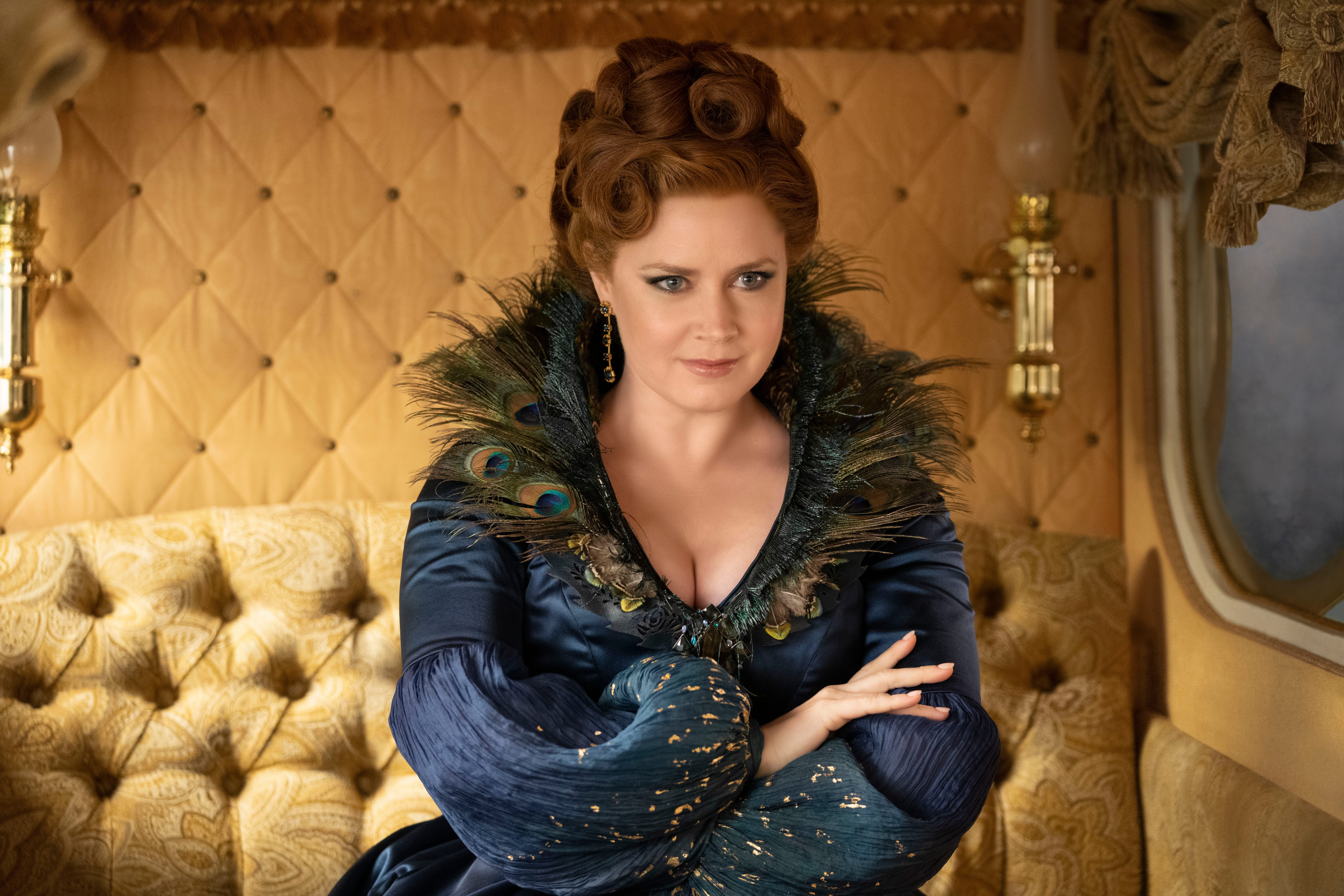
So Giselle becomes sharp, vain, cruel, theatrical, and dangerous. Her clothes darken. Her voice changes. Her patience evaporates. She begins to see Morgan not as a hurt teenager, but as a rival and obstacle. The film literalizes the terror that haunts so much idealized motherhood: if you stop being endlessly giving, you become the monster.
The good mother gives. The bad mother wants.
The good mother absorbs pain. The bad mother expresses it.
The good mother sacrifices. The bad mother resents sacrifice.
The good mother makes the house feel magical. The bad mother admits that maybe magic is exhausting when everyone expects you to perform it for free.
This is where the sequel becomes a darker companion to Enchanted. In the first film, Giselle’s emotional openness is reparative. In the second, that same openness has curdled under the pressure of domestic responsibility. She still wants joy. She still wants love. She still wants the family to be happy. But now joy is not simply something she offers freely. It is something she is expected to manufacture.
And when she cannot, she blames herself.
That is the postfeminist bargain in miniature. The system creates the pressure, then sells women the responsibility for managing it.
If you are unhappy, make better choices.
If the family is strained, mother harder.
If the house is chaotic, organize more.
If the teenager is resentful, be more patient.
If the suburb is hostile, integrate better.
If the dream is failing, renovate the dream.
This is why the film’s white feminism matters. Giselle’s struggle is real, but it is also incredibly protected. Her crisis is not housing insecurity. It is not medical neglect. It is not racism. It is not food scarcity. It is not state violence. It is not unsafe schools, wage exploitation, reproductive coercion, or the thousand daily violences that shape women’s lives outside the glossy boundaries of middle-class domestic fantasy.
Her crisis is that her privileged family life no longer feels magical.
That does not make her pain meaningless. Emotional labor is real. Maternal pressure is real. The demand that women produce happiness for everyone around them is real. But the film’s idea of “women’s struggle” lives in a very nice house.
A broken nice house, sure.
But still a nice house.
And that matters because mainstream white feminism has often been very good at mistaking the discomforts of privileged women for the boundaries of feminist politics. It asks whether women can have romance, beauty, family, personal fulfillment, professional meaning, and emotional satisfaction, which are not bad questions. But when those become the only questions, feminism shrinks into lifestyle management for women with mortgages.
The problem is not that Disenchanted cares about domestic unhappiness. It should. Domestic life is political. The family is political. Motherhood is political. Suburbia is political. The home has never been some neutral little cupcake cottage outside history.
The problem is that the film critiques the performance of domestic happiness while leaving the domestic ideal itself largely intact.
Monroeville is not dismantled. It is softened.
Malvina is not removed from power. She becomes nicer.
Giselle does not reject the suburban dream. She learns to want it correctly.
Morgan does not get to say, “Actually, this move was bad for me and I would like one adult to take that seriously for longer than eight seconds.” She is folded into the family resolution.
Robert does not have to undergo a major reckoning with how little of the emotional burden he carries. He gets a sword-adjacent subplot and then local professional purpose.
By the end, everyone is better adjusted to Monroeville.
Which is not the same thing as freedom.
It is inclusion into the machine.
That is the film’s deepest limitation. It is self-aware enough to know the scripts are scripts, but not brave enough to stop using them. It knows that “happily ever after” is inadequate. It knows that fairy-tale femininity is a performance. It knows that women can be trapped by roles even when those roles are beautiful. It knows that suburbia can be a disciplinary system wearing a cardigan.
But knowing is not escaping.
Disney has become very good at talking to itself. Enchanted winked at the old princess formula while still enjoying it. Frozen eventually said, “You can’t marry a man you just met,” because apparently subtlety left the building wearing Elsa’s cape.

Disenchanted continues that corporate self-analysis. It looks back at the fairy tale and says, “Hmm, maybe this structure is a trap.”
Then it puts everyone back in the trap with better lighting.
And to be clear, I do not think that makes the film useless. I actually think it makes it more interesting. The most revealing texts are often the ones that can see the problem but cannot imagine the solution. Disenchanted isn’t fascinating because it is secretly radical. It is fascinating because it is almost radical, then gets nervous and retreats into tasteful domestic resolution.
Very on brand, really.
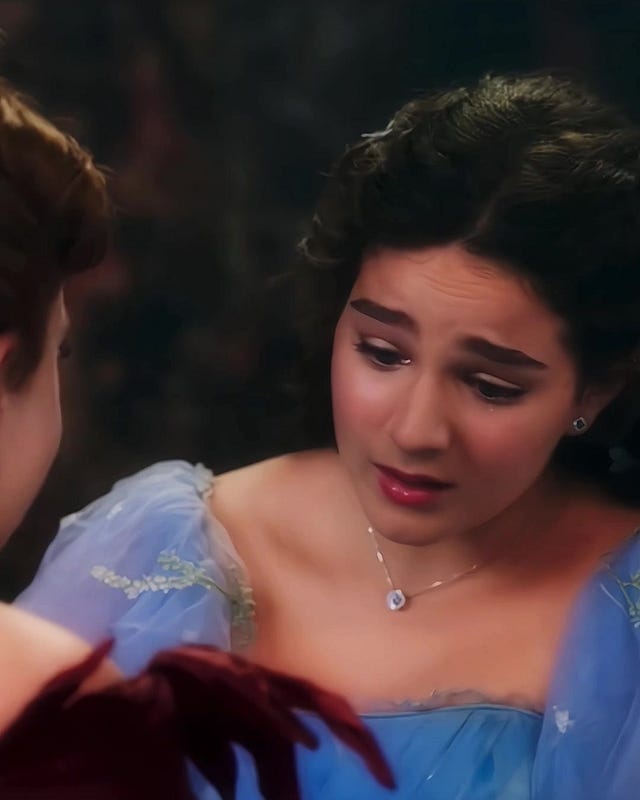
The film’s ending is emotionally satisfying because the relationship between Giselle and Morgan does matter. Morgan naming Giselle as her mother is genuinely moving. Their bond is the heart of the story, and the film is right to treat stepmotherhood as real motherhood rather than a counterfeit version. That part matters, especially in a genre that has spent centuries treating stepmothers as emotionally suspicious at best and child-endangering at worst.
 Tiktok failed to load.
Enable 3rd party cookies or use another browser
But the emotional truth of that reconciliation does not erase the political limitation of the ending.
Love repairs the relationship.
It does not repair the system that made the relationship carry the weight of an entire suburban fantasy.
That is the thing Disenchanted cannot quite face. Giselle and Morgan’s conflict is not just personal. It is produced by a larger set of expectations around motherhood, daughterhood, family happiness, feminine goodness, and domestic success. Giselle is supposed to make the move work. Morgan is supposed to adjust. Robert is supposed to be supportive in a vague dad-shaped way. The house is supposed to become a home. The town is supposed to become a community. Everyone is supposed to become happy because that is what the story promised.
And when that does not happen, the failure gets routed through Giselle.
Because of course it does.
Women are still expected to be the emotional infrastructure of the family. If the household is unhappy, we look for the woman who failed to regulate the temperature. She was too distant, too controlling, too ambitious, too passive, too anxious, too permissive, too strict, too much, not enough. There is no version of womanhood patriarchy cannot mark up in red pen.
Giselle’s wicked stepmother transformation simply makes the grading system visible.
She wanted too much.
She tried too hard.
She controlled too tightly.
She failed to be endlessly good.
Therefore, villain.
The final irony is that Disenchanted knows the house is haunted, then decides the solution is redecorating.
And that may be the perfect metaphor for Disney’s current relationship to feminism. The company is aware of the ghosts in its archive. It knows the princess stories are loaded. It knows the old formulas do not travel innocently into the present. It knows audiences now expect critique, revision, parody, and at least one line that says, “Actually, marrying someone after one song is weird.”
But Disney also wants the castle to remain standing.
So it renovates. It updates. It adds self-awareness. It makes the princess joke about princesses. It gives the queen a motive.
It lets the heroine be angry. It complicates the stepmother. It swaps obedience for “choice.” It paints empowerment over the old beams and hopes nobody notices the foundation is still doing foundation things.
That does not mean we throw the whole thing away. I remain, unfortunately for my credibility and possibly my blood pressure, a person who thinks Disney texts are worth analyzing because they are cultural machinery disguised as comfort objects. People watch them. Rewatch them. Show them to their children. Quote them. Build identities around them. Use them as emotional vocabulary. That matters.
Fairy tales are not harmless just because they sparkle.
Sparkles have politics.
And Disenchanted is a very sparkly example of postfeminist containment. It gives us a woman struggling under domestic expectation, then resolves her struggle through personal adjustment. It gives us a suburb that disciplines women, then makes the suburb home. It gives us female power in Malvina, then reveals that power as status management rather than liberation. It gives us a critique of fairy-tale roles, then returns everyone to a more flexible version of those roles.
It is not anti-feminist in any simple way. That would be too easy. The film has genuine feminist insight. It understands that femininity is scripted. It understands that motherhood is demanding. It understands that women can hurt each other while enforcing systems they did not invent. It understands that the wicked stepmother is a narrative punishment for women who fail at acceptable mothering.
But its feminism is domesticated.
House-trained, even.
It can sit politely in the living room. It can attend the committee meeting. It can critique the fantasy without asking anyone to sell the house.
That is why Disenchanted is not the opposite of Enchanted. It is the logical sequel. Enchanted asked whether femininity, joy, softness, romance, and sincerity could still be meaningful in a cynical world. Disenchanted asks what happens when those same qualities are absorbed into the machinery of family life and suburbia.
The first film says joy can be rebellion.
The second says joy can also be unpaid labor.
And honestly, that is the darker fairy tale.
Because the villain is not a dragon. It is not a sorceress. It is not even Malvina, though she is absolutely one PTA meeting away from declaring martial law.
The villain is the fantasy that a woman’s love can fix everything if she just performs it beautifully enough.
That fantasy is older than Disney, but Disney has been one of its most successful distributors. The princess does not just find love. She restores order. She heals the kingdom. She softens the man. She repairs the family. She makes the world emotionally legible. Her goodness is measured by her ability to transform suffering into harmony without asking too many structural questions.
In Disenchanted, Giselle tries to do exactly that.
And for a while, it turns her into a monster.
That is the part worth sitting with.
Not because Giselle is secretly bad. Not because motherhood is bad. Not because romance is bad. Not because wanting a home is bad. But because any ideal that requires women to erase their exhaustion in order to remain good is not a dream.
It is a curse with a better soundtrack.
By the end, Disenchanted breaks the magical curse. But the quieter curse remains: the belief that happiness lives in the right house, the right family structure, the right community, the right performance of womanhood, the right balance between sincerity and self-control.
The film lets Giselle escape being the wicked stepmother.
It does not let her escape Monroeville.
And maybe that is the real happily ever after Disney is selling here: not freedom, not transformation, not liberation, but adjustment.
A nicer suburb.
A softer hierarchy.
A committee invitation.
A family that loves each other.
A woman who has learned to stop trying quite so hard, but not to question why she was made responsible for everyone’s happiness in the first place.
The house is still haunted.
Disney just added crown molding.
Citations and Recommended Reading
“But They Still Lived Happily Ever After—or at Least, Happily: Disney’s Contemporary ‘Postmodern’ Fairy Tales” by Michelle Anya Anjirbag-Reeve
Empowered: Popular Feminism and Popular Misogyny by Sarah Banet-Weiser
Contemporary Disney Animation: Genre, Gender and Hollywood by Eve Benhamou
The Monstrous-Feminine: Film, Feminism, Psychoanalysis by Barbara Creed
Disenchanted by Adam Shankman
The Rise of Enlightened Sexism: How Pop Culture Took Us from Girl Power to Girls Gone Wild by Susan J. Douglas
“Postfeminist Media Culture: Elements of a Sensibility” by Rosalind Gill
Hood Feminism: Notes from the Women That a Movement Forgot by Mikki Kendall
The Aftermath of Feminism: Gender, Culture and Social Change by Angela McRobbie
The Disney Princess Phenomenon: A Feminist Analysis by Robyn Muir
What a Girl Wants? Fantasizing the Reclamation of Self in Postfeminism by Diane Negra
Interesting analysis. I appreciate it. As someone who was trapped in that soul-crushing lifestyle, who “tried to make the most of it” while being suffocated by stucco, white walls, and beige carpets, who spent over a decade not recognizing myself in the mirror, of seeing my dying desperate eyes peeking through a mask, while family around me weaponized gratitude and told me my dreams were too much, I definitely won’t watch this. I DESPISE Disney movies.
Oddly, I did let my kids watch a few Barbie movies—they were a little more “girl power” than “get a man.” Have you analyzed any of them? I didn’t watch them closely when my kids were that young. I wasn’t yet at the point of pausing shows to give lectures. lol “Why don’t the LEGO Ninjago boys let the sister join them? Why does the sister have to have darkened eye lashes to show she’s a girl?” “How many American flags has Michael Bay inserted into this ridiculous propaganda movie?!” (Transformers 4) 😂