
Stop Gendering the Entire Human Personality
Courage, care, ambition and vulnerability are not tied to XX or XY chromosomes.

Apparently, there is a serious masculinity crisis caused by women being allowed to have courage too.
In a recent essay called “Progressives Don’t Understand Masculinity,” the pseudonymous Substack writer LastBlueDog complains that progressive commentators cannot recognise “anything distinctively good about men.” Whenever courage, ambition, assertiveness, strength or risk-taking are praised as masculine qualities, someone ruins the occasion by pointing out that women can possess them too. This, he argues, leaves masculinity defined as “purely negative” and prevents boys from seeing it as an “aspirational quality.”

This is a fascinating problem to invent.
Courage cannot apparently inspire boys unless it belongs more to them than to girls. Ambition cannot simply be valuable to any person who has something worth achieving. Strength loses some of its affirming masculine glow once women are permitted to be strong without filing a special exemption. A trait cannot merely be positive; it must be positive in a way that helps distinguish men from women.
Perhaps the problem is not that progressives refuse to say anything good about men. Perhaps the problem is that we have decided positive traits need to be gendered before men are allowed to value them.
This debate is usually framed as a dispute over whether masculinity is good or bad. Defenders of “positive masculinity” accuse feminists of treating every traditionally male characteristic as toxic, while critics point toward the damage caused by aggression, dominance, hierarchy and emotional repression.
Both conversations can slide past the more fundamental question: why are we assigning the human personality to separate sexes in the first place?
Courage, ambition, confidence, tenderness, empathy, discipline, anger, vulnerability, leadership, care and fear do not arrive in pink and blue containers. What gender determines is not who can possess these traits, but which people will be rewarded, excused, mocked or punished for showing them.
The problem with toxic masculinity is not that anger, dominance and aggression become delightful when a woman does them. Women can be angry, domineering, abusive, arrogant, authoritarian and cruel. Margaret Thatcher did not become a nurturing communal spirit because she wore a skirt. The problem is that men are often encouraged to interpret certain harmful behaviours as evidence of successful masculinity, while women are punished for the same behaviour because it violates femininity.
A man who dominates a conversation is assertive. A woman who does it is bossy. A man who refuses to compromise is decisive, while a woman is difficult. A man who becomes angry cares deeply and will not tolerate incompetence; a woman who becomes angry is emotional, unstable, shrill or having some sort of hormonal weather event.
The behaviour has not changed. Its social meaning has.
The Same Trait Has Two Names
Researchers distinguish between descriptive stereotypes, which tell us how men and women supposedly behave, and prescriptive stereotypes, which tell us how they should behave. That difference matters because gender stereotypes are not simply erroneous observations about the world. They are instructions backed by social consequences. Research on prescriptive gender stereotypes has shown that women and men are not only expected to possess different characteristics but are punished when they violate the rules attached to their assigned gender.
It is one thing to believe that women tend to be caring. It is another to believe that women should be caring, that they owe care to everyone around them, and that any woman who declines to provide it is cold, selfish or fundamentally defective. It is one thing to associate men with courage. It is another to teach boys that fear, uncertainty or a request for help might disqualify them from being respected as men.
The same behaviour can therefore acquire two entirely different moral identities depending upon who performs it. Anger provides a particularly neat demonstration. In a series of workplace experiments, Victoria Brescoll and Eric Uhlmann found that angry professional women were granted less status than angry professional men. Men’s anger was more likely to be attributed to external circumstances, while women’s anger was interpreted as evidence that they were angry people or “out of control.” Even a woman identified as a chief executive faced the penalty.
The man was angry because something had happened; the woman was angry because something was wrong with her.
That distinction is the whole system in miniature. A man’s anger can reinforce the idea that he is entitled to authority, while a woman’s anger becomes evidence that she cannot be trusted with it.
This does not mean that every angry man is rewarded or that every woman who expresses anger is destroyed. Race, class, disability, sexuality and professional status all shape who is allowed to display authority. A Black man’s anger, for example, is not necessarily interpreted with the same generosity as a wealthy white executive’s. The point is that the mythology of masculine authority provides men with a cultural route through which anger can become strength, while femininity provides women with a trapdoor through which the same emotion becomes pathology.
The dynamic extends far beyond anger. An ambitious man has plans; an ambitious woman has an agenda.
A confident man believes in himself; a confident woman thinks rather highly of herself. A man who makes unpopular decisions is willing to lead; a woman doing the same apparently needs to work on her tone.
Researchers studying backlash against women in leadership have repeatedly found that women face a double bind. They must display the agency associated with leadership to appear competent, but they can be penalised when that agency violates expectations that women remain warm, agreeable and non-dominant. Women can therefore be judged insufficiently capable when they behave “femininely” and socially unpleasant when they behave in precisely the manner expected of leaders.
When women become assertive, assertiveness suddenly develops a personality problem.
We Built the Boxes and Then Called Them Biology
The traits involved are often divided into two broad clusters. Agency includes independence, ambition, assertiveness, confidence, decisiveness and leadership. Communion includes warmth, empathy, cooperation, nurturance and attentiveness to others. Men are associated with agency, while women are associated with communion.
This division is frequently discussed as though civilisation discovered two pre-existing human subspecies. Men emerged from the primordial mist prepared to run companies and establish rankings in fight gyms, while women materialised nearby holding casseroles and asking whether everyone had adequately processed the experience.
Social-role theory offers a rather less magical explanation. People observe women and men occupying different social positions and infer that the qualities associated with those positions reflect their natural dispositions. Men historically occupied more roles involving paid employment, formal authority, military service and political power, so agency became masculine. Women were concentrated in domestic labour, child-rearing, caregiving and service, so communion became feminine. Society created the division of labour and then pointed to the behaviour produced by that division as evidence that the arrangement had been natural all along.
We distributed the work, watched people perform the work we had assigned them and called the result biology.
The Victorian ideology of separate spheres made this division especially theatrical. Men belonged to the competitive public world of business, politics, empire and military action, which supposedly required strength, courage and rationality. Women belonged to the domestic sphere, where they served as morally pure guardians of the home. Men were understood as physically strong but morally vulnerable, while women were physically weak yet spiritually elevated, a very convenient arrangement that allowed men to retain legal and political power while women received a decorative certificate announcing that they were morally better people.
![Discourses on Writing Women [licensed for non-commercial use only] / Heiniger WJ2](https://substackcdn.com/image/fetch/$s_!dPLQ!,f_auto,q_auto:good,fl_progressive:steep/https%3A%2F%2Fsubstack-post-media.s3.amazonaws.com%2Fpublic%2Fimages%2F17d2dbd4-7a24-44f3-91f0-667c0272cd62_1512x902.jpeg "Discourses on Writing Women [licensed for non-commercial use only] / Heiniger WJ2")
This was not simply a belief that women and men possessed different personalities. It was an entire political economy translated into character traits. Men needed to be ambitious and competitive because they were expected to succeed in the marketplace and support a family. Women needed to be patient, self-sacrificing and domestic because someone had to maintain the home, raise the children and repair the emotional damage caused by the supposedly amoral outside world.
Courage belonged to men because courage authorised public action. Care belonged to women because care justified unpaid labour.
A “positive” stereotype can still be an extremely efficient method of control. The belief that women are naturally more caring, gentle and morally sensitive sounds much nicer than open contempt, which is why it is sometimes described as benevolent sexism. Benevolent sexism praises women as special, delicate creatures deserving male protection, but that protection comes with restrictions. A woman who must be protected is also a woman who can be told where she may go, what risks she may take and which decisions she is qualified to make.
A compliment becomes a cage when it arrives with enforcement powers.
The Boxes Move Whenever Power Needs Them To
One of the clearest signs that these gendered traits are political rather than timeless is how quickly they can be reassigned when institutions need women’s labour.
War has repeatedly performed this little magic trick. Women who were supposedly too fragile for strenuous work became capable of running factories, transporting supplies, nursing under bombardment, operating machinery and performing technically demanding work whenever enough men were unavailable. Once the emergency ended, the same societies often rediscovered women’s delicate constitutions and profound longing for domesticity.
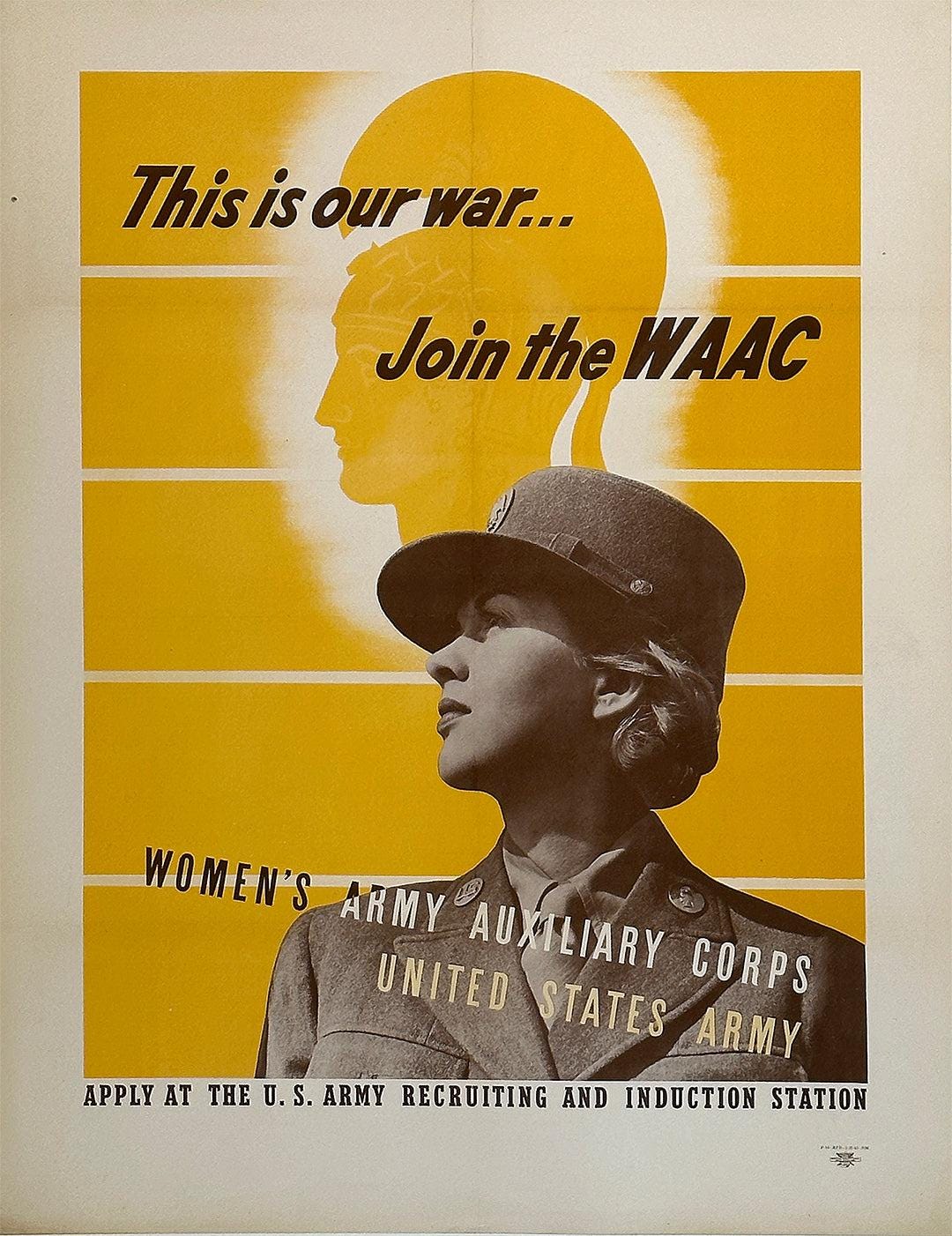
The point is not that war permanently liberated women. It usually did not. The point is that necessity exposed the flexibility of traits presented as natural. Governments could encourage women to be resilient, disciplined, physically courageous and technically competent when those qualities served national production, then return them to the masculine shelf once the crisis had passed.
During the First World War, more than nine million American women mobilised for the war effort, working in agriculture, industry, transport, communications, nursing and military support. Organisations still felt compelled to reassure the public that this work would not “masculinise” them, because apparently military logistics were acceptable for women as long as nobody mistook them for lesbians at the train station.
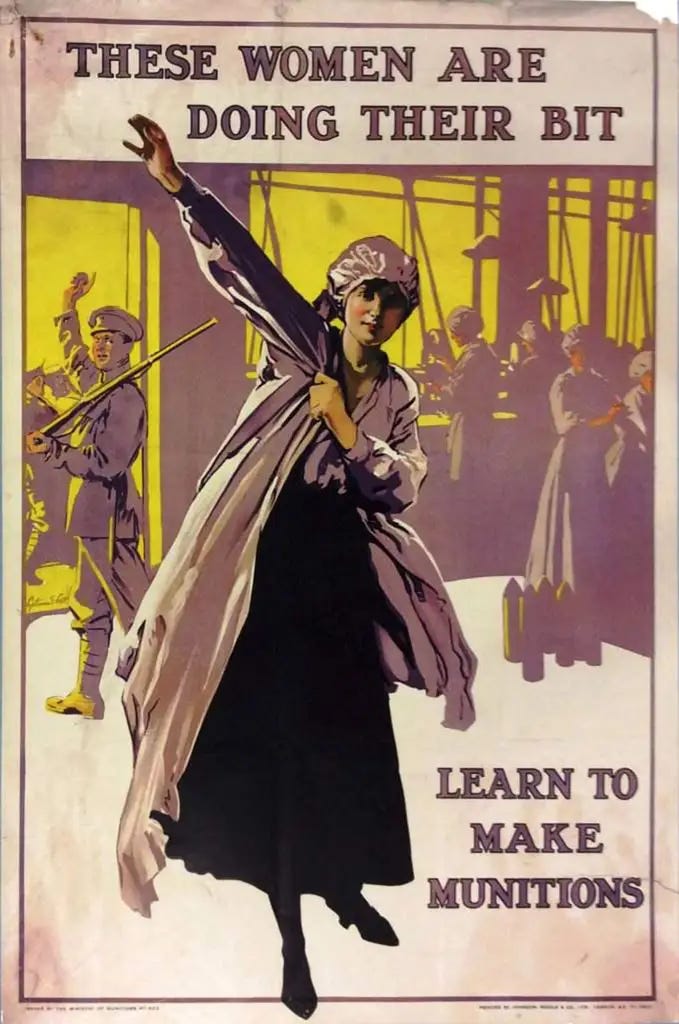
The pattern returned during the Second World War. Women were recruited into industrial jobs because wartime production could not function without them. Once the war ended, many were dismissed or pressured to leave because those jobs had abruptly become men’s property again. Women had not lost their mechanical competence between V-J Day and breakfast. The political demand for their labour had changed.
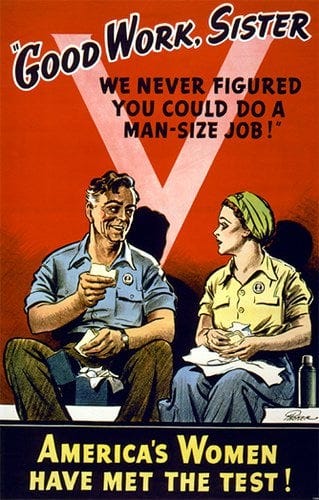
Women’s military service offers a similarly revealing history. Women have repeatedly demonstrated the courage and discipline supposedly intrinsic to men, but military institutions often responded by treating the male body and male life as the neutral template. Women could enter, provided they adapted to uniforms, equipment and standards designed around men.
A 2021 change to United States Air Force grooming regulations, for example, allowed women to wear longer braids and ponytails after service members reported that the previous requirement to wear tight buns caused migraines, hair damage and hair loss. The earlier rule had not been a timeless requirement of military efficiency. It was a standard designed around a particular idea of what a soldier should look like, with women’s bodies expected to absorb the consequences.
The issue was never simply whether women could be courageous. It was whether their courage entitled them to reshape the institution to serve within it.
The history of China’s Iron Girls makes the same point from a different direction. During the Maoist period, women who repaired electrical wires, drove tractors, welded, mined coal or performed difficult agricultural labour could be publicly celebrated for entering fields traditionally reserved for men. Women who participated sometimes described the experience as profoundly liberating, particularly in rural communities where gender taboos had prevented women from doing particular kinds of work.
Yet the state’s celebration of their strength was not primarily a feminist project. The government wanted labour, productivity and industrial development. Women’s capacity to perform masculine-coded work could be praised without requiring a broader dismantling of the gender hierarchy. Many women remained concentrated in traditionally female industries, and the burden of domestic work did not evaporate merely because propaganda had discovered that women could drive tractors.
Patriarchal societies are perfectly capable of admitting that women possess supposedly masculine traits when those traits are economically useful. What they resist is allowing women to convert those traits into permanent authority.
Women may be brave enough to win a war, disciplined enough to keep factories operating and strong enough to rebuild a village. The difficulty begins when they ask whether bravery, discipline and strength might also qualify them to govern.
Men Are Not Born Afraid of Vulnerability
The gendering of personality also harms men, although it does not do so in a way that magically cancels men’s greater access to social power. Patriarchy can advantage men as a group while injuring individual men who fail, refuse or are unable to perform its preferred version of masculinity.
The LastBlueDog essay inadvertently provides an excellent description of how this works. Its author argues that boys must earn recognition as men by acquiring a respectable career, physical competence, self-respect, male approval, heterosexual desirability, marriage, children and the ability to provide for a family. Manhood is not simply adulthood. It is a credential issued after a lengthy performance review.
This closely resembles what researchers call precarious manhood: the idea that masculinity is a difficult social status that must be earned, publicly demonstrated and continually defended. A man can lose standing by appearing weak, dependent, frightened, sexually unsuccessful, physically incapable or insufficiently respected by other men.
The author has identified the machinery of precarious manhood and mistaken it for an instruction manual.
Under this system, losing a job is not merely an economic crisis. It threatens manhood. Disability does not merely alter someone’s relationship with his body; it threatens manhood. Romantic rejection is not simply painful; it threatens manhood. Fear, grief and dependence are not ordinary parts of being alive. They are evidence that the masculinity accreditation board may need to review your file.
This is why encouraging men to be more emotionally open should not be seen as asking them to become women. That objection assumes emotional openness is inherently feminine. By the same token, emotional openness should not function as an insult to a man. The insult only works because femininity is already treated as inferior. Boys are taught not just that crying is unacceptable, but that it makes them seem girlish, weak or lesser. Emotional repression is maintained through the fear of being seen as feminine.
Men are not simply afraid of vulnerability. They are taught that vulnerability represents status loss.
This does not mean that all restraint is bad or that every emotion must be deposited into the group chat before breakfast. Emotional regulation is valuable. So are endurance, courage and the ability to function during a crisis. The problem begins when regulation becomes amputation, when men are encouraged to recognise anger but not fear, control but not need, protectiveness but not tenderness.
A large meta-analysis found that stronger conformity to traditional masculine norms was generally associated with poorer mental-health outcomes and less favourable attitudes toward seeking psychological help, although individual norms differed in their effects. Courage and responsibility are not inherently damaging. The danger lies in a rigid package that makes self-reliance, emotional restriction and status into conditions of belonging.
Masculinity then permits men to care only after care has been translated into a more respectable dialect. A man may not nurture, but he may protect. He may not need closeness, but he may demonstrate loyalty. He may not experience fear, but he may responsibly assess risk while staring into the middle distance, like the brooding hero of a Gothic novel.
We keep taking ordinary human capacities, repainting them blue and selling them back to men in packaging labelled EXTREME EMOTIONAL ACCOUNTABILITY FOR MEN.
Revaluing Femininity Is Not Enough
A reasonable response to all of this is that traits associated with women have been systematically devalued. Care, patience, cooperation and emotional intelligence are essential to any functioning society, yet the work requiring those qualities is frequently underpaid, unpaid or treated as something women simply do because they are lovely.
Feminists have therefore spent decades insisting that care work matters. Cultural feminism, in particular, tried to challenge societies that glorified masculine-coded aggression and competition while dismissing feminine-coded kindness, nurturing and cooperation. It called for greater respect for parenting, domestic labour, mutuality and women’s culture.
There was something important in that correction. A civilisation that venerates conquest while treating childcare as a private hobby has its values arranged rather badly.
The problem comes when we move from “care has been unjustly feminised and devalued” to “women are inherently the caring sex.” That preserves the border and merely installs nicer furniture on one side of it.
Women remain responsible for care. Men remain visitors to it.
It also creates a fantasy in which women’s natural empathy will save the world from men’s natural aggression, a theory somewhat complicated by every woman who has ever enthusiastically supported war, empire, white supremacy, authoritarianism or been the president of a homeowners’ association.
Reversing the value hierarchy is not the same as abolishing it. Declaring women morally superior because they are ‘naturally’ nurturing still reduces women to a reproductive and emotional function. It also makes structural change unnecessarily dependent upon women behaving better than everyone else while men are granted a biological exemption from developing empathy.
The qualities attributed to women may instead reflect the conditions under which women have been required to live. Women may become practised at monitoring emotions because they are expected to manage families, relationships and workplaces without making anyone uncomfortable. They may learn patience because open anger carries consequences. They may learn cooperation because direct authority has been denied to them.1
Those capacities can be real, valuable and hard won without being naturally female.
The same applies to men. Men may become practised at emotional restraint because vulnerability has been punished, or confident in physical risk because risk has been rewarded. Socialisation can produce genuine patterns without turning those patterns into eternal truths about the sexes.
Feminism should not answer “men are rational and women are caring” by announcing that caring is better and women therefore win. That leaves the sorting system intact and merely changes which department gets the better promotional poster.
Not Every Woman Is Allowed to Be Feminine
Even the supposedly universal category of femininity has never applied equally to all women.
The delicate woman who needs protection has historically been white, respectable, heterosexual, able-bodied and sufficiently wealthy to avoid visible physical labour. Working-class women were expected to work. Enslaved women were expected to endure violence and backbreaking labour while being denied the innocence and vulnerability used to justify white women’s protection. Black women have repeatedly been stereotyped as stronger, angrier, more durable and less in need of care.
Some women are placed on pedestals. Others are expected to carry the pedestal.
This matters because a simple account in which men are forced to be strong and women are allowed to be vulnerable misses how vulnerability itself is distributed as a privilege. A wealthy white woman’s tears may confirm her femininity, while a Black woman’s pain is ignored because she is presumed capable of enduring it. The “Strong Black Woman” or “Superwoman” ideal can appear complimentary while demanding emotional suppression, relentless competence and self-sacrifice from Black women who are simultaneously denied care.
A disabled woman may be denied agency through excessive paternalism, while another disabled person is punished for failing to embody independence. Femininity does not simply confer weakness. It decides whose weakness will inspire protection and whose will be treated as inconvenience.
Queer and trans people make the instability of the entire arrangement especially visible. Gender policing becomes most intense when someone demonstrates that a body does not reliably produce the personality society assigned to it. A “masculine” woman, a “feminine” man, a trans person or anyone whose life refuses the binary arrangement exposes the fact that these categories require continual maintenance.
If courage were simply male, we would not need to discourage it in girls. If tenderness were simply female, boys would not require years of humiliation to learn that it is dangerous.
The punishment reveals the construction.
An Average Difference Is Not a Property Deed
None of this requires claiming that no average differences ever exist between men and women. That is the emergency exit every gender essentialist builds into the argument: identify one statistical difference, announce the discovery of biology and sprint away before anyone can ask what the difference actually proves.
Janet Shibley Hyde’s gender similarities hypothesis emerged from a review of dozens of meta-analyses and found that women and men were similar on most psychological variables, although not every variable and not in every context.
Even where an average difference exists, however, an average is not a property deed.
It does not tell us that every member of a group possesses the trait. It does not tell us whether the difference emerged from biology, socialisation, opportunity or some interaction among them. It does not tell us whether the trait should be encouraged, discouraged or made into a moral obligation. It certainly does not tell us that one sex should retain exclusive cultural ownership.
Suppose men are, on average, more inclined toward a particular form of physical risk-taking. That would not make courage male. Courage can mean entering a burning building, but it can also mean leaving an abusive marriage, exposing corruption, undergoing frightening medical treatment, admitting wrongdoing or defending someone when doing so could cost you your community.
Suppose women are, on average, more practised in reading other people’s emotions. That would not make empathy female. It might instead prompt us to ask how many girls were trained from childhood to monitor moods, anticipate needs and manage social discomfort because their safety and acceptance depended upon it.
Averages describe populations. They do not issue instructions to individuals.
Men Do Not Lose Courage When Women Acquire It
LastBlueDog worries that treating courage, ambition and strength as universal removes the positive content from masculinity. But men do not lose courage when women are courageous. Women do not lose empathy when men become emotionally attentive. A girl’s ambition does not subtract from a boy’s sense of purpose, and a boy’s vulnerability does not cheapen a girl’s compassion.
The only thing lost is the ability to use those traits as border controls.
If courage stops affirming men when women are also courageous, then the source of affirmation was never courage. It was the belief that courage distinguished men from women.
There may still be value in providing boys with male role models. A boy may find it particularly meaningful to see a respected man admit fear, care for children, seek therapy, act with integrity or refuse cruelty. People understand themselves through identity, and representation can widen their sense of what is possible.
But there is a difference between telling boys that vulnerability is compatible with being male and declaring vulnerability a new form of positive masculinity. The second approach still implies that an ordinary human capacity must be approved and repackaged before boys can safely use it.

We do not need “male empathy,” “masculine tenderness” or “manly emotional openness.” We need boys to understand that empathy, tenderness and emotional openness do not make them less male.
Likewise, we do not need to preserve courage as specifically masculine so that boys will admire it. Boys can admire courageous men, courageous women and courage itself.
We do not need to repaint the entire human personality blue before boys are allowed to enter it.
Stop Requiring Every Trait to Show a Gender Passport
The goal is not to make men more like women or women more like men. That formulation still assumes that two complete and opposing sets of human qualities exist, and that equality means allowing people to borrow occasionally from the other side.
The goal is to stop treating the human personality as sex-segregated property.
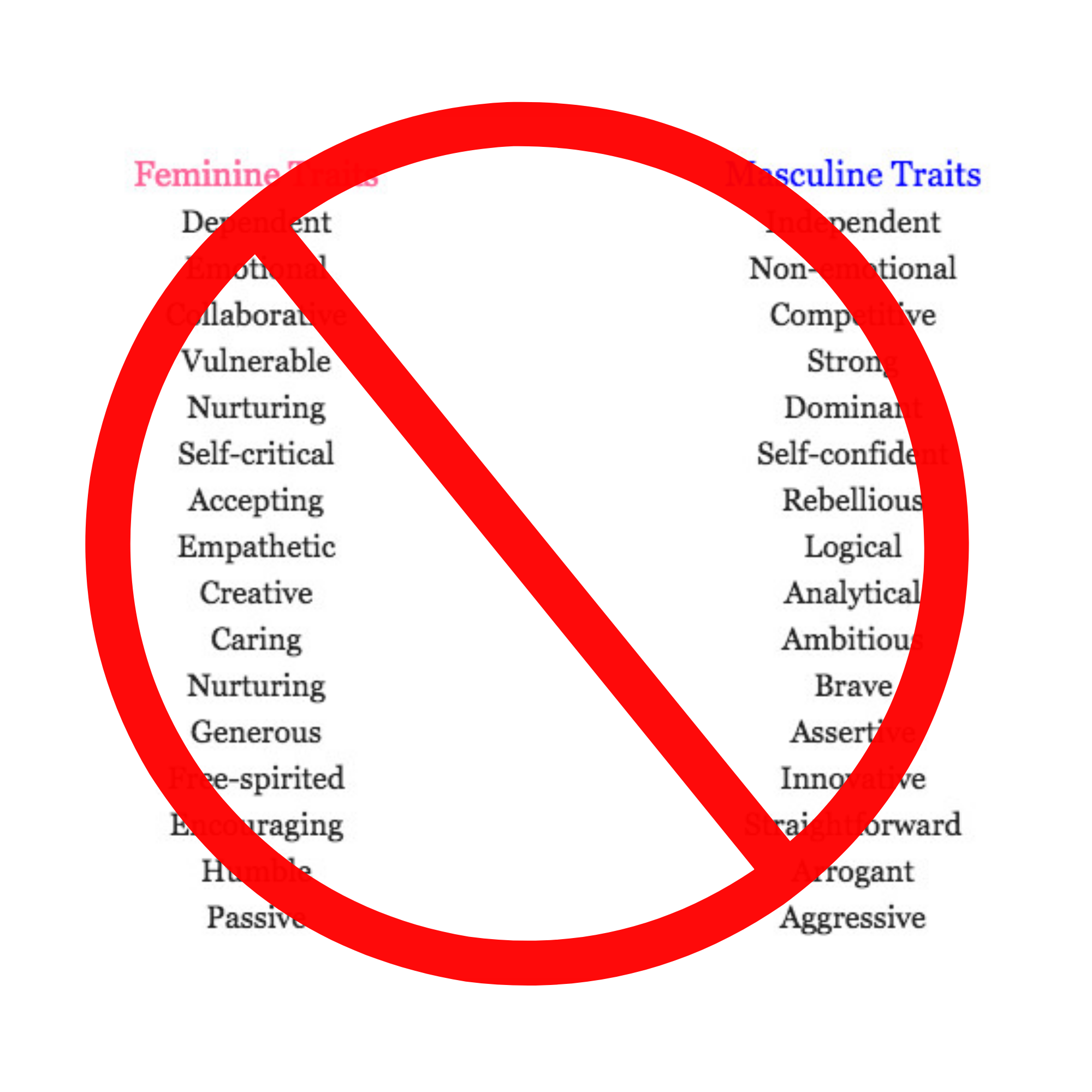
Teach courage, including the courage to acknowledge fear and ask for help. Teach ambition, paired with ethics and the understanding that other people are not rungs on a ladder. Teach leadership as responsibility rather than domination, anger as an emotion carrying information rather than an automatic claim to authority, and discipline without glorifying suffering for its own sake.
Teach tenderness without making women responsible for providing all of it. Teach vulnerability without treating it as feminine contamination. Teach care without turning it into unpaid female labour, and confidence without treating every room as a hierarchy that someone must conquer.
Boys do not need to be told that courage belongs especially to them. They need opportunities to practise courage. They do not need ambition protected as masculine property. They need ambitions worth pursuing. They do not need emotional openness repackaged as a rugged artisanal form of vulnerability. They need to know that grief, tenderness, uncertainty and need do not revoke their membership in manhood.
Girls do not need to be told that empathy is their special gift. They need permission to set boundaries around their care. They do not need to be praised for natural selflessness while everyone nearby benefits from their labour. They need to know that anger, ambition and authority do not make them defective women.
The problem with toxic masculinity is not that masculinity makes every trait toxic, or that women become morally pure whenever they perform the same behaviour. The problem is that gender assigns different permissions and consequences. It teaches men that dominance may prove their strength while teaching women that dominance makes them unlovable. It teaches women that care is their duty while teaching men that care is optional, exceptional or vaguely suspicious unless renamed protection.
Courage, care, ambition and vulnerability do not belong to separate sexes. Neither do anger, leadership, resilience, aggression, empathy or fear.
What gender often determines is not who can possess these qualities, but who will be praised, excused or punished for showing them.
That is the system we need to dismantle, not because men are defective women, but because nobody should be required to become a defective half-person in order to perform their gender correctly.
I’ve been watching season 1 of The Diplomat and there’s a scene in which Keri Russell’s character, Kate Wyler, tells her husband the importance of people like you as a diplomat. He rejects the idea. I pointed out to my friend that this was very much the difference between being a woman in politics and a man.
Great post!
First, a moment of silence and a big sigh for LastBlueDog's article...*sigh*
Talk about pointing out the bars of one's cage while still not being able to see them.
The good and bad news is that since masculinity and femininty are social constructs, we have choices as to what these things mean.
A man can literally custom build his masculinity and it is totally fine to choose a masculine framework for one's life as long as it is the mature version.
The best choice of all however, is to not choose.
The masculine framework is an option. We men could instead choose to become the best version of our authentic selves and continue working towards even better versions of that self.
Not mention the freedom of that. Among other things, it allows men to engage in things because they want to and not just because it involves a manly trait.
Being able to make that choice however requires some degree of inner work and self-reflection. So to the men out there...
...do the work.
This, this, so much this. Why does everything have to be viewed through the lens of gender? It’s not a very useful one.