
The Data Is Women’s History
Social media made the backlash louder. It did not invent the script.

A man came into my replies last week to inform me that men blaming women for their loneliness, resentment, and lack of social skills is apparently a new problem entirely caused by social media.1
This was news to Eve.

It was also news to the witches, the “fallen women,” the suffragists accused of destroying the family, the Victorian wives tasked with preserving men’s morality while being legally subordinated to them, and the postwar working women accused by psychiatric “experts” of ruining husbands, children, sex, and civilization itself.
But sure.
New problem.
The original post was simple enough: men and boys are not in crisis because of feminism. They are in crisis because patriarchy taught them to expect to be the center of the universe while putting in very little emotional effort. Now that they are not getting what they want, they do not have the tools to handle disappointment.
This is, clinically speaking, a skill issue.
A man then appeared to explain that I was “half right,” which is always a promising start when a stranger enters your comments to explain your own field to you. According to him, yes, boys and men lacked social and psychological skills, but this was not because of patriarchy. If patriarchy were to blame, he argued, this would have shown up 100 years ago. Or 1,000 years ago.
Reader.
It did.
It has been showing up for so long that the archive is basically one long receipt printed by a furious CVS machine.
To be clear, social media absolutely matters. I am not arguing that it does not. Social media has intensified isolation, resentment, parasocial intimacy, algorithmic grievance, and the weird emotional economy of men turning loneliness into livestreamed contempt. Tech has given a lot of men a place to avoid vulnerability while calling it “logic.”
But amplification is not invention.
A microphone does not create the sermon. It makes the preacher louder.
Social media did not invent men blaming women for their unhappiness. It did not invent the idea that women are responsible for men’s moral development, sexual frustration, emotional regulation, social status, loneliness, family stability, and national decline. It just gave that old story a comment section, a podcast studio, and a Patreon tier.
We can start, as Western patriarchy so often does, with Eve.
The story of the Fall has had an enormous afterlife in Western gender ideology. Eve eats the fruit, gives it to Adam, and suddenly centuries of theologians, preachers, moralists, and ordinary men with opinions decide that women are uniquely susceptible to temptation, curiosity, bodily weakness, and disobedience. Adam is there. Adam eats too. Adam is not exactly tied to a chair being force-fed forbidden produce. But in the larger cultural imagination, Eve becomes the doorway through which sin enters the world.
A woman wanted knowledge and a snack, and somehow men made that everyone’s problem forever.
That basic structure repeats again and again: men act, but women become responsible for the conditions of male action. A man sins because a woman tempted him. A man falls because a woman misled him. A man fails because a woman did not keep him pure, soothed, sexually satisfied, emotionally managed, and safely tucked into the moral bassinet.
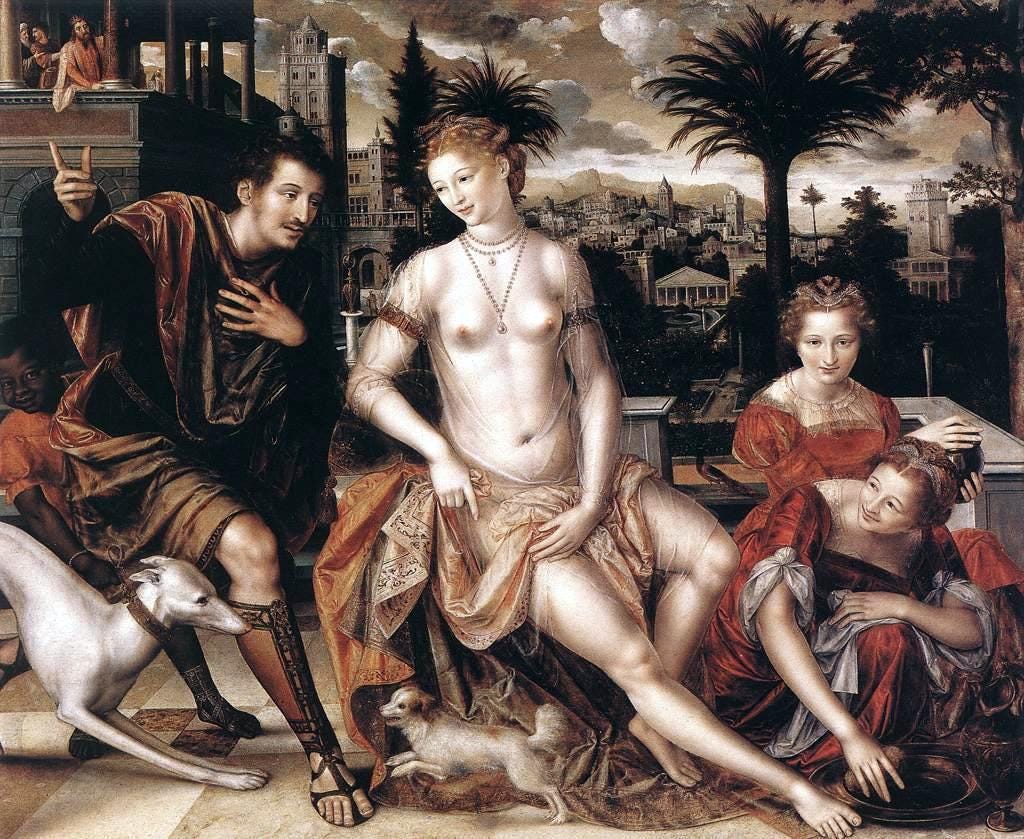
By the Victorian era, this logic had acquired lace curtains.
Victorian gender ideology divided society into separate spheres. Men belonged in the public world: politics, commerce, empire, law, industry, competition. Women belonged in the private world: home, children, religion, emotional refinement, and the maintenance of everyone else’s soul. Women were framed as physically weak but morally superior domestic guardians, while men were imagined as physically strong but morally weaker actors in the amoral public world. Your basic ideological setup was: men get the power, women get the responsibility.
Victorian women were told they were too delicate for public life, but somehow strong enough to preserve the moral order of civilization from inside the home. They were too irrational for politics, but rational enough to raise moral citizens. They were too weak for independence, but powerful enough that their failure to be pure, obedient, modest, and domestic could supposedly destabilize society.
That is not equality. That is a hostage situation with better upholstery.
And when women tried to move from moral influence to political rights, the backlash was immediate.
Anti-suffrage activists claimed women voting would disrupt home life, destroy women’s proper role as wives and mothers, spread socialism, create “sex antagonism,” weaken patriotism, empower the wrong voters, and destabilize society. Women voting was not treated as a normal political disagreement. It was framed as the collapse of the home, the nation, racial hierarchy, gender order, morality, and civilization.
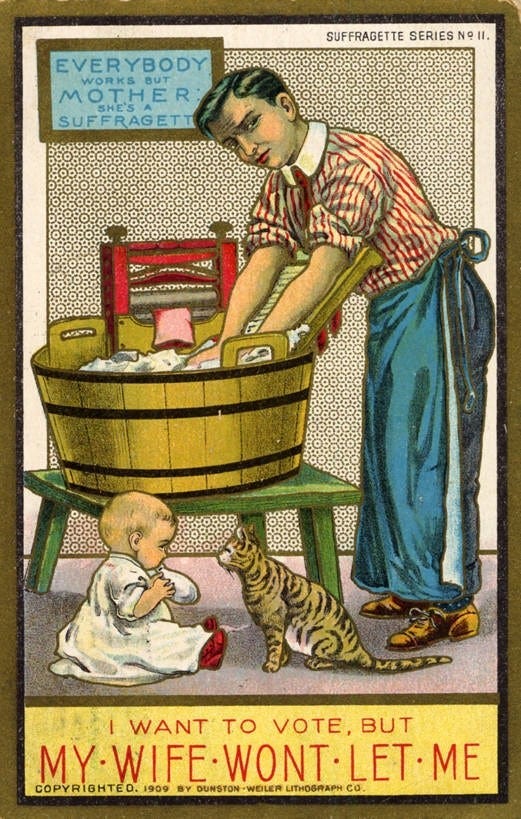
Because apparently a woman touching a ballot was enough to make the republic clutch its pearls and faint onto a chaise lounge.
Anti-suffrage propaganda also mocked suffragists as ugly, unwanted, sexually deviant, unfeminine, bad wives, bad mothers, failed women, and threats to men.
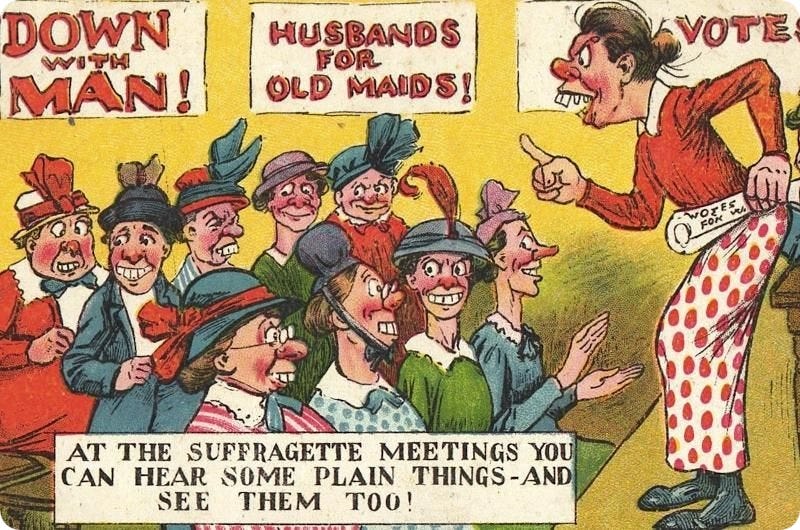
Sound familiar?
Modern feminists are still called ugly, bitter, lonely, unfeminine, sexually undesirable, man-hating, anti-family, mentally unstable, and angry. The insult drawer has not been reorganized in a century. Men just keep opening it and acting like they invented storage.
Then came the postwar era, when the United States performed one of its most dramatic ideological costume changes.
During World War II, women were useful. They were patriotic. They worked in factories, offices, volunteer networks, and military-adjacent roles. They were Rosie the Riveter. They were proof that women could do demanding work when the nation required it.
Then the war ended, men came home, and suddenly women’s independence became a problem.
A problem requiring experts.
A problem requiring books.
A problem requiring an entire cultural apparatus to convince women that the fulfillment they had found outside the home was actually pathological, selfish, unfeminine, and dangerous to their children.
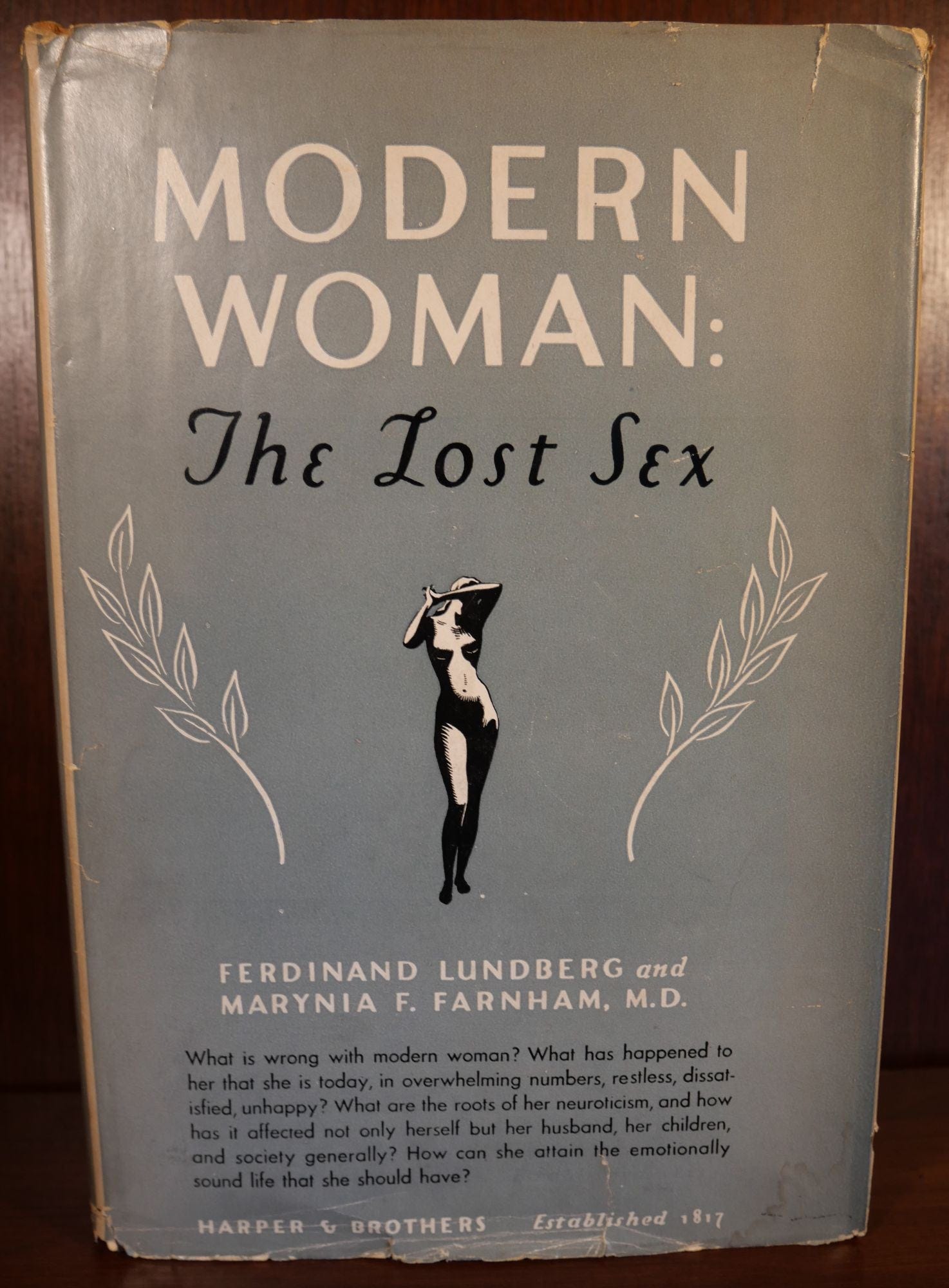
Books like Modern Woman: The Lost Sex argued that modern women were psychologically disordered, that working women made bad mothers, and that feminism itself was a deep illness. Women had done what the country asked of them during wartime, and then they were blamed for wanting to keep the income, independence, and identity they had gained.
Again, women were blamed for social instability.
Women gained work, so they were blamed for hurting men.
Women wanted independence, so they were blamed for hurting children.
Women felt trapped by domesticity, so they were told the problem was not domesticity. The problem was them.
This is patriarchy’s diagnostic model: if women are unhappy under the system, the system is fine and the women are broken.
So when a man in 2026 says men blaming women for their loneliness and lack of social skills is a new problem caused by social media, I need everyone to understand how historically silly that is.
The manosphere did not invent this. Andrew Tate did not invent this. Reddit did not invent this. Podcasts did not invent this. Social media did not invent this.
They are not the origin point.
They are the distribution network.
The substance is ancient: your pain is her fault.
Your loneliness is her fault.
Your lack of purpose is her fault.
Your sexual frustration is her fault.
Your inability to handle rejection is her fault.
Your discomfort with equality is her fault.
Your nostalgia for unearned authority is her fault.
This is why the “show me data” move is often less reasonable than it pretends to sound. Evidence matters. Of course it does. But when a woman points to centuries of historical pattern and a man replies, “No, show me current data,” what he often means is: “Please move the conversation onto ground where I feel more comfortable dismissing you.”
Historical evidence is data.
The archive is data.
Patterns are data.
Women’s history is not “vibes.”
And no, invoking your mother’s academic credentials does not solve this. In this particular case, the man’s own public biography notes that he grew up traveling with his mother, anthropologist Dr. Carolyn Heinz. Which is lovely. Truly. But having an anthropologist for a mother does not make your comments peer-reviewed.
Proximity to scholarship is not scholarship.
Being raised near fieldwork does not make every later opinion an ethnographic finding.
“My mother is an anthropologist” is not a citation. It is a biographical detail that makes me want to find his mother on LinkedIn and send a complaint to the manufacturer of the man in my comments.2
What this entire exchange demonstrated was the thing it tried to deny: patriarchy teaches men that their opinions deserve entry into every room, that women’s expertise must remain perpetually available for cross-examination, that correction from women is aggression, that women’s anger invalidates women’s knowledge, and that men can position themselves as victims even while demanding intellectual labor from the women they are dismissing.
That is not new.
That is the archive.
So yes, boys and men are struggling. Yes, many are lonely. Yes, many lack social skills. Yes, many are being radicalized by online spaces that feed them resentment instead of connection.
But the answer is not to pretend this crisis exists outside gender.
The answer is to ask what boys are being taught about women, rejection, sex, care, friendship, vulnerability, entitlement, and power. The answer is to ask why so many men experience women’s autonomy as abandonment. The answer is to ask why men are more comfortable blaming feminism than learning emotional reciprocity.
That is patriarchy.
Not because every individual man is evil.
Not because women are perfect.
Not because social media is irrelevant.
But because patriarchy is the system that trains men to confuse dominance with belonging, control with intimacy, attention with love, and women’s compliance with social order.
When that compliance weakens, backlash follows.
Every time.
That is the data.
That is the history.
And if a man still needs proof that patriarchy teaches men to blame women for their discomfort, he is welcome to consult the archive.
Or, apparently, his own comment history.
I don’t want to give this washed up frontman for a “steampunk” band any more attention that he deserves, but if you are in that subculture, perhaps look for a more feminist friendly band than Abney Park to support. Robert is an asshole.
Side note: I have 11 connections in common with his mother and I did send her a connection request.
A few years ago, personal responsibility was a very popular argument from certain corners of the internet. I think it's fair to apply it here, too. Blaming women for personal failings is the height of entitlement.
Thanks, Prof.
--Great article.
"It has been showing up for so long that the archive is basically one long receipt printed by a furious CVS machine." OH, ProfessorMEREDITH! And: "A woman wanted knowledge and a snack, and somehow men made that everyone’s problem forever." I fell on the floor laughing reading those sentences. You won the internet today, my dear. Brava! xo