
The Economics of Jennifer’s Body
Notes from the Trenches of a Gender Studies MA

Jennifer’s Body is not a feminist film.
Hold up, before you get upset, let me explain.
Over the past decade, Jennifer’s Body has undergone one of the most satisfying cultural reappraisals in modern pop culture. When it was released in 2009, the marketing treated it like a teenage boy’s fantasy: Megan Fox, short skirts, suggestive taglines, and the vague promise that something sexy might happen in a high school hallway. What the marketing campaign did not emphasize was that the movie is actually about a teenage girl who gets drugged, sacrificed by an indie rock band hoping to become famous, and comes back wrong.
Once people revisited the film outside that marketing disaster, a different picture emerged. It’s written by Diablo Cody, directed by Karyn Kusama, and centered on the messy, emotionally intense friendship between two teenage girls. It’s also bluntly critical of male entitlement. A group of mediocre men decides that sacrificing a teenage girl is an acceptable price to pay for success. In the current cultural moment, that premise lands very differently than it did in 2009.
Because of that shift, Jennifer’s Body is often described as a feminist revenge story. Jennifer gets hurt, Jennifer gains power, Jennifer turns the tables on men.
But that interpretation has always felt a little too neat to me.
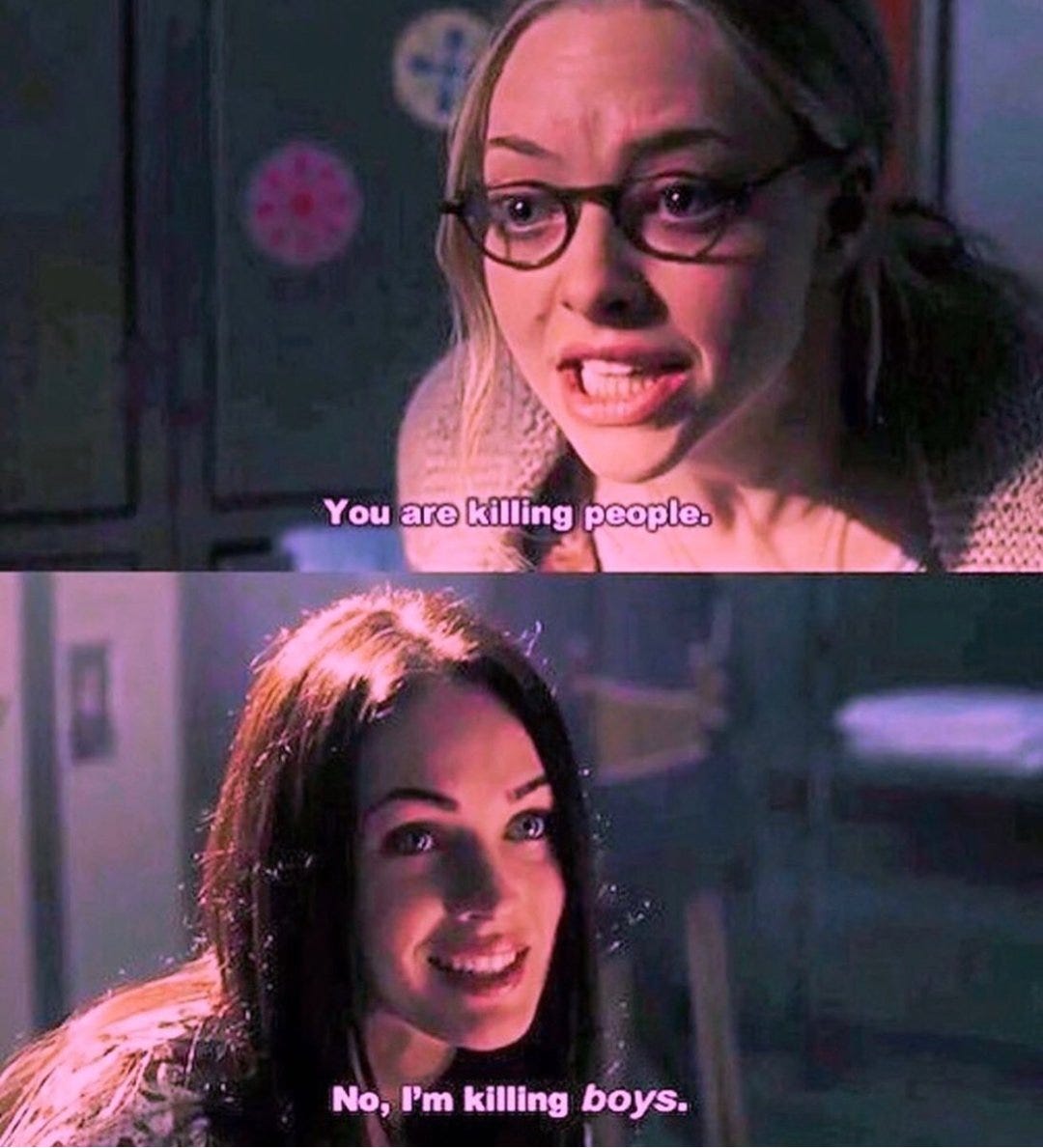
The problem is that Jennifer isn’t actually taking revenge on the men who hurt her. She doesn’t track down the band members who sacrificed her and exact some elaborate justice. Instead, she kills boys who had nothing to do with what happened to her. Her victims are simply the boys who flirt with her, who want her attention, who believe they might have access to her body if they play their cards right.
That makes Jennifer’s violence feel less like revenge and more like something else entirely.
Jennifer doesn’t become a monster because she wants justice. She becomes a monster because she has to survive.
And the way she survives is by consuming the same thing that was already consuming her.
To see how that works, it helps to look at Jennifer before the demon ever enters the story. She’s not a shy girl discovering power for the first time. She’s already the most socially powerful person in the room. Jennifer is beautiful, charismatic, and perfectly aware of the effect she has on the boys around her. She flirts constantly, but rarely with the intention of actually following through. Instead, she maintains a kind of gravitational pull. People orbit around her because she knows how to make them want her.
None of that makes her unusually manipulative. It just means she understands the system she’s living in.
And that system operates a lot like an economy.
In Jennifer’s high school, attention is currency and desirability is the most reliable form of wealth a girl can possess. Jennifer knows exactly how to generate it. She flirts, she teases, she lets boys believe they might eventually get what they want, and in return she gets influence. Popularity flows toward her because people want access to the thing she appears to offer.
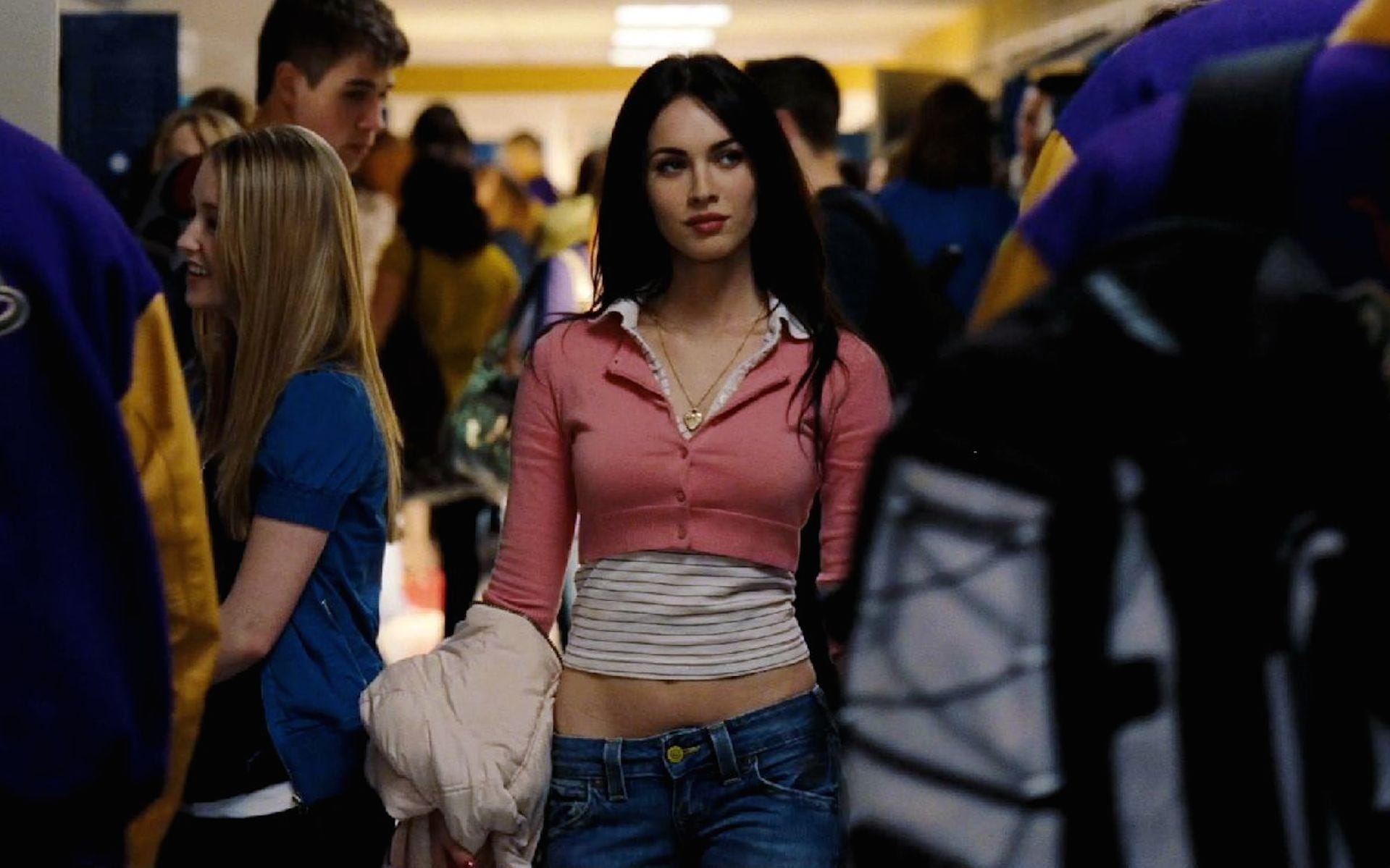
Judith Butler famously argued that gender isn’t something we simply are, but something we repeatedly perform according to social expectations. Jennifer performs the role of the desirable girl perfectly because it’s the role that gives her the most leverage in the system she inhabits.
Her beauty isn’t just an identity.
It’s capital.
Then the ritual happens.
The band doesn’t just attack Jennifer. They sacrifice her because they believe her body can buy them something. Fame. Success. A record deal. To them, Jennifer isn’t a person so much as an investment. They believe they can trade her life for their future.
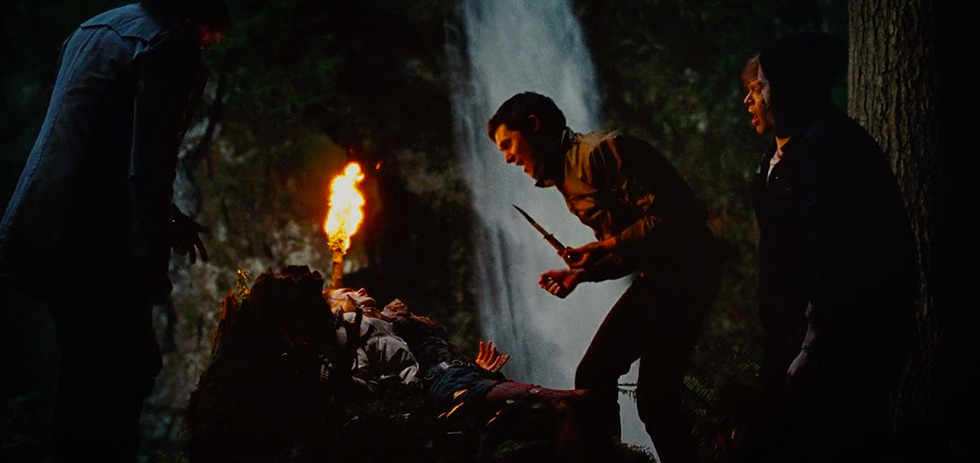
And in the logic of the film, they’re not entirely wrong. The ritual works. The band becomes successful. The sacrifice produces exactly the return they expected.
Jennifer’s body literally becomes currency. The only problem is that because she isn’t actually a virgin, she ends up turning into a demon.1
This is where horror theory usually steps in with a familiar explanation. Barbara Creed famously described the “monstrous feminine,” a figure in horror where women become terrifying when their bodies become excessive, devouring, or uncontrollable. The monstrous woman bleeds too much, desires too much, consumes too much. Once the demon takes hold, Jennifer certainly fits that description. She becomes sexually predatory, aggressive, and literally devours male bodies.
From Creed’s perspective, Jennifer looks like a textbook example of horror’s long tradition of portraying female sexuality as dangerous.
But Jennifer’s Body complicates that reading in an important way.
Because the movie goes out of its way to show how Jennifer becomes monstrous in the first place. She isn’t an ancient symbol of male fear. She’s a girl who was drugged, assaulted, and sacrificed by a group of men who believed her body was expendable. The monster doesn’t emerge from some deep psychological terror of women’s bodies. It emerges from a very specific act of violence. The dehumanizing of women for the sake of male power.
This is where Cynthia Freeland’s critique of feminist horror theory becomes useful. Freeland argues that critics sometimes rely too heavily on universal psychological explanations for horror, as if every terrifying woman on screen must represent the same symbolic fear of sexuality or motherhood. Instead, she suggests looking more closely at the social and ideological structures that films construct.
From that perspective, Jennifer’s Body starts to look less like a symbolic nightmare and more like a story about how bodies circulate within systems of power.
Before the ritual, Jennifer survives by generating attention. Her desirability produces influence and social protection. After the ritual, she survives by consuming bodies.
The structure of the exchange doesn’t change.
The currency does.
Before, Jennifer is the commodity everyone else wants to spend. Afterward, she becomes the consumer.
That shift makes the film much darker than a straightforward feminist revenge fantasy. Revenge stories usually restore balance. Someone hurts the heroine, and she strikes back at the people responsible.
Jennifer doesn’t restore balance.
She simply adapts to the system that destroyed her.
That difference becomes especially clear if you compare Jennifer to another female monster: the vampire in A Girl Walks Home Alone at Night. Ana Lily Amirpour’s film also centers on a woman who stalks men in the darkness, but the moral logic is completely different. The Girl doesn’t simply prey on whoever crosses her path. She targets men who exploit others: abusive boyfriends, predatory drug dealers, men who move through the world assuming they will never face consequences.
Her violence functions almost like a correction to the system around her.

Jennifer’s doesn’t.
Jennifer consumes whoever is available. The boys she kills didn’t assault her, didn’t sacrifice her, didn’t personally harm her. They simply exist inside the same structure that made her body expendable in the first place. They approach her with the expectations the culture has already taught them: that her attention might be earned, that her body might eventually become accessible to them.
Jennifer just takes that logic to its extreme conclusion.
If bodies are resources, she might as well start eating.
This is why Jennifer’s Body lingers in such an uncomfortable place. The film doesn’t show a woman overthrowing the system that harmed her. It shows a woman adapting to it in the most literal way possible.
Before the ritual, Jennifer’s body is a form of currency everyone expects to spend.
After the ritual, she decides she’s done being the product.
She doesn’t break the system that consumed her.
She simply stops pretending she isn’t part of the economy.
Jennifer’s Body isn’t a feminist fantasy.
It’s something darker than that.
It’s a story about what happens when a girl realizes that in the world she lives in, bodies are already being consumed.
She just decides she’s tired of being the one on the menu.
I could write an entire book the topic of how “virginity” is approached in witchcraft in popular culture and how girl’s sexual purity is positioned as protection from corruption, but that’s for another time.
This is why I think that the feminist arc comes from Needy's story not Jennifer's story arc. Needy goes from being "needy" locked into a steady relationship with a boy who is not very nice to her and whose best friend bullies her.
Needy is the one who embraces her own sexuality by losing her virginity, who pushes against the social BS and expectations, liberates her demonic friend, and goes on the murder the boys who killed her friend.
I think the horror in Jennifer's Body comes form the idea of what if you push a woman so far she begins to act like the men? Just like how the band uses her body to get the social currency of fame, Jennifer uses men's bodies to become more attractive and charismatic, but just like how the entertainment industry constantly needs new female bodies to exploit, Jennifer has to continuously consume men's bodies as well.
I think one of the strong points of the movie is it starts with showing us victims who feel like they deserve it. It starts with gross men, those that would 100% exploit Jennifer if they could. It is only later in the film that is shows Jennifer's first victim as a marginalized, and in many ways weaker foreign exchange student. This mirrors the idea that exploited women somehow asked for it, or were deserving of their fate when in reality these men target the weak and vulnerable. I think this point is further supported by the band leader insisting Jennifer must be a virgin, because girls like that are always teases. Clearly Jennifer deserves this treatment for being a tease.
I think in many ways Jennifer's Body is a good feminist film, but in so far as it explored gendered dynamics and female exploitation. As a feminist revenge story, not so much. Jennifer's story is just sad through and through, and I think Megan Fox goes a good job portraying that.