
The Power Was Never the Sword (And Yes, the Sword Is Your Penis)
He-Man Went to Therapy. Skeletor Started a Podcast.

Spoilers ahead, go see the film! It is genuinely funny and fun and we don’t get enough fun movies anymore.
There is no particularly dignified way to say this, so let us begin with the obvious: the sword in Masters of the Universe is a penis.1
We are not surprised by this. Fantasy as a genre has spent many decades handing men long, rigid objects and insisting they represent destiny, kingship and divine authority rather than the much more obvious Freudian symbolism.
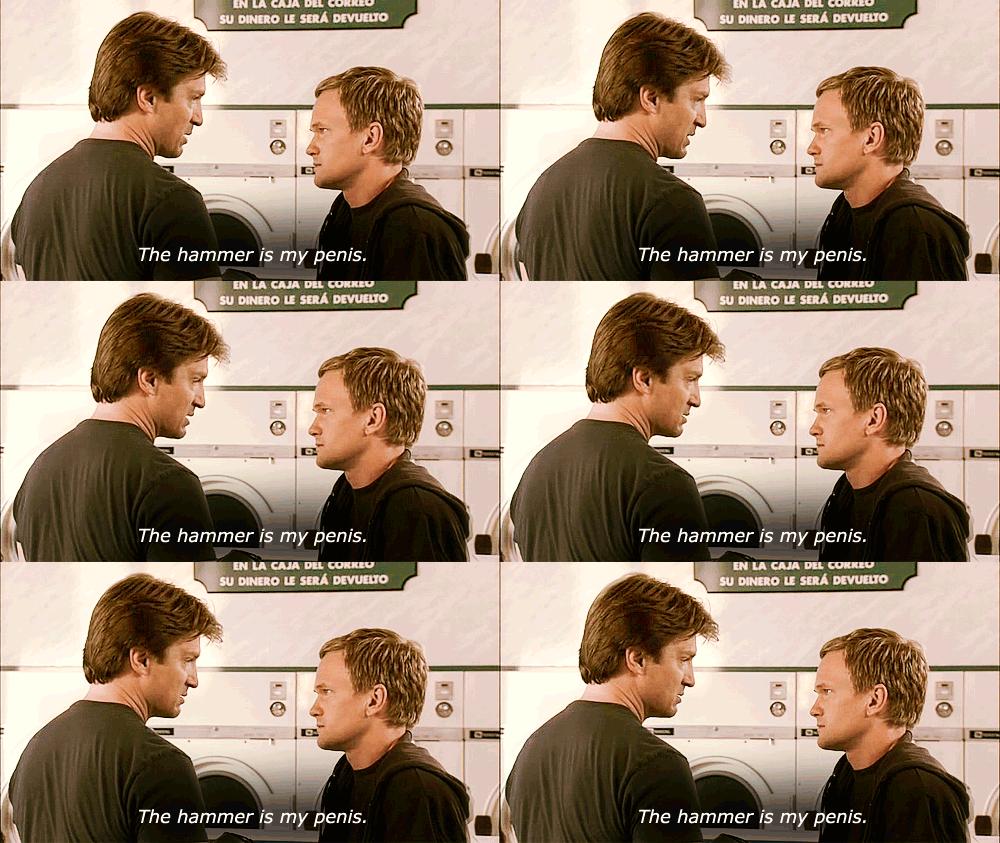
But in case anyone is worried that I am imposing vulgar feminist symbolism upon an innocent movie about a nearly naked man thrusting a weapon into the sky while shouting that he has the power, Skeletor helpfully removes all ambiguity.
At one point, he refers to the “big long sword dangling between [Adam’s] glorious thighs.”
No, really.
I didn’t invent that sentence. I merely sat in a mostly empty cinema and received it while trying to not snort soda out my nose.
And yet the most interesting thing about Masters of the Universe isn’t that it understands the sword is a penis. It’s that the film spends more than two hours carefully separating the possession of traditional masculine symbols from actual strength, leadership or moral authority.
The sword is enormous. Adam’s muscles are enormous. Skeletor’s insecurity is also enormous.
Only one of these things ultimately matters.
What Kind of Man Is He-Man?
Director Travis Knight has been unusually explicit about the film’s central question. During interviews, he said he wanted to explore: “What does it mean to be a man?”
That might sound like an alarmingly serious ambition for a film featuring characters named Fisto and Ram Man, but Knight is not trying to scrape the glitter off the franchise and reveal a sombre prestige drama hiding beneath it. The ridiculousness is part of the argument.
He-Man is one of the most exaggerated images of masculinity ever mass-produced. He is a bronzed wall of muscle wearing boots, a harness and a leather loincloth. He looks as though someone fed Conan the Barbarian directly into a toy factory.2
But Adam is not the kind of man his body tells us he should be.
He is not a hardened soldier. He is not obsessed with dominance. He is not constantly looking for someone to overpower. He is an artist who works in human resources, talks openly about emotions and repeatedly attempts to solve conflict through communication.3
The most visibly hypermasculine man in the universe is, spiritually, the colleague who reminds everyone to use “I feel” statements during workplace mediation.4
This is not incidental. Knight has described Eternia as representing a distinctly 1980s model of masculinity, organized around physical strength, emotional discipline and power. Adam, raised in contemporary America, returns with a competing model based on empathy, communication and understanding.
The film then smashes those ideas together with all the delicacy of two action figures being hurled across a living-room floor.5
Adam looks like the old ideal but refuses to perform it correctly.
That makes him a disappointment to nearly every man who believes masculinity is something that must be proven through pain.
“This World Is No Place for the Weak”
Adam first learns the rules of patriarchal masculinity from his father.
King Randor humiliates his young son in front of the soldiers Adam is supposed to command one day, telling him, “This world is no place for the weak.”
It’s toxic masculinity in concentrated form: vulnerability must be shamed out of boys before it becomes visible enough for anyone else to punish. Leadership means hardness. Authority must be established publicly. A son becomes a man by learning that love and approval are conditional upon his ability to conceal fear and excel physically.
Randor believes humiliation will prepare Adam to rule.
Instead, it teaches him that he cannot become the kind of man his father respects without amputating the parts of himself that make him Adam. This is shown explicitly when Adam is reunited with his father and says that now he’s who is father wanted him to be. His father asks what his son thought he wanted him to be and Adam says “not me.”
The film does not present Randor as uncomplicatedly monstrous. After fifteen years in Skeletor’s prison, he appears to have had some time to reconsider his parenting philosophy. Captivity is not generally recommended as a route to emotional growth, but apparently it can produce remarkable clarity regarding whether publicly degrading your sensitive child was an effective succession strategy.
Randor represents inherited masculinity: the beliefs passed from fathers to sons not necessarily because they work, but because no one has been permitted to question them. King Randor, in many ways, feels like the kind of Korean and Vietnam veterans that raised the boys who were watching He-Man in the 1980s. In extreme need of therapy and instead choosing to tell their sons to “man-up” and that “crying is for girls.”
“When war breaks out, it’s not the poets that step up. It’s the man with the muscle.”
That is the governing logic of Eternia. Strength means force. Leadership means command. Masculinity means being physically capable of defeating another man and emotionally incapable of admitting that anything has hurt you.
Adam returns looking like the final boss of a protein-powder commercial, but he does not accept those terms of engagement. He may not be a poet, but he is sensitive and artistic and not the man with the muscle. He’s the kind of man who wears a sweatshirt with a kitten in a teacup with the words “alpha male” on it, unironically, to the gym.
Skeletor Is Andrew Tate as Andrew Tate Imagines Himself
If Randor represents traditional masculinity reproduced through fathers and institutions, Skeletor represents its diseased endpoint.
Knight described Skeletor before the film’s release as “the embodiment of toxic masculinity.” In another interview, he characterized him as a deeply insecure, power-hungry man who is always performing and becomes furious when his audience fails to respond correctly.
Which is why the most concise description of this version of Skeletor may be: Andrew Tate as Andrew Tate thinks he is, except with more wit.
Skeletor does not merely want power. He needs power to be visible and successfully performed for the masses.
He needs submission, spectacle and recognition. His authority can’t simply exist; it must be constantly staged through humiliation and fear. Everyone must know he’s the strongest man in the room because the possibility that they might not know is intolerable.
His theatricality is not separate from his insecurity. It is the scaffolding holding it upright.
He is particularly obsessed with Adam’s masculinity: his body, his strength, his sword and whether he is sufficiently ruthless to use them.6
“You may have the power,” Skeletor tells him, “but you’re too scared to use it. You don’t even know how.”
Adam answers, “I know how to use it. I just prefer not to.”
That exchange contains the film’s entire argument.
Skeletor can’t imagine power that doesn’t continually prove itself through domination. To possess force and choose restraint looks, to him, exactly like impotence.
Adam understands something Skeletor can’t: having the ability to hurt people does not make hurting them necessary. Restraint is not proof that power is absent. Sometimes it is the clearest evidence that power is secure.
This is where the film’s critique extends neatly into contemporary gym-bro and manosphere culture. The problem isn’t exercise, muscle or physical strength. The problem is the conversion of the male body into a public referendum on worth, based on muscle mass.
The body must become evidence. Its size, hardness and discipline must demonstrate that the man inside it cannot be dismissed, feminized, humiliated or controlled. Masculinity becomes a status permanently under review, requiring constant measurement against weaker men.
Skeletor has constructed his entire identity around winning that comparison.
Adam declines to participate.
Nothing to See Here, Bro
The film makes the same point on a much smaller scale through Adam’s roommate, Hussein. When Adam is away, Hussein watches romantic movies alone and allows himself to cry openly. The moment Adam returns, however, he scrambles to conceal what he has been watching, wipes away the evidence of emotion and noticeably lowers his voice. Nothing about his feelings has changed. Only his audience has.
The scene turns masculinity into a performance assembled in real time, complete with vocal adjustment, emotional concealment and the urgent need to establish that he was definitely not sitting at home moved by a romance.
The joke works because Adam is possibly the least threatening person before whom Hussein could perform this ritual. Adam is emotionally expressive, artistic and hardly likely to revoke another man’s membership card for crying at a film. Yet Hussein still assumes that another man’s presence requires him to become less visibly vulnerable.
The surveillance doesn’t have to be hostile, or even real, because he’s already internalized it. He watches himself on patriarchy’s behalf.
That brief domestic gag expands the film’s argument beyond obviously toxic men such as Randor and Skeletor. Most men do not rule kingdoms, imprison their relatives or make threatening remarks about the glorious swords hanging between other men’s thighs. They may simply deepen their voices, hide the romantic movie and pretend they were never crying.
The scale is different, but the governing anxiety is the same: masculinity must be demonstrated, and emotion becomes dangerous the moment another man might see it.
The Most Muscular Man Alive Would Like to Open a Dialogue
Before resorting to violence, Adam tries to talk Skeletor down.
He attempts to “open a dialogue,” speculating that Skeletor may have conquered Eternia because he could not become king or because he was insufficiently loved as a child.
This is, objectively, an astonishing approach to a skull-faced genocidal dictator.
It is also crucial to the film’s distinction between Adam and the men around him. Adam doesn’t refuse violence because he is incapable of it. He refuses because he believes other possibilities should be exhausted first.
He is not weak. He is unwilling to make violence the organizing principle of his identity.
Eventually, of course, he fights. The movie is still called Masters of the Universe, not A Productive Mediation Session at Castle Grayskull. But violence is Adam’s final instrument rather than his preferred language.
Even his command to Skeletor, “Face me like a man,” is immediately punctured by Skeletor’s response:
“A, I don’t have a face, and B, I don’t want to!”
The film constantly destabilizes its own masculine spectacle. Every heroic declaration is in danger of being interrupted by a joke, an innuendo or Skeletor calling Adam “you naughty boy.”
Which he does…twice.
This is a film that knows masculine power is theatre and keeps allowing someone backstage to drop a sandbag onto the performance.
The Sorceress Explains the Metaphor for Anyone Still Taking Notes
Near the end of the film, the Sorceress finally explains why Adam was chosen.
Earlier men used the Sword of Power largely for brute strength. Adam offers something else: understanding, empathy and humanity.
When Adam protests that the sword has been broken, the Sorceress reacts with something close to: That sword? You thought this was about that sword?
The power was never contained in the object.
Adam is the vessel.
This changes the meaning of the franchise’s most famous declaration. Adam does not lift the weapon and announce:
“By the power of Grayskull, my sword has the power.”
He says:
“By the power of Grayskull, I have the power.”
The difference isn’t just grammar. It’s the film’s thesis.
The sword provides access to power, but it cannot decide what power means. That depends upon the man holding it.
In Skeletor’s hands, power means domination because domination is the only thing that can quiet his insecurity. In Randor’s worldview, power means hardness because hardness is how kings prove they deserve to rule. In Adam’s hands, power becomes protective because his identity does not depend upon everyone else becoming smaller.
Orko later delivers the film’s tidy moral in the style of the original cartoon:
“Today, we learned that muscles don’t necessarily make a man.”
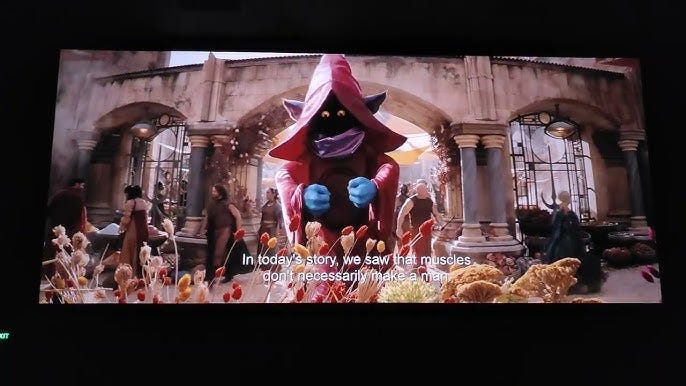
Correct, little floating wizard.
No notes.
Apparently Some People Thought This Was Just Innuendo
The conservative review site Plugged In catalogued the film’s sexual jokes with the grave diligence of someone documenting contraband found during a prison search. It notes the suggestive uses of Fisto, “give ’em head,” the sword and Adam being “ravished.”
All of those things are indeed in the film.
At one point an employee begs Adam, “Please stop ravishing the pillager.”
Adam replies, “He’s ravishing me!”
Elsewhere, Fisto shouts, “GIVE ’EM HEAD, RAM MAN!”
Ram Man, with perfect confusion, answers: “What?”
But treating these jokes as a collection of stray sexual asides misses what they are doing. The film is not accidentally placing phallic innuendo inside a story about men competing over physical dominance, bodily power and the right to rule.
The innuendo is part of the critique.
The sword is funny because swords have always operated as symbols of masculine authority while pretending not to resemble anything else. The names are funny because “Fisto” and “Ram Man” emerged from a toy line that was already an unintentional festival of hypermasculine camp.
The film does not invent the homoeroticism of Masters of the Universe. It merely turns the spotlight on them during Pride month in a very particularly funny way.
A Better Kind of Strength
Not every element of the film’s critique is perfectly resolved. Adam ultimately defeats authoritarian masculinity through a large physical confrontation because that is what this genre demands. The film still depends upon the pleasure of watching a spectacular male body hit things very hard.
But it does not ask Adam to become Skeletor in order to defeat him.
He remains awkward. He remains emotionally open. He remains the kind of man who would rather negotiate than dominate, create rather than destroy and admit fear rather than disguise it as aggression.
His transformation gives him a stronger body. It does not replace his personality with a more conventionally masculine one.
That may be the film’s smartest decision. Adam does not need to outgrow empathy before becoming heroic. His empathy is what makes him capable of using power without being consumed by it.
The movie gives us a hero who has everything the gym-bro ideal promises will make a man powerful: the body, the weapon, the bloodline and the ability to crush his enemies.
Then it insists that none of those things makes him worthy.
The power is understanding.
The power is restraint.
The power is remaining human when the world tells you humanity is weakness.
The sword is still your penis, obviously.
But the power was never the sword.7
To note, the movie IS family friendly. The innuendos are like most 80s cartoons, kids will miss them and parents will be rolling in the aisles.
Arguably this is kind of what happened.
And they aren’t always playing that for laughs. His leadership skills are real and useful, even if no one he’s talking to knows what a “seminar” or a “workplace” is.
“Maybe we need less ‘truth-telling’ and more ‘truth-listening’” is a line that will be deployed by me in the future.
Or being made to kiss by the weird kid playing with them. We don’t judge.
Statement from a friend: “This might explain Evil-Lyn’s terrible mood in this film, she’s been trying to keep Skeletor’s attention all while he’s busy obsessing over some other guy’s…sword.”
There’s at least five other points I would like to discuss about this film, but I’ll wait until I can purchase it and watch it again so I can get the quotes I need.
I did not have this movie on my (admittedly short) summer movie watching list. I’m reconsidering that now. Unrelated note: many years ago when Tommy Thompson (R) was governor of Wisconsin, there was a famous headline about all his vetoes that said: Thompson’s pen is a sword.” Unfortunately, or not, the justification in the typesetting process made it read, “Thompson’s penis a sword.” 30-plus years later it still makes me laugh. And your headline brought it all back to me!
i went and saw this movie purely for nicholas galatzine in a loincloth and i left the theater with tears in my eyes and a giant smile. this movie was everything i wanted it to be and more and you articulated the purpose of it so well. it was so refreshing to see a big macho oiled up man be goofy and awkward and ultimately, incredibly empathetic and kind. i would absolutely recommend this movie to anyone.