
What The Pitt Understands About Human Ugliness - Season 2 Spoilers Ahead!
Why Robby, Santos, and other difficult characters matter more than our moral sorting habits

There is a particular kind of online media discourse that makes me want to lie face down on the floor for a while.
You know the one. A character behaves badly, becomes harder to like, lashes out, makes a mess of themselves, hurts people, or otherwise fails to remain a perfectly legible little morality puppet, and suddenly half the internet starts acting like they have been deputized by the Bureau of Narrative Disposal. Bad person. Toxic. Irredeemable. Misogynist. Delete him. Launch her into the sun. Case closed. Gold star for everyone involved, apparently.
And to be clear, I am not talking about viewers noticing harm. Characters can and do behave horribly and we need to recognize that. Sometimes they are cruel. Sometimes they are selfish. Sometimes they are deeply unfair to the people around them. That is not the issue. The issue is that more and more people seem to think identifying bad behavior is the same thing as interpreting it.
It is not. Not even close.
What has been so interesting to me about the discourse around The Pitt, especially around Dr. Robby and D. Santos, is that it reveals a deeper problem in how a lot of people watch television now. We do not just analyze characters anymore. We sort them. We classify them. We assign them a moral label as quickly as possible so we can escape the discomfort of having to sit with what the story is actually doing.
And The Pitt is a very uncomfortable show if you are committed to that kind of shortcut.1
Because The Pitt is not asking us to approve of its difficult characters. It is asking us to witness them. It is asking us to watch what pressure, trauma, grief, ego, shame, burnout, and institutional chaos do to people over time. It is asking us to confront something a lot of viewers seem increasingly allergic to: the fact that human beings are messy, contradictory, and sometimes genuinely ugly without ceasing to be human.
That is the part I think a lot of people do not want to look at. Not really.
Because if we are being honest, what many viewers actually want is not complexity. They want complexity with good branding. They want damage that is poetic. Trauma that is eloquent. Depression that is photogenic and self-aware and preferably packaged in one devastating monologue per season. They want pain that still knows how to perform itself in a way that makes everyone around it look thoughtful and compassionate.
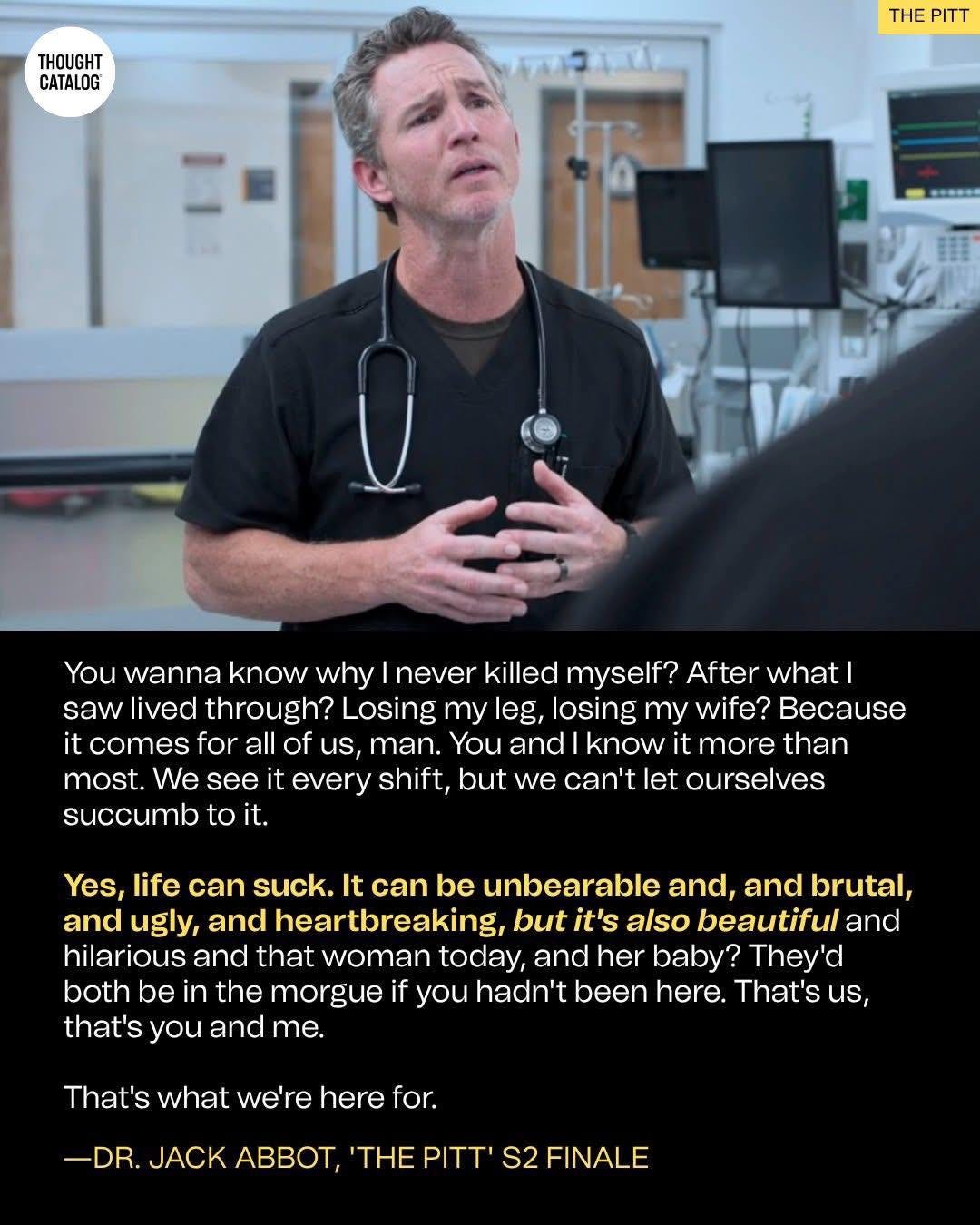
What they do not want is what trauma and emotional collapse often actually look like.
Which is annoying. Repetitive. Petty. Mean. Defensive. Shut down. Irrational. Exhausting. Sometimes selfish. Sometimes humiliating. Sometimes ugly in ways that are not especially cinematic.
That is where The Pitt comes in and starts flipping tables.
Robby is a great example of the kind of character audiences claim to want right up until they get him. People love to say they want realism. They want stories about burnout, mental health, grief, and the strain of institutional pressure. But then a character actually starts unraveling in a way that makes him worse to work with, worse to listen to, less patient, less generous, less emotionally coherent, more likely to let the pressure cooker of trauma explode and make it everyone else’s problem, and suddenly people are acting like the show has committed a moral crime by no longer making him easy to love.
But that is the point.
Robby is not compelling because he is secretly innocent underneath it all. He is compelling because the show lets deterioration look like deterioration. It does not turn him into a tragic little ceramic figurine arranged attractively in the window of prestige television. It lets him get harsher. It lets him get harder. It lets him become more difficult to defend. It lets his damage spill outward in ways that affect other people. And that is precisely what makes him feel human.
And no, saying that does not mean his behavior is fine. This is where people lose the plot in a way that makes me want to hand out helmets.
Understanding a character is not excusing them. Accepting that a person’s pain often looks petty and cruel from the outside is not saying that we have to just let people lash out with no accountability.
Recognizing that someone is behaving badly because they are in pain does not magically make the bad behavior disappear. The people around them still get hurt. The damage is still real. Accountability still matters. But if all we do is slap a label on the character and call the case closed, we are not doing criticism. We are doing moral filing. We are shoving a complicated human process into a little drawer so we do not have to think about it anymore.
And that is not just intellectually lazy. It is emotionally cowardly.
Because one of the hardest things fiction asks us to confront is the truth that people do not become inhuman the second they become unpleasant. Trauma does not transform someone into a separate species called Bad People. It turns them into wounded people who may wound others. It can make them smaller, pettier, colder, more defensive, more controlling, less generous. It can make them ugly before it makes them wiser.
That is not a bug in the human condition. That is part of it.
And, honestly, this is part of why I find these conversations so frustrating on a personal level too. I have dealt with my own mental health struggles, and one of the least glamorous truths about struggling is that it does not always make you a softer, more emotionally articulate version of yourself. Sometimes it makes you withdrawn. Sometimes it makes you sharp. Sometimes it makes you hard to be around. Sometimes it makes you feel like your own mind has become a hostile workplace run by incompetent management and one very mean supervisor. There is nothing noble about it in the moment. There is certainly nothing aesthetically pleasing about it. Sometimes it’s crying on the floor of the shower at 2am and sometimes it’s yelling abuse at someone just trying to help you, when you don’t feel particularly worthy of help.
One of the things I have had to learn, and keep learning, is that healing is not the same thing as being pretty. Growth is not always graceful. Becoming better does not always begin with a breakthrough and a tasteful string quartet in the background. Sometimes it begins in embarrassment. In defensiveness. In saying the wrong thing. In realizing you have been unfair. In recognizing, with immense irritation, that pain has made you smaller than you want to be.
That recognition matters. And I think stories matter partly because they let us practice it.
That is also why Santos matters so much here.
Because The Pitt does not just give us one difficult man falling apart. It gives us a difficult woman who does not go out of her way to make herself easy to digest. Santos is sharp, ambitious, defensive, abrasive, often right, sometimes unfair, and in absolutely no mood to package herself as lovable for the convenience of the audience. Which means the reaction to her tells us a great deal about how viewers actually process difficult characters, especially female ones.
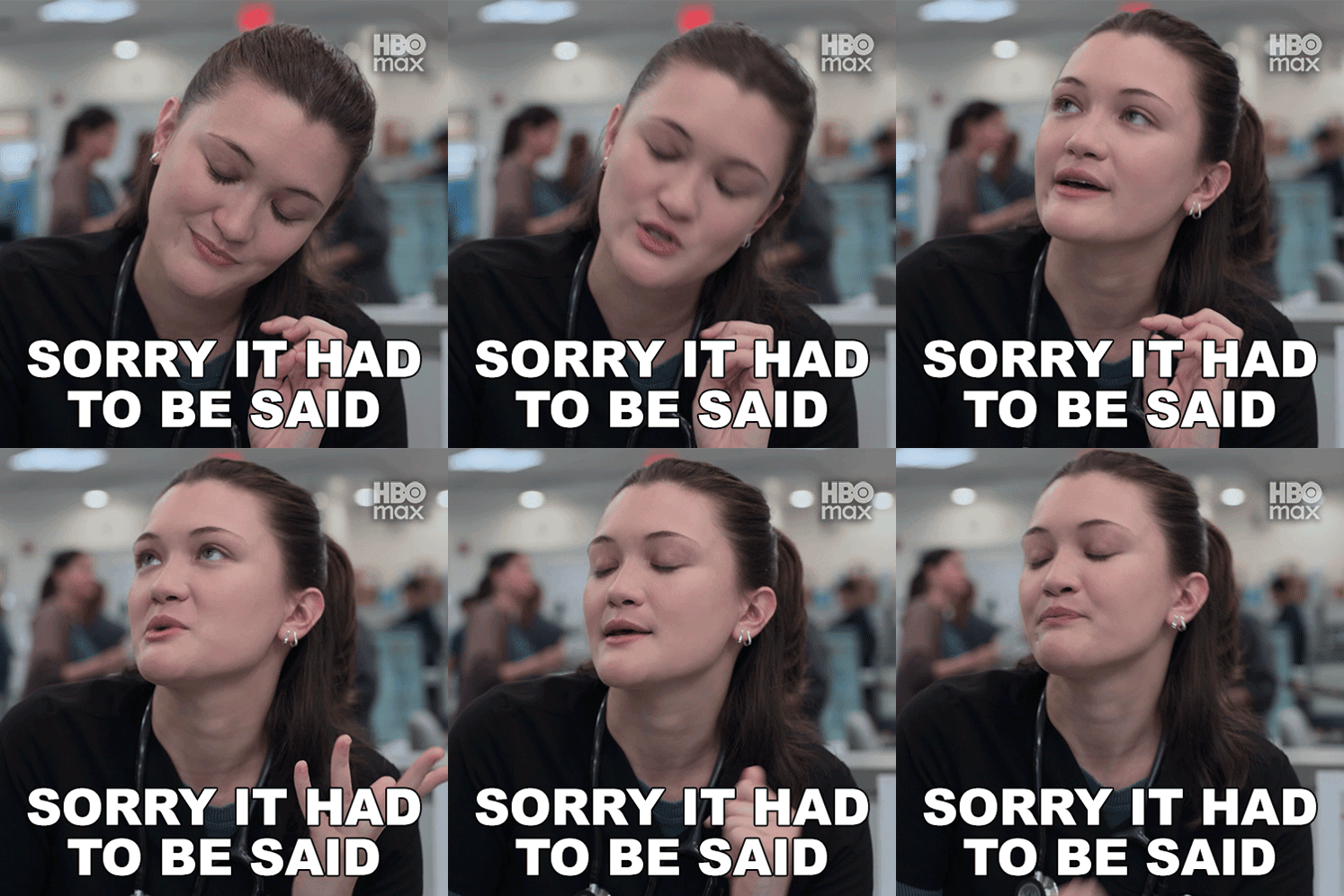
Because fandom does not just judge behavior. It judges who is allowed to behave badly without becoming narratively disposable.
Abrasive men are often read as complicated. Abrasive women are more likely to be read as unbearable. A difficult man gets analysis. A difficult woman gets a personality indictment. A man can be sharp-edged and still be treated as narratively substantial. A woman is often expected to earn complexity by first being likable enough to deserve it.
And if she does not? Suddenly everyone has a doctorate in why she is the worst.
Santos exposes that nonsense beautifully. She is not there to be easy. She is there to be human. Jaggedly, frustratingly, recognizably human. And the speed with which some viewers wanted to flatten her this season says a lot less about the writing than it does about the audience’s own tolerance for women who do not soften themselves into emotional customer service.
That is one of the reasons The Pitt works so well for me. It understands something I wish more viewers did: bad behavior is not the end of interpretation. It is often the beginning of it.
What interests me about Robby and Santos is not whether they behave badly. They do. What interests me is what that bad behavior reveals. About pressure. About gender. About institutional violence. About survival. About the stories people tell themselves when they are barely holding it together. About the way pain can become arrogance, control, harshness, withdrawal, or cruelty. About the very unsexy reality that damage does not always make people more profound. Sometimes it just makes them harder.
And if we cannot handle that in fiction, I am not convinced we are very serious about understanding it in life.
Because this is not just about television. It is about humanity. It is about whether we can tolerate the reality that people are capable of immense good and real harm, sometimes at once, sometimes in succession, sometimes in ways that make neat moral categories feel almost embarrassingly inadequate. It is about whether we can accept that ugliness is part of growth, part of trauma, part of healing, part of being alive among other flawed people.
We have become very attached to the fantasy that goodness is always aesthetically pleasing. It is not. Sometimes goodness is buried under grief, burnout, fear, pride, shame, or old wounds that have been left to fester too long. Sometimes healing starts in behavior that looks ugly before it looks noble. Sometimes the first step toward becoming better is not enlightenment. Sometimes it is the miserable realization that you have become someone you do not particularly enjoy meeting.
That is true in life. It should be true in fiction too.
And great stories have known this for a long time. BoJack Horseman refused to let damage become an excuse while also refusing to pretend damage was irrelevant. The Bear understands that trauma can be repetitive, controlling, joyless, and brutal to be around. Better Call Saul works because Jimmy McGill can never be reduced to either “good deep down” or “rotten all along” without flattening the whole tragic point. And Star Trek VI gives us one of the most jarring moments in Kirk’s history when grief hardens into prejudice and he spits out, “Let them die.”
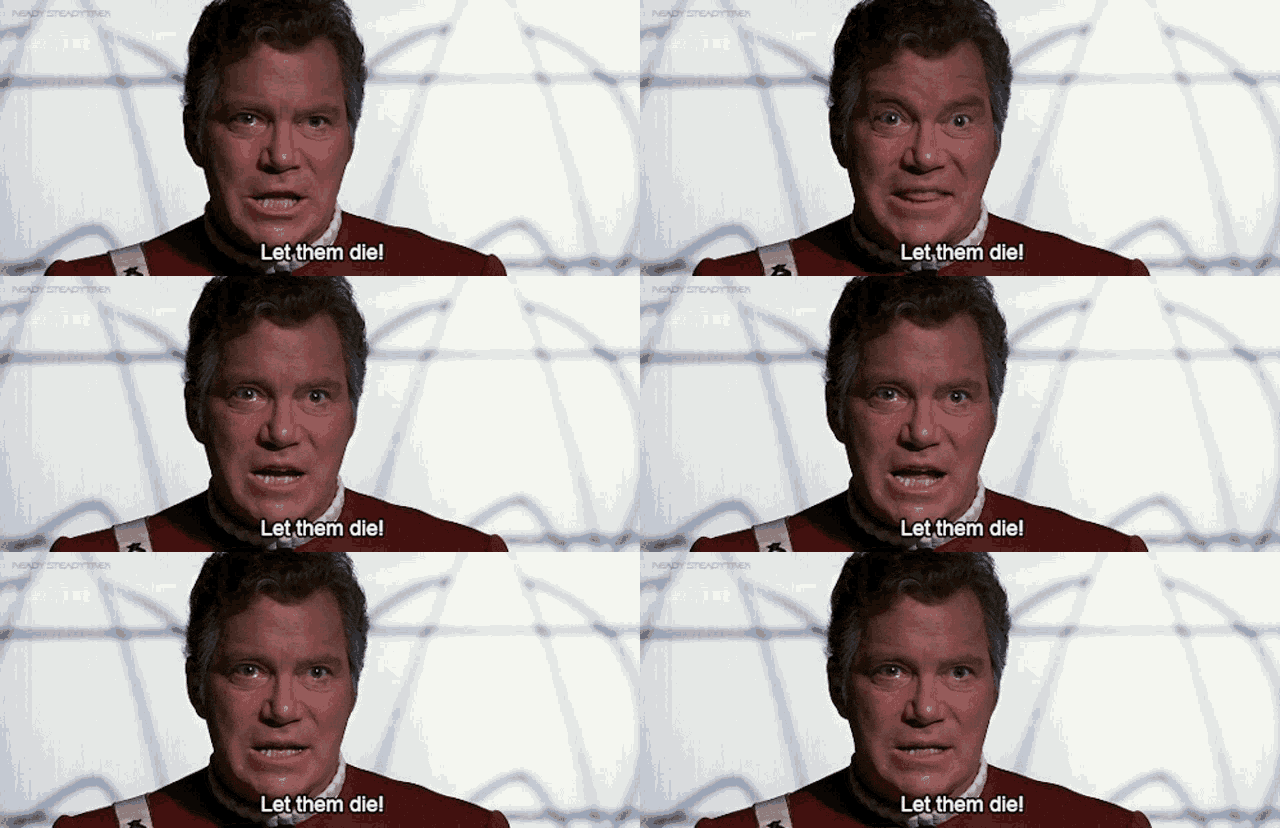
The film is not asking us to shrug and move on because he is hurting. It is asking us to confront the horrifyingly human truth that hurting people are still capable of becoming unjust, hateful, and small.
Not because they are monsters.
Because they are people.
That is the point. That is always the point.
To recognize ugliness in a character is not to absolve them. It is to refuse the comforting lie that harm only belongs to people unlike us. And to me, that is what stories like The Pitt are doing at their best. They are not asking for moral laziness. They are asking for moral seriousness and nuance. They are asking us to hold multiple truths at once.
This person is causing harm. This person is in pain. This person is not reducible to one thing. Accountability matters. Compassion matters. Recognition matters. None of these truths cancel the others out.
But that kind of reading takes work. It is much easier to throw a character away. It is much easier to declare them irredeemable and call that insight. It is much easier to confuse disposal with accountability and certainty with intelligence.
I do not think that makes us better readers. I think it makes us more frightened ones.
Because if every difficult person must be launched into the sea the moment they become hard to love, then we are not really engaging with human complexity at all. We are trying to protect ourselves from it.2 We are asking stories to reassure us that goodness is tidy, that badness is obvious, and that everyone can be sorted cleanly into categories that leave our own consciences sparkling.
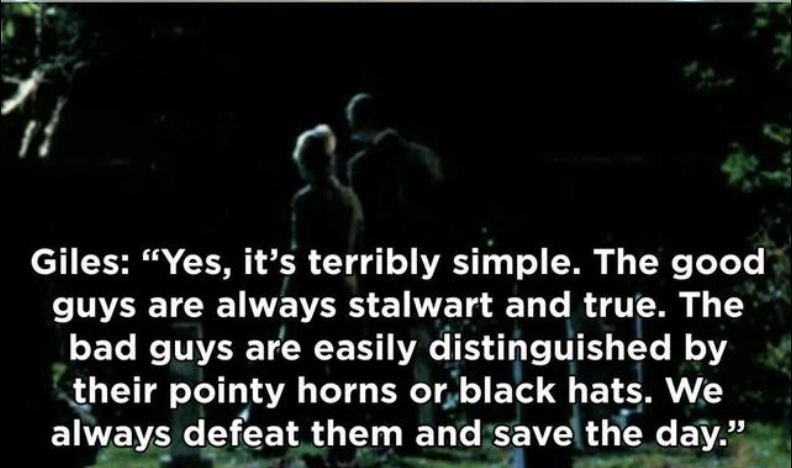
Real life, inconveniently, does not work that way.
Neither does trauma. Neither does healing. Neither does growth.
And thank God, neither do the best stories.
If The Pitt has anything to teach us, it is not that we should excuse human ugliness. It is that we should be honest enough to recognize it. In others. In ourselves. In the painful, unbeautiful work of becoming better. The point is not approval. The point is recognition. The point is that people under strain are rarely graceful, and that does not make them narratively worthless or humanly disposable.
It just makes them human.
And because it takes place over the course of 15 hours, while the viewers have the benefit of weeks to process, we are even less forgiving of the lack of a shortcut.
And worse, we are telling the people who fail to suffer beautifully enough and sympathetically enough that they can never earn forgiveness for the things they said or did at the worst points in their life. They are, we are saying, their worst day, their worst impulse, their worst moment of defensiveness and grief.
Enjoyed this. I read another post on here a couple days ago where the author scathingly rebuked Robby for his treatment of Mohan. They wrote him off as a misogynist among other things. It bothered me because it kind of sidestepped the fact that he was at the end of his rope emotionally. He’s suicidal and lashing out and isolating himself because that’s what people do when they are in that state. “Morally filing” is such a succinct way to phrase it. Good stuff
I love the Pitt. I love the characters & that they can be more than one thing. Abbott is my favorite but they’re all pretty great. I like getting frustrated or annoyed with them & surprised by them. It feels real. If that makes sense.