
You Always Wanted a Baby, Apparently
Dr. Oz, fertility panic, and the vintage gaslighting of compulsory motherhood

I hate it when my archival research for a course ends up still being relevant because sociopolitically we have not moved past nostalgia for 1950s gender roles and social norms apparently.
I recently finished a project on 1950s American pronatalism, medical authority, and advertising. It was one of those term-paper projects you finish, close the tabs on, and hope not to think about again until grades come in. I had done my little archival excavation. I had stared into the abyss of midcentury baby formula ads, medical guides, cigarette marketing, and hair dye campaigns. I had written my theory. I had made my point.
And then Dr. Oz said Americans are “under-babied.”
So here we are.
Oz used the term at a White House event to describe people who have no children or fewer children than they supposedly “would normally want,” while Robert F. Kennedy Jr. called declining fertility an “existential crisis.”
The phrase is absurd. The logic underneath it is not.
“Under-babied” assumes the desire first. It implies there is a correct number of babies people naturally want, and if they have fewer, something has gone wrong. Not with wages. Not with housing. Not with childcare. Not with healthcare. Not with abortion bans. Not with the fact that pregnancy in America can be expensive, dangerous, and politically policed.
No, the problem becomes the baby deficit.
My poster project was titled You Always Wanted a Baby! and its central argument was: medicine naturalized motherhood; capitalism monetized it. In 1950s America, pronatalism did not usually arrive as an open command. It moved through medical advice, psychological literature, women’s magazines, suburban aspiration, and advertising. It made motherhood feel natural, inevitable, emotionally fulfilling, medically correct, and conveniently available for purchase.
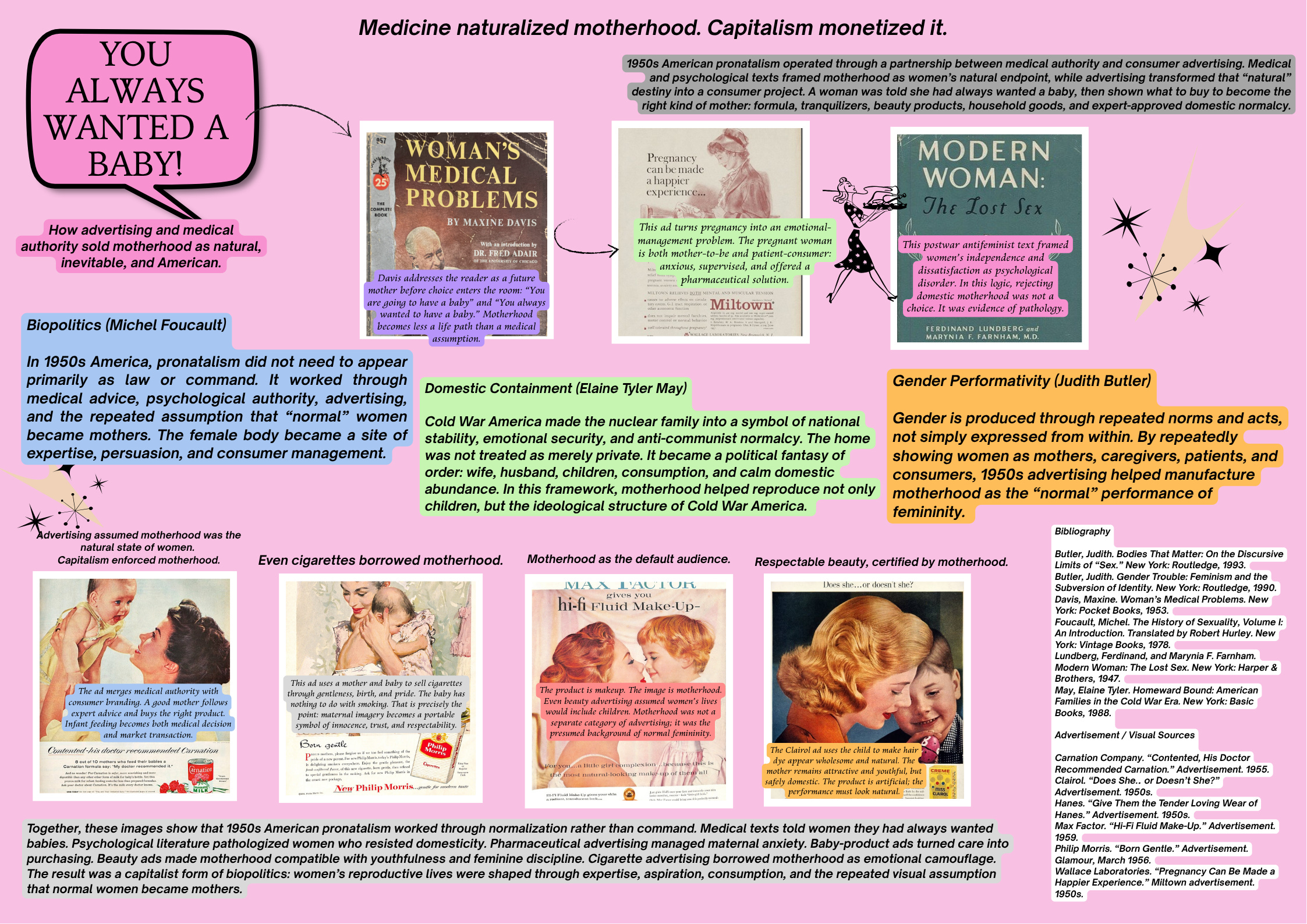
In Maxine Davis’s 1953 medical guide Woman’s Medical Problems, women are told, “You are going to have a baby” and “You always wanted to have a baby.” That is not neutral medical advice. That is an expert announcing women’s desires for them, then treating those desires as biological truth.
The 1950s were excellent at this. Medical texts told women they naturally wanted babies. Postwar psychological texts framed female independence as maladjustment. Advertisements assumed women were mothers even when selling lipstick, hair dye, tranquilizers, cigarettes, formula, and baby clothes.
Motherhood was not one category of advertising. It was the wallpaper of every woman’s life.
That was one of the stranger findings of the project. The ads did not simply sell to mothers. They sold through motherhood. A baby in a cigarette ad made cigarettes seem gentle. A child in a hair dye ad made artificial beauty look wholesome. A doctor-recommended formula ad turned a purchase into proof of good mothering. A tranquilizer ad promising pregnancy could be “a happier experience” turned maternal anxiety into a market.
The whole system said: of course you are a mother, and here is what to buy so you can do it correctly.
The theory behind the poster was not just “wow, these ads are unhinged,” although, to be clear, they are. I used Michel Foucault’s concept of biopolitics: the idea that modern power works through the management of life itself, including bodies, health, sexuality, reproduction, and population. Fertility panic fits neatly into that framework. It turns private reproductive decisions into public infrastructure. Suddenly, whether someone has a child is no longer only about desire, money, health, relationships, risk, or preference. It becomes a matter of national survival.
A birth rate is data. A “fertility crisis” is a political story about data, and that story usually ends up staring meaningfully at women’s bodies.
I also used Judith Butler’s theory of gender performativity, because repetition matters. Gender appears natural because the same script is staged again and again until it looks inevitable. In 1950s advertising, “normal womanhood” was repeatedly performed as maternal, attractive, domestic, calm, medically supervised, and constantly buying something. Eventually, the performance could be mistaken for instinct.
That is also what “under-babied” is doing. It treats reproduction as the normal script and non-reproduction as a deviation requiring explanation.
Elaine Tyler May called the Cold War version of this domestic containment: the nuclear family as a symbol of national security, moral order, and anti-communist stability. Mother in the kitchen, father at work, children in the yard, communism defeated by casserole. The modern fertility panic is not identical, but it rhymes. Once again, private reproductive life is being asked to solve public anxiety.
And some of the modern “support” is not exactly reassuring. Critics of the new Moms.gov website argue that it presents itself as a resource for pregnant women while directing users toward anti-abortion crisis pregnancy centers and omitting information on contraception, abortion access, and paid family leave. That is the vintage move in digital drag: call it help, narrow the options, then insist the script is natural.
People do need support if they want children. Fertility care matters. Maternal healthcare matters. Childcare, paid leave, safe pregnancy care, and family support matter. But support is not the same as pronatalist pressure.
A government serious about wanted children would start with autonomy and material conditions: affordable childcare, housing, healthcare, paid leave, reproductive freedom, maternity and paternity leave, and wages that do not require a GoFundMe to buy diapers.
Instead, fertility-crisis rhetoric often starts with the assumption that people are failing to reproduce enough.
That is the gaslight. It says: you wanted this. You always wanted this. You should do this for the good of society and because really suffering through poverty to have a child is what you wanted aall
In 1953, the medical guide said, “You always wanted to have a baby.” In 2026, Dr. Oz says Americans are “under-babied.” The phrasing has changed. The entitlement has not.
If a rich person is "worried" about something it generally means you're on the right track. When all of the rich people are 'worried' you know you are.
A woman’s JOB is to bear multiple children.
A man’s JOB is to abuse the hell out of them.
I watched my mom who had 6 children. I said “no thank you”. I know what children do not get coming from large religious families.
I have 3.