
The Waiting Room Is Everywhere
Ireland may be ending its three-day abortion waiting period. Unfortunately, the much older waiting period is still alive and well.

Ireland’s parliament has voted to remove the mandatory three-day waiting period before an abortion can take place. Supporters of the change have called the rule paternalistic and unnecessary. Opponents have framed it as a ‘safeguard’, because apparently the state is now a concerned aunt with a clipboard, hovering near the exam room door asking, “But have you really thought about it, sweetheart?”

On the surface, this sounds like a debate about seventy-two hours. Should someone seeking an abortion have to wait three days between requesting care and receiving it? Is that a reasonable pause? Is it a protective measure? Is it an obstacle? Is it one of those policies that pretends to be neutral while quietly doing the political equivalent of putting superglue on a doorknob?
But the waiting period is not really about time. It is about belief.
The assumption behind a mandatory waiting period is that a woman who requests an abortion today may not truly understand what she wants until three days from now. Her stated decision is treated as incomplete. Her certainty needs a probationary period. Her judgment must sit in the bureaucratic naughty chair until the state decides enough reflection has occurred. This is usually presented as compassion, but it is not compassion to assume that an adult patient has arrived at a medical appointment without ever once considering the implications of the thing she is there to do.
That is the insult hiding under the paperwork.
Because the history of women’s reproductive healthcare is, in many ways, the history of women not being believed about their own bodies. They are not believed when they say they are in pain. They are not believed when they say something is wrong. They are not believed when they say they do not want children. They are not believed when they say they want an abortion. They are not believed when they say pregnancy is dangerous, unwanted, unsustainable, or simply not the future they choose.
Again and again, the central question is not whether women know themselves. The central question is whether institutions are willing to believe them.
The three-day waiting period is not the whole story. It is a symptom. It is the policy rash that appears when a society has been infected for centuries with the idea that women are unreliable narrators of their own lives.
For most of Western history, women were treated as fundamentally suspect authorities on themselves. Under coverture, married women effectively ceased to exist as independent legal persons, which is quite an achievement if your goal is to make marriage function like a legal sinkhole with floral centerpieces. Women were denied access to higher education because they were supposedly too delicate for intellectual strain. They were excluded from voting because they were supposedly too emotional for political judgment. They were restricted in property ownership because they were supposedly incapable of managing their own affairs, despite being expected to manage households, children, kin networks, community obligations, social reputations, and every domestic crisis from “the baby has a fever” to “your father has decided feelings are for the French.”
The contradiction was not accidental. Patriarchy has always been very good at making women responsible for everything and authoritative about nothing. Women were expected to raise future citizens but not vote. They were expected to shape the moral character of the nation but not participate fully in public life. They were expected to bear children but not control reproduction. They were expected to understand everyone else’s needs while remaining strangely unqualified to interpret their own.
Medicine inherited that logic, added Latin, and called it science.
For centuries, women’s testimony was treated as suspect. Pain was minimized. Exhaustion was dismissed. Anger was pathologized. Dissatisfaction was medicalized. The diagnosis of hysteria became medicine’s junk drawer for women who were sad, angry, traumatized, sexually dissatisfied, politically inconvenient, resistant to domestic confinement, or just generally failing to perform womanhood with the required amount of lace-covered gratitude. A woman could say something was wrong. A doctor could decide the real problem was that she was a woman saying things.
Very tidy. Deeply stupid. Historically persistent.
The point was not merely that women were seen as fragile. It was that women were positioned as unreliable witnesses to their own bodies. A woman might feel pain, but someone else had to decide whether the pain was real. A woman might be unhappy, but someone else had to decide whether her unhappiness was justified. A woman might say she did not want children, but someone else had to interpret whether that desire was genuine, temporary, pathological, selfish, immature, or simply waiting to be cured by the mystical powers of a sufficiently persuasive man and a beige nursery.
That assumption never disappeared.
Today, it often arrives in the language of concern. We should make sure she understands. We should make sure she has thought about it. We should make sure she will not regret it. These statements sound reasonable until you notice how selectively they are applied. Patients make serious medical decisions every day. They consent to surgeries. They refuse treatments. They begin chemotherapy. They decline chemotherapy. They undergo procedures that alter their bodies permanently. Yet abortion attracts a special machinery of hesitation, as if pregnancy is the one medical condition where the patient’s own decision requires state-managed emotional marination.
That question did not emerge from nowhere. It has been rehearsed in law, medicine, religion, advertising, television, film, and family conversation for generations. Before a woman ever walks into a clinic, culture has already taught her what her body is for, what choices are acceptable, which emotions she is supposed to feel, and whether her own judgment is enough.
This is why reproductive healthcare is never just a medical issue. Healthcare begins long before a patient meets a doctor. Healthcare begins in culture.
Most people do not learn about reproductive healthcare from medical journals. They learn from television, movies, news coverage, social media, churches, schools, families, and the ambient misogyny fog machine we call “public discourse.” They learn from stories about what “good women” do. They learn from narratives in which motherhood is fulfillment, childfreedom is damage, abortion is tragedy, and a woman who says no to pregnancy must be either confused, traumatized, immature, selfish, or waiting for the plot to teach her better.
This is where popular culture matters. Not because television directly tells people what to think in some cartoonishly simple brainwashing machine where Shonda Rhimes pulls a lever and lawmakers fall out of the wall. Culture matters because it teaches people what feels normal. It gives politics its emotional vocabulary. It trains audiences in who deserves sympathy, who deserves suspicion, and whose certainty is allowed to count.
Take Cristina Yang on Grey’s Anatomy. Cristina is one of television’s clearest examples of a woman who knows she does not want children and is treated by those around her like this must be a temporary software glitch in the Motherhood Operating System. She does not say she is unsure. She does not say she may want children later. She does not say she is waiting for the right partner, the right age, the right home, or the right Instagrammable kitchen island around which to perform maternal fulfillment. She says, repeatedly and clearly, that she does not want to be a mother.1
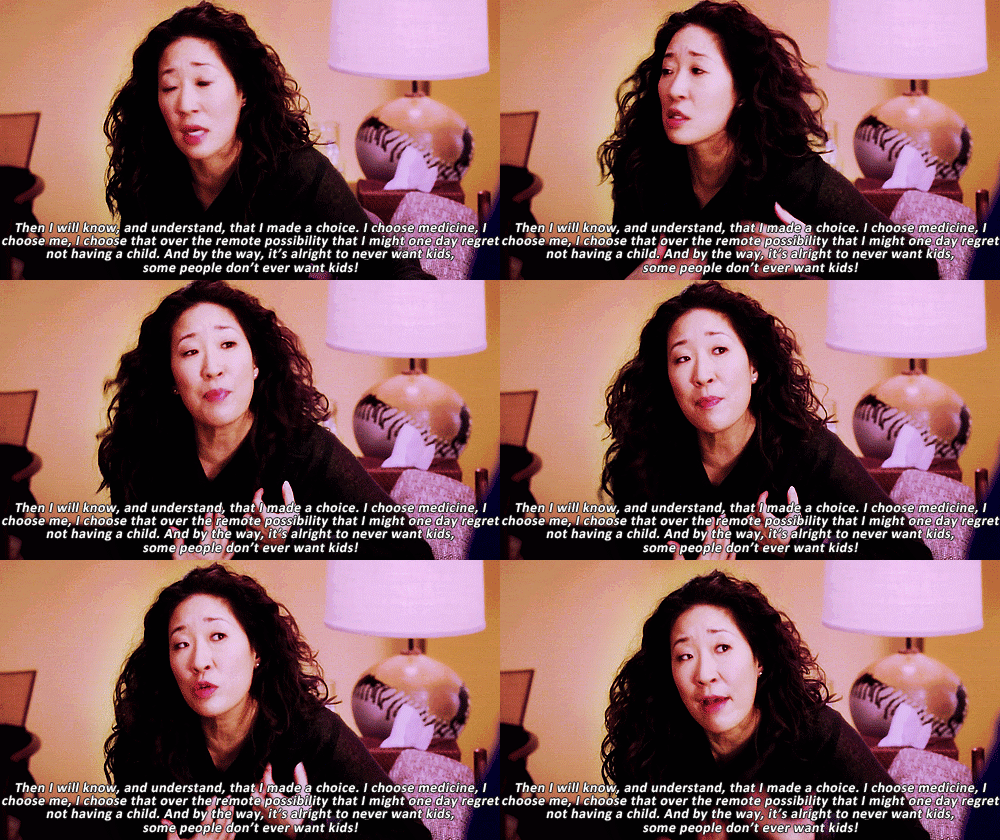
When Cristina becomes pregnant and chooses abortion, the conflict is not that she does not know her own mind. The conflict is that other people refuse to believe she knows her own mind. Owen tries to reinterpret her decision as fear rather than clarity. He suggests she is afraid she would not be a good mother, as if every woman who rejects motherhood is secretly trapped in an emotional escape room and just needs a man with enough confidence and absolutely no business being there to find the key. Cristina’s response is devastating because it names the thing everyone keeps refusing to hear: she knows she could love a child, but she does not want one. She does not want to be a mother.
That distinction matters. Cristina is not incapable of love. She is capable of self-knowledge. The scandal is not that Cristina has an abortion. The scandal is that Cristina does not repent of not wanting motherhood. She refuses the expected narrative arc in which the ambitious woman eventually discovers that babies were the missing ingredient in her sad little career casserole. Instead, she keeps saying what she has said all along: this is not the life she wants.
And that is apparently very upsetting to a culture that has spent centuries insisting that all women secretly want the same thing.

The fact that Cristina’s storyline felt unusual tells us quite a lot, because television has spent decades treating women who do not want children as either temporary anomalies or narrative problems awaiting repair. Even when childfree women appear, the story often cannot simply let them not want children in peace. In The Baby, Natasha’s reluctance around motherhood is refreshing at first, but even there the show gives her a damaged-childhood explanation, because apparently “I just don’t want kids” is still not enough of a character motivation unless we first take it through the prestige-TV trauma car wash. Seinfeld gives us Elaine pushing back against the endless “you gotta have a baby” chorus, only to have her reconsider when a man she is dating gets a vasectomy, because even sitcoms about nothing somehow find time to ask whether a woman’s reproductive choices are really final. Ally McBeal turns this into full narrative clown shoes: Ally spends years embodying the anxious single-career-woman question, complete with the infamous dancing baby hallucination,2 and then the show eventually has a child appear at her door thanks to an egg-bank mix-up, because heaven forbid a woman end the series with only a law career, friends, and unresolved emotional issues like a normal television man.
Succession gives Shiv a more modern version of the trap: she is ambivalent, aware that motherhood would collide with career, marriage, power, and family dysfunction, yet even her refusal gets treated as unstable once her mother tells her some women are not meant to be mothers. Suddenly motherhood becomes defiance, because apparently the only thing more powerful than patriarchy is a mother making one emotionally devastating comment over lunch.
The pattern is exhausting. Not wanting children cannot simply be a preference. It has to be a wound, a phase, a panic response, a symptom, a joke, a challenge, or a narrative error that the writers eventually try to correct by dropping a baby into the plot like a moral at the end of an episode of He-Man.

That is the cultural soil in which abortion waiting periods grow. If culture repeatedly teaches that women who say they do not want children are probably confused, damaged, selfish, or not yet in possession of the full truth about themselves, then a mandatory waiting period starts to look less like an intrusion and more like common sense. After all, if women are always about three days away from discovering their “real” maternal instincts, why not make them wait? Maybe on day two the uterus will release a tiny statement clarifying its position.
The same logic appears in a different form in the Grey’s Anatomy episode “(Don’t Fear) the Reaper,” where Miranda Bailey, an actual surgeon and chief of surgery, walks into another hospital and says she is having a heart attack. Bailey is not a random person misreading WebMD at two in the morning after googling “weird chest feeling, am I dead?”3 She is a doctor. She knows the symptoms. She knows that heart attacks can present differently in women. She asks for appropriate testing. She tells them what is happening in her own body.
And still, she is dismissed.
The doctors at Seattle Presbyterian minimize her concerns, focus on stress, and eventually send in a psychiatrist. This is where the episode becomes less “medical drama” and more “documentary with better lighting.” Bailey knows exactly what is happening to her body, but her knowledge is treated as anxiety until her body performs the only argument some medical systems seem willing to accept from women: a full-scale crisis. Only after she worsens is the heart attack confirmed and treated.
That episode is so effective because the point is not subtle. If Miranda Bailey, a doctor, a surgeon, a chief, a woman who has spent years saving lives with the confidence of a battle axe in Crocs, can be treated as an unreliable witness to her own body, what exactly is supposed to happen to everyone else?
The answer, historically speaking, is: exactly what you think.
Women say they are in pain. Women say something is wrong. Women say their symptoms do not feel normal. And too often they are told it is stress, anxiety, hormones, weight, age, motherhood, not motherhood, their period, perimenopause, depression, or that thrilling diagnostic category known as “have you considered being less difficult?” The details change, but the structure remains the same. Women’s bodily knowledge is provisional until someone with more authority confirms it.
Now bring that back to abortion. The logic of the waiting period is not separate from the logic of the doctor dismissing Bailey’s heart attack. It is the same logic in a different lab coat. Bailey says, “Something is wrong with my body,” and the institution says, “Are you sure?” A woman seeking abortion says, “I do not want to continue this pregnancy,” and the state says, “Are you sure?” Cristina says, “I do not want to be a mother,” and the culture says, “Are you sure?” The repeated question is not a neutral request for clarification. It is a system of delay, doubt, and control.
And then there is the “good girls avoid abortion” problem, one of those pop culture tropes so common it practically deserves its own waiting room magazine. The sympathetic woman may consider abortion. She may schedule an appointment. She may cry, agonize, pace, stare at a phone, touch her stomach, or look soulfully out a rain-streaked window. But if she is meant to remain morally legible to a broad audience, the story often prevents her from actually having one. She miscarries. She changes her mind. The pregnancy becomes medically impossible. The father suddenly becomes less of a collection of red flag in a trenchcoat. The baby becomes a sign of growth. The future magically rearranges itself into something workable because the plot has apparently found childcare, healthcare, rent money, paid leave, emotional support, and a reliable partner in the back of a wardrobe.
This is not just storytelling convenience. It is cultural training.
The “good woman” is permitted to be overwhelmed by pregnancy, but not to reject motherhood with clarity. She can be frightened, but not firm. She can be conflicted, but not certain. She can walk up to the abortion storyline, tap on the glass, and consider entering, but the narrative frequently grabs her by the shoulders and redirects her toward the motherhood exit before she does something the audience might not forgive. The story reassures viewers that a good woman may think she wants an abortion, but if given enough time, enough pressure, or enough plot manipulation, she will discover that she does not.
Again, notice how close this is to the logic of waiting periods. The woman says she wants an abortion. The law says wait. The trope says wait. The culture says wait. Maybe you will change your mind. Maybe you are scared. Maybe you are confused. Maybe you are not really the kind of woman who does this. Maybe your future self, the one we have invented for you and dressed in soft-focus maternal lighting, knows better than you do.
This is why the waiting period is so revealing. It is not merely an administrative hurdle. It is the bureaucratic version of a story we have been telling about women for centuries. It takes the cultural assumption that women are unreliable authorities on their own bodies and turns it into policy.
The more you look at these examples together, the clearer the pattern becomes. Cristina Yang says she does not want children and is treated as though she must be wrong about her own desires. Miranda Bailey says she is having a heart attack and is treated as though she must be wrong about her own body. The “good girls avoid abortion” pattern says women may believe they want to end a pregnancy, but a good narrative will reveal that they were wrong about their own decision before the credits roll.
The shared assumption is that women require verification. Their pain requires verification. Their symptoms require verification. Their desires require verification. Their reproductive decisions require verification. Their “no” requires verification. Their “yes” requires verification. Their certainty is never quite finished until someone else signs off on it.
And that is the real issue with mandatory waiting periods. They do not simply delay care. They formalize doubt. They take suspicion already embedded in culture and give it an appointment slot.
By the time someone walks into a clinic, she is not arriving as a blank slate. She is arriving after years of cultural messaging about motherhood, regret, femininity, credibility, pain, sacrifice, and what “good women” are supposed to do. She is arriving from a world that has repeatedly told her women often misunderstand themselves. The waiting period then repeats that lesson in the language of law: maybe you do not know yet. Maybe you need more time. Maybe the state should help you think.
But women have been thinking.
Women think before they miss a period. They think when they take the test. They think when they calculate rent, childcare, medical bills, work schedules, existing children, relationships, safety, health, dreams, risks, and what kind of life they can actually survive. The idea that reflection begins only once the state starts the clock is insulting. It is also revealing. The waiting period is not designed around women’s reality. It is designed around institutional disbelief.
Ireland may soon remove its mandatory three-day abortion waiting period, and that matters. It matters because barriers to care matter. It matters because delays matter. It matters because reproductive autonomy should not be treated like a customer service return window for a defective toaster.
But removing the legal waiting period does not automatically remove the cultural one.
The cultural waiting period is the one women enter the moment they say something inconvenient about their own bodies. I am in pain. I do not want children. I want an abortion. I want contraception. I want sterilization. I know something is wrong. I know what I want. I know what I can handle. I know what I cannot.
And then comes the response, sometimes from doctors, sometimes from husbands, sometimes from lawmakers, sometimes from television writers, sometimes from the comments section, that glorious haunted hayride of unsolicited male expertise:
Are you sure?
The legal waiting period may only last seventy-two hours.
The cultural waiting period has been running for centuries.
And frankly, it should have been discharged from care a long time ago.
To the credit of Grey’s Anatomy they never reversed that decision. She’s a fascinating example of the exception that proves the rule in most media.
I WISH I WAS JOKING. The look on her face when she sees the baby is the look on ALL OUR FACES.

Don’t look at my WebMD history.
I will be sharing this with so many friends of all ages. Beautifully written and argued. Dr Bailey's experience reminded me of Serena Williams' experience after giving birth. She had spent her life shaping her body into a well honed machine, yet doctors did not listen when she said something felt wrong. There I think we see the intersectional experience of being Black and female in Western society.
Thank you for writing this.
Preach.
I’m a male. An Ob/Gyn. And I live this every day of my professional life.
There are so many delicious pull-quotes in this piece that I would love to hang in every public space I can! But I’ll just confirm this one publicly:
“They were expected to understand everyone else’s needs while remaining strangely unqualified to interpret their own.
Medicine inherited that logic, added Latin, and called it science.”
Yup. This right here.
We’ve (medicine) come a long way. But there are many miles to travel yet.
Keep screaming it from the mountain tops.