
"Where Are the Potatoes?" The Gender Politics of “Helping”

You are getting an article this week, because I didn’t have time to finish recording the podcast. Enjoy my rambling on an event on TikTok from 2024. You’ll be getting the podcast episode on the Combahee River Collective next Sunday.
Grocerygate 2024 was not, technically speaking, about groceries.
It started with a man making a TikTok video about how angry he was that his wife sent him to the grocery store with a list, then didn’t answer the phone to when he called to get information about the list. From what I recall, he specifically mentions something about wanting to ask her where certain items were in the store.
He wanted to call her to ask where basic things were. Potatoes. Staples. The kinds of foods that appear in the average household with the reliability of taxes and seasonal depression. And because she wasn’t on standby to serve as his remote-control domestic operating system, he acted like he was the victim of a great injustice.
Which is impressive, honestly. To stand in a building full of labeled aisles with employees paid to assist you and still decide the real problem is that a woman somewhere else failed to provide customer support.
But that is exactly what Grocerygate exposes: not “men are bad at shopping,” but men are frequently absent from the day-to-day domestic systems that make a household run. So when they do show up, they experience basic household maintenance as confusing, optional, and deeply inconvenient. And they often solve that confusion by outsourcing the thinking back to the woman who already carries it.
So sure, it’s potatoes. But it’s also the entire goddamn infrastructure of domestic life.
“Helping” is not the same as “Owning”
Let’s begin with the key concept that saves lives and relationships:
Helping is doing a task when asked.
Owning is being responsible for the task from start to finish, including all the thinking that makes it possible.
Helping is:
“I can go to the store if you tell me what to get.”
“Just text me the list.”
“I’m at the store. What kind of milk do we buy again?”
“They’re out of the thing. What do I do?”
Owning is:
noticing the kitchen is low on basics without being told
keeping a running list because you are a member of the household, not an intern
knowing what meals are planned, what ingredients that requires, and what substitutions make sense
making a decision when the store is out of something without calling the household manager like you’re stuck in an escape room
The Grocerygate guy wanted credit for the physical act of shopping while still demanding his partner do the cognitive work in real time. That’s not help. That’s outsourcing the job while still holding the title.
It’s like offering to “help” someone move by showing up empty-handed and asking for an assignment for each box they carry.1
The part that breaks women: the mental load
Here’s the dirty secret about domestic labor: the exhausting part is not always the task itself.
The exhausting part is the fact that the tasks are infinite, time-sensitive, and mentally sticky.
Groceries aren’t one chore. Groceries are a chain reaction:
tracking what’s in the house
predicting what will run out
planning meals
factoring in work schedules, kids’ schedules, dietary needs, budget, and what people will actually eat
writing and updating lists
making substitutions when the store is out of something
remembering which brand doesn’t give someone heartburn or an allergic reaction
managing the consequences when something important doesn’t get bought
When men “help” by going to the grocery store but call their partner every five minutes, they’re essentially saying: I will move through space and time, but you will remain responsible for all decisions, quality control, and outcomes.
And women know this, because if he comes home with the wrong stuff, the consequence doesn’t land on him. The consequence lands on the person who has to feed everyone tomorrow. Which is usually her.
So she answers. She monitors. She manages. She problem-solves. From a distance. While doing her own job. Or caring for children. Or, you know, trying to have a single uninterrupted thought in her own life.
That’s not “shared domestic labor.” That’s a man performing the visible errand while the woman continues running the household from behind the curtain like an exhausted wizard.
Why are women’s chores daily and men’s chores occasional?
There’s a pattern here that’s so consistent it might as well be in the terms and conditions of heterosexual adulthood.
The chores we culturally code as “women’s work” tend to be the ones that are relentless. They happen every day, sometimes multiple times a day. They’re time-sensitive. They’re hard to postpone without consequences. And when they don’t get done, the fallout is immediate and personal. People don’t say “Wow, the household systems are failing.” They say “She’s letting herself go,” or “She can’t keep a home,” or “What does she even do all day?”
These are the tasks that sit directly on top of care: feeding people, cleaning up after them, keeping children alive and functional, tracking what the house needs, making sure everyone has what they need when they need it. It’s not just labor. It’s maintenance of human life, and it comes with a built-in moral judgment if you ever stop.
The chores we code as “men’s work,” by contrast, are often the ones that are optional in practice even if they’re necessary in theory. They’re episodic. They’re visible. They’re easy to delay. They tend to be praised as “helping” even when they are basic adult responsibilities. And, crucially, they’re often external to the home: the car, the lawn, the repairs. These tasks happen weekly or monthly, not constantly. And if they don’t happen right away, the household doesn’t immediately implode into chaos and Cheerios.
That difference matters. A lot.
Because the minute you remove the car and the lawn from the equation, the imbalance becomes impossible to ignore.
Put a couple in a city apartment. No yard. No mower. No garage. Maybe they don’t even own a car. Suddenly a whole category of “men’s chores” evaporates. So what happens next?
Do men step up and absorb the daily, repetitive work inside the home?
Historically: no.
What often happens instead is that women keep doing the same nonstop domestic work while men’s share quietly disappears. Like fog. Like mist. Like a suburban dad walking away from an empty gas can the second someone suggests he learn where the fucking potatoes are.
And then we get the greatest hits.
“But I take out the trash.”
“But I mowed the lawn.”
“But I fixed that thing once.”
“Congratulations, do you want a fucking medal,” says the exhausted woman washing her second load of laundry for the day, because both kids have a stomach flu and her mother-in-law is coming to visit next week.
WWII to now: how this became “normal”
Grocerygate is not a random personality flaw. It’s not “men these days.” It’s not “kids don’t learn life skills anymore.” It is the latest flare-up in a long postwar Western project: domesticity as women’s natural domain, packaged as tradition, and sold like a product.
During WWII, women entered paid work at massive scale in many Western countries because the state needed labor. The message was basically: You can do anything. Put on the uniform. Pick up the tools. We have a war to win.
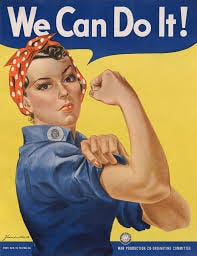
Then the war ended, soldiers came home, and the message did a hard pivot into: Actually, no. Now you should do the laundry and smile about it. We need stability. We need babies. We need the economy to hum. And we need you back in the kitchen so men can return to being men without competition.
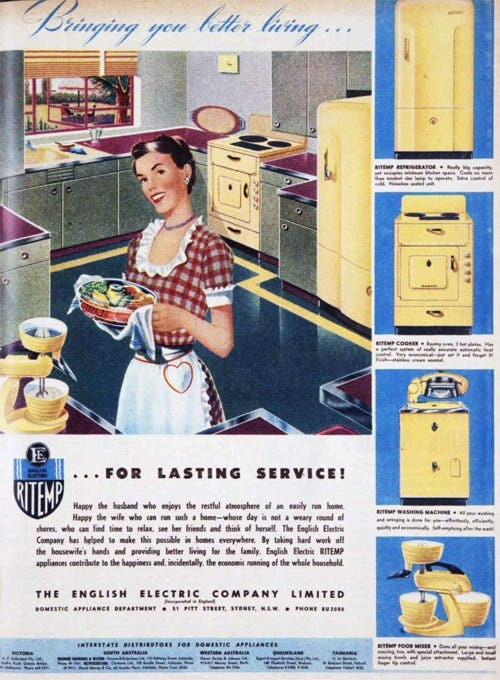
This wasn’t simply a “return” to older gender roles, like we all accidentally wandered back into the 19th century. Postwar domesticity was manufactured, professionalized, and marketed. Consumer capitalism and state priorities aligned perfectly: women as household managers meant a stable family unit as social policy, a steady domestic consumer buying appliances and food products and cleaning supplies, and a cultural script where women’s unpaid labor quietly propped up everyone else’s paid labor.
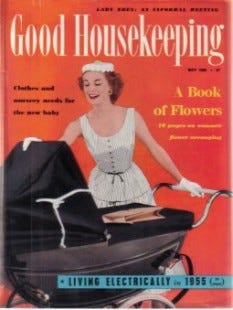
Mass media helped seal it. The home became not just a place, but a moral identity. The “good woman” wasn’t just someone who lived there. She was someone who kept it running smoothly, quietly, constantly, and without asking anyone else to participate too much—because participation would imply the work is real.
And here’s the trick: if domestic labor is treated like a real job, then someone has to be accountable for it. If it’s treated like women’s natural essence, then men can opt out without guilt.
Fast forward through the second half of the twentieth century: women enter paid work in higher numbers. Careers become necessary, not optional. Wages stagnate. Households need two incomes.2 But the domestic expectation doesn’t dissolve.
It stacks.
The result is what a lot of women live now: a double day. Work. Then home. Then the cognitive management of everything that keeps the home functional. Then, for fun, being told to “communicate your needs better.”
Sure. Let me just schedule a meeting with my nervous system.
The “bumbling husband” trope has done real damage
One reason Grocerygate felt so instantly recognizable is because popular culture has been normalizing male domestic incompetence for decades.
Sitcom dads who can’t cook. Commercials where men destroy laundry like it’s a performance art piece. Husbands who treat childcare like a volunteer opportunity. The joke is always the same: “Isn’t it funny that he’s useless in the home?”
But that joke has consequences, because it teaches everyone what to expect.
Women are expected to be competent by default. Men are expected to be domestically incompetent and get credit for effort alone. The domestic sphere is framed as women’s territory, so men can claim ignorance like it’s a get out of jail free card.
A man who doesn’t know where the potatoes are is not a tragic figure. He is a grown adult who has outsourced basic household knowledge to a partner and then resents her when she isn’t available.
It’s not cute. It’s not quirky. It’s a labor arrangement.
Is it weaponized incompetence?
Sometimes.
Sometimes it’s deliberate: perform incompetence, create frustration, get excused from the task forever. If every grocery trip becomes a disaster unless she micromanages it, eventually she stops delegating. And the man gets what he wanted all along: the task returns to her because it’s “easier” if she just does it herself.
Sometimes it’s not deliberate, but the effect is the same. He’s unfamiliar because he hasn’t participated consistently. And instead of treating unfamiliarity as a skill gap to solve, he treats it as proof the task isn’t his problem.
Either way, the outcome is consistent:
She remains responsible.
He remains optional.
And “help” becomes another job she has to manage.
The real tell in Grocerygate wasn’t confusion. Confusion is solvable.
The tell was the anger. The entitlement. The belief that her availability was part of the grocery process. The belief that his discomfort was her fault.
That is not incompetence. That is a worldview.
Intersectionality: whose labor gets ignored, outsourced, or punished
It’s also worth saying plainly: the household labor gap isn’t one neat, universal experience. It’s shaped by race, class, disability, immigration status, sexuality, and access to resources.
Some women can outsource parts of domestic labor through paid childcare, cleaners, meal services, or flexible work. Many cannot. In wealthier households, the domestic burden often gets shifted onto paid workers, frequently women, often women of color whore are underpaid, whose labor is treated as “help” instead of skilled, exhausting work.
Disabled people and chronically ill people navigate domestic labor with extra barriers, and “help” becomes even more loaded when it comes with control, resentment, or conditionality. Single parents don’t get to pretend the grocery store is a wilderness. They learn. They do it. Because it has to be done.
Same-sex couples may negotiate domestic labor differently, but they’re not automatically immune to gender scripts. Those scripts leak into behavior because we live in a culture that teaches all of us what “women do” and what “men do,” and then calls it biology when we repeat it.
The point is: domestic inequality isn’t only about “men vs women.” It’s about how care work is undervalued, feminized, and treated as an infinite resource that just… appears.
Like potatoes.
What “doing better” actually looks like
“Do better” does not mean offering to help when asked. It does not mean doing a task while requiring constant supervision. It does not mean expecting applause for participating in your own household. And it definitely does not mean treating your partner like a manager instead of a co-owner.
Doing better means ownership.
Ownership means you don’t just execute the task. You carry the responsibility for it. You hold the knowledge. You make the decisions. You handle the consequences. You don’t need a woman on speakerphone to complete basic adult functioning.
Grocery ownership looks like this:
You know the staples your household eats without calling anyone. You maintain a running list, not because you are a hero, but because you have eyes. You can make substitutions without contacting your partner like she’s grocery GPS. You complete the task start to finish, including putting things away. You notice what’s missing next time without needing a performance review.
Household ownership, broadly, looks like this:
You take responsibility for a category of work and you carry it consistently. You don’t treat domestic tasks like “requests” your partner makes; you treat them like reality. You stop framing your participation as doing a favor or “helping out.” You stop asking for instructions you could solve with five minutes of adult thought.
Here’s the simplest rule:
If the task collapses when she’s unavailable, she owns it.
And if you need to call your wife to find potatoes, I promise you this: the grocery store is not confusing. You are just new to the job you’ve been letting her do alone.
Welcome. The benefits are terrible. The hours are endless. And yes, you are expected to learn where things are.
That’s just adulthood.
My oldest sibling did this to me when I was moving once. I eventually told them to get the fuck out or start actually helping. To no one’s surprise, they left.
Arguably, if you were a white, middle-class family in the 1950s, dual income was more the rule than the exception. The concept of women of color being stay at home wives and mothers was still incredibly rare.
I have a keeper husband, one of the “good ones” but the shift from a full time career to sahm changed the dynamic and respect he had for my time when I was the top earner in the household.
We made a list of what it would cost to cover my workload in case I were to suddenly be absent (take a job or sudden illness, etc). We included all of the daily things I do and the things I brought to the relationship that make life less expensive for us(mower, power tools etc) that he would have to buy/ pay someone to do for him. I told him to cross off anything he would be willing to absorb into his own chore list in addition to a full time job(grocery shopping/ laundry, etc).
I asked him to price each task based on local prices so he felt it was fair. When he handed me the list he looked a little pale.
I got the impression this exercise was an eye opener for him. To replace the role of the mother/wife/ workhorse I have assumed since having children it would take his entire salary and then some. The dynamic has shifted since we did this exercise and he recognized the monetary value of my menial daily tasks.
I exercised my “option” by divorcing the useless man child who was adept at all the ploys mentioned in this article to not have to help or contribute.
Being married was fcking exhausting! Especially when you’re the only one doing everything, including trying to hold the marriage together. It wasn’t worth the effort. Eighteen years was a prison sentence of slave labor.
My workload was immediately reduced by 95% and I only had to manage my life. Blissfull!
As a friend said, that was 170 pounds I could afford to lose.