


People love to say “chivalry is dead.”
In this episode, we pull apart what “chivalry” actually is—and why it keeps coming back every time gender roles get uncomfortable. Because chivalry was never just about manners. It was a system. A story that turned hierarchy into romance, control into care, and women’s safety into something conditional.
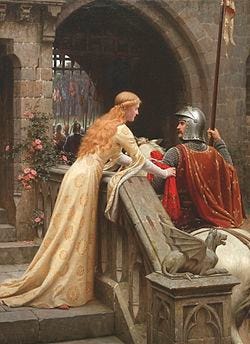
We start in the present, where “chivalry is dead” gets used to complain about modern dating, workplace dynamics, and public etiquette. Then we go back to the medieval world where chivalry was invented—not as a spontaneous outbreak of honor, but as a branding strategy for a violent elite. Knights weren’t made respectable by kindness. They were made respectable by stories.
Those stories mattered. They taught men how to perform virtue and taught women how to embody honor. Women were elevated, praised, “served”—and turned into symbols that carried male reputation. And once honor lives in women’s bodies, women’s behavior becomes something to police.
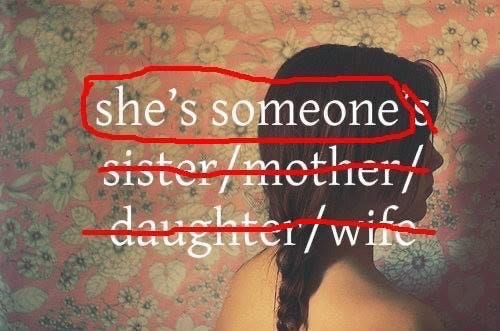
From courtly love and tournaments to guardianship law and legal standing, this episode traces how “protection” worked in practice. Not as freedom, but as supervision. Not as safety, but as management. We look at medieval legal structures where women couldn’t even bring criminal complaints in their own name—and why that logic still echoes today.
Because once protection is something men give women, it can also be taken away.

Welcome to Arc Three: Pretty Cages—where admiration builds the bars, and the cage looks like love.
Resources & Additional Reading
Medieval Chivalry, Law, and Gender
Nigel Saul, Chivalry in Medieval England
A foundational study of chivalry as a cultural system shaped by aristocratic performance, ritual, and power—not just battlefield behavior.
Geoffroi de Charny, Livre de Chevalerie
A primary text outlining knightly ideals, emphasizing prowess, honor, and disciplined violence.
Ramon Llull, Libre del ordre de cavalleria
A didactic work defining what knighthood should be, illustrating how chivalry was constructed and taught.
Anonymous, Ordene de chevalerie
A romance that dramatizes chivalric ritual and ideology through instruction and performance.
Jean Charles Léonard de Sismondi, History of the Italian Republics
A classic critique warning against confusing romantic chivalry with the brutal realities of feudal life.
David Herlihy, Women, Family, and Society in Medieval Europe
Essential for understanding women’s roles in households, property transmission, and family structure—and the limits of their autonomy.
Medieval Law & Guardianship
Edict of Rothari (Lombard Law, 7th century)
A key legal text illustrating lifelong guardianship (mundium) and the absence of legal autonomy for free women.
Oxford Academic entries on Lombard Law and mundium
Clear summaries of how “protection” functioned as permanent supervision in early medieval legal systems.
Modern Theory & Cultural Analysis
Peter Glick & Susan Fiske, “Ambivalent Sexism”
Foundational research on hostile vs. benevolent sexism, including “protective paternalism.”
Film & Popular Media
The Last Duel, dir. Ridley Scott
A dramatization of the 1386 rape trial of Marguerite de Carrouges, illustrating how women’s legal standing—and even survival—was mediated through male authority.


