


Matilda Joslyn Gage should be one of the most recognizable names in the history of American women’s rights. Instead, she’s often treated like an optional footnote.
In this arc finale, we take Gage seriously on her own terms: not just as a suffrage leader, but as a political thinker and historian who refused to make women’s freedom small or respectable. Gage didn’t want the vote as a polite reform. She wanted structural change — especially an end to the church–state logic that had justified women’s subordination for centuries.
This episode focuses on Gage’s work, including Woman, Church & State and Woman as Inventor, where she argues that women’s oppression is not natural but institutional, maintained through law, culture, and memory. Her most famous insight — reading “witches” as women — becomes a way to understand how societies label, punish, and erase women who step out of line.
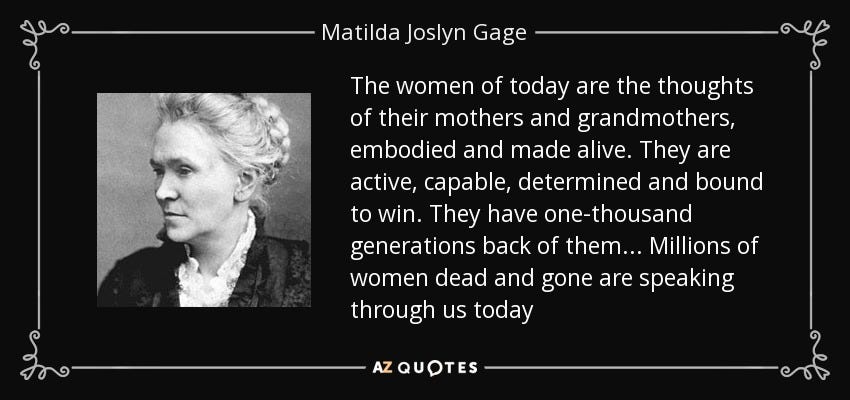
We also look at how Gage was treated by her own movement as suffrage politics shifted toward respectability and religious alliances. Her punishment wasn’t dramatic expulsion, but something quieter: sidelining, distancing, and eventual omission.
Gage is the capstone of this arc not just because she fits the pattern, but because she explains it. She didn’t only challenge power — she taught us how to recognize it.
Resources & Recommended Reading
Primary sources by Matilda Joslyn Gage
Matilda Joslyn Gage, Woman, Church & State (1893). Project Gutenberg edition.
Matilda Joslyn Gage, “Woman as an Inventor” (1883). Originally published in The North American Review (Vol. 136).
Matilda Joslyn Gage (with Stanton & Anthony), History of Woman Suffrage (Volumes I–III). She’s not just “in” this history, she helped make the archive that later minimized her.
Essential scholarship on Gage and her “erasure”
Margaret W. Rossiter, “The Matthew/Matilda Effect in Science” (1993). Foundational piece naming the recognition bias that under-credits women and credits their work away; Rossiter explicitly names the phenomenon after Gage.
Gage as archivist and witness
Peter Svenson (ed.), The “War Scrap Book” of Matilda Joslyn Gage: Witness to Rebellion (Lehigh University Press, 2018). Publisher page describing the scrapbook project and its framing of Gage as a historical witness.


