


Every few years, the Girl Scouts accidentally start a culture war.
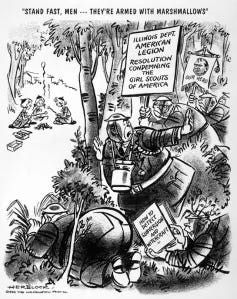
You’d think an organization best known for cookies and camping would be safely boring. Instead, they keep ending up at the center of national freakouts: heavy metal lawsuits over Thin Mints, boycotts over “woke” cookies, outrage over letting trans girls join, hand-wringing because some troops show up at marches or dare to talk about things like civil rights and bodily autonomy.
On paper, it looks absurd. In practice, it tells us a lot about how terrified people are of girls with power.
A few threads we pull on
Without spoiling the whole thing, here’s the kind of territory we cover:
Girl Scouts as a quiet jailbreak
When Juliette Gordon Low started the Girl Scouts in 1912, she wasn’t waving a big political banner. She was doing something more subversive: telling girls they could be competent. They could learn skills, make decisions, and be useful outside the living room.
In a world that still largely treated girls as decorative future wives, even that was a problem.
When world friendship became suspicious
Fast-forward to the early Cold War: the Girl Scouts are teaching international friendship, letter-writing to girls abroad, learning about other cultures, normal “let’s be good humans” stuff.
Then the Red Scare hits, and suddenly:
global awareness looks like treason,
maps and folk songs get labeled “propaganda,” and
someone publishes a rant asking if even the Girl Scouts have been infiltrated.
Politicians actually spent time worrying about whether girls’ badges were secretly preparing them for world government. Because obviously the real threat to the nation is twelve-year-olds who know where Belgium is.
Without spoiling the whole thing, here’s the kind of territory we cover:
Girl Scouts as a quiet jailbreak
When Juliette Gordon Low started the Girl Scouts in 1912, she wasn’t waving a big political banner. She was doing something more subversive: telling girls they could be competent. They could learn skills, make decisions, and be useful outside the living room.
In a world that still largely treated girls as decorative future wives, even that was a problem.
When world friendship became suspicious
Fast-forward to the early Cold War: the Girl Scouts are teaching international friendship, letter-writing to girls abroad, learning about other cultures—normal “let’s be good humans” stuff.
Then the Red Scare hits, and suddenly:
global awareness looks like treason,
maps and folk songs get labeled “propaganda,” and
someone publishes a rant asking if even the Girl Scouts have been infiltrated.
Politicians actually spent time worrying about whether girls’ badges were secretly preparing them for world government. Because obviously the real threat to the nation is twelve-year-olds who know where Belgium is.
From communists to feminists to “woke”
Once you decide that girls doing things is dangerous, you can keep rebranding the danger forever.
We walk through how:
In the 1950s, the fear was “communism” and “internationalism.”
By the 1970s–80s, it shifts to “sexual agendas” and feminism.
In the 90s and 2000s, it’s “family values” vs. “girl power.”
Now it’s “gender ideology,” trans inclusion, and DEI.
The details change. The anxiety doesn’t: adults panicking that girls might become people who think for themselves.
So what’s the big picture?
Underneath all the congressional pearl-clutching, boycotts, Facebook rants, and thinkpieces, the story is actually pretty simple:
The Girl Scouts aren’t radical in the way their loudest critics imagine.
They are consistently in the business of giving girls skills, confidence, and practice being in charge.
That alone is enough to set off repeated moral panics in a society that still isn’t comfortable with girls having real agency.
Every time a troop sets up a cookie booth, negotiates prices, learns how to manage money, or plans a service project, they’re doing something that hits patriarchy where it hurts: they’re rehearsing power.
That’s the through-line of this episode:
the Girl Scouts as an accidental case study in what happens when you treat girls like future adults instead of future wives and mothers, and how threatened people get when you do.
Additional Reading:
Excellent on how world friendship, maps, and pen pals went from wholesome to “suspicious” in a Cold War climate.
Susan H. Swetnam, “Look Wider Still: The Subversive Nature of Girl Scouting in the 1950s.”
Frontiers: A Journal of Women Studies 37, no. 1 (2016).
Traces the 1953–54 handbook controversy, the “un-American” accusations, and what conservatives thought Girl Scouts were really up to.
Broader than just Girl Scouts, but great for situating them within U.S. projects of “global responsibility” and youth citizenship.
“When the Girl Scouts Were Accused of Being Commies,” JSTOR Daily.
Short, accessible summary that ties together Swetnam’s research, LeFevre, and the Red Scare backlash.
Amy Erdman Farrell, Intrepid Girls: The Complicated History of the Girl Scouts of the USA (Ferris & Ferris / UNC Press, 2025)
Farrell—an American studies and women’s and gender studies scholar and former Scout—offers a full institutional history of GSUSA from 1912 to the early 21st century. It’s more academic than nostalgic, but if you want a single, up-to-date, critical-yet-affectionate history of the Girl Scouts that sits perfectly with a “culture wars over girlhood” episode, this is it.


